Vijayalakshmi Bidari: UPSC AIR 1 (2001), Strategy
What do you do when you clear India’s toughest exam, secure AIR 107, get allotted a prestigious government service, and still know you fell 35 marks short of your actual goal?
Vijayalakshmi Bidari skipped her Foundation Course training, went back to her books, and prepared again. The second time, she did not just clear the IAS cutoff. She topped the entire country.
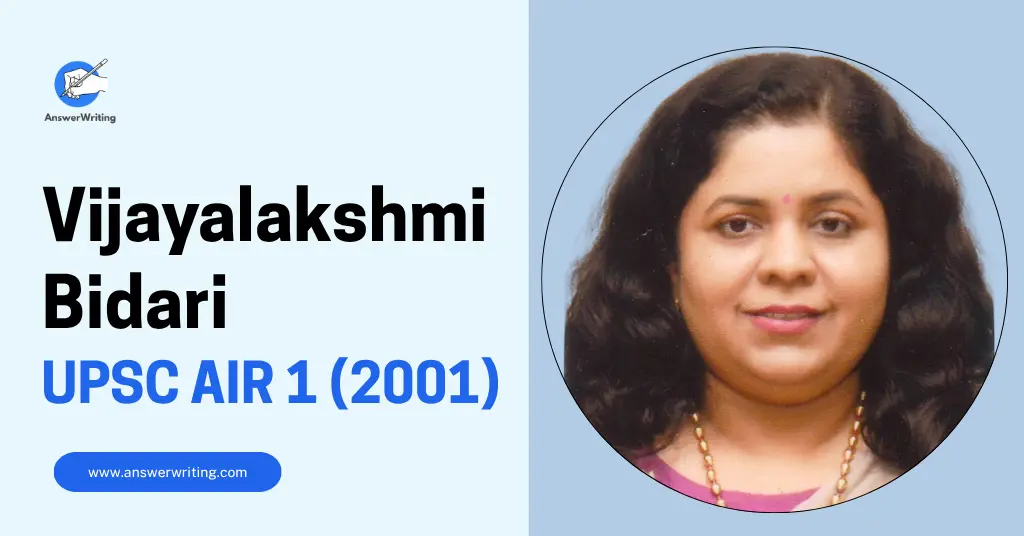
In doing so, she became the first person from Karnataka to top the Civil Services Examination in the history of the exam, including the pre-Independence ICS era, and the first woman from South India to secure AIR 1.
Who Is Vijayalakshmi Bidari?
Vijayalakshmi Bidari was born on 10 January 1977 in Gulbarga (now Kalaburagi), Karnataka. She is a Computer Science engineer from RV College of Engineering, Bangalore, and belongs to a family with five civil servants across three generations.
She secured All India Rank 1 in UPSC CSE 2001, in her second attempt. She was allotted the IAS and the Rajasthan cadre.
| Detail | Information |
|---|---|
| Full Name | Vijayalakshmi Bidari |
| Date of Birth | 10 January 1977 |
| Hometown | Gulbarga (Kalaburagi), Karnataka |
| Education | B.Tech Computer Science, RV College of Engineering, Bangalore (1995-1999) |
| UPSC Exam Year | 2001 (CSE 2001 batch) |
| All India Rank | 1 |
| Number of Attempts | 2 |
| Optional Subjects | Kannada Literature and Political Science and International Relations |
| Service Allotted | Indian Administrative Service (IAS) |
| Cadre | Rajasthan (2001 batch) |
| First Attempt Result | AIR 107, allotted Indian Customs and Central Excise Service |
She holds the distinction of being the first person from Karnataka to top Civil Services in the entire history of the exam, including the ICS era, and the first woman from South India to secure AIR 1.
Vijayalakshmi Bidari’s UPSC Marksheet and Score Details
Paper-wise marks for UPSC CSE 2001 are not comprehensively available in the public domain. The table below reflects verified details. Aspirants should cross-check official UPSC sources for complete accuracy.
| Component | Details |
|---|---|
| First Attempt Rank | AIR 107 (UPSC CSE 2000) |
| First Attempt Service | Indian Customs and Central Excise Service |
| Margin from IAS (First Attempt) | 35 marks (as per available reports) |
| Final Rank | AIR 1, UPSC CSE 2001 |
| Optional Subjects | Kannada Literature and Political Science and International Relations |
| Study Hours per Day | 8 hours |
The 35-mark gap in the first attempt is significant context. It was not a near-miss that discouraged her. It was precise information that told her exactly how much ground she needed to cover.
Educational Background and Early Life
Vijayalakshmi Bidari grew up in an exceptional family. Her father, Shankar Mahadev Bidari, was an IPS officer of the 1978 batch who went on to become the Director General and Inspector General of Police of Karnataka. Her mother, Umadevi, is a gynecologist in government service. Her brother Vijayendra Bidari is an IPS officer, and his wife Rohini P. Bhajibhakare is an IAS officer. Five civil servants in a family of six. The only non-civil servant is her mother.
Growing up in this environment, the idea of public service was never abstract. It was the daily reality of her household.
Her father’s career meant frequent transfers. Over ten years of schooling, she studied across eleven different places, in State board schools and Missionary institutions at small postings. That kind of constant change either breaks a student’s continuity or forces them to become deeply self-reliant. For Vijayalakshmi, it did the latter.
She scored 100 out of 100 in Mathematics in her Class 10 board exam. She missed her state rank by just five marks overall. That result encouraged her to take up science in Class 11 and 12, choosing Physics, Chemistry, Mathematics, and Biology.
When she was in Class 11, her father was posted as Commander of a Special Task Force set up to nab the forest brigand Veerappan. For three and a half years, the family’s lives were under constant risk, with security cover at all times. She wrote in her own account that this period was one of the most difficult of her life.
After Class 12, she earned a merit seat at RV College of Engineering, Bangalore, one of Karnataka’s most reputed engineering institutions. She completed her B.Tech in Computer Science between 1995 and 1999. By the time she graduated, she already had two job offers in hand, from BFL Software and from HPCL Calcutta. She had achieved financial independence before leaving college.
But the civil services remained the goal. Her father had spoken to her about them after Class 10. She had been drawn to the idea but wanted a secure professional foundation first. Engineering gave her that. Then she turned her full attention to UPSC.
How Many Attempts Did Vijayalakshmi Bidari Take?
Vijayalakshmi Bidari took two attempts. The first attempt produced AIR 107. The second produced AIR 1.
After finishing her engineering degree in March 1999, she prepared seriously for her first UPSC attempt. She cleared the exam and secured AIR 107, which allotted her the Indian Customs and Central Excise Service. It was a significant achievement for any aspirant. But she had missed the IAS cutoff by 35 marks.
The decision she made next defines this story. She decided to skip the Foundation Course training for the Customs service and go back to prepare for a second attempt. She was already inside a government service, which created a very specific psychological challenge.
She wrote in her widely available first-person account: “It was a little tough to motivate myself because I was already in a service. At this point my friends and my mother made sure I put in a lot of effort, telling me that I deserved the best and should aim for the best.”
That combination of internal clarity and external support carried her through the second attempt. She described being extremely satisfied with her Mains papers. She then joined Customs Academy at NACEN in Faridabad for training, still waiting for results from her second attempt.
On 16 May 2001, she excused herself from a class at NACEN to check results online. The page would not load until 4:15 in the afternoon. She started crying. Then her father called. He told her she had done well. She did not understand what that meant. He called a third time and told her she had topped the list. The press arrived within half an hour. Interviews went on all night and for the next three days.
It is one of the most human and memorable result-day accounts in UPSC topper history.
Vijayalakshmi Bidari’s Optional Subjects: Why Kannada Literature and PSIR Worked
Vijayalakshmi Bidari’s optional subject combination is one of the most instructive choices in the history of UPSC toppers.
She was a Computer Science engineer. Her academic training was entirely in the sciences and technology. Yet she chose Kannada Literature as one of her Mains optional subjects.
This was not an accident or an experiment. Kannada was her mother tongue, and she had grown up deeply immersed in the language, its literature, its culture, and its expression. That lifelong immersion could not be replicated by an aspirant who picked Kannada Literature as a tactical choice without that background. For her, the subject was authentic territory.
Her second optional, Political Science and International Relations (PSIR), provided the governance and policy framework that complemented both her Mains General Studies papers and her interview preparation. PSIR overlaps significantly with GS Paper 2 (Polity and Governance) and feeds directly into essay writing and current affairs analysis. It was a strategic choice that multiplied the value of her preparation time.
The combination worked because both subjects were areas where she had genuine depth: one from lifelong immersion in language and culture, the other from deliberate academic engagement with governance and political thought.
For aspirants wondering whether a science or engineering background prevents strong optional subject performance in humanities: Vijayalakshmi Bidari’s AIR 1 with Kannada Literature and PSIR is the most direct answer available.
UPSC Preparation Strategy of Vijayalakshmi Bidari
Vijayalakshmi Bidari’s preparation method was systematic, repeatable, and built around honest self-assessment. She described it clearly in her own account.
She studied eight hours a day. Not occasionally. Consistently. Eight hours was her daily standard, including during her second attempt when she was simultaneously dealing with the psychological weight of already being in a government service.
Her preparation process had four clear steps that she repeated across every topic. First, she read a topic completely. Second, she made notes. Third, she attempted test papers within the allotted time. Fourth, she got those test papers corrected and worked specifically on the mistakes she identified.
This loop, read, note, test, correct, and improve, is not complicated. But most aspirants skip either the testing phase or the correction phase. They read and make notes but do not close the feedback loop. Vijayalakshmi Bidari built the correction and improvement step into her core process, which is why it worked.
She believed strongly in combined study with serious aspirants. She noted that studying with others who are equally committed makes preparation more disciplined and intellectually sharper. Peer accountability and peer discussion both improve retention and reduce the isolation that long UPSC preparation often creates.
She also consistently emphasised the importance of listening, to teachers, to peers, to feedback from corrected test papers. Learning to be a good listener was one of the direct pieces of advice she shared with aspirants. It is a softer skill than most UPSC guidance covers, but it underpins the ability to absorb feedback and adjust strategy.
Books and Resources Recommended by Vijayalakshmi Bidari
A comprehensive verified booklist from Vijayalakshmi Bidari is not available in the public domain. Sources are from the early 2000s and specific book recommendations were not widely documented. The table below reflects resources consistent with her optional subjects and preparation approach. Aspirants should verify through her primary interviews and accounts directly.
| Subject | Resource | Notes |
|---|---|---|
| Kannada Literature Optional | Standard Kannada literary texts and classical works | Built on lifelong engagement with the language |
| Political Science and International Relations | Standard PSIR texts | Overlaps with GS Paper 2 on governance and polity |
| General Studies | Newspapers (daily reading) | Foundation for current affairs and essay preparation |
| Self-Assessment | Timed test papers with corrections | Core of her preparation method |
| Revision | Self-made topic-wise notes | Essential for exam-time recall |
Mains Answer Writing Approach
Vijayalakshmi Bidari’s approach to Mains was centred on one practice that most aspirants underuse: attempting test papers under timed conditions, getting them corrected, and actively working on every mistake.
She did not treat test papers as performance benchmarks alone. She treated them as diagnostic tools. Every paper she attempted produced a list of specific gaps. Every gap became a preparation task. This made her revision purposeful rather than repetitive.
Timed practice is something aspirants understand in theory but underdo in practice. Writing an answer in 7 to 10 minutes, within a word limit, under exam conditions, is a fundamentally different skill from knowing the content. Vijayalakshmi Bidari built that skill deliberately, across both her attempts.
For aspirants building a similar system today, AnswerWriting.com’s Full Length Test Evaluator allows you to submit complete mock test answer copies and receive holistic AI evaluation across all papers. This mirrors exactly the correction-and-improvement loop that Vijayalakshmi Bidari built into her preparation. The platform’s Answer Evaluator also provides detailed feedback on individual answers covering structure, content, and UPSC scoring parameters, making it possible to identify and close specific gaps after every practice session.
The principle she demonstrated remains the same regardless of the tool: writing under time pressure, receiving honest feedback, and fixing mistakes systematically is what separates aspirants who know the content from those who can convert it into marks.
Interview (Personality Test) Experience
Vijayalakshmi Bidari’s own account reveals something honest about her interview experience: she was worried. She genuinely believed she might miss the IAS because of her interview marks. That anxiety, coming from someone who had prepared rigorously and cleared Mains confidently, is worth noting.
It tells aspirants that interview anxiety is not a sign of inadequacy. It is a normal response to a high-stakes, unpredictable stage of the exam. What matters is whether the preparation underneath the anxiety is sound.
Her DAF would have offered the board extraordinarily rich material. A Computer Science engineer who chose Kannada Literature as an optional. A daughter of one of Karnataka’s senior IPS officers, who had watched her father work in high-risk jungle operations against Veerappan. A candidate already in the Indian Customs and Central Excise Service, preparing for a second attempt to reach IAS. Each of these threads would have produced substantive interview conversations.
Her direct, first-person communication style, visible throughout her written accounts, suggests she would have engaged the board with specificity rather than rehearsed generality. That quality, answering what is actually asked with precise, honest content, is what interview boards consistently reward.
Detailed information about the board composition or specific questions asked in her interview is not available in the public domain. Aspirants should cross-check primary records for further accuracy.
Service and Cadre Allotted to Vijayalakshmi Bidari
Vijayalakshmi Bidari was allotted the Indian Administrative Service and the Rajasthan cadre, 2001 batch.
Before her IAS allotment, she had been undergoing training at NACEN (National Academy of Customs, Excise and Narcotics) in Faridabad as part of her first-attempt allotment to the Indian Customs and Central Excise Service.
Her career in the Rajasthan cadre spanned district administration and governance roles across the state. As of January 2015, she had been appointed Regional Director of the Staff Selection Commission in Bangalore. She also pursued advanced professional development, completing a programme in Governance and Anti-Corruption Strategy at the Asian Institute of Technology, Thailand, in 2014.
Her career reflects a consistent engagement with governance, administration, and institutional capacity, areas she had already anchored through her optional subject choices in PSIR and her own account of what drew her to civil services in the first place.
Key Lessons Every UPSC Aspirant Can Take from Vijayalakshmi Bidari
- Missing the IAS cutoff in your first attempt is data, not defeat. Vijayalakshmi Bidari missed IAS by 35 marks and treated it as precise information about where to improve. She went back, fixed the gaps, and topped the country. A near-miss is the most actionable kind of feedback an aspirant can receive.
- Your mother tongue can be a legitimate optional subject advantage. She was a Computer Science engineer who chose Kannada Literature and scored well enough to secure AIR 1. Lifelong immersion in a language produces depth no short-term coaching can replicate. If your mother tongue has a literature optional, it deserves serious consideration.
- The correction step is as important as the practice step. She built a four-part loop into her preparation: read, make notes, attempt timed tests, get them corrected, and improve on mistakes. Most aspirants do the first two steps well and rush the last two. The improvement loop is where marks are actually earned.
- Preparing while in a service requires a different kind of motivation. She wrote honestly about the difficulty of motivating herself when she was already in a government role. She relied on her mother and friends to keep her accountable. Aspirants preparing for subsequent attempts while employed need an external accountability structure, not just internal willpower.
- Aim higher than you think you need to. She believed in the principle of shooting for the highest goal, knowing that even falling short lands you somewhere significant. That mindset prevented her from settling after AIR 107 and drove her toward AIR 1.
FAQs About Vijayalakshmi Bidari
1. What was Vijayalakshmi Bidari’s optional subject in UPSC?
Her optional subjects were Kannada Literature and Political Science and International Relations (PSIR). She was a Computer Science engineer who chose Kannada Literature because it was her mother tongue and an area of genuine lifelong depth, not a trending choice.
2. How many attempts did Vijayalakshmi Bidari take to clear UPSC?
She took two attempts. In her first attempt, she secured AIR 107 and was allotted the Indian Customs and Central Excise Service, missing the IAS cutoff by 35 marks. In her second attempt, she secured AIR 1.
3. What are the historic firsts associated with Vijayalakshmi Bidari?
She was the first person from Karnataka to top the Civil Services Examination in the entire history of the exam, including the pre-Independence ICS era. She was also the first woman from South India to secure AIR 1 in Civil Services.
4. What cadre was Vijayalakshmi Bidari allotted?
She was allotted the Indian Administrative Service and the Rajasthan cadre, 2001 batch.
5. What did Vijayalakshmi Bidari do between her first and second UPSC attempts?
After her first attempt result of AIR 107, she was allotted the Indian Customs and Central Excise Service. She skipped the Foundation Course training and resumed preparation for a second UPSC attempt. She was undergoing training at NACEN in Faridabad when her second attempt result was declared.
6. What was Vijayalakshmi Bidari’s preparation method?
She studied eight hours a day, working topic by topic, making notes, attempting timed test papers, getting them corrected, and systematically improving on mistakes. She also emphasised combined study with serious aspirants and the importance of being a good listener throughout the preparation process.