UPSC Toppers Answer Writing Strategy
Most UPSC toppers were not born great writers. They started exactly where you are: writing vague, lengthy answers that scored poorly. What separated them was not talent. It was a deliberate, repeatable process of identifying mistakes and fixing them one by one.
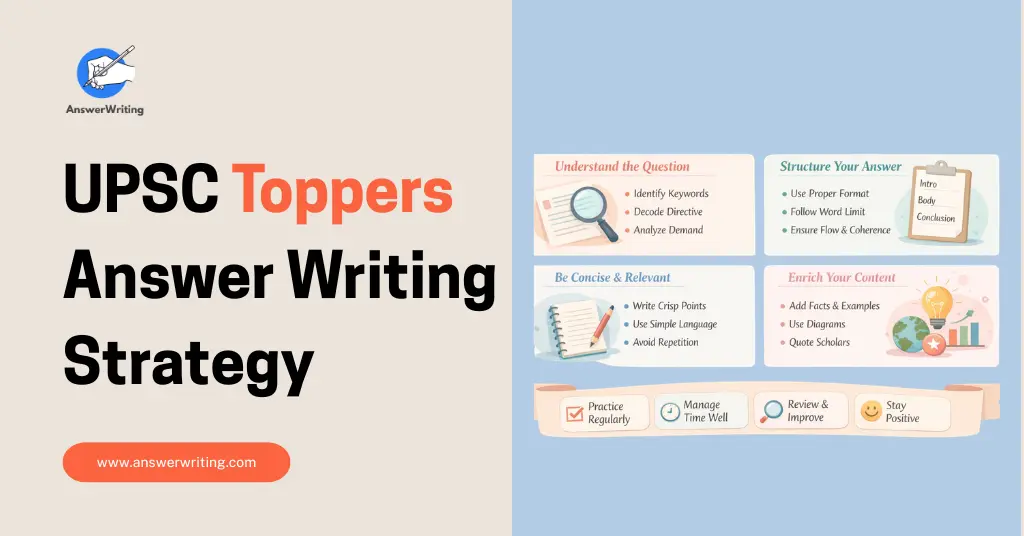
This post breaks down that process through real patterns observed across topper interviews and case studies. If you are preparing for UPSC Mains, treat this as a blueprint.
The Gap Between Knowing and Writing
Many aspirants spend 10 to 12 months building content knowledge. They read NCERTs, standard books, and newspapers religiously. Then Mains results arrive, and the scores disappoint.
The reason is almost always the same. Knowing a concept and expressing it clearly under exam conditions are two completely different skills. UPSC Mains does not test memory. It tests structured thinking, precision, and the ability to present multiple dimensions of an issue within a word limit.
Toppers understand this difference early. They stop treating answer writing as a “later stage” activity and start practicing it from day one of Mains preparation.
Case Study 1: From Vague Answers to Structured Responses
Consider the pattern seen consistently among Rank 1 to 50 holders in recent years. In their initial months, their answers looked like dense paragraphs with no clear beginning or end. They wrote everything they knew about a topic without any filter.
One common description from topper interviews: “My early answers were like brain dumps. I had the knowledge, but the examiner had no reason to give me marks because I wasn’t answering the question asked.”
The fix was structural. They adopted a simple but powerful three-part framework:
- Introduction: Define the concept or set the context in 2 to 3 lines. Surprise the examiner with a relevant fact, judgment, or quote.
- Body: Break the answer into sub-themes using clear headings or spacing. Use the “dimensions approach”: historical, constitutional, social, economic, and contemporary angles wherever relevant.
- Conclusion: Never summarize. Instead, give a forward-looking statement, a committee recommendation, or a balanced judgment.
This framework alone, practiced consistently, improved scores by 15 to 20 marks per paper for many aspirants.
The second fix was learning to read the question demand. Words like “critically examine,” “discuss,” and “analyze” carry different expectations. Toppers created a personal reference sheet of these directive words and practiced answering accordingly.
Case Study 2: The Feedback Loop That Changed Everything
One of the most underrated patterns among toppers is external feedback. Self-evaluation has limits. You tend to read what you meant to write, not what you actually wrote.
A composite pattern from multiple topper accounts reveals this: aspirants who plateaued in mock test scores made dramatic improvements (often 30 to 45 marks per paper) after they started getting their handwritten answers evaluated by teachers or structured peer groups.
The key word here is “handwritten.” Writing on paper under timed conditions is fundamentally different from typing notes. The physical act of writing, managing time, and maintaining legibility under pressure are skills that only develop through consistent handwritten practice.
This is where platforms like AnswerWriting.com add real value. The platform allows students to submit handwritten answers and receive structured, examiner-style feedback from experienced evaluators. Teachers on the platform can also assign and review answers systematically. For aspirants who lack access to quality coaching or mentors, this kind of structured evaluation can genuinely close the feedback gap.
Toppers consistently say the same thing: “One evaluated answer is worth more than ten unevaluated ones.” Feedback tells you exactly which dimension you missed, which keyword the examiner was looking for, and where your argument became unclear.
Case Study 3: Cracking the Essay and Ethics Papers
GS Paper 4 (Ethics) and the Essay paper are where many aspirants lose crucial marks, often without realizing it.
Toppers who scored 130+ in Ethics and 140+ in Essay shared a common approach. They treated these papers not as knowledge tests but as judgment and articulation tests.
For Ethics answers, they built a personal bank of thinkers, their quotes, and real-life applications. Rather than mechanically listing theories (Consequentialism, Deontology, Virtue Ethics), they wove these frameworks into their analysis. An answer on “conflict of interest” would reference both Chanakya’s Arthashastra and a contemporary governance example.
For the Essay, they practiced writing complete essays from the planning stage. Before writing a single word, they spent 5 to 7 minutes creating a mind map: the central argument, counter-arguments, evidence, and a closing philosophical position.
One insight from a Rank 12 holder (2022 interview): “The examiner is reading 500 essays on the same topic. Your job is to give them a thread, a clear argument they can follow from the first paragraph to the last.”
Structure and originality of thought, not vocabulary, is what separates a 130-mark essay from a 100-mark one.
The 5 Common Mistakes Toppers Fixed
| Mistake | What Toppers Did Instead |
|---|---|
| Writing everything they knew (brain dump) | Filtered content to answer the specific question demand |
| Starting answers with a dictionary definition | Opened with a fact, judgment, constitutional provision, or quote |
| Ignoring word limits | Practiced strict 150-word and 250-word versions of every answer |
| Skipping diagrams and flowcharts | Added simple, relevant diagrams in Geography, Economy, and Polity answers |
| Vague conclusions (“Thus, we can see that…”) | Ended with a committee recommendation, court judgment, or policy direction |
The Daily Habits Behind Topper-Level Writing
Improvement in answer writing is not about writing more. It is about writing deliberately. Here is the daily routine pattern that most toppers followed:
- Write at least one answer daily from the syllabus topic being studied that day. Integrate content and writing, do not separate them.
- Time every answer. For a 250-word answer, allow yourself 7 to 8 minutes maximum. This builds the internal clock you need on exam day.
- Read one editorial or government report daily and identify two to three “insertable points” that can strengthen future answers.
- Review yesterday’s answers before starting new ones. Look for repetition, missed dimensions, and weak conclusions.
- Maintain a “mistakes register.” Write down the specific errors flagged in feedback. Review this register every Sunday.
- Practice diagram-making for at least three GS topics weekly. A well-drawn flowchart on “Legislative Process” or “Carbon Cycle” takes 2 minutes and can earn 2 to 3 extra marks.
What Evaluators Actually Look For (And Toppers Know This)
UPSC examiners evaluate hundreds of answer scripts per day. They are not reading every word. They are scanning for signals.
Those signals are: a clear introduction, structured body with visible sub-themes, relevant keywords, diagrams where appropriate, and a purposeful conclusion. Toppers reverse-engineered this by studying model answers, UPSC toppers’ copies (which are publicly available), and evaluator feedback.
Keywords matter enormously. In a Polity answer on federalism, terms like “cooperative federalism,” “Finance Commission,” “Article 356,” and “Sarkaria Commission” signal to the examiner that the candidate has command over the subject. These are not jargon for show. They are markers of genuine understanding.
This is precisely why structured evaluation is so important. A good evaluator does not just mark answers right or wrong. They tell you which keywords you missed, which dimension was underdeveloped, and whether your argument had internal consistency. Platforms designed specifically for UPSC answer evaluation, like AnswerWriting.com, simulate this examiner perspective and help aspirants internalize what “marks-worthy” actually looks like.
How to Build Your Own Improvement Arc
You do not need a perfect system on day one. You need a starting point and consistent iteration.
- Week 1 to 2: Write 5 answers from your current study topic. Do not worry about quality. Focus on completing answers within the time limit.
- Week 3 to 4: Get all 5 answers evaluated externally (teacher, peer group, or a structured platform). Identify your top 3 recurring mistakes.
- Month 2: Target those 3 mistakes specifically. Write 10 answers with the conscious goal of fixing them.
- Month 3 onward: Simulate full 3-hour GS paper attempts. Practice all 20 questions in one sitting at least twice a month.
- Ongoing: Maintain your mistakes register, review topper copies quarterly, and keep integrating current affairs into your answer examples.
The improvement arc is not linear. There will be weeks where your answers feel worse than before. That usually means you have internalized a new standard and are in the process of meeting it. Trust the process.
FAQs
Q1. When should I start answer writing practice for UPSC Mains?
Start from the first month of Mains preparation, not after completing the syllabus. Integrating writing with study is far more effective than treating it as a separate “later” activity.
Q2. How many answers should I write per day?
Quality beats quantity here. One well-thought-out, timed, and subsequently evaluated answer per day is more productive than five rushed, unevaluated attempts.
Q3. Should I write answers in bullet points or paragraphs?
Use a mix. Paragraphs work better for analytical questions (“Critically examine,” “Discuss”). Bullet points work for listing features, causes, or steps. Never write an entire answer in only bullets as it signals shallow thinking to the examiner.
Q4. How do I improve my introductions?
Build a bank of strong openings: relevant constitutional articles, landmark judgments, committee names, recent data points, and thinker quotes. Practice opening with one of these every time instead of a plain definition.
Q5. Is it necessary to draw diagrams in UPSC Mains answers?
Not in every answer, but diagrams in the right places (Geography, Economy, Science and Technology, Polity flowcharts) can clearly improve presentation and signal organized thinking. Keep them simple, labeled, and relevant.
Q6. How do I know if my answers are actually improving?
Track your scores across mock tests or evaluations over a 4 to 6 week period. If scores are not improving despite more writing, the issue is likely that your answers are not being evaluated with specific feedback. Seek structured external evaluation to break that plateau.
Answer writing is the most underestimated skill in UPSC preparation. Toppers did not crack it by writing more. They cracked it by writing deliberately, getting honest feedback, fixing specific mistakes, and repeating that cycle. Start today, write one answer, get it evaluated, and improve one thing. That is the entire strategy.