UPSC Prelims Cutoff Trends and Safe Score Analysis: Is the Paper Getting Tougher?
In 2023, the UPSC Prelims cutoff for the General category crashed to 75.41 out of 200. That was the lowest in the history of the Civil Services Examination. Just one year later, in 2024, it climbed back to 87.98. What explains a 12-mark swing in a single year? And more importantly, what does this mean for your preparation?
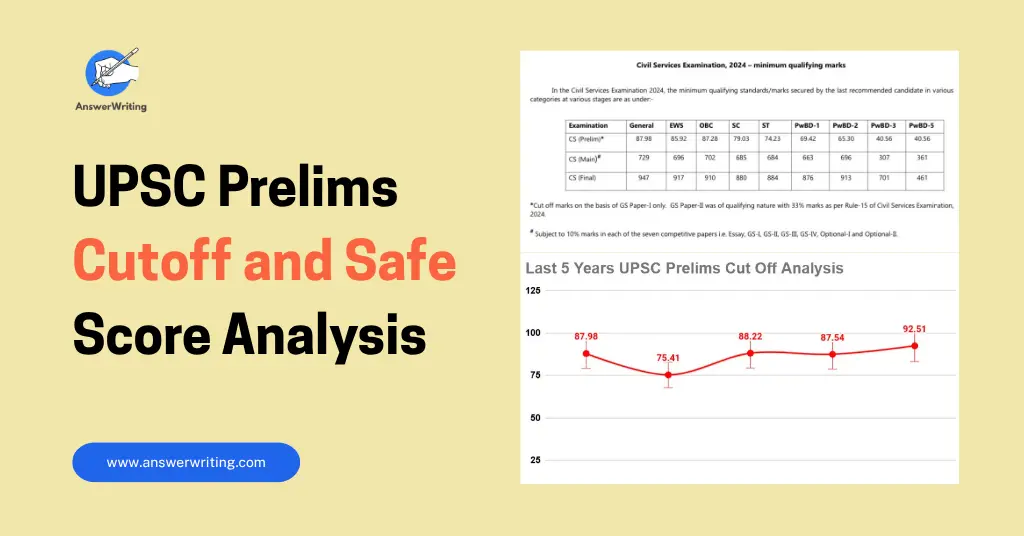
Cutoff numbers tell a story. But only if you know how to read them.
This post breaks down every major cutoff trend since 2013, explains the forces that push cutoffs up and down, and gives you a realistic “safe score” target for each category.
How the UPSC Prelims Cutoff Actually Works
Before reading any cutoff data, you need to understand one critical rule.
Only GS Paper 1 marks determine your cutoff. CSAT (Paper 2) is purely qualifying. You need 33% in CSAT, which means 66 marks out of 200. That is it. CSAT marks do not count toward your merit ranking or your cutoff calculation.
So when you see “cutoff: 87.98 for General,” that number is out of 200 marks in GS Paper 1 only.
A few other things worth knowing:
- UPSC applies a normalisation procedure to account for difficulty variation across question paper sets. This is why cutoffs are often in decimal points.
- The cutoff is not a target UPSC sets in advance. It is the score of the last candidate who qualifies for Mains in each category.
- UPSC does not announce cutoffs before or during the exam cycle. They are released only after the final result.
UPSC Prelims Cutoff Data: 2013 to 2024 (General Category)
Note: From 2011 to 2014, CSAT marks were also counted in the cutoff calculation, so those numbers are out of 400. From 2015 onwards, only GS Paper 1 marks (out of 200) are counted. Always compare post-2015 figures with each other for accurate trend analysis.
| Year | General | OBC | SC | ST | EWS | Total Marks |
|---|---|---|---|---|---|---|
| 2013 | 241 | 222 | 207 | 202 | N/A | 400 |
| 2014 | 205 | 190 | 175 | 163 | N/A | 400 |
| 2015 | 107.34 | 106.00 | 94.00 | 91.34 | N/A | 200 |
| 2016 | 116.00 | 110.66 | 99.34 | 96.00 | N/A | 200 |
| 2017 | 105.34 | 102.66 | 88.66 | 89.34 | N/A | 200 |
| 2018 | 98.00 | 95.34 | 84.00 | 83.34 | N/A | 200 |
| 2019 | 98.00 | 95.34 | 82.00 | 77.34 | 90.00 | 200 |
| 2020 | 92.51 | 89.12 | 78.48 | 72.59 | 90.03 | 200 |
| 2021 | 87.54 | 84.48 | 68.61 | 66.65 | 85.07 | 200 |
| 2022 | 88.22 | 85.52 | 74.22 | 70.44 | 85.52 | 200 |
| 2023 | 75.41 | 74.75 | 59.25 | 47.82 | 68.02 | 200 |
| 2024 | 87.98 | 87.28 | 79.03 | 74.23 | 85.92 | 200 |
Source: Official UPSC cutoff PDFs available at upsc.gov.in. Always verify figures from the official source.
Three moments stand out in this data:
The 2016 spike to 116 marks remains the highest cutoff in the post-CSAT era. The 2023 collapse to 75.41 is the lowest ever recorded. And the consistent sub-100 trend from 2018 onwards signals a structural shift in how the paper has been designed.
What Actually Drives Cutoff Fluctuations
Many aspirants assume a lower cutoff means the paper was harder. That is partially true. But three other variables matter just as much.
1. Number of Vacancies Fewer vacancies mean fewer candidates qualify for Mains, which can push the cutoff up. More vacancies mean the net is cast wider, which can lower the cutoff. In 2021, vacancies were relatively lower, which contributed to a sub-90 cutoff alongside a difficult paper.
2. Number of Serious Candidates The total number of applicants has grown. But the number of seriously prepared candidates has grown faster, thanks to improved access to quality coaching and online resources. A larger pool of well-prepared aspirants pushes the average score up, not down.
3. CSAT as an Indirect Filter In 2023, the CSAT paper was widely reported as unusually difficult. When a significant number of candidates fail to clear the 33% qualifying threshold in CSAT, they are eliminated regardless of their GS Paper 1 score. This reduces the effective candidate pool and can pull down the GS Paper 1 cutoff, even if the GS paper itself was not the hardest ever.
The key takeaway: A low cutoff does not always mean GS Paper 1 was easy. It can reflect fewer vacancies, a tougher CSAT, or both. Never use the cutoff alone to judge paper difficulty.
Is the Paper Actually Getting Tougher? A Difficulty Analysis
The short answer is: yes, in specific and measurable ways.
How Question Types Have Shifted
Early UPSC Prelims papers (2011 to 2015) leaned heavily on static knowledge. You could score well by memorising facts about history, geography, and polity from standard textbooks.
From 2016 onwards, UPSC started introducing more application-based and elimination-based questions. These questions present four options that all look partially correct. The skill being tested is not recall. It is the ability to identify the most accurate statement under pressure and time constraints.
This shift explains why cutoffs began declining after the 2016 peak, even as candidate preparation quality improved.
The Rising Weight of Current Affairs
Current affairs in Prelims used to mean a handful of questions on recent events. Today, current affairs permeates almost every section of GS Paper 1. Environment questions reference recent NGT orders. Economy questions reference recent RBI or budget data. Science and Technology questions are often built on news from the previous 12 months.
This makes Prelims preparation more time-intensive than it used to be. Aspirants now need continuous engagement with current events throughout their preparation cycle, not just a last-minute revision.
CSAT: From Rubber Stamp to Real Filter
When CSAT was made qualifying in 2015, many aspirants treated it as a formality. Score 66 marks, move on. For most candidates with a reasonable English and reasoning background, that was enough.
The 2023 paper changed that assumption. Reports from aspirants and coaching institutes indicated widespread difficulty with the comprehension and reasoning sections. The indirect effect on the GS cutoff was visible in the data: the lowest General cutoff ever, at 75.41.
CSAT can no longer be dismissed. Aim for 90 to 100 in CSAT, not just the bare minimum.
Static GS: Still the Foundation
Despite the shift toward application-based questions, static GS remains the backbone of GS Paper 1. Indian Polity, History, Geography, Economy basics, and Environment fundamentals together account for the bulk of the paper.
What has changed is that knowing the fact is no longer enough. You need to know the fact, understand its context, and eliminate three cleverly worded distractors. That requires depth, not just breadth.
What Is a “Safe Score” for UPSC Prelims?
The cutoff is the minimum to qualify. A safe score is what gives you a genuine buffer against uncertainty, including fluctuations in normalisation and unexpected difficulty spikes.
Here are the recommended safe score ranges by category, based on cutoff trends from 2018 to 2024:
| Category | Recent Cutoff Range | Safe Score Target | Comfortable Score Target |
|---|---|---|---|
| General | 75 to 98 | 105 to 110 | 115+ |
| OBC | 74 to 95 | 100 to 105 | 110+ |
| EWS | 68 to 90 | 98 to 103 | 108+ |
| SC | 59 to 84 | 90 to 95 | 100+ |
| ST | 47 to 83 | 85 to 90 | 95+ |
These are indicative ranges. Adjust based on your attempt year’s paper difficulty and UPSC’s announced vacancies.
A score 15 to 20 marks above the typical cutoff for your category means you clear Prelims in most scenarios, including tough years like 2023. A comfortable score of 115+ for General category candidates almost guarantees qualification across all historical cutoffs since 2015.
The Marks You Cannot See: Negative Marking’s Real Impact
UPSC deducts one-third of the marks for every wrong answer. That means each wrong answer costs you 0.66 marks. On paper, that sounds small. In practice, it reshapes your entire strategy.
Consider this: if you attempt 10 uncertain questions and get 5 right and 5 wrong, your net gain is only 5 marks minus 3.33 marks, which equals approximately 1.67 marks. You attempted 10 questions for less than 2 marks.
If you had skipped those 10 questions, you would have scored zero from them but not lost anything. That is often a better outcome, especially when you are already clearing the cutoff comfortably from your confident attempts.
The smarter approach:
- Attempt questions where you can eliminate at least two options confidently.
- Avoid random guessing entirely.
- Track your attempt accuracy in mock tests. If you are getting more than 25% of attempted questions wrong, you are over-attempting.
This is also why evaluating mock test performance in a structured way matters so much. Many aspirants score well in comfort-zone mocks but collapse under exam pressure because they never analysed their wrong-answer patterns. Platforms like AnswerWriting.com focus on this kind of structured evaluation, helping students identify systematic errors in their approach, not just mark counts. The same discipline that improves Mains answer writing also builds the analytical habit of reviewing where and why you go wrong in Prelims.
Year-on-Year Difficulty: Key Observations (2020 to 2024)
2020: Cutoff at 92.51. Paper was considered moderately difficult. This was, at the time, the lowest General cutoff since 2015. COVID-19 year. Fewer candidates appeared due to the pandemic context.
2021: Cutoff fell further to 87.54. Paper difficulty increased noticeably. Questions on environment, science, and polity were more nuanced and statement-based. First year cutoff dropped below 90 for General category.
2022: Marginal recovery to 88.22. Paper difficulty was comparable to 2021, but slightly more vacancies and a larger candidate pool kept the cutoff almost flat.
2023: Historic low at 75.41. Two factors combined: an unusually difficult GS Paper 1 and a very tough CSAT that eliminated many aspirants at the qualifying stage. The gap between OBC (74.75) and General (75.41) was barely 0.66 marks, which was historically unusual.
2024: Recovery to 87.98. Paper returned to moderate difficulty. Cutoff moved back toward the 2021 to 2022 range. The gap between General and OBC narrowed again, suggesting increasingly competitive performance across categories.
The overall trajectory since 2016 shows a clear downward shift in cutoffs compared to pre-2016 levels, driven primarily by harder question design, not by candidates performing worse.
How to Use This Data in Your Preparation
Cutoff data is a diagnostic tool, not a target-setting tool. Here is how to use it properly.
Set your personal target at 110 to 115 (General category). This gives you a 20 to 35 mark buffer above even the highest recent cutoffs. Preparing to score 110 also means you are prepared enough to score 95 to 100 in a genuinely difficult year.
Use mock test scores to track real progress. Your mock test score, when taken under strict exam conditions (no pausing, real time pressure), is the most reliable predictor of exam-day performance. Aim to consistently score 105 to 110 in well-designed mocks before your actual exam.
Do not chase cutoffs. Chase accuracy. An aspirant who attempts 75 questions with 85% accuracy scores around 95 to 100 net marks. An aspirant who attempts 90 questions with 65% accuracy scores roughly the same, but with far more risk. The first approach is more sustainable and less stressful.
Review previous year papers from 2017 to 2024. This is not optional. The style, language, and traps used by UPSC in setting options are consistent. Learning to read UPSC question language is a skill that comes from repeated practice with authentic papers.
5 Myths About UPSC Prelims Cutoffs
- Myth 1: A lower cutoff means I can prepare less. Wrong. A lower cutoff usually means the paper was harder. You need more preparation to handle a harder paper, not less.
- Myth 2: General category aspirants have to score the highest. The General cutoff is highest in absolute terms, but as a percentage of total paper marks, cutoffs across categories are not as dramatically different as many assume. Competitive preparation is the same across categories.
- Myth 3: UPSC normalises marks to a fixed standard. UPSC uses a normalisation procedure to account for variation across question paper booklet sets. This is not a percentile system. It is an adjustment mechanism, and its exact methodology is not publicly disclosed.
- Myth 4: If I score above last year’s cutoff, I will qualify. Not necessarily. Cutoffs change every year. You should target a score 15 to 20 marks above the highest recent cutoff for your category to be genuinely safe.
- Myth 5: CSAT does not matter since it is qualifying. The 2023 data proves otherwise. A difficult CSAT can eliminate thousands of otherwise well-prepared candidates before their GS score even counts. Treat CSAT with serious respect.
FAQs
Q1. Why is the UPSC cutoff given in decimal points like 87.98 instead of whole numbers?
The decimal values result from UPSC’s normalisation process. Because different candidates receive question paper booklets with slightly different question sequences (and sometimes minor variations), UPSC applies a statistical adjustment to ensure fair comparison. This produces fractional scores.
Q2. Does the UPSC Prelims cutoff apply to each paper separately?
No. The cutoff applies only to GS Paper 1. Paper 2 (CSAT) has a fixed qualifying threshold of 33% (66 marks out of 200) applicable to all categories equally.
Q3. Is there a separate cutoff for IAS, IPS, and IFS at the Prelims stage?
No. The Prelims cutoff is uniform for all services within the Civil Services Examination. The differentiation between services happens at the Mains and Interview stage, based on your rank and service preference.
Q4. I belong to the OBC category but am well above the OBC cutoff. Should I compete as General?
No. Category is determined by your certificate at the time of application. You cannot opt to compete as a different category. However, if you score above the General cutoff, it may benefit your final rank during the Mains and Interview stage depending on the merit list.
Q5. How many candidates qualify for Mains after Prelims?
UPSC typically qualifies approximately 12 to 15 times the number of advertised vacancies. If 1,000 posts are advertised, roughly 12,000 to 15,000 candidates qualify for Mains. This number varies year to year based on vacancies and the distribution of scores.
Q6. Should I be worried if my mock test scores are consistently around the cutoff range?
Yes, treat it as a signal. Scoring consistently at or just above the cutoff in mocks leaves almost no buffer for exam-day stress, harder questions, or a bad half-hour. Diagnose your weak areas immediately, whether that is static GS, current affairs, or negative marking control, and address them with focused revision.
Conclusion
Cutoff trends reveal one clear message: UPSC Prelims is not getting easier. The post-2016 design shift toward application-based questions has made rote preparation far less reliable. But the paper is also not unpredictably difficult. It rewards structured thinking, deep static knowledge, and disciplined exam strategy.
A score of 110 or above for General category candidates represents genuine safety. Anything above 100 is competitive. Getting there consistently requires not just content preparation, but honest mock test analysis and the ability to manage your attempts under time pressure.
Cutoffs are a lagging indicator. The score you build today is the only number that matters on exam day.