UPSC Prelims: Complete Strategy
Only about 2 to 3 percent of aspirants who appear for UPSC Prelims actually clear it. Not because the exam is impossibly hard, but because most people prepare without a real plan. They read too much, revise too little, and make the same mistakes year after year.
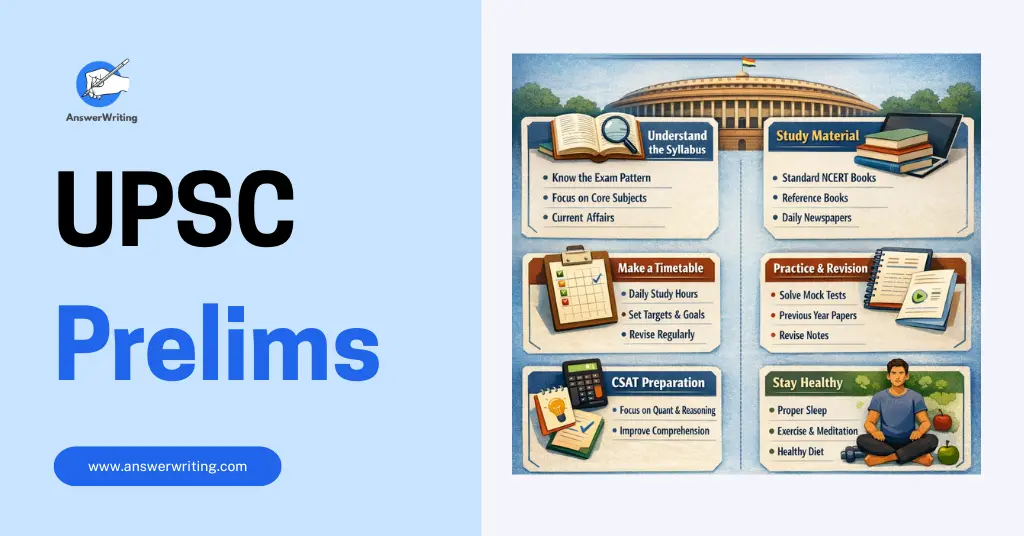
This guide fixes that. It covers everything: what Prelims actually tests, when to start, how to build a strategy, and the mistakes that silently kill your chances.
Understanding UPSC Prelims: The Gate You Must Cross First
UPSC Prelims is the first of three stages in the Civil Services Examination. It is an objective (MCQ) test held once a year, usually in May or June. It is purely a screening test. Your Prelims marks do NOT count toward your final merit list.
But do not make the mistake of taking it lightly. Lakhs of aspirants compete for a few thousand slots. The cutoff fluctuates every year. In 2023, the GS Paper I cutoff was around 88 to 92 marks out of 200, depending on the category.
Paper I: General Studies (GS)
This is the paper that decides whether you move forward.
- Total marks: 200
- Number of questions: 100
- Time: 2 hours
- Negative marking: One-third of marks deducted for every wrong answer
Paper I tests your knowledge of History, Geography, Polity, Economy, Environment, Science and Technology, and Current Affairs. The questions are indirect, layered, and often designed to confuse. Knowing a fact is not enough. You need to understand the concept behind it.
Paper II: CSAT (Civil Services Aptitude Test)
CSAT is a qualifying paper. You only need 33 percent (66 out of 200) to pass. Your score does not count beyond that threshold.
It tests reading comprehension, logical reasoning, and basic numeracy. Most science and engineering graduates find it manageable. Humanities graduates need to give it slightly more attention, especially the numerical and logical sections.
Do not ignore CSAT completely. At least 4 to 6 weeks of focused practice is essential to be safe.
UPSC Prelims: Paper Pattern at a Glance
| Feature | Paper I (GS) | Paper II (CSAT) |
|---|---|---|
| Total Marks | 200 | 200 |
| Number of Questions | 100 | 80 |
| Time Allowed | 2 hours | 2 hours |
| Negative Marking | Yes (1/3) | Yes (1/3) |
| Nature | Merit-based | Qualifying (33%) |
| Key Topics | History, Geography, Polity, Economy, Environment, Science, Current Affairs | Reading Comprehension, Reasoning, Numeracy |
Prelims Before or After Mains Preparation? Settling the Debate
This is the most argued question in every UPSC forum. Should you focus on Prelims first and worry about Mains later? Or should you build Mains-level depth from day one?
The short answer: prepare for both, but not equally at the same time.
The Integrated Approach (What Most Toppers Actually Do)
The subjects in Prelims and Mains overlap heavily. Polity, History, Geography, Economy, and Environment appear in both. If you study these subjects with Mains-level depth, you will automatically be well-prepared for Prelims too.
Toppers do not study Prelims as a separate exam. They study subjects thoroughly, and then use the last 3 to 4 months before Prelims to shift focus toward MCQ practice, revision, and current affairs consolidation.
This is the integrated approach, and it is the most time-efficient way to prepare.
When a Prelims-First Approach Makes Sense
There are specific situations where you should prioritize Prelims over Mains preparation:
- You are in the last 4 to 6 months before the Prelims exam date
- You are a repeater who cleared Prelims before but wants to consolidate basics again
- You have not yet started preparation and have less than 8 months to the exam
- You are struggling with MCQ accuracy despite having decent conceptual knowledge
- You are preparing alongside a full-time job and have limited daily hours
In these cases, a focused Prelims-first approach makes practical sense.
How to Prepare for UPSC Prelims: Subject-Wise Breakdown
Polity and Governance
Polity is one of the highest-yielding subjects in Prelims. UPSC consistently asks 15 to 20 questions from this section. The focus is not just on Articles of the Constitution but on their application, recent amendments, landmark Supreme Court judgments, and constitutional bodies.
Start with M. Laxmikanath’s Indian Polity. Read it once cover to cover, then revisit specific chapters for revision. Map constitutional articles to real-world events (for example, Article 356 to President’s Rule cases). Link the Preamble to Fundamental Rights and Directive Principles to understand the constitutional philosophy as a whole.
History and Culture
History carries roughly 15 to 20 questions across Ancient, Medieval, and Modern India, plus Art and Culture. Modern History and Art and Culture get the most weightage.
Use NCERTs (Class 6 to 12) as your base. For Modern History, Spectrum’s “A Brief History of Modern India” is the standard reference. For Art and Culture, Nitin Singhania’s book is widely used. Focus on cultural movements, architectural styles, painting schools, and the freedom struggle.
Geography
Geography questions span physical geography, Indian geography, and increasingly, economic and environmental geography. Expect 10 to 15 questions.
Start with NCERT Class 11 and 12 (Fundamentals of Physical Geography and India: Physical Environment). Use maps actively. Practice atlas-based learning every week. UPSC has started asking location-based questions with increasing frequency.
Economy
Economy is intimidating for many aspirants but is highly scorable once you understand the core concepts. Expect 10 to 15 questions covering national income, inflation, monetary policy, banking, fiscal policy, and government schemes.
The Economic Survey and Union Budget are critical for current economic affairs. Ramesh Singh’s “Indian Economy” is a popular reference, but do not read it passively. Summarize each chapter in your own words.
Environment and Ecology
This is one of the fastest-growing sections in Prelims. UPSC is asking 10 to 15 questions from Environment, much more than a decade ago. Topics include biodiversity, climate change, international conventions, pollution, protected areas, and government schemes like the National Action Plan on Climate Change.
Shankar IAS Academy’s Environment notes are widely recommended. Supplement them with the Ministry of Environment’s annual reports and UPSC’s own question trends.
Science and Technology
Science and Technology questions are mostly current affairs-based. Static science (basic concepts from Physics, Chemistry, Biology) still appears but the trend is toward emerging technologies: AI, biotechnology, space, defence, and health science.
Read PIB (Press Information Bureau) releases related to ISRO, DRDO, DBT, and DST regularly. Monthly science current affairs compilations from trusted sources save time.
Current Affairs: The Real Differentiator
This is where Prelims is won or lost. Many aspirants underestimate current affairs. UPSC integrates current events with static knowledge. A question may look like it is testing you on Environment but its hook is a recent government report or international agreement.
Cover The Hindu or Indian Express daily. Maintain a monthly current affairs notebook. Use reliable monthly compilations to revise. The last 12 to 16 months before the exam are the most relevant period.
Subject-Wise Reference Table
| Subject | Expected Questions | Key Static Source | Current Affairs Source |
|---|---|---|---|
| Polity | 15 to 20 | M. Laxmikanth | PRS India, SC Judgments |
| History and Culture | 15 to 20 | NCERT, Spectrum, Nitin Singhania | ASI Reports, Cultural Events |
| Geography | 10 to 15 | NCERT Class 11 and 12, Atlas | Geographical surveys, disasters |
| Economy | 10 to 15 | Ramesh Singh, NCERT Class 11 and 12 | Economic Survey, Budget |
| Environment | 10 to 15 | Shankar IAS Notes | MEF Reports, IPCC, CBD |
| Science and Technology | 8 to 12 | NCERT Class 9 and 10 | PIB, ISRO, DRDO Updates |
| Current Affairs | 15 to 25 | N/A | The Hindu, Yojana, PIB |
When Should You Start UPSC Prelims Preparation?
The answer depends on who you are and where you are starting from.
If You Are a Fresh Graduate
Start at least 12 to 14 months before your target Prelims date. You have the time advantage. Use the first 8 to 10 months to build subject-wise depth (which also prepares you for Mains). Dedicate the last 4 months to MCQ practice, revision, and current affairs consolidation.
Do not rush into mock tests in the first month. Build a base first.
If You Are a Working Professional
Your challenge is not knowledge, it is time. You may only have 4 to 6 hours a day on weekdays and more on weekends.
Start 14 to 18 months before Prelims. Use early mornings and weekends for reading. Rely more on audio content (podcasts, YouTube) during commutes. Prioritize high-yield subjects first. CSAT requires special attention since you may be rusty on reasoning and numeracy.
If You Are a Repeater
You already have a base. Your job is to identify where you went wrong.
- If you scored close to the cutoff: Focus on accuracy, not volume. Targeted revision and mock tests are your tools.
- If you fell significantly short: Revisit your study sources and current affairs strategy. Rebuild with a cleaner approach.
Start your revised preparation at least 10 to 12 months before the next Prelims.
UPSC Prelims: 6-Month vs. 1-Year Strategy
The 1-Year Strategy: Building the Foundation
A 1-year preparation window allows you to study for Prelims and Mains simultaneously. You can afford to go deep into each subject.
Phase 1 (Months 1 to 4): Foundation Building
Read NCERTs for all subjects. Cover standard reference books for Polity, History, Geography, and Economy. Build a current affairs reading habit from Month 1. Do NOT start mock tests yet.
Phase 2 (Months 5 to 8): Consolidation and Overlap
Complete standard references. Start subject-wise MCQ practice (not full mock tests). Begin making notes or mind maps. Link current affairs to static topics.
Phase 3 (Months 9 to 12): Prelims-Focused Sprint
Shift to full-length mock tests (at least 2 to 3 per week). Analyze every mock in detail. Revise notes. Focus intensely on current affairs for the last 12 to 16 months. Do not start any new book in the last 2 months.
The 6-Month Strategy: Focused and Targeted
Six months is tight but workable, especially for repeaters or those with a prior knowledge base.
Phase 1 (Months 1 to 2): Rapid Foundation
Use NCERTs and short notes. Prioritize high-yield subjects: Polity, Environment, Current Affairs. Skip deep reading of low-yield areas.
Phase 2 (Months 3 to 4): Practice and Gaps
Start mock tests from Month 3. Identify weak areas. Plug gaps with targeted reading. Do not try to cover everything.
Phase 3 (Months 5 to 6): Intensive Revision
Daily mock tests and analysis. Current affairs revision. No new topics. Revise, revise, revise.
6-Month vs. 1-Year Strategy: Comparison Table
| Parameter | 1-Year Strategy | 6-Month Strategy |
|---|---|---|
| Best For | Fresh graduates, first-time aspirants | Repeaters, those with prior base |
| Depth of Study | High (Mains integration possible) | Moderate (selective coverage) |
| Mock Test Start | Month 9 onward | Month 3 onward |
| Current Affairs Coverage | 16 to 18 months | 12 to 14 months |
| Risk Level | Lower | Higher (no room for error) |
| CSAT Preparation Time | 6 to 8 weeks | 3 to 4 weeks |
| Revision Cycles | 3 to 4 cycles | 1 to 2 cycles |
A Realistic Weekly Timetable for UPSC Prelims
The biggest mistake aspirants make with timetables is building an ideal schedule that they cannot actually follow. The timetable below is realistic and sustainable for someone studying full-time.
Weekday Schedule (Monday to Friday): 8 to 9 Hours
| Time Slot | Activity |
|---|---|
| 6:00 AM to 7:00 AM | Newspaper reading (The Hindu or Indian Express) |
| 7:00 AM to 9:00 AM | Subject study: Static topic (e.g., Polity chapter) |
| 9:00 AM to 9:30 AM | Breakfast, break |
| 9:30 AM to 12:30 PM | Subject study: Second subject (e.g., Geography or Economy) |
| 12:30 PM to 1:30 PM | Lunch and rest |
| 1:30 PM to 3:30 PM | Subject study: Third subject or CSAT practice |
| 3:30 PM to 4:00 PM | Break |
| 4:00 PM to 6:00 PM | Revision of the day’s topics or previous week’s notes |
| 6:00 PM to 7:00 PM | Current affairs: PIB, schemes, recent developments |
| 7:00 PM to 8:00 PM | Exercise, dinner, downtime |
| 8:00 PM to 9:00 PM | Light reading: Yojana, Kurukshetra, or monthly compilation |
Weekend Schedule (Saturday and Sunday)
| Time Slot | Activity |
|---|---|
| Saturday Morning | Full-length mock test (2 hours, exam conditions) |
| Saturday Afternoon | Mock test analysis (subject-wise, question-wise) |
| Saturday Evening | Weak area study based on mock analysis |
| Sunday Morning | Weekly revision: All subjects covered in the week |
| Sunday Afternoon | Current affairs consolidation and note-making |
| Sunday Evening | Rest and planning for the next week |
Timetable Adjustment for Working Professionals
If you are working full-time, you cannot follow an 8-hour daily schedule. Here is a realistic adaptation:
- Morning (5:30 AM to 7:30 AM): Primary study slot, 2 hours of focused reading
- Commute: Audio lectures, podcasts, or reading on mobile
- Lunch break: 20 to 30 minutes of current affairs or MCQ practice
- Evening (8:00 PM to 10:00 PM): Secondary study slot, 2 hours
- Weekends: 6 to 7 hours each day, including one mock test per week
This gives you roughly 5 to 6 hours daily, which is enough if you are consistent and cut distractions.
Common Mistakes in UPSC Prelims (And How to Avoid Them)
These are the mistakes that appear year after year. Recognizing them is half the battle.
1. Reading Too Many Books
Many aspirants collect 5 to 6 books per subject and read none of them completely. Stick to 1 to 2 standard references per subject and revise them thoroughly. Depth beats breadth in Prelims.
2. Ignoring Revision
Reading a topic once and moving on is one of the most common preparation errors. Without revision, you forget up to 70 percent of what you read within a week. Build at least 2 to 3 revision cycles into your schedule before Prelims.
3. Starting Mock Tests Too Late
Many aspirants wait until they feel “ready” to attempt mock tests. That readiness rarely comes. Start subject-wise MCQ practice from Month 3 or 4 (in a 1-year plan) and full mock tests from Month 9. Mock tests are not just evaluation tools. They are learning tools.
4. Not Analyzing Mocks
Attempting a mock test and not spending equal time analyzing it is wasted effort. For every hour you spend on a mock test, spend at least 45 minutes reviewing wrong answers, understanding why you got them wrong, and revisiting the underlying concept.
5. Neglecting Current Affairs Until the Last Minute
Current affairs cannot be crammed in 2 weeks. It needs to be a daily, consistent habit throughout your preparation. Missing 4 to 6 months of current affairs and trying to cover it at the end is a recipe for failure.
6. Over-Relying on Coaching Notes
Coaching notes are convenient but they cannot replace the understanding that comes from reading original sources (NCERT, government reports, standard books). Use notes for revision, not for primary learning.
7. Attempting Too Many or Too Few Questions in the Exam
Negative marking scares some aspirants into attempting only 60 to 65 questions, which is too few. Overconfident aspirants attempt 95+ questions even when unsure. The ideal approach: attempt a question if you can eliminate at least 2 wrong options. Research on past toppers suggests attempting 75 to 85 questions is a reasonable target.
8. Ignoring CSAT Completely
Every year, dozens of aspirants who would have cleared Prelims fail because they score below 66 in CSAT. Do not assume you will automatically qualify. Practice at least 3 to 4 CSAT mock tests before the exam.
9. Inconsistent Study Hours
Studying 12 hours one day and 2 hours the next day is not effective. 6 consistent hours every day beats 10 irregular hours. Build a routine and protect it.
10. Falling Into the News Overload Trap
Reading 3 newspapers daily, watching news debates, and subscribing to 10 YouTube channels does not make you better prepared. It makes you anxious and scattered. One quality newspaper plus a reliable monthly current affairs compilation is enough.
The Role of Self-Evaluation Even at the Prelims Stage
Most aspirants think answer writing and self-evaluation are only for Mains preparation. That is not entirely true.
At the Prelims stage, self-evaluation means understanding why you got a question wrong, not just that you got it wrong. Was it a conceptual gap? A revision failure? Overconfidence? A trick in the question framing?
This habit of honest self-assessment builds the analytical thinking that directly helps in Mains. Platforms like AnswerWriting.com are helping aspirants and teachers bridge this gap, enabling structured evaluation of both MCQ patterns and written answers so students can track improvement over time, not just performance on a single test day.
Start evaluating yourself from Day 1 of your preparation, not just in the final months.
Closing Thoughts
There is no secret strategy that turns an unprepared aspirant into a Prelims qualifier overnight. What works is a simple formula: the right sources, consistent daily effort, regular revision, and honest self-analysis.
Prelims does not reward those who read the most. It rewards those who remember the most and apply it under pressure. Build your preparation around that truth.
Start today. Stay consistent. Let the compound effect of daily effort do the rest.
Frequently Asked Questions (FAQs)
Q1. How many hours should I study daily for UPSC Prelims?
For a full-time aspirant, 6 to 8 focused hours daily is the realistic and effective range. Quality matters more than quantity. Studying 10 hours with poor concentration is less productive than 6 hours of focused, distraction-free study.
Q2. Is it possible to clear UPSC Prelims in 6 months?
Yes, but primarily for repeaters or candidates with a prior academic background in relevant subjects. For a fresh aspirant with no prior preparation, 6 months is very tight. A 10 to 12 month timeline is more practical and safer.
Q3. How many mock tests should I attempt before UPSC Prelims?
Aim for at least 25 to 30 full-length mock tests before the exam, preferably 2 to 3 per week in the last 3 months. The key is not the quantity but the quality of analysis after each test.
Q4. Should I read The Hindu every day for Prelims?
Yes, but read it strategically. Do not try to read every page. Focus on national affairs, government policies, international relations, environment, and science sections. Develop a habit of tagging news items to static topics in your syllabus.
Q5. What is the best way to cover current affairs for UPSC Prelims?
Combine a daily newspaper habit with a reliable monthly current affairs magazine or compilation (such as Vision IAS or Insights monthly). Make short notes linking current events to static topics. Revise these notes once a month. Start this habit at least 14 to 16 months before your target Prelims date.
Q6. Is NCERT enough for UPSC Prelims?
NCERTs are the starting point, not the endpoint. They build your conceptual base. You must supplement them with standard references (Laxmikanth for Polity, Spectrum for Modern History, Shankar for Environment) and current affairs to be fully prepared.