UPSC CSAT Complete Syllabus, Preparation Strategy, and Everything You Need to Know
Every year, a quiet tragedy plays out in UPSC Prelims results. Aspirants who scored 105, 110, even 115 marks in GS Paper I find their name missing from the qualified list. Not because they failed GS Paper I. Because they scored below 66 marks in CSAT.
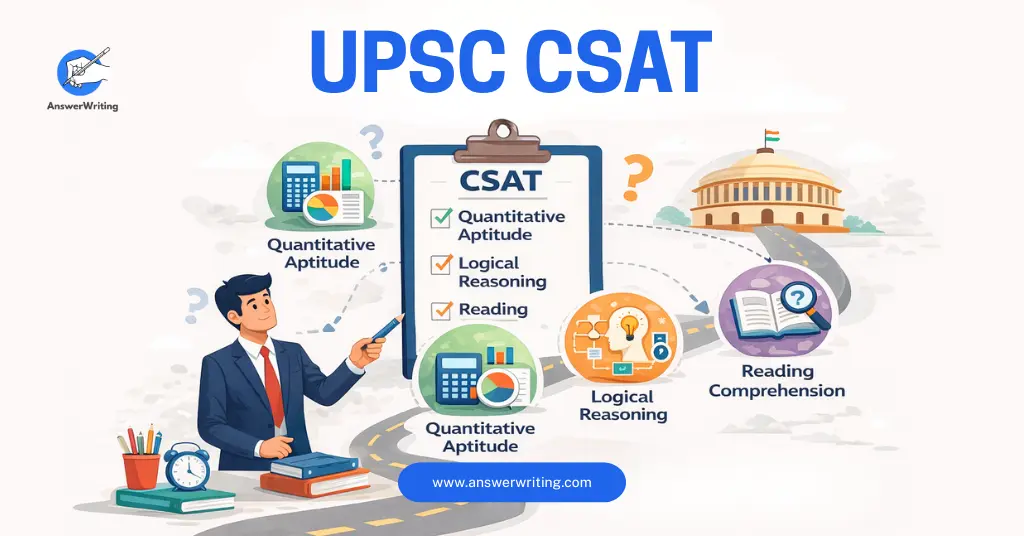
One paper. Qualifying in nature. Not counted in the merit score. And yet capable of ending an entire year of preparation in a single morning.
CSAT is the most underestimated paper in the UPSC Civil Services Examination. Most aspirants treat it as an afterthought. A significant number discover, too late, that it was not.
This guide gives you everything you need to understand CSAT, prepare for it intelligently, and make sure it never becomes the reason you miss the cut.
What Is UPSC CSAT and Why It Cannot Be Ignored
CSAT stands for Civil Services Aptitude Test. It is the second paper of the UPSC Preliminary Examination, officially called General Studies Paper II.
Here are the key facts about CSAT:
- It carries 200 marks
- The qualifying threshold is 33%, which means you need at least 66 marks out of 200
- There is negative marking: one-third of marks are deducted for each wrong answer
- The paper is 2 hours long
- It contains approximately 80 questions
- Your CSAT score does not contribute to your Prelims merit score, which is based entirely on GS Paper I
That last point is the one that misleads aspirants. Because CSAT marks do not count toward the merit score, many aspirants deprioritise it entirely. They reason: why spend time on a paper that does not help my rank?
The answer is simple. A paper that can disqualify you regardless of your GS performance is not optional preparation. It is risk management.
The 33% threshold sounds low. And for most aspirants with strong reading and reasoning skills, it is entirely manageable. But “manageable” and “guaranteed” are not the same thing. Aspirants with weak English comprehension, poor mathematical foundations, or limited practice with logical reasoning have failed this threshold in real exams. And when they did, their GS Paper I score, however strong, counted for nothing.
CSAT was introduced in 2011 to bring an aptitude dimension into the civil services screening process. The intent was to test skills beyond factual knowledge: reading comprehension, logical reasoning, and basic quantitative ability. These are skills a civil servant genuinely needs. They are also skills that can be built with the right preparation.
CSAT Syllabus: Complete Subject-wise Breakdown
The official UPSC syllabus for CSAT covers six broad areas. Understanding what each area actually tests is the foundation of smart preparation.
| Subject Area | What It Tests | Approximate Weightage | Difficulty Level |
|---|---|---|---|
| Comprehension | Reading and understanding English and Hindi passages | 25 to 30% | Low to Moderate |
| Interpersonal Skills and Communication | Situational judgement and communication understanding | 5 to 8% | Low |
| Logical Reasoning and Analytical Ability | Patterns, sequences, arguments, and logical deduction | 25 to 30% | Moderate to High |
| Decision Making and Problem Solving | Situational reasoning and administrative judgement | 8 to 10% | Moderate |
| General Mental Ability | Analogies, classifications, series, and mental puzzles | 10 to 15% | Moderate |
| Basic Numeracy and Data Interpretation | Arithmetic, percentages, ratios, graphs, and tables | 20 to 25% | Moderate to High |
Comprehension
Comprehension questions present a passage (in English or Hindi) followed by questions that test your understanding of the passage content, its central argument, the author’s tone, and logical inferences that can be drawn from it.
This is the highest-weightage area in CSAT and the one where most aspirants can score most reliably. The passage is self-contained. You do not need prior knowledge. You need careful reading and the ability to identify what the passage actually says versus what you assume it says.
UPSC comprehension passages are often dense and academic in tone. They draw from philosophy, governance, science, and social commentary. The questions test precise reading rather than general intelligence.
Interpersonal Skills and Communication
This area tests situational understanding of communication dynamics: how to handle a difficult conversation, what makes communication effective, how to navigate a conflict. Questions here are generally straightforward and reward common sense and a basic understanding of professional conduct.
This is the lowest-stakes area of CSAT in terms of preparation time required. Most aspirants handle these questions well without specific preparation.
Logical Reasoning and Analytical Ability
This is one of the two most challenging areas of CSAT for aspirants who have not practised it. Logical reasoning covers:
- Syllogisms and logical deductions
- Statement and assumption questions
- Statement and conclusion questions
- Cause and effect reasoning
- Strengthening and weakening arguments
- Coding and decoding
- Blood relations
- Direction and distance problems
- Ranking and order arrangements
- Series completion (number and letter)
- Analogies and classifications
The variety is wide and the question types are specific. Each type requires a distinct approach. Aspirants who have not practised these question types systematically find them time-consuming and confusing under exam pressure.
Decision Making and Problem Solving
Decision-making questions present an administrative or professional scenario and ask you to choose the most appropriate response. These questions test practical judgement rather than formal logic.
Unlike the decision-making questions in GS Paper IV (Ethics), CSAT decision-making questions are more procedural and less ethically complex. They test whether you understand basic principles of fair, transparent, and effective administration.
There are no fixed rules to memorise for this section. The best preparation is familiarity with administrative principles and consistent practice with past UPSC CSAT papers.
General Mental Ability
General mental ability covers a range of reasoning tasks that test how quickly and accurately you can identify patterns and relationships:
- Number and letter series
- Odd one out
- Analogies
- Clocks and calendars
- Mirror and water images
- Venn diagrams
- Cubes and dice problems
These questions reward pattern recognition and speed. Regular practice builds both.
Basic Numeracy and Data Interpretation
This is the area that most consistently trips up aspirants from non-mathematics backgrounds. Basic numeracy covers:
- Number systems and simplification
- Percentages
- Ratio and proportion
- Profit and loss
- Time, speed, and distance
- Time and work
- Simple and compound interest
- Averages and mixtures
- Permutations and combinations (basic)
- Probability (basic)
Data interpretation covers:
- Bar graphs
- Line graphs
- Pie charts
- Tables
- Mixed graphs
The UPSC syllabus specifies that numeracy is at the Class 10 level. But Class 10 level mathematics, when applied under time pressure with negative marking, requires thorough practice. Knowing the concept and being able to solve a question accurately in 90 seconds are different skills.
Who Needs to Prepare Seriously for CSAT
Not every aspirant needs the same level of CSAT preparation. Be honest about your profile before deciding how much time to invest.
You need minimal dedicated CSAT preparation if:
- You have a strong English reading background (regular newspaper reading, academic reading)
- You are comfortable with Class 10 mathematics and can solve basic arithmetic quickly
- You have an engineering or mathematics background where logical reasoning is second nature
- Your mock test scores in CSAT consistently sit above 90 to 100 marks
You need moderate CSAT preparation if:
- You are comfortable with comprehension but weak in mathematics
- You understand logical reasoning conceptually but lack speed
- Your mock test scores in CSAT sit between 75 and 90 marks
- You are from a humanities background with limited recent mathematics practice
You need serious, dedicated CSAT preparation if:
- You are from a Hindi or regional language medium background with limited English reading practice
- Your Class 10 or higher secondary mathematics foundation is weak
- You have never practised logical reasoning questions formally
- Your mock test scores in CSAT sit below 80 marks
- You have previously come close to or fallen below the 66-mark threshold
Honest self-assessment here is critical. Overestimating your CSAT readiness and underinvesting in preparation is exactly how aspirants get disqualified despite strong GS performance.
Subject-wise Preparation Strategy
Comprehension: Read quality English content daily. The Hindu editorial, economic and governance-focused articles, and academic writing all prepare you for the dense, analytical passages UPSC uses. When practising comprehension questions, train yourself to answer only from the passage, never from prior knowledge. The most common error in comprehension is choosing an answer that is true in general but not supported by the specific passage.
Practice reading a passage once, answering all questions, and then going back to verify each answer against the passage text. This verification habit catches careless errors that negative marking punishes.
Logical Reasoning: Categorise all logical reasoning question types and practise each type in isolation before mixing them. Spend two weeks on syllogisms, two weeks on series and analogies, two weeks on arrangements and directions. Once each type is familiar, move to mixed practice sets under timed conditions.
The key skill in logical reasoning is not intelligence. It is the ability to apply the correct approach to each question type quickly and systematically. That comes entirely from practice.
Basic Numeracy: If your mathematics foundation is weak, start with NCERT Class 8, 9, and 10 mathematics before moving to CSAT-specific books. Do not skip the foundation. Trying to solve percentage problems without a solid understanding of fractions is like trying to run before walking.
Once your foundation is solid, practise CSAT numeracy questions daily with a timer. Speed is as important as accuracy here. A question you can solve in three minutes is only useful if the paper gives you three minutes for it. Most CSAT numeracy questions need to be solved in 60 to 90 seconds.
Data Interpretation: Practice reading graphs and tables quickly and accurately. The most common DI error is misreading the scale of a graph or the unit of measurement in a table. Slow down on these elements before calculating. A fast wrong answer under negative marking costs more than a slightly slow correct one.
Decision Making: Read past UPSC CSAT papers and their official answer keys carefully. Understand the reasoning behind the correct answers. Over time, you will develop a feel for the administrative principles UPSC applies in these questions. There is no shortcut here other than exposure to a large number of past questions.
Best Books and Resources for CSAT
| Resource | Best For |
|---|---|
| CSAT Paper II by Arihant Publications | Comprehensive coverage of all CSAT topics |
| Analytical Reasoning by M.K. Pandey | Logical reasoning and analytical ability |
| Quantitative Aptitude by R.S. Aggarwal | Numeracy and data interpretation |
| NCERT Mathematics Class 8, 9, 10 | Building mathematical foundation from scratch |
| Past UPSC CSAT Papers (2011 to present) | The single best practice resource available |
| INK by Disha Publications | Integrated CSAT preparation |
Among all resources, past UPSC CSAT papers are the most valuable. UPSC has a distinct style of question framing. No coaching material replicates it as accurately as the actual papers. Solve every available past paper under timed conditions before your exam.
Common Mistakes Aspirants Make in CSAT
| Common Mistake | Why It Hurts | The Fix |
|---|---|---|
| Treating CSAT as completely ignorable | Creates disqualification risk regardless of GS Paper I performance | Take at least two full mock CSAT tests early in preparation to assess your baseline score |
| Not practising under timed conditions | CSAT has 80 questions in 120 minutes: 90 seconds per question on average. Untimed practice creates false confidence | Always practise full papers under strict 120-minute conditions |
| Attempting all questions without strategy | Negative marking penalises guessing. Attempting uncertain questions reduces your score | Attempt questions you are confident about first. Skip genuinely uncertain ones unless you can eliminate two options |
| Neglecting comprehension for mathematics | Comprehension is the highest-weightage area and the most reliably scorable | Practise at least two comprehension passages daily throughout your preparation |
| Starting numeracy preparation too late | Building a weak mathematics foundation takes time. Last-minute numeracy preparation rarely works | Identify your mathematics weaknesses in the first month of preparation and address them early |
| Not reading Hindi medium comprehension passages | UPSC includes Hindi passages in CSAT. Hindi medium aspirants must practise both language comprehensions | Practise comprehension in both English and Hindi regardless of your medium |
Mock Test and Practice Strategy for CSAT
Your CSAT practice strategy should follow three phases.
Phase 1: Diagnosis (First two weeks of preparation) Take one full-length mock CSAT paper under timed conditions without any specific preparation. Score it honestly. Identify your weakest areas by subject. This diagnostic sets your preparation priority. If you score above 100, CSAT requires only maintenance practice. If you score between 70 and 100, targeted subject preparation is needed. If you score below 70, CSAT needs dedicated daily preparation alongside your GS preparation.
Phase 2: Targeted Subject Practice (Month 1 to Month 4) Address your weakest areas systematically using the subject-specific strategy outlined above. Practise each weak area daily for a defined period before moving to the next. Do not attempt to fix everything simultaneously. Focused improvement in one area at a time is more effective.
Phase 3: Integrated Mock Tests (Final two months before Prelims) Shift entirely to full-length timed mock tests. Attempt at least one full CSAT paper every week. After each mock, conduct a detailed error analysis: which question types did you get wrong, why, and what was the correct approach? Implement those corrections before your next mock.
In the final two weeks before Prelims, solve one past UPSC CSAT paper every two days. Familiarity with the actual paper style, question difficulty, and time pressure is the best final preparation you can do.
FAQs on UPSC CSAT
1. Is CSAT really difficult to clear for most aspirants?
For aspirants with strong English reading habits and basic mathematical comfort, clearing the 33% threshold is not difficult with moderate preparation. For aspirants from non-English medium backgrounds or with weak mathematics foundations, it requires genuine dedicated preparation. The difficulty is not in the ceiling of the paper but in the floor: the 33% threshold that must be crossed without fail.
2. How much time should I dedicate to CSAT preparation daily?
This depends entirely on your diagnostic score. If you score above 100 in your baseline mock, 30 to 45 minutes of CSAT practice three times a week is sufficient maintenance. If you score between 70 and 100, one hour of daily CSAT preparation is appropriate. If you score below 70, treat CSAT as a parallel primary subject and dedicate 90 minutes to two hours daily until your score is consistently above 90.
3. Can I clear CSAT without studying mathematics at all?
It depends on your performance in the other sections. If you score very high in comprehension, logical reasoning, decision making, and general mental ability, it is theoretically possible to cross 66 marks without mathematics. But this is a risky strategy. Mathematics and data interpretation together account for 20 to 25% of the paper. Avoiding them entirely leaves very little margin for error in other sections. Address your mathematical weaknesses rather than avoiding them.
4. Does CSAT preparation help with GS Mains preparation?
Yes, indirectly but meaningfully. The reading comprehension practice builds the close reading skills that GS answer writing requires. The logical reasoning practice builds the structured analytical thinking that GS analytical questions demand. The data interpretation practice builds comfort with graphs and tables that appear in GS Paper III economy questions. CSAT preparation is not wasted even though the marks do not count.
5. What is the best way to handle negative marking in CSAT?
Develop a three-tier approach to every question. Tier one: questions you can solve with confidence. Attempt all of these. Tier two: questions where you can eliminate two options confidently. Attempt these with a calculated risk. Tier three: questions where you have no reliable basis for elimination. Skip these entirely. The negative marking in CSAT is one-third of marks per wrong answer. Getting three tier-three questions wrong to gain one right answer is a neutral outcome at best and a negative one when your elimination is unreliable.
6. Is CSAT the same every year in terms of difficulty?
The difficulty level varies year to year. Some years the mathematics section has been significantly harder than others. Some years comprehension passages have been unusually dense. This variability is why consistent preparation across all sections is more reliable than betting on one section being easy. Your preparation should ensure you can score comfortably above 66 even in a harder-than-average year.
Final Thought
CSAT is not the most glamorous part of UPSC preparation. It does not appear in topper interviews. It does not feature in the stories of rank one achievers. Nobody talks about their CSAT score at the academy.
But it is the paper that ends the journey of aspirants who were otherwise ready. Quietly, without drama, and without a second chance that year.
Assess your baseline honestly. Prepare targeted to your weaknesses. Take it seriously enough to never make it the reason you do not move forward.
One threshold. Sixty-six marks. Make sure you cross it with room to spare.