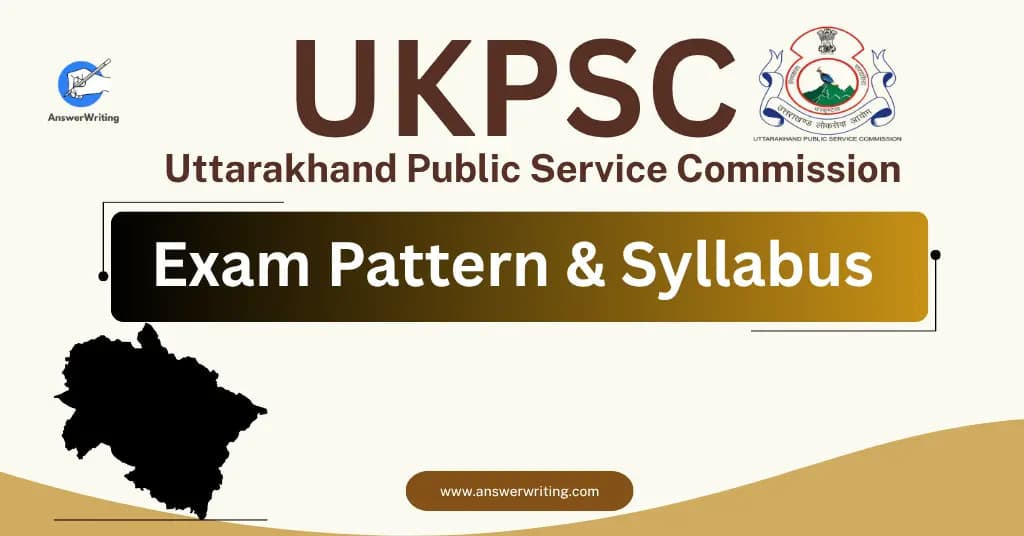
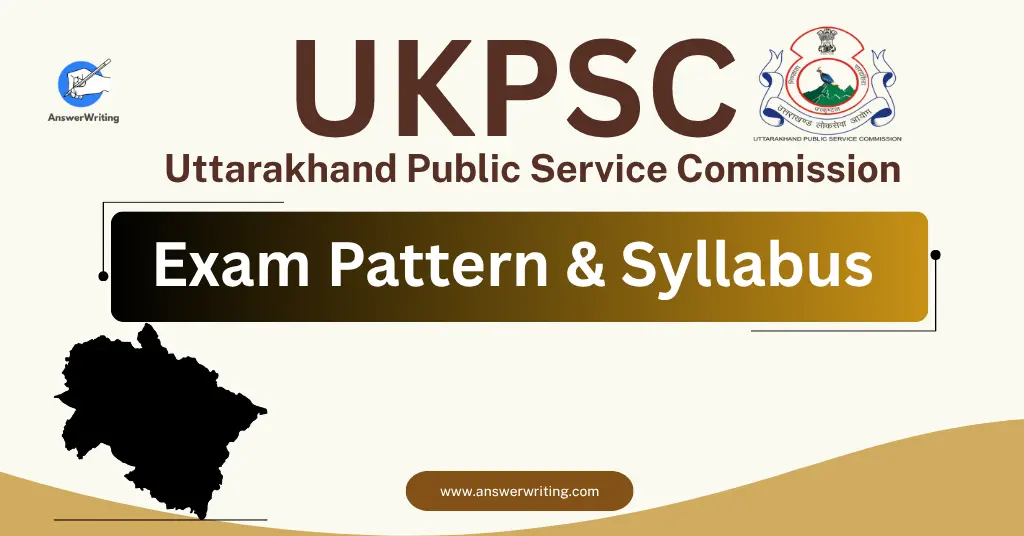
The Uttarakhand Public Service Commission (UKPSC) conducts the State Civil/Upper Subordinate Services Examination to recruit candidates for various administrative positions within the Uttarakhand government.
The recruitment process follows a strict three-tier structure:
- Stage I: Preliminary Examination (Screening)
- Stage II: Mains Examination (Written/Subjective)
- Stage III: Interview/Personality Test
Stage I: Preliminary Examination Pattern
The Preliminary examination is the initial screening stage. It consists of two objective-type papers. While Paper I determines the cutoff for the Mains, Paper II is qualifying in nature.
| Feature | Paper-I: General Studies (GS) | Paper-II: General Aptitude Test (CSAT) |
| Number of Questions | 150 | 150 |
| Total Marks | 150 Marks | 150 Marks |
| Duration | 2 Hours | 2 Hours |
| Marking Scheme | 1 Mark per question | 1 Mark per question |
| Negative Marking | 0.25 (1/4) marks deducted per wrong answer | 0.25 (1/4) marks deducted per wrong answer |
| Qualifying Criteria | Marks used for merit ranking to entry Mains | Mandatory 33% (approx. 50 marks) to qualify |
Preliminary Syllabus
Paper I: General Studies
1. Indian History, Culture, and National Movement
- Pre-Historic Period: Harappa Civilization, Vedic Civilization, and Sangam Age. Mahajanapadas and the rise of Magadh.
- Religious Movements: Jainism, Buddhism, Bhagavatism, and Shaivism.
- Ancient Empires: Mauryan Empire (Chandragupta, Ashoka’s Dhamma, Administration, Economy, and Art). Kushanas and Greek contacts.
- Gupta Empire: Foundation, Consolidation, and Decline. Detailed study of Chandragupta I, Samudragupta, Chandragupta II, and Skandagupta. Focus on Administration, Literature, and Art.
- Post-Gupta Period: Harshavardhan, Pal, Pratihara, Rashtrakuta, Chola, Pallava, Chandel, Paramar, and Chauhan dynasties. Socio-economic development between 650 A.D. and 1200 A.D.
- Advent of Islam: Delhi Sultanate (Iltutmish, Balban, Alauddin Khalji, Tughlaqs, Lodis). Administration, society, and Indo-Islamic Architecture. Bhakti and Sufi movements.
- Mughal Empire: Babar to Aurangzeb. Focus on Mansabdari and Jagirdari systems, Art, Architecture, and Literature. Rise of Marathas, Sikhs, and Jats.
- European Expansion: Portuguese, Dutch, French, and British East India Company. British administration (1758–1857). Economic impact of British rule.
- National Movement: 1857 War of Independence. 19th-century Socio-religious reforms. Indian National Congress (Moderates and Extremists). Gandhian Era (Non-Cooperation, Civil Disobedience, Quit India). Government of India Acts (1858, 1919, 1935). Indian Independence Act 1947 and Partition.
2. History and Culture of Uttarakhand
- Pre-historic and Proto-historic periods of the region.
- Ancient tribes: Kuninda and Yaudheya.
- Regional Dynasties: Kartikepur, Kattyuri, Parmar (Garhwal), and Chand (Kumaon).
- Gorkha Invasion and their rule.
- British Rule and the Tehri Estate.
- Role of Uttarakhand in the National Movement and regional People’s movements.
3. Indian and World Geography
- World Geography: Solar System, Lithosphere (Latitudes, Longitudes, Rotation, Revolution), Hydrosphere (Currents, Tides, Salinity), Atmosphere (Layers, Humidity). Global Agriculture, Minerals, Population, and International boundaries.
- Geography of India: Relief, Structure, Drainage systems, Climate, Vegetation, Soils, and Water Resources. Population, Urbanization, and Scheduled Castes/Tribes.
- Geography of Uttarakhand: Geographical location, Relief, Climate, Drainage, Wild life, Irrigation, and Natural hazards.
4. Indian Polity and Constitution
- National: Parliamentary system, Coalition politics, Regionalism, Casteism, and Communalism. Welfare provisions for SC/ST/OBC and Minorities. Gender politics and Electoral reforms. Governance institutions and Planning machinery (NITI Aayog/Planning Commission).
- Constitution of India: Constitutional Development, Preamble, and Basic Features.
- International Affairs: United Nations, Environmental concerns at the global level, Regional groups (SAARC, ASEAN, BRICS). India’s approach to Disarmament, Human Rights, and Globalization.
5. Economic and Social Development
- LPG (Liberalization, Privatization, Globalization) and its impact.
- Banking Sector (RBI, NABARD, IDBI).
- Development schemes (MNREGA, NRHM, JNNURM).
- Social Sector initiatives and Public-Private Partnership (PPP) mode.
Stage II: Mains Examination Pattern
The Mains examination is a descriptive/written test. This stage is crucial as marks obtained here are combined with the interview marks for final selection. There are eight compulsory papers.
| Paper | Subject | Total Marks | Duration |
| Paper I | Language (Hindi) | 150 Marks | 3 Hours |
| Paper II | Essay | 150 Marks | 3 Hours |
| Paper III | General Studies I: Indian History, Social Justice, and Culture | 200 Marks | 3 Hours |
| Paper IV | General Studies II: Governance, Constitution, Polity, and IR | 200 Marks | 3 Hours |
| Paper V | General Studies III: Technology, Economics, Environment, and Security | 200 Marks | 3 Hours |
| Paper VI | General Studies IV: Ethics, Integrity, and Aptitude | 200 Marks | 3 Hours |
| Paper VII | General Studies V: Knowledge of the State of Uttarakhand (Part 1) | 200 Marks | 3 Hours |
| Paper VIII | General Studies VI: Knowledge of the State of Uttarakhand (Part 2) | 200 Marks | 3 Hours |
| Total | 1500 Marks |
Mains Syllabus
Paper I: Language (Hindi)
This paper tests the candidate’s proficiency in the Hindi language through various exercises:
- General Hindi Grammar and Vocabulary.
- Antonyms, Synonyms, and One-word substitutions.
- Phrases and phrasal verbs.
- Transformation of sentences.
- Letter writing and Official correspondence.
- Comprehension and Précis writing.
Paper II: Essay
Candidates are required to write multiple essays on diverse topics. The assessment focuses on the clarity of thought, expression, and logical flow. Topics generally include:
- Social and political issues.
- Economic trends.
- Environmental challenges.
- Literature and Culture.
- National and International current events.
Paper III: General Studies I (History, Social Justice, and Culture)
- Indian History: Political, Economic, Social, and Cultural history from Harappan civilization to modern times.
- World History: Major events that shaped the modern world.
- Indian Cultural Heritage: Art forms, literature, and architecture from ancient to modern times. Focus on World Heritage sites in India.
- Social Justice: Issues related to vulnerable sections, empowerment, and welfare schemes.
Paper IV: General Studies II (Governance, Constitution, Polity, and IR)
- Indian Constitution: Features, amendments, and significant provisions.
- Polity: Functions and responsibilities of the Union and the States. Parliament and State Legislatures.
- Governance: Transparency, accountability, e-governance, and role of civil services in a democracy.
- International Relations: India’s neighborhood relations and global agreements involving India’s interests.
Paper V: General Studies III (Technology, Economics, Environment, and Security)
- Economy: Indian Economy and issues relating to planning, mobilization of resources, and employment. Government budgeting.
- Science & Technology: Developments and applications in everyday life. Achievements of Indians in S&T.
- Environment: Conservation, environmental pollution, and degradation.
- Security & Disaster Management: Internal security challenges, cyber security, and disaster mitigation strategies.
Paper VI: General Studies IV (Ethics, Integrity, and Aptitude)
- Ethics and Human Interface: Essence, determinants, and consequences of ethics in human actions.
- Attitude: Content, structure, function, and its influence on thought and behavior.
- Aptitude: Integrity, impartiality, objectivity, and empathy towards the weaker sections.
- Emotional Intelligence: Concepts and utilities in administration and governance.
- Probity in Governance: Concept of public service and philosophical basis of governance and probity.
Paper VII & VIII: General Studies V & VI (Knowledge of Uttarakhand)
These papers are dedicated to the specific study of Uttarakhand state:
- History of Uttarakhand: Regional movements, dynasties, and the struggle for statehood.
- Geography and Economy: Natural resources, forest wealth, tourism, and hydropower potential. Rural development and migration issues.
- Polity and Administrative Setup: Local government, Panchayati Raj in the hills, and state-specific laws.
- Social Structure: Tribes of Uttarakhand, folk arts, traditions, festivals, and cultural heritage.
Stage III: Interview / Personality Test
Candidates who clear the Mains examination are invited for the final stage.
- Total Marks: 150 Marks.
- Evaluation Criteria:
- Personality: Assessment of the candidate’s overall bearing and confidence.
- Communication Skills: Ability to express ideas clearly and effectively.
- Problem-Solving: Evaluating the candidate’s analytical approach to administrative scenarios.
- General Awareness: Knowledge of state, national, and international affairs.
- Intellectual Qualities: Mental alertness, critical powers of assimilation, and logical exposition.
- Social Traits: Integrity, moral courage, and leadership potential.
Final Merit Ranking: The final selection list is prepared by aggregating the marks obtained in the Mains Examination (1500) and the Interview (150), for a total of 1650 marks.