Srushti Jayant Deshmukh: AIR 5 and Top Woman, UPSC CSE 2018, Strategy and Journey
She did not start preparation with the goal of topping India. She started with the goal of clearing the exam. That one distinction, between chasing a rank and chasing competence, shaped everything about how Srushti Jayant Deshmukh prepared, and it showed in her result.
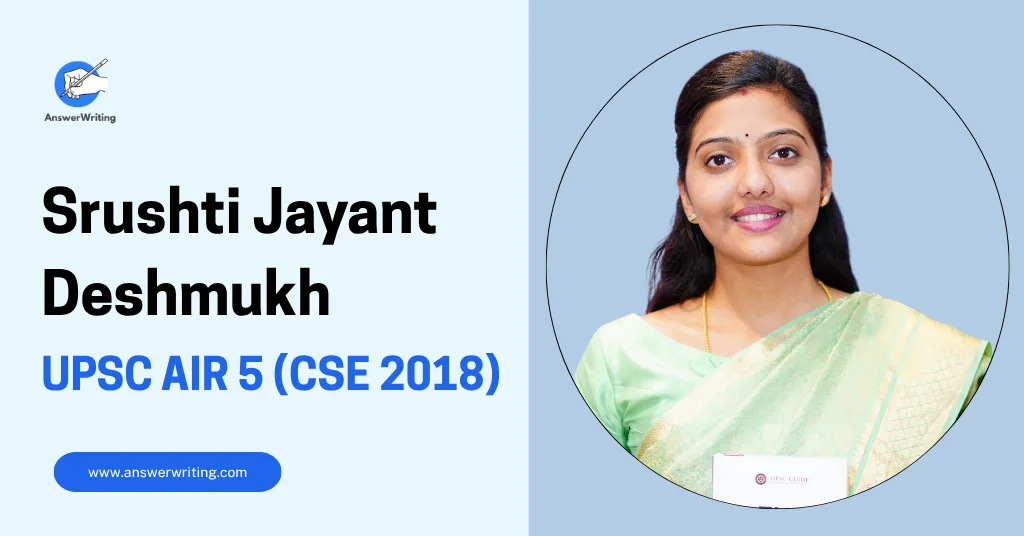
AIR 5 overall. Rank 1 among all women candidates in CSE 2018. First attempt. Age 23.
Who Is Srushti Jayant Deshmukh?
Srushti Jayant Deshmukh is an IAS officer from Madhya Pradesh who secured AIR 5 in the UPSC Civil Services Examination 2018, with results declared in April 2019. She was the top-ranked woman candidate in that cycle.
She belongs to Bhopal, Madhya Pradesh, and completed her engineering degree from a Bhopal-based college. She chose Anthropology as her optional subject despite having an engineering background, a decision that attracted significant attention and discussion among aspirants.
She was allotted the IAS with the Madhya Pradesh cadre.
Quick Profile
| Detail | Information |
|---|---|
| Full Name | Srushti Jayant Deshmukh |
| AIR | 5 (CSE 2018) |
| Rank Among Women | 1st (Top Woman Candidate) |
| Exam Year | UPSC CSE 2018 |
| Attempts | 1 (First attempt) |
| Optional Subject | Anthropology |
| Service | IAS |
| Cadre | Madhya Pradesh |
| Educational Background | B.E., Chemical Engineering, RGPV Bhopal |
| Home City | Bhopal, Madhya Pradesh |
Srushti Jayant Deshmukh UPSC Marksheet and Score Details
As per widely reported figures, here is Srushti’s score breakdown:
| Stage | Marks Obtained | Maximum Marks |
|---|---|---|
| Mains Written | 1011 | 1750 |
| Interview (Personality Test) | 182 | 275 |
| Final Total | 1193 | 2025 |
| Anthropology Paper I | 174 | 250 |
| Anthropology Paper II | 208 | 250 |
Her Anthropology Paper II score of 208 out of 250 is particularly noteworthy. It reflects both strong conceptual clarity and effective answer presentation.
Individual GS paper-wise scores are not officially published in granular detail. Aspirants should cross-check specific sub-scores from official UPSC marksheet disclosures or verified interview sources.
Educational Background and Early Life
Srushti grew up in Bhopal and completed her schooling there. She went on to pursue a B.E. in Chemical Engineering from Rajiv Gandhi Proudyogiki Vishwavidyalaya (RGPV), Bhopal, one of Madhya Pradesh’s prominent technical universities.
She began preparing for UPSC while still in the final stages of her engineering degree. This overlap between college completion and UPSC preparation is a model many engineering aspirants follow, though few execute it as effectively.
Her Bhopal base is significant. She did not relocate to Delhi’s coaching hub in Mukherjee Nagar or Rajendra Nagar. She built her preparation from her home city, using a combination of self-study and selective coaching, which makes her approach directly relevant to aspirants outside metro cities.
How Many Attempts Did Srushti Jayant Deshmukh Take?
Srushti cleared UPSC CSE 2018 in her very first attempt. She appeared for the exam immediately after completing her engineering degree.
What made this possible was not a relaxed preparation schedule. She treated UPSC preparation as a full-time commitment from the moment she decided to pursue it. There was no casual phase, no exploratory year of half-hearted study.
For multi-attempt aspirants reading this, the lesson is not “first attempt is better.” The lesson is that clarity of commitment, knowing exactly what you are preparing for and why, is what determines the quality of your preparation, regardless of which attempt you are on.
Srushti Jayant Deshmukh’s Optional Subject: Anthropology
Why a Chemical Engineer Chose Anthropology
This is the question most aspirants ask first. Why would someone from a Chemical Engineering background choose Anthropology over a science or engineering-related optional?
Srushti has addressed this in multiple interviews. Her reasoning was practical and strategic. Anthropology has a compact, well-defined syllabus. It overlaps meaningfully with GS Paper 1 (Indian society, tribal issues) and GS Paper 2 (social justice). The subject does not require prior academic exposure. A motivated self-studier can master it within the preparation timeline.
For an engineering graduate with no background in social sciences, Anthropology offered a cleaner learning curve than, say, Sociology or Political Science, where theoretical frameworks take longer to internalise.
How She Scored
As per widely reported figures, she scored 174 in Paper I and 208 in Paper II, totalling 382 out of 500. This is a strong optional score and contributed significantly to her overall rank.
Paper II of Anthropology covers applied aspects, including tribal issues in India, which is a content area that connects directly to current affairs and government policy. Aspirants who follow current affairs diligently tend to perform better in Paper II, and Srushti’s score reflects that alignment.
Books and Strategy for Anthropology
She focused on standard Anthropology texts and supplemented them with notes from coaching material. Her approach emphasised answer writing practice specific to the optional, not just content reading.
Key books widely associated with her preparation include:
- “Anthropology” by Peter Metcalf (for conceptual foundation)
- IGNOU study material for Anthropology (comprehensive and UPSC-aligned)
- Previous year question papers for pattern recognition
Aspirants choosing Anthropology should note that the subject rewards those who can write analytically, use diagrams where relevant, and connect theoretical concepts to real-world Indian examples.
UPSC Preparation Strategy of Srushti Jayant Deshmukh
Coaching vs. Self-Study
Srushti used coaching for specific subjects rather than enrolling in a full integrated programme. As per her interviews, she attended classes selectively and relied heavily on self-study for the bulk of her preparation.
This is an important distinction. Coaching gave her direction and structured notes for certain GS papers. Self-study gave her the depth and personalisation that classroom instruction rarely provides.
GS Paper Approach
For GS Paper 1, she used NCERT textbooks as her foundation for History, Geography, and Indian Society. She built upward from NCERTs rather than jumping directly into reference books.
For GS Paper 2, she focused on the Constitution, governance, and schemes through standard sources like M. Laxmikanth for Polity and government websites for scheme details.
For GS Paper 3, Economy and Environment received significant attention. She linked economic concepts to current policy developments and used newspapers to stay updated.
For GS Paper 4, she emphasised understanding ethical frameworks rather than memorising definitions. She practised case studies regularly, treating them as answer writing exercises with a specific structure.
Revision and Note-Making
She made concise, handwritten notes throughout her preparation and revised them multiple times before the exam. Her note-making was selective: not everything went into notes, only what she knew she would struggle to recall under exam pressure.
She followed the widely recommended principle of reading fewer sources more thoroughly rather than covering many sources superficially.
Study Hours
As per available reports and her interviews, she studied for approximately 10 to 12 hours daily during peak preparation phases. She maintained consistency over intensity, prioritising regular study over occasional marathon sessions.
Books and Resources Recommended by Srushti Jayant Deshmukh
As per her widely reported interviews and verified sources:
| Subject | Book / Resource | Author / Source |
|---|---|---|
| Ancient and Medieval History | NCERT Textbooks (Class 6 to 12) | NCERT |
| Modern History | India’s Struggle for Independence | Bipan Chandra |
| Indian Polity | Indian Polity | M. Laxmikanth |
| Indian Economy | Indian Economy | Ramesh Singh |
| Geography | NCERT Geography (Class 11 and 12) | NCERT |
| Environment and Ecology | Shankar IAS Environment | Shankar IAS Academy |
| Ethics (GS4) | Lexicon for Ethics | Niraj Kumar |
| Current Affairs | The Hindu | Daily Reading |
| Anthropology Optional | IGNOU Study Material | IGNOU |
| Anthropology Optional | Previous Year Papers | UPSC |
Cross-check this list against her official interviews, as specific mentions may vary across sources.
Mains Answer Writing Approach
Srushti’s Mains written score of 1011 out of 1750 is competitive, and her answer writing approach reflects habits that any aspirant can replicate.
She practised writing full-length answers within time limits regularly. She did not just read model answers. She wrote her own, then compared them against good examples to identify gaps in structure, content, and language.
Her answers followed a clear pattern: a direct introduction that addressed the question immediately, body paragraphs with subheadings or bullet points where appropriate, real-world examples or data to support arguments, and a brief conclusion that added perspective rather than just summarising.
One area she has emphasised is the importance of getting external feedback on written answers. Reading your own answers repeatedly creates blind spots. You stop seeing what is missing because you already know what you meant to write.
This is exactly the problem that platforms like AnswerWriting.com solve. Its Daily Answer Writing feature gives aspirants fresh prompts every day, and the AI-powered Answer Evaluator provides structured feedback on content, presentation, and UPSC scoring parameters. For aspirants who do not have access to a mentor or peer group, this kind of consistent, objective feedback can replicate what Srushti got through her own review process.
Writing answers is a skill. It degrades without practice and sharpens with feedback. Both halves of that equation matter.
Interview (Personality Test) Experience
Srushti scored 182 out of 275 in the Personality Test, a solid performance that complemented her written scores effectively.
She has spoken about her interview preparation in several widely reported interviews. Her approach involved thorough DAF (Detailed Application Form) review, revisiting everything she had written about herself, her background, her engineering degree, and her reasons for choosing civil services.
As per available reports, the board asked her questions rooted in her Chemical Engineering background and her choice of Anthropology as an optional, a combination that made for an interesting and unconventional DAF. She was asked about the connection between engineering and governance, and about tribal issues in Madhya Pradesh, which aligned with her cadre preference.
She has also mentioned that she stayed current on Madhya Pradesh-specific issues during interview preparation, knowing her home state preference and its relevance to board questioning.
Her advice, as widely reported, was to be honest and direct in the interview rather than trying to give textbook-perfect answers. The board evaluates personality, not just knowledge.
Service and Cadre Allotted to Srushti Jayant Deshmukh
Srushti Jayant Deshmukh was allotted the Indian Administrative Service (IAS) with the Madhya Pradesh cadre. This was her home state preference, and her rank of AIR 5 gave her strong positioning in the allotment process.
Her current posting and administrative assignments should be verified from official government or recent news sources, as postings change over time and this article does not carry potentially outdated placement information.
Key Lessons Every UPSC Aspirant Can Take from Srushti Jayant Deshmukh
- Optional subject choice is strategic, not sentimental. Srushti did not choose Anthropology because she loved it. She chose it because its syllabus was compact, its scoring potential was high, and it connected well with GS. Evaluate your optional the same way.
- You do not need Delhi to crack UPSC. She prepared from Bhopal with selective coaching and self-study. Geography is not a barrier. Discipline and resource quality are what matter.
- NCERTs are not optional reading. She built her GS foundation on NCERTs before moving to reference books. Aspirants who skip this step often find their conceptual base is weaker than they realise when Mains answers demand depth.
- Feedback on your writing is not a luxury. She consistently reviewed and improved her answers throughout preparation. Aspirants who only read and never write, or who write but never seek feedback, are preparing with a significant blind spot.
- Prepare to clear, not to top. Her own framing of her preparation goal was clearing the exam, not chasing AIR 1. That mindset reduces anxiety, improves consistency, and paradoxically leads to better results.
FAQs About Srushti Jayant Deshmukh
What was Srushti Jayant Deshmukh’s optional subject? She chose Anthropology as her optional subject and scored 382 out of 500 across both papers, as per widely reported figures.
How many attempts did Srushti Jayant Deshmukh take? She cleared UPSC CSE 2018 in her first attempt and secured AIR 5 overall and Rank 1 among women.
Which college did Srushti Jayant Deshmukh attend? She completed her B.E. in Chemical Engineering from Rajiv Gandhi Proudyogiki Vishwavidyalaya (RGPV), Bhopal.
Did Srushti Jayant Deshmukh take coaching for UPSC? She used coaching selectively for specific subjects rather than enrolling in a full integrated programme. Her preparation was largely self-directed.
Why did Srushti Jayant Deshmukh choose Anthropology as her optional? As per her interviews, she chose Anthropology for its compact syllabus, scoring potential, and overlap with GS papers on Indian society and tribal issues.
What was Srushti Jayant Deshmukh’s total score in UPSC CSE 2018? As per available reports, her final total was 1193 out of 2025, including 1011 in Mains written and 182 in the Personality Test.
Which cadre was Srushti Jayant Deshmukh allotted? She was allotted the IAS with the Madhya Pradesh cadre, her home state preference.