Sriram Venkataraman: UPSC Rank 2, Strategy, and the Journey of a Doctor-Turned-IAS
What drives a gold-medalist doctor to trade his stethoscope for the files of a District Collector? For Sriram Venkataraman, the answer lay in the scale of impact. While a doctor heals individuals, an administrator has the power to heal systems.
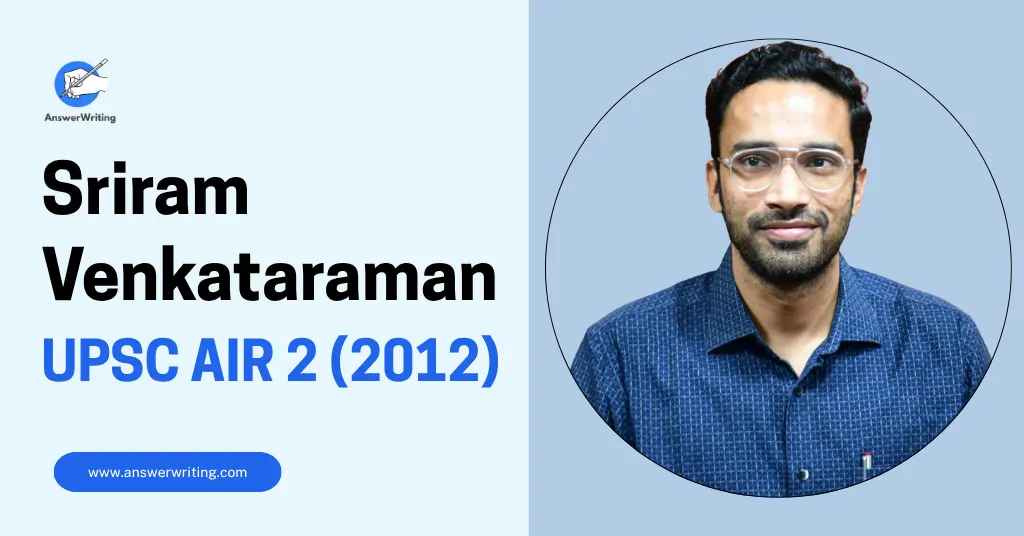
Securing All India Rank (AIR) 2 in the 2012 UPSC Civil Services Examination, Sriram proved that professional expertise and competitive success go hand in hand. His journey is a masterclass for working professionals and medical students who believe the syllabus is too vast to manage alongside a demanding career.
Who Is Sriram Venkataraman?
Sriram Venkataraman is a 2013-batch officer of the Indian Administrative Service (IAS). He belongs to the Kerala cadre and has consistently been in the spotlight for his uncompromising stance on administrative issues. Before entering the civil services, he was a highly accomplished medical professional with specialized training in internal medicine.
| Feature | Details |
|---|---|
| Full Name | Sriram Venkataraman |
| UPSC Rank | AIR 2 |
| Exam Year | 2012 |
| Service Allotted | Indian Administrative Service (IAS) |
| Cadre | Kerala |
| Attempt Number | Second Attempt |
| Education | MBBS (Trivandrum Medical College), MD General Medicine (SCB Medical College, Cuttack) |
| Optional Subject | Medical Science |
Sriram Venkataraman UPSC Marksheet and Score Details
Sriram’s success was defined by a massive score in his optional subject and a highly rated performance in the personality test. His ability to articulate complex medical and social issues gave him a significant edge over other candidates.
| Component | Marks (Estimated/Approx) |
|---|---|
| Written (Mains) | High Merit (Leading in Medical Science) |
| Personality Test | 200+ |
| Final Total | Ranked 2nd in India |
Educational Background and Early Life
Sriram’s academic foundation was built on excellence. He completed his MBBS from the Government Medical College, Thiruvananthapuram, where he was known for his sharp clinical skills. Following his graduation, he pursued an MD in General Medicine at SCB Medical College, Cuttack.
His background in medicine taught him the value of long hours and high-pressure decision-making. These are the same traits required to survive the UPSC preparation cycle. His transition from the hospital wards of Odisha to the study rooms of Delhi was a calculated move to expand his horizons beyond clinical practice.
How Many Attempts Did Sriram Venkataraman Take?
Sriram cleared the UPSC exam in his second attempt. His first attempt was a learning phase where he familiarized himself with the vastness of the General Studies papers. He realized that while his medical knowledge was strong, his approach to humanities needed a more structured framework.
In his second attempt, he shifted his mindset from a “student” to an “administrator.” He began looking at social issues through the lens of policy rather than just observation. For many aspirants, this mindset shift is the hardest part. Today, platforms like AnswerWriting.com offer an AI Mentor that helps candidates make this transition by providing personalized guidance and helping them align their existing professional expertise with the UPSC requirements.
Sriram Venkataraman Optional Subject: Medical Science
Choosing Medical Science was a natural decision for Sriram. Having just completed his MD, the subject was fresh in his mind. However, Medical Science is known for being extremely vast and technically demanding.
- Strategy: He focused on the clinical aspects that are frequently asked in the UPSC. He used his residency experience to write practical, case-based answers.
- Precision: He used medical diagrams to save time and add clarity to his answers.
- Balance: He ensured that his technical answers were understandable to an expert evaluator while remaining concise.
He proved that specialized optionals are high-reward if you have the academic depth to back them up.
UPSC Preparation Strategy of Sriram Venkataraman
Sriram’s strategy is particularly relevant for those with limited time. He prepared for the UPSC while undergoing his MD residency, which is notoriously grueling.
- Micro-Management of Time: He utilized small breaks during hospital shifts to read current affairs or revise medical terminologies.
- Note-Making: He created “on-the-go” notes. Instead of bulky registers, he used concise cards and digital tools to revise during his commute.
- Consistency over Intensity: Rather than studying for 15 hours occasionally, he focused on studying for 4 to 6 hours every single day, without exception.
- Scientific Temperament: He applied a logical, diagnostic approach to General Studies, breaking down complex social problems into their root causes and potential treatments.
Books and Resources Recommended by Sriram Venkataraman
Sriram followed a mix of standard medical texts and the classic UPSC GS booklist.
| Subject | Book/Resource | Author/Source |
|---|---|---|
| Medical Science | Harrison’s Principles of Internal Medicine | Kasper et al. |
| Human Anatomy | Human Anatomy | B.D. Chaurasia |
| Polity | Indian Polity | M. Laxmikanth |
| Economics | Indian Economy | Ramesh Singh |
| Modern History | A Brief History of Modern India | Spectrum |
| Environment | Shankar IAS Notes | Shankar IAS |
Mains Answer Writing Approach
Sriram’s writing style was a reflection of his medical training: precise, evidence-based, and highly structured. He believed that the examiner should be able to “scan” the answer and find all the key points within seconds.
He frequently used:
- Flowcharts to explain administrative processes.
- Point-wise presentation to ensure all parts of the question were addressed.
- Clinical clarity in his optional papers.
Today, aspirants can replicate this structured approach using the Answer Evaluator on AnswerWriting.com. It provides immediate feedback on whether your answers meet the UPSC scoring parameters, helping you refine your structure just as Sriram did through rigorous self-practice. Additionally, for medical professionals, the Optional Evaluator is a vital tool to ensure that technical answers remain relevant to the UPSC syllabus.
Interview (Personality Test) Experience
Sriram’s interview was a deep dive into his motivations. The board was curious about why a specialist doctor wanted to leave a lucrative medical career. He famously articulated that while medicine allowed him to save lives, the IAS allowed him to change the conditions that made people sick in the first place—such as poor sanitation, lack of clean water, and poverty.
His composure and clarity on medical ethics and public health policy impressed the board. He did not shy away from his professional identity; he used it as his greatest strength.
Service and Cadre Allotted to Sriram Venkataraman
Sriram was allotted the Indian Administrative Service (IAS) and was assigned to his home cadre, Kerala.
His career has been marked by bold initiatives. As the Sub-Collector of Devikulam (Munnar), he led high-profile anti-encroachment drives against the land mafia. This made him a hero to many environmentalists and the common public. Although his career has faced later legal and professional challenges, his initial years remain a textbook example of an officer taking courageous stands in the face of political pressure.
Key Lessons Every UPSC Aspirant Can Take from Sriram Venkataraman
- Profession is a Strength: Whether you are a doctor, engineer, or lawyer, use your professional background as a unique perspective in your answers and interview.
- Time is Elastic: If Sriram could clear the exam with Rank 2 during an MD residency, any working professional can manage the preparation with proper time management.
- Depth over Width: Instead of reading fifty different sources, master the standard ones. Sriram’s reliance on classic medical and GS texts paid off.
- Courage is Part of the Job: The IAS is not just about a rank; it is about the will to act. His work in Munnar reminds aspirants of the responsibilities that come with the power of the service.
FAQs About Sriram Venkataraman
What was Sriram Venkataraman’s UPSC rank? Sriram Venkataraman secured All India Rank (AIR) 2 in the 2012 UPSC Civil Services Examination.
What was his optional subject? His optional subject was Medical Science, which he chose based on his MBBS and MD background.
In which attempt did he clear the exam? He cleared the UPSC exam in his second attempt.
Which cadre was he allotted? He was allotted the Kerala cadre of the Indian Administrative Service (IAS).
Can medical students clear UPSC alongside their studies? Yes. Sriram’s journey proves that with disciplined time management, one can balance medical residency and UPSC preparation successfully.
What is he famous for in his administrative career? He gained significant public attention for his bold anti-encroachment drives against illegal constructions in Munnar, Kerala.