Smriti Mishra: UPSC AIR 4 (CSE 2022), Strategy, and Journey
One year, she could not clear the CSAT. The very next attempt, she secured All India Rank 4 in one of the world’s toughest examinations. And she did it as part of a historic sweep where the top four positions in UPSC CSE 2022 were all claimed by women.
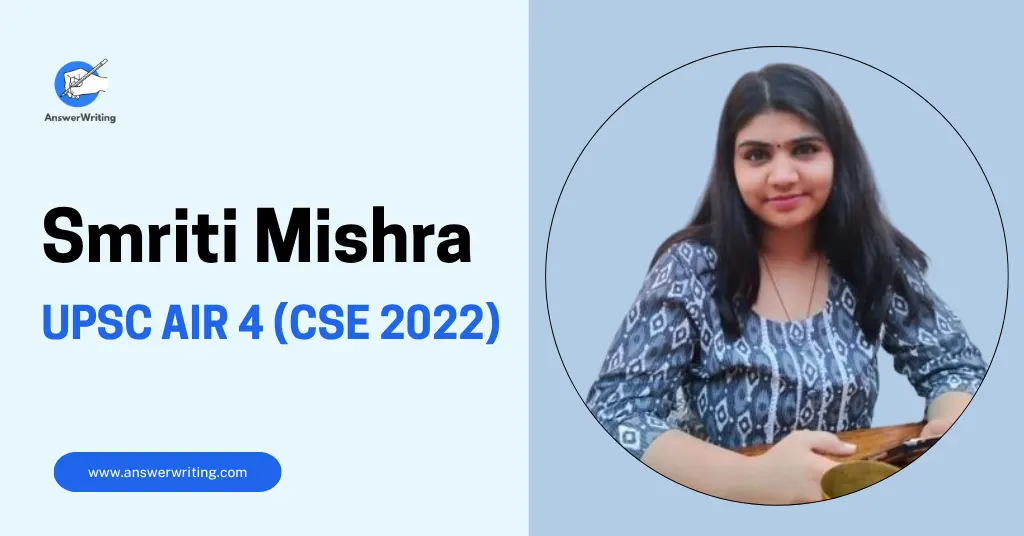
Smriti Mishra’s story is not just about topping an exam. It is about rebuilding after a setback that would have broken most aspirants, and coming back sharper, more focused, and with a rank that placed her among the best in the country.
Who Is Smriti Mishra?
Smriti Mishra hails from Prayagraj, Uttar Pradesh. She did most of her schooling in Agra, completed her graduation from one of Delhi’s most respected colleges, and cleared the UPSC Civil Services Examination 2022 in her third attempt, securing AIR 4.
| Detail | Information |
|---|---|
| Hometown | Prayagraj, Uttar Pradesh |
| School | St. Clair’s Higher Secondary School, Agra |
| Graduation | B.Sc., Miranda House, University of Delhi |
| Other Education | Pursuing LLB (at the time of the exam) |
| UPSC Exam Year | CSE 2022 (results declared May 2023) |
| All India Rank | 4 |
| Number of Attempts | 3 |
| Optional Subject | Zoology |
| Service Allotted | Indian Administrative Service (IAS) |
| Cadre | As per available reports, UP cadre (please verify from official sources) |
Her father, Rajkumar Mishra, serves as a Deputy Superintendent of Police (DSP) in Bareilly, Uttar Pradesh. Her mother, Anita Mishra, is a homemaker. Her elder brother, Lokesh Mishra, is an advocate practising at the Supreme Court of India.
Smriti Mishra UPSC Marksheet and Score Details
Smriti scored a total of 1055 marks across the written examination and the interview. Her Zoology optional was a clear strength, contributing 281 out of a possible 500 marks.
| Component | Marks Obtained |
|---|---|
| Essay (Paper 1) | 145 |
| GS Paper 1 | 113 |
| GS Paper 2 | 130 |
| GS Paper 3 | 97 |
| GS Paper 4 (Ethics) | 116 |
| Zoology Optional Paper 1 | 148 |
| Zoology Optional Paper 2 | 133 |
| Total Written | 882 |
| Interview (Personality Test) | 173 |
| Grand Total | 1055 |
Her GS Paper 2 score of 130 was particularly strong. The 173 in the interview also reflects a confident, well-prepared personality test performance.
Educational Background and Early Life
Smriti grew up in a household where public service was a daily reality. Her father joined the UP Police as a sub-inspector in 1989 and rose to become a DSP. Watching him serve the community shaped Smriti’s desire to do the same, but at a higher level.
She did her schooling at St. Clair’s Higher Secondary School in Agra, where she scored 96.6% in her Class 12 board examinations. That result was not just a number. It reflected the work ethic she would carry into UPSC preparation years later.
After school, she moved to Delhi with her brother. She enrolled in Miranda House, University of Delhi, for a Bachelor of Science degree. Miranda House is known for its rigorous academic culture, and Smriti thrived there. She ranked second in her university in Zoology, a fact that would directly shape her optional subject choice.
She was also pursuing an LLB alongside her UPSC preparation at the time of her final attempt. Her brother’s legal background likely influenced this parallel pursuit.
How Many Attempts Did Smriti Mishra Take?
Smriti cleared UPSC in her third attempt. But the path to that third attempt was not linear.
In her first attempt, she could not clear the Prelims. That is a common setback, but it still tests a candidate’s resolve. Smriti chose to treat it as data, not defeat.
In her second attempt in 2021, she cleared the General Studies Prelims paper but failed to qualify the CSAT (Civil Services Aptitude Test, Paper 2). The CSAT is often underestimated by aspirants who focus almost entirely on GS. Smriti paid for that mistake.
What changed after the second failure was significant. She stopped treating CSAT as a formality. She devoted dedicated time to quantitative aptitude and logical reasoning. She also made a broader mindset shift: every gap in her preparation was now a problem to be diagnosed and fixed, not ignored.
In her third attempt, with that corrected strategy and three years of deep preparation behind her, she secured AIR 4 nationally. She reportedly found out about her rank while travelling on the Delhi Metro, and called her parents immediately.
The lesson here is simple but hard to internalize: failure in UPSC is rarely about intelligence. It is usually about gaps in strategy that you have not yet identified.
Smriti Mishra’s Optional Subject: Zoology
Smriti chose Zoology as her optional subject, and her reasoning was clear. She had studied the subject deeply at Miranda House and ranked second in her university. The foundation was already there. She was not starting from scratch.
She has said that she began studying Zoology even before she started her General Studies preparation in her final attempt. That sequencing was deliberate. She wanted to lock in her optional advantage early.
Her combined Zoology score was 281 out of 500, which is a strong performance for this optional. The subject suits candidates with a science background who can write conceptually dense answers with precision.
For aspirants considering Zoology, Smriti’s approach points to one key principle: choose a subject where you already have a genuine foundation, not one that appears “safe” because others have scored well in it. Her confidence in Zoology came from her university standing, not from coaching advice.
UPSC Preparation Strategy of Smriti Mishra
Smriti’s preparation was built on three pillars: deep note-making, early answer writing practice, and deliberate isolation from distraction.
She studied for approximately 8 hours every day. She did not rely on marathon sessions. Consistency over 8 focused hours, day after day, was her method.
One of the most talked-about aspects of her preparation is that she stayed off social media for three full years. In an era where UPSC aspirants often lose hours to distraction, this was a conscious and disciplined decision. She reduced social gatherings as well, keeping her circle focused on her goal.
For the foundation of her GS preparation, she relied heavily on NCERT books. She used them to clear her conceptual basics before moving to advanced sources. For current affairs, she read two newspapers daily and made her own notes.
She also studied YouTube videos for concept clarity on specific topics. This shows she was practical about using every resource available, as long as it served a clear purpose.
Her biggest strategic asset was learning from previous toppers. She specifically referred to the notes and answer scripts of Shruti Sharma, who had secured AIR 1 in UPSC CSE 2021. Studying how a topper structures answers gave Smriti a real-world template to work from.
She solved previous years’ question papers regularly and used test series to evaluate her progress. After her CSAT failure, she added dedicated practice for quantitative aptitude and reasoning to her Prelims preparation.
Books and Resources Recommended by Smriti Mishra
Smriti has not released an exhaustive book list publicly. Based on widely reported interviews and strategy discussions, the following resources formed the core of her preparation:
| Subject/Area | Book/Resource | Notes |
|---|---|---|
| All GS Subjects (Foundation) | NCERT Books (Class 6 to 12) | Used for conceptual clarity |
| Current Affairs | Two national newspapers (daily) | Read and noted every day |
| GS and Mains Strategy | Shruti Sharma’s notes and answer scripts | Learned answer structuring from AIR 1, CSE 2021 |
| Optional: Zoology | Standard university-level Zoology texts | Built on strong academic foundation from Miranda House |
| Revision | Self-written notes | Made across all subjects throughout preparation |
| Practice | Previous Year Question Papers | Solved regularly for all stages |
| Test Series | Enrolled in a structured test series | Used for self-evaluation and gap identification |
Aspirants should note that Smriti placed enormous value on self-written notes over printed material. She has specifically said that writing notes by hand improves retention significantly beyond just reading.
Mains Answer Writing Approach
Smriti started practicing answer writing before she even cleared the Preliminary examination. That is one of the clearest takeaways from her preparation.
She allocated a fixed 30 minutes per answer during her practice sessions. This time discipline trained her to think quickly, structure efficiently, and avoid over-writing. She used diagrams and flowcharts to make her answers visually clear, particularly in subjects like Geography and Zoology. For GS Paper 4 (Ethics), she incorporated relevant quotes and case studies to add depth.
Her answers consistently featured multiple examples, fact citation for cross-application, and a tone of administrative maturity. She was not just reproducing information. She was demonstrating how she would think as a civil servant.
For aspirants building this habit, structured feedback is critical. Simply writing answers without knowing their weaknesses does not improve performance. Platforms like AnswerWriting.com allow aspirants to submit their handwritten Mains answers and receive detailed AI feedback on structure, content, language, and UPSC scoring parameters, exactly the kind of gap analysis that Smriti did through toppers’ answer scripts and test series. Practicing daily on a platform like this can sharpen your writing in a way that passive reading simply cannot.
The key principle from Smriti’s method: start answer writing early, time yourself strictly, and get your work evaluated.
Interview (Personality Test) Experience
Smriti’s Detailed Application Form (DAF) gave the interview board clear threads to pull from. She hails from Prayagraj, the city that hosts the Kumbh Mela, one of the largest human gatherings on earth.
The board asked her questions about Kumbh Mela: how it is organized and what she would suggest for managing the massive crowds effectively. These are questions that test administrative thinking, not just general knowledge. Smriti was well-positioned to answer them given her personal connection to Prayagraj.
She was also asked about her choice between law and her career as a civil servant. Her answer, that she would choose law because law simplifies lives, showed both conviction and the ability to connect personal values to public purpose.
For interview preparation, she read two newspapers daily and built comprehensive notes. She approached the personality test as an extension of her overall preparation, not a separate phase. Her interview score of 173 reflects how well that approach worked.
Service and Cadre Allotted to Smriti Mishra
Smriti Mishra was allotted the Indian Administrative Service (IAS). As per available reports, she is allocated to the UP cadre. Aspirants should verify the exact cadre from official UPSC or DoPT notifications.
She has spoken clearly about what she intends to focus on as an officer. Her stated priorities include financial independence for women and their skill development, expanding access to technology for common citizens, controlling corruption at lower levels of administration, strengthening urban local governance, and improving civic sense among the public.
These are not vague aspirations. Each of them points to specific governance challenges in urban and semi-urban India, and signals the kind of administrator she intends to be.
Key Lessons Every UPSC Aspirant Can Take from Smriti Mishra
- CSAT is not optional preparation: Smriti’s second-attempt failure came from underestimating Paper 2. Treat CSAT as seriously as GS. One weak paper can end an attempt regardless of how well everything else is going.
- Write your own notes, always: She has repeatedly emphasized that making notes by hand, rather than just reading, dramatically improves retention. No printed material can replace this.
- Start answer writing before you clear Prelims: Most aspirants delay Mains preparation until after the Prelims result. Smriti started much earlier. That head start gave her a significant advantage in the actual Mains examination.
- Build your optional on genuine strength: She chose Zoology because she was already excellent at it, not because it seemed like a good bet. Subject familiarity reduces the preparation burden and improves scoring.
- Protect your focus environment: Three years without social media is an extreme commitment, but it reflects a real principle: your environment shapes your output. Remove what drains your focus, deliberately and consistently.
FAQs About Smriti Mishra
What rank did Smriti Mishra get in UPSC? Smriti Mishra secured All India Rank 4 in the UPSC Civil Services Examination 2022, the results of which were declared in May 2023.
What was Smriti Mishra’s optional subject? She chose Zoology as her optional subject. She scored 281 out of 500 in the optional papers combined, and had ranked second in her university in the subject.
How many attempts did Smriti Mishra take to clear UPSC? She cleared the exam in her third attempt. She could not clear Prelims in her first attempt and failed to qualify the CSAT in her second attempt in 2021.
Which college did Smriti Mishra study in? She completed her B.Sc. from Miranda House, University of Delhi. She was also pursuing an LLB at the time of her final UPSC attempt.
Did Smriti Mishra take coaching for UPSC? Based on widely available reports, she followed a largely self-study approach, relying on NCERTs, newspapers, test series, and notes from previous toppers like Shruti Sharma. She has not publicly credited a specific coaching institute for her success.
How many hours did Smriti Mishra study per day? She studied for approximately 8 hours each day. She also stayed off social media for three years during her preparation.
What is Smriti Mishra’s total UPSC score? She scored 882 marks in the written examination and 173 in the interview, bringing her grand total to 1055 marks.