Siddharth Jain: UPSC CSE 2017 AIR 13, Mathematics Optional
What do you do when you clear IIT Bombay, attempt UPSC twice, and still do not make the final list?
Most people would stop. Siddharth Jain did not. He came back a third time, chose Mathematics as his optional subject, and walked out with All India Rank 13 in UPSC Civil Services Examination 2017.
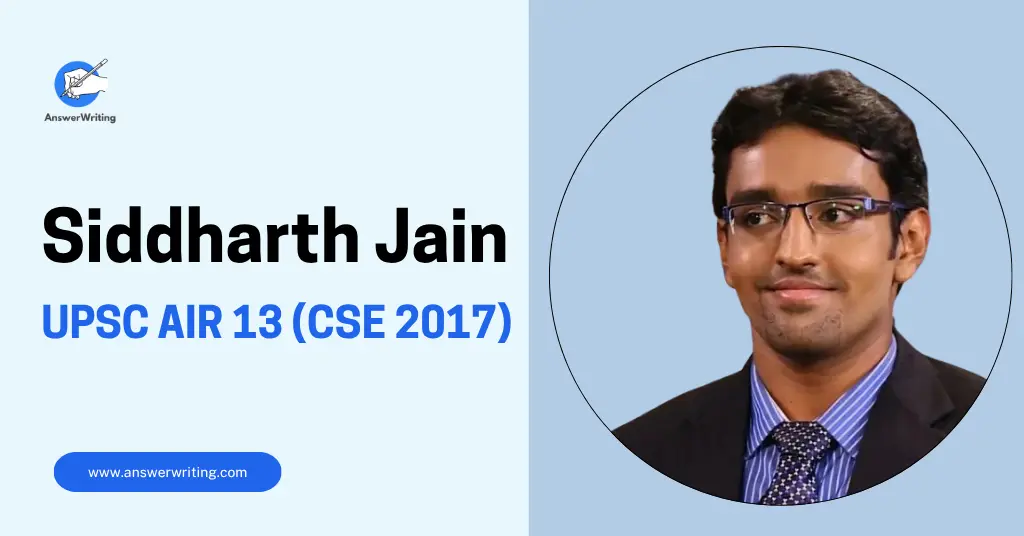
His story is not just about persistence. It is about understanding what was going wrong, making precise corrections, and returning with a sharper strategy. For every aspirant sitting with a failed attempt behind them and another attempt ahead, this profile is worth reading slowly.
Who Is Siddharth Jain?
Siddharth Jain secured AIR 13 in the UPSC Civil Services Examination 2017. He is a B.Tech graduate from IIT Bombay, one of India’s most competitive engineering institutions. He hails from Rajasthan and chose Mathematics as his optional subject, a decision that played a significant role in his final rank.
| Detail | Information |
|---|---|
| Full Name | Siddharth Jain |
| UPSC CSE Year | 2017 |
| All India Rank | 13 |
| Optional Subject | Mathematics |
| Number of Attempts | 3 (as per widely reported sources) |
| Educational Background | B.Tech, IIT Bombay |
| Home State | Rajasthan |
| Service Allotted | Indian Administrative Service (IAS) |
| Cadre | To be verified from official DoPT records |
He is one of the most referenced toppers among aspirants who come from engineering or science backgrounds and are considering Mathematics as their optional subject. His preparation approach, particularly his handling of multiple attempts and his Mathematics strategy, remains widely discussed years after his result.
Siddharth Jain UPSC Marksheet and Score Details
UPSC publishes official marksheets for qualified candidates on its website at upsc.gov.in. Aspirants are strongly advised to access the official records for exact paper-wise marks. The figures below are based on widely reported sources and should be cross-verified from official documents.
| Stage | Details | Remarks |
|---|---|---|
| Prelims GS Paper 1 | Not officially disclosed separately | Qualifying threshold cleared |
| Prelims CSAT | Not officially disclosed separately | Qualifying (33% minimum required) |
| Mains Written (GS Papers) | As per available reports | Verify at upsc.gov.in |
| Mains Mathematics Optional Paper 1 | As per available reports, strong score | Verify at upsc.gov.in |
| Mains Mathematics Optional Paper 2 | As per available reports, strong score | Verify at upsc.gov.in |
| Interview (Personality Test) | As per available reports | Verify at upsc.gov.in |
| Final Total | AIR 13 confirmed | Official UPSC result |
What is consistently reported across his post-result interviews is that his Mathematics optional score was among the stronger contributors to his final total. This is a pattern seen among candidates who prepare Mathematics with the rigour it demands. When done right, Mathematics produces scores that humanities optionals rarely match in absolute terms.
Educational Background and Early Life
Siddharth Jain is from Rajasthan, a state with a strong culture of competitive examination preparation. He completed his B.Tech from IIT Bombay, clearing the JEE examination to gain admission, one of the most competitive undergraduate entrance processes in the country.
IIT Bombay shaped his thinking in ways that proved directly relevant to UPSC preparation. The institute demands structured problem-solving, comfort with complex quantitative material, and the ability to work independently under pressure. These are not incidental advantages in a UPSC context. They are transferable skills that served him throughout his preparation.
His background in mathematics and engineering meant that choosing Mathematics as an optional subject was not a gamble. It was a strategic decision built on genuine subject familiarity. He did not need to build basic competence in the subject from scratch. He needed to reorient his existing knowledge toward the UPSC examination format.
This distinction matters. Many aspirants confuse choosing a familiar subject with having an automatic advantage. Familiarity is a starting point, not a guarantee. The UPSC Mathematics optional requires specific examination preparation, not just subject knowledge.
How Many Attempts Did Siddharth Jain Take?
Siddharth Jain cleared the UPSC Civil Services Examination in his third attempt in 2017. As per widely reported sources, his first two attempts did not result in final selection.
Three attempts is not an unusual number for UPSC. The examination is designed to be difficult, and many officers who have served the country with distinction cleared it on their second, third, or even later attempt. What matters is what happens between attempts.
What Failed in Attempts 1 and 2
Siddharth has spoken in interviews about the gap between his first two attempts and his successful third attempt. Several issues emerge from those conversations.
In early attempts, he faced the challenge that many IIT graduates face when they first approach UPSC: the assumption that strong subject knowledge translates directly into strong UPSC answers. It does not. UPSC Mains is an examination of structured expression, not just knowledge.
His GS preparation in the early attempts was broad but not deep enough in the right areas. He covered a large number of sources without building the revision cycles needed to retain information accurately under exam conditions.
His answer writing practice, as per available reports, was not systematic in his early attempts. He wrote answers but did not seek consistent structured feedback. Without feedback, answer writing practice reinforces existing habits, including the ones that cost marks.
The optional subject preparation, while built on genuine mathematical ability, needed to be more examination-specific. Mathematics optional requires not just solving problems correctly but presenting solutions in a way that earns maximum partial credit, a skill that is distinct from solving problems on paper for personal satisfaction.
What Changed in Attempt 3
The third attempt was built on an honest audit of what had not worked in the first two.
He tightened his GS preparation to focus on depth in core areas rather than surface coverage of a wide range. He built a systematic revision cycle, revisiting material at fixed intervals rather than reading new content continuously.
He made answer writing practice a daily non-negotiable. He wrote answers regularly, evaluated them against model answers, and worked on identifying recurring weaknesses in structure and expression.
For Mathematics optional, he shifted his focus from solving problems to optimising his scoring approach. This meant identifying the high-weightage topics, practising step-by-step solution presentation for maximum partial credit, and working on time management within the three-hour paper duration.
He also paid more attention to the Interview stage in his final attempt. Having been through the examination process twice before, he understood the full arc of preparation required and did not treat the interview as an afterthought.
The lesson for aspirants: a failed attempt is only wasted if you do not analyse it. Each attempt contains precise information about your gaps. The candidates who convert that information into targeted corrections are the ones who move from clearing Prelims to securing a rank.
Siddharth Jain’s Optional Subject: Mathematics, Why He Chose It, and How He Scored
Mathematics optional is one of the most discussed and debated choices in the UPSC community. It attracts strong opinions on both sides. Siddharth Jain’s AIR 13 is one of the clearest data points in favour of the subject when approached correctly.
Why Mathematics Works (and When It Does Not)
Mathematics optional has a unique characteristic that no other optional subject shares: the answers are either right or partially right. There is no subjectivity in evaluation. A correctly solved integration problem earns full marks regardless of which examiner checks the paper. A correctly structured proof does not depend on the examiner’s interpretation of the argument.
This objectivity is the central reason why Mathematics optional attracts high scores from candidates who prepare it rigorously. In humanities optionals, even a well-written answer can receive varying marks depending on examiner perception. In Mathematics, the work either supports the answer or it does not.
The second advantage is syllabus stability. The Mathematics optional syllabus has not undergone significant changes in many years. The topics are fixed, the question patterns are identifiable from previous years’ papers, and the preparation path is clear. There is no need to chase current affairs or track evolving interpretations.
However, Mathematics optional has clear conditions under which it does not work. If you do not have a strong mathematical background from undergraduate study, starting Mathematics optional from scratch is extremely high-risk. The syllabus covers topics up to graduate-level mathematics: linear algebra, real analysis, complex analysis, numerical analysis, mechanics, and differential equations, among others. These require genuine prior exposure.
If you have that background, as Siddharth did from IIT Bombay, Mathematics becomes one of the most efficient optional subjects available.
How to Study Mathematics Optional
Siddharth’s approach to Mathematics optional, as reported across his interviews, followed a clear structure.
Previous years’ questions first. Before reading any standard book, he went through previous years’ UPSC Mathematics optional papers to understand which topics carry maximum weight, which types of questions repeat, and how solutions should be presented. This gave him a map before he started the territory.
Topic-wise mastery before integration. He did not attempt to cover the entire syllabus simultaneously. He took one topic at a time, built mastery within it, and then moved to the next. This sequenced approach prevents the confusion that comes from jumping between topics before any individual topic is solid.
Step-by-step solution writing from the beginning. In competitive examinations, partial credit is awarded for correct steps even when the final answer is wrong. He practised writing every solution with full stepwise clarity, never skipping intermediate steps. This discipline maximises scoring even on questions where the final answer is not reached within the time limit.
Timed practice under exam conditions. The three-hour paper duration for each Mathematics optional paper requires consistent time management. He practised completing full papers within the time limit regularly, building both speed and accuracy.
Revision cycles for formula and theorem retention. Mathematics optional requires active retention of a large number of formulas, theorems, and their proofs. He built structured revision cycles to keep this material fresh throughout the preparation period.
Books for Mathematics Optional
| Topic | Book | Author |
|---|---|---|
| Linear Algebra | Linear Algebra | K.C. Prasad / Schaum’s Series |
| Calculus and Real Analysis | Mathematical Analysis | S.C. Malik and Savita Arora |
| Complex Analysis | Functions of a Complex Variable | S. Ponnusamy |
| Ordinary Differential Equations | Ordinary and Partial Differential Equations | M.D. Raisinghania |
| Algebra (Abstract) | Contemporary Abstract Algebra | Joseph Gallian |
| Mechanics | Statics and Dynamics | S.L. Loney |
| Numerical Analysis | Introductory Methods of Numerical Analysis | S.S. Sastry |
| Previous Years’ Papers | UPSC Mathematics Optional PYQs | UPSC Official |
Aspirants should treat previous years’ question papers as primary study material, not supplementary practice. The UPSC Mathematics optional follows identifiable patterns. Knowing those patterns shapes how you prioritise topics.
UPSC Preparation Strategy of Siddharth Jain
Prelims Approach
Siddharth’s Prelims approach was built on NCERT mastery followed by standard references, combined with consistent MCQ practice from previous years’ papers.
He treated the NCERT texts not as beginner material to be rushed through but as foundational documents to be read carefully and revisited multiple times. Concepts introduced in NCERTs appear in UPSC Prelims in modified forms. Missing them at the source creates gaps that standard references cannot always fill.
For current affairs, he followed a focused reading approach rather than covering multiple newspapers. He compiled monthly summaries and cross-referenced current affairs with static syllabus topics to understand how recent developments connect to examination themes.
Mock tests were a consistent part of his Prelims preparation. He used them not just to measure performance but to identify the specific areas where his accuracy was weak. An MCQ wrong in a mock test is information. He used that information to revise and correct.
For aspirants building their Prelims accuracy, consistent topic-wise practice makes a measurable difference. The MCQ Practice feature on AnswerWriting.com is built specifically for UPSC Prelims, with topic-wise and full-length tests that help identify weak areas systematically. Using it as part of a regular mock test routine can sharpen both speed and accuracy before the actual examination.
Mains GS Approach
His GS approach in the successful third attempt was depth-focused. He selected a core set of books for each GS paper and read them thoroughly, making notes in his own words rather than transcribing.
He connected static syllabus knowledge with current affairs examples consistently. Every major current development was mapped to a relevant GS topic, so that his answers could ground theoretical knowledge in contemporary reality.
He practised writing answers to previous years’ GS questions as a primary preparation activity, not as a supplementary one. This gave him both content direction (questions reveal what the examiner values) and writing practice in a structured format.
Study Hours and Timetable
As per available reports, Siddharth maintained a study routine of approximately 10 to 12 hours daily during peak preparation periods. However, he has been consistent in emphasising that study hours alone do not determine outcomes. The quality and focus of those hours matter far more than the raw count.
His timetable balanced GS preparation with Mathematics optional practice on a daily basis. He did not dedicate entire weeks exclusively to one or the other. Both received daily attention, with the balance shifting based on the proximity of specific examination stages.
He built in fixed revision periods rather than treating revision as something to do when new content ran out. Revision was scheduled, not reactive.
Coaching vs Self-Study
As per widely reported sources, Siddharth Jain used a combination of coaching and self-study. He accessed coaching material and test series for structured guidance, particularly for GS papers and interview preparation. His Mathematics optional preparation was heavily self-directed, given his strong prior background in the subject.
The key principle from his approach is that coaching is a resource, not a replacement for self-study. He extracted what was useful from coaching structures and built the rest independently. The self-directed portion of his preparation was what allowed him to go deep enough to score at the AIR 13 level.
Books and Resources Recommended by Siddharth Jain
The following resources are drawn from widely reported interviews and preparation discussions. Aspirants should verify current editions and check recent topper recommendations, as examination emphases can shift year to year.
| Subject | Book / Resource | Author / Source |
|---|---|---|
| Indian Polity | Indian Polity | M. Laxmikanth |
| Modern History | India’s Struggle for Independence | Bipan Chandra |
| Ancient and Medieval History | NCERT Class 11 and 12 | NCERT |
| Indian Economy | Indian Economy | Ramesh Singh |
| Geography | NCERT Class 11 and 12 (Physical and Human Geography) | NCERT |
| Environment and Ecology | Shankar IAS Environment | Shankar IAS Academy |
| Ethics GS4 | Lexicon for Ethics, Integrity and Aptitude | Chronicle Publications |
| Current Affairs | The Hindu | Daily |
| Science and Technology | NCERT Science (Class 9 and 10) plus current affairs | NCERT |
| Mathematics Optional | Topic-wise standard references (see Optional section) | Multiple authors |
| Previous Years’ Papers | UPSC CSE GS and Optional PYQs | UPSC Official |
A consistent note across all of Siddharth’s reported interviews: he prioritised depth over breadth. He read fewer books more thoroughly rather than collecting a large reading list and covering everything superficially. This is a principle worth holding onto.
Mains Answer Writing Approach
Mains answer writing was the area where Siddharth made the most significant improvement between his early attempts and his successful third attempt. His approach in the final attempt had several distinguishing features.
Structured templates adapted to question type. He developed a mental framework for approaching different categories of GS questions: analytical questions, descriptive questions, opinion-based questions, and case study questions each require a different structural approach. He built familiarity with these structures through consistent practice.
Introduction and conclusion discipline. Many aspirants underestimate the importance of the first and last paragraphs of a GS answer. The introduction signals to the examiner that you have understood the question. The conclusion demonstrates that you can synthesise and not just describe. He paid deliberate attention to both.
Use of examples grounded in current affairs. He built a working bank of current examples that could be deployed across multiple GS papers. A scheme example from current affairs can appear in GS2 for governance, in GS3 for economy, and in GS4 for ethical dimensions of policy. Maintaining a cross-referenced example bank significantly improves answer quality.
Diagrams and flowcharts in appropriate answers. For geography, environment, and economy questions where spatial or process relationships matter, he used diagrams to communicate what prose alone cannot. A well-drawn diagram is credited separately and communicates understanding visually.
Daily writing with honest self-evaluation. He wrote answers daily and compared them against model answers and previous toppers’ copies. This comparison is not about copying a style. It is about identifying the specific elements your answers are missing and the elements that model answers do well.
Getting this kind of regular structured feedback is one of the highest-return activities in Mains preparation. The Daily Answer Writing feature on AnswerWriting.com provides fresh prompts every day, and the Answer Evaluator gives detailed AI-powered feedback on structure, content, language, and how closely your answer matches UPSC scoring parameters. For aspirants who do not have access to a consistent mentor or peer review group, this bridges a critical gap in the preparation process.
Mathematics optional answer presentation. For his optional papers, he was meticulous about stepwise solution writing. Every step was written clearly and labelled. He never skipped intermediate steps, even when they felt obvious. This discipline ensures maximum partial credit on questions where the complete solution is not reached within the time limit.
Interview (Personality Test) Experience
The UPSC Interview carries 275 marks and represents a meaningful component of the final total. At AIR 13, Siddharth’s interview performance would have contributed significantly to his rank.
His Detailed Application Form (DAF) prominently featured his IIT Bombay background, his Rajasthan origins, and his Mathematics optional subject. These three elements formed the natural anchor points for interview questions.
The IIT Bombay to IAS question is one that every engineering-background candidate must prepare for carefully. The board is not hostile to the choice, but they want a genuine, specific answer. Generic responses about wanting to serve the country do not satisfy experienced interviewers. Siddharth’s preparation for this question would have required honest reflection on his personal motivations and clear articulation of what administrative work means to him specifically.
Mathematics as an optional subject also opens up a specific category of interview questions. Boards sometimes ask candidates to explain complex mathematical concepts in simple terms, or to connect mathematical thinking to administrative problem-solving. The ability to communicate technical knowledge to a non-technical audience is a genuine administrative skill, and the interview tests for it.
For Rajasthan-related questions, he would have prepared on the state’s administrative challenges, key development indicators, water scarcity issues, tribal communities in Rajasthan, and the state’s economic profile. Candidates are expected to know their home state well enough to speak about it with the fluency of someone who has observed it closely.
Specific board details and individual questions from his interview are not verified in widely available public sources. Aspirants should cross-check from documented accounts he may have given in verified forums or interviews.
General principles from his reported interview preparation:
- His DAF was reviewed exhaustively. Every entry was a potential question.
- He prepared his “why civil services” answer with personal specificity, not generic phrasing.
- He stayed current with affairs in the two to three months before the interview.
- He practised speaking in structured, measured sentences rather than unstructured thinking out loud.
- He was prepared to say he did not know something rather than fabricate an answer under pressure.
Service and Cadre Allotted to Siddharth Jain
Siddharth Jain was allotted the Indian Administrative Service (IAS) based on his AIR 13 in UPSC CSE 2017. Cadre allotment for IAS officers follows a process that combines rank, service preference, and cadre availability under the IAS Cadre Allocation Policy.
Exact cadre details and current posting information should be verified from official DoPT records or government notifications, as these details are confirmed through formal administrative processes after training at LBSNAA in Mussoorie.
What is confirmed is that an AIR 13 in IAS carries significant weight in terms of future postings, deputation opportunities, and career trajectory. Officers who join with high ranks tend to have greater flexibility in their career choices over time, though all IAS officers are ultimately subject to the administrative needs of their cadre state.
Key Lessons Every UPSC Aspirant Can Take from Siddharth Jain
- Treat each failed attempt as a diagnostic, not a verdict. Siddharth’s third attempt succeeded precisely because he did not repeat what had failed in the first two. He audited his preparation honestly, identified the specific gaps, and corrected them deliberately. This is the only productive response to a failed attempt.
- Mathematics optional is viable, but only with genuine prior background. His success with Mathematics came from a strong undergraduate foundation at IIT Bombay. If you do not have that background, choosing Mathematics from scratch is extremely high-risk. If you do have it, the subject offers objectivity of evaluation and syllabus stability that are difficult to find elsewhere.
- Study hours are inputs. Rank is the output. What connects them is quality. Siddharth has consistently emphasised that 10 to 12 hours of unfocused study is less valuable than 6 to 7 hours of deeply concentrated preparation. Build your study hours around genuine focus, not around appearing to work hard.
- Answer writing practice must be daily and must include honest evaluation. Writing answers without feedback reinforces existing weaknesses. He built feedback into his daily routine, comparing his answers to model answers and identifying specific gaps. This is the discipline that moved him from a non-selection in attempt 2 to AIR 13 in attempt 3.
- The interview is not separate from the examination. It is the final paper. At a rank like AIR 13, the interview contributed meaningfully to the total. He prepared for it with the same structured rigour he applied to GS papers. Aspirants who treat the interview as less important than Mains are leaving marks on the table.
FAQs About Siddharth Jain
What was Siddharth Jain’s optional subject in UPSC CSE 2017?
Siddharth Jain chose Mathematics as his optional subject for UPSC CSE 2017. He leveraged his strong background from IIT Bombay to score well in this subject, which was a significant contributor to his AIR 13.
How many attempts did Siddharth Jain take to clear UPSC?
As per widely reported sources, Siddharth Jain cleared the UPSC Civil Services Examination in his third attempt in 2017. His first two attempts did not result in final selection.
What is Siddharth Jain’s educational background?
Siddharth Jain completed his B.Tech from IIT Bombay, one of India’s premier engineering institutions.
Is Mathematics a good optional subject for UPSC?
Mathematics optional has the advantage of objective evaluation and a stable syllabus. It produces high scores for candidates who prepare it rigorously. However, it requires a strong prior background in mathematics, typically from an engineering or science undergraduate programme. For candidates without that background, it carries significant risk. Siddharth Jain’s AIR 13 with Mathematics is one of the strongest data points in its favour for eligible candidates.
Did Siddharth Jain take coaching for UPSC?
As per available reports, he used coaching resources and test series selectively alongside significant self-study. His Mathematics optional preparation was largely self-directed. Specific coaching institute details should be cross-checked from verified interview sources.
Which service was Siddharth Jain allotted?
Siddharth Jain was allotted the Indian Administrative Service (IAS) based on his AIR 13 in UPSC CSE 2017. Cadre details should be verified from official DoPT records.
What books did Siddharth Jain recommend for UPSC preparation?
His core booklist covers standard UPSC references: M. Laxmikanth for Polity, Ramesh Singh for Economy, Bipan Chandra for Modern History, NCERT texts for Geography and Ancient History, and topic-wise standard books for Mathematics optional. The complete list is covered in the Books and Resources section above.
A Final Word for Aspirants
Siddharth Jain’s AIR 13 is the number that gets searched. But the preparation that produced it was built across three attempts, each one teaching him something the previous one had not.
The first attempt taught him that IIT credentials do not automatically translate into UPSC marks. The second attempt taught him that broad preparation without depth and structured answer writing does not produce a final selection. The third attempt was the one where all of those lessons were applied together.
UPSC is not a test of how much you know. It is a test of how clearly you can think, how well you can express structured arguments under pressure, and how consistently you performed across a multi-stage process that stretches over nearly a year.
None of those capabilities are given. All of them are built. Siddharth Jain built them over three attempts, and the third attempt showed exactly what they were worth.