Shruti Sharma: UPSC AIR 1 (CSE 2021), Strategy, and Journey
She missed the interview call by exactly one mark. Not ten. Not twenty. One.
And that single mark, lost because of a medium of instruction error she did not cause, could have ended everything. Instead, it became the turning point. In her very next attempt, Shruti Sharma topped the entire country.
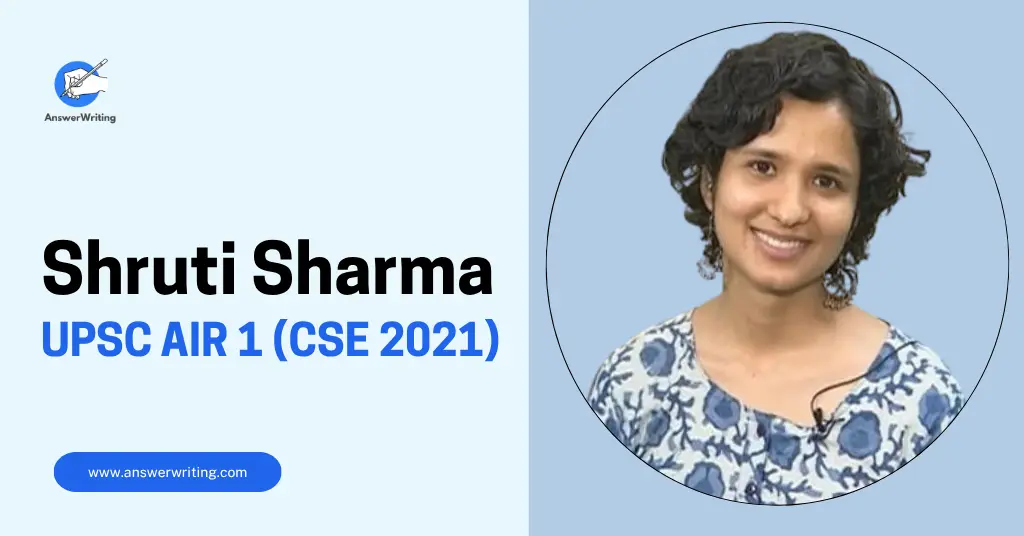
Her story is not about luck or exceptional intelligence. It is about what you do after a setback that should not have happened.
Who Is Shruti Sharma?
Shruti Sharma hails from Bijnor, Uttar Pradesh, but spent most of her life in Delhi, where she studied and prepared for the Civil Services Examination. She secured All India Rank 1 in UPSC CSE 2021, becoming the top-ranked candidate in a field of over eleven lakh applicants.
| Detail | Information |
|---|---|
| Hometown | Bijnor, Uttar Pradesh |
| School | Sardar Patel Vidyalaya, Delhi |
| Graduation | B.A. (Hons) History, St. Stephen’s College, Delhi University |
| Post-Graduation | M.A. History, Jawaharlal Nehru University (JNU), incomplete at time of result |
| UPSC Exam Year | CSE 2021 (results declared 2022) |
| All India Rank | 1 |
| Number of Attempts | 2 |
| Optional Subject | History |
| Coaching | Residential Coaching Academy (RCA), Jamia Millia Islamia, Delhi |
| Service Allotted | Indian Administrative Service (IAS) |
| Cadre | Uttar Pradesh (home cadre) |
| Current Posting | Joint Magistrate, Deoria, Uttar Pradesh (as per available reports) |
She is the only person in her family to have chosen arts and humanities. Her father, Sunil Dutt Sharma, is an architect and construction consultant in Delhi. Her mother, Rachna Sharma, is a homemaker. Her brother plays cricket for UP Ranji, as per available reports.
Shruti Sharma UPSC Marksheet and Score Details
Shruti scored 1105 out of 2025 marks. Her written total was 932, and she scored 173 in the interview. What stands out in her marksheet is not any single exceptional paper. It is how consistent every paper is.
| Component | Marks Obtained |
|---|---|
| Essay (Paper 1) | 132 |
| GS Paper 1 | 135 |
| GS Paper 2 | 121 |
| GS Paper 3 | 139 |
| GS Paper 4 (Ethics) | 112 |
| History Optional Paper 1 | 155 |
| History Optional Paper 2 | 138 |
| Written Total | 932 |
| Interview | 173 |
| Grand Total | 1105 / 2025 |
There is no single paper here that is dramatically higher than the rest. No one paper “saved” her rank. Every paper contributed. That balance is itself a strategy lesson. In 2024, her marksheet went viral on social media when it was compared to CSE 2023 topper Aditya Srivastava’s scores. Shruti’s total of 1105 was higher than his 1099, even though she topped three years earlier.
Educational Background and Early Life
Shruti grew up in a household shaped by science and medicine. Her great-grandfather was a doctor. Her grandfather was also a doctor. Her father became an architect. In that environment, Shruti made an unusual choice: she picked arts and history.
She completed her schooling at Sardar Patel Vidyalaya in Delhi, where she was active in debates, parliamentary discussions, and cultural activities. She served as Secretary of Cultural Affairs in her school student committee. These early experiences in public speaking and structured argumentation would prove directly useful years later, both in answer writing and in the interview.
She scored 98% in Class 10 and 95% in Class 12, as per available reports.
For graduation, she joined St. Stephen’s College, Delhi University, one of the most academically rigorous institutions in the country, and studied History (Honours). She then enrolled at Jawaharlal Nehru University for a Master’s in History. Her postgraduate studies were incomplete when the UPSC CSE 2021 results were declared.
Studying History at both the undergraduate and postgraduate levels gave her something most aspirants try to build through crash courses: a genuine understanding of how societies work, how policies emerge, and how to think in terms of cause and consequence. That academic foundation shaped everything from her optional subject choice to her GS essay approach.
How Many Attempts Did Shruti Sharma Take?
Shruti cleared UPSC in her second attempt. But the story of her first attempt is the more important one.
In her first attempt (2020), something went wrong before she even sat for the Mains. Due to a technical error related to her medium of instruction, she was forced to write her Mains papers in Hindi rather than English. She had prepared in English. She gave the examination anyway, under that significant disadvantage.
She missed the interview call by exactly one mark.
That outcome would have broken most aspirants. She chose a different response. She joined the Residential Coaching Academy (RCA) at Jamia Millia Islamia, a government-funded coaching programme in Delhi. She rebuilt her strategy. She worked on her weaknesses methodically and revised her entire approach to answer writing.
There was one more obstacle. Just before the Mains examination in her second attempt, she contracted COVID-19. She prepared through six days of high fever. She did not stop. She sat for the exam, and she topped the country.
The lesson her journey carries is direct: the gap between an aspirant who gets knocked down and one who reaches the top is often not preparation quality. It is the response to setbacks that no one planned for.
Shruti Sharma’s Optional Subject: History
Shruti chose History as her optional subject, and the reasoning was clear. She had studied History at the highest academic levels, at St. Stephen’s and then at JNU. The subject was not new to her. It was familiar, deeply understood ground.
She scored 293 out of 500 in History, with 155 in Paper 1 and 138 in Paper 2. That is a solid, stable performance across both papers, not a spike in one and a drop in the other.
History carries 500 marks in the Mains examination. Those marks have significant weight in the final merit list. Choosing a subject where you have genuine depth, rather than one you picked because someone else scored well in it, reduces the preparation load while increasing your confidence in the exam hall.
Shruti has specifically said that aspirants should not blindly follow another topper’s optional subject choice. The right optional is the one you understand well, the one whose material is available to you, and the one you can write about with clarity under exam pressure. For her, that subject was always History.
UPSC Preparation Strategy of Shruti Sharma
Shruti’s approach was built on a principle she stated clearly: it is not about how many hours you study. It is about the quality of what you absorb.
She began her preparation with NCERT books across subjects. Once the conceptual foundation was in place, she moved to standard reference books and stayed with them. She did not keep adding new sources. She made a deliberate choice to limit her study material and revise those limited sources multiple times.
She prepared her own handwritten notes for every subject. Those notes became her primary revision tool before the exam. She has specifically said that making notes, not just reading, is what builds retention.
For current affairs, she read newspapers every day and integrated what she read into her subject-wise notes. She did not treat current affairs as a separate preparation track but wove it into the GS preparation continuously.
She used online test series to practice and identify gaps. She solved previous years’ question papers regularly, which gave her a clear understanding of what the exam actually rewards. Her Prelims strategy focused on the same approach: thorough understanding of the syllabus, past papers, and no unnecessary diversions.
Her preparation at Jamia’s RCA gave her structured guidance and access to mentors. She has spoken about the importance of having a mentor during preparation, someone who can flag weak areas and keep the strategy on track.
One aspect of her preparation that aspirants often miss: she approached every subject by first reviewing the previous year’s question papers. Only after understanding what the exam demands did she go back to the material. That sequencing matters.
Books and Resources Recommended by Shruti Sharma
Shruti consistently recommended limited resources used deeply over multiple resources used superficially. Based on widely reported interviews and strategy discussions, here is what she used:
| Subject | Book/Resource |
|---|---|
| Polity | M. Laxmikanth (used selectively, prioritised her own class notes) |
| Economy | Class notes from coaching |
| Modern History | Spectrum: A Brief History of Modern India |
| Ancient and Medieval History | R.S. Sharma NCERT |
| Geography | Class 11-12 NCERTs; Class 6-10 NCERTs for basic understanding |
| Science and Technology | NCERTs + previous year question papers |
| Current Affairs | Daily newspapers + monthly current affairs compilation |
| Prelims Practice | Previous year UPSC Prelims question papers |
| Optional: History | Standard university-level texts (built on strong B.A. and M.A. foundation) |
| Answer Writing Reference | Previous toppers’ answer scripts |
She specifically noted that Laxmikanth is not always necessary if you have good class notes on Polity. The principle behind her book list is the same as her preparation approach: fewer sources, deeper engagement.
Mains Answer Writing Approach
Shruti’s answer writing style became one of the most widely followed templates in the UPSC aspirant community. Her answer copies were shared publicly, downloaded by thousands, and cited by subsequent toppers, including Smriti Mishra (AIR 4, CSE 2022), who explicitly studied Shruti’s scripts as part of her own preparation.
What made Shruti’s answers stand out was what they did not have. There was no decorative language. No attempt to sound impressive. Her answers read like those written by someone who understands governance, not someone trying to perform understanding.
Her approach had specific features. She used short, direct points. Her structure was clear enough to read quickly. She included relevant examples, data, and reports where they added substance. For essays, she used quotes and approached the topic from multiple perspectives. She has said that essays require a creative viewpoint and that reading widely helps develop that.
She also used diagrams and structured formats where they added clarity, particularly in GS Papers 1 and 3. The use of flowcharts and tables in Mains answers is widely recommended, and her copies demonstrate how they should actually appear.
The core of her method: start answer writing early, not after you have finished the syllabus. Writing early reveals exactly which concepts you have actually understood and which ones only feel familiar. That diagnostic value alone makes early writing practice irreplaceable.
For aspirants building this habit today, platforms like AnswerWriting.com offer structured daily answer writing prompts and AI-powered evaluation that covers structure, content, and UPSC scoring parameters. Getting that kind of regular feedback on your writing, the kind Shruti built through test series and mentor guidance, is what separates improvement from just practice.
Interview (Personality Test) Experience
Shruti scored 173 in the Personality Test, a strong and stable score that reflects a well-prepared, confident candidate.
She prepared for the interview by reading two newspapers daily and building comprehensive notes on current issues. She attended mock interviews to become comfortable with the format and the environment. She has specifically recommended that aspirants not skip mock interviews, because the ability to think and speak under the pressure of a panel is a skill that requires practice, not just knowledge.
Her Detailed Application Form (DAF) would have included her background at St. Stephen’s and JNU, her interest in History, and her roots in Bijnor, Uttar Pradesh. These typically form the threads that interview boards pull from: questions about her subject, her region, her family background, and current governance issues.
She described the interview as a test of how you think, not just what you know. Her advice to aspirants is to be honest in the interview, to own their background and interests confidently, and to avoid trying to say what the board wants to hear.
Maintaining consistency between what is written in the DAF and what is said in the interview is something she emphasised. The board reads the DAF carefully. Surprise them with depth, not with inconsistency.
Service and Cadre Allotted to Shruti Sharma
Shruti Sharma was allotted the Indian Administrative Service (IAS) with the Uttar Pradesh cadre, her home cadre. She is part of the 2022 IAS batch, as UPSC CSE 2021 results were declared in 2022.
As per available reports, her first posting was as Joint Magistrate in Deoria, Uttar Pradesh, where she has been involved in revenue administration and implementation of government schemes. Please verify current posting details from official sources, as administrative postings change regularly.
She has spoken about wanting to use her position to bring change at the grassroots level, particularly for those who have historically been distant from governance and public services. Coming from a family with no prior civil services background, she carries a perspective shaped by understanding both the system from the outside and, now, from within.
Key Lessons Every UPSC Aspirant Can Take from Shruti Sharma
- One mark does not define the journey: Shruti missed the interview call by one mark in her first attempt through no fault of her own. She did not quit. She rebuilt. The UPSC journey is long enough that a single setback, even an unfair one, does not have to be final.
- Revise fewer sources more deeply: She did not chase every new book or resource. She picked a small set, made her own notes from them, and revised those notes repeatedly. Aspirants who keep adding material often end up revising nothing properly.
- Choose your optional on genuine strength: History is considered a vast and difficult optional. For Shruti, it was familiar academic ground built over years at St. Stephen’s and JNU. She did not choose it for its scoring reputation. She chose it because she understood it deeply.
- Write answers like an administrator, not a student: Her answer copies became community reference material because they were direct, structured, and substantive. Clarity beats verbosity every time in UPSC Mains.
- Balanced performance beats spiked performance: Her marksheet has no single outstanding paper and no weak paper. Every paper contributed. Neglecting any one paper because it feels harder is a risk that aspirants routinely underestimate.
FAQs About Shruti Sharma
What rank did Shruti Sharma get in UPSC?
Shruti Sharma secured All India Rank 1 in UPSC CSE 2021. The results were declared in 2022. She scored a total of 1105 out of 2025 marks.
What was Shruti Sharma’s optional subject in UPSC?
She chose History as her optional subject, which aligned with her B.A. and M.A. academic background. She scored 293 out of 500 in the optional papers.
How many attempts did Shruti Sharma take to clear UPSC?
She cleared the exam in her second attempt. In her first attempt, she missed the interview call by one mark after being forced to write the Mains in Hindi due to a medium of instruction error.
Which coaching did Shruti Sharma attend for UPSC?
She prepared at the Residential Coaching Academy (RCA) at Jamia Millia Islamia in Delhi, a government-funded coaching programme.
Did Shruti Sharma study at JNU?
Yes. She completed her graduation in History (Honours) from St. Stephen’s College, Delhi University, and was pursuing her Master’s in History at Jawaharlal Nehru University (JNU) when the CSE 2021 results were declared.
What is Shruti Sharma’s current posting?
As per available reports, her first posting was as Joint Magistrate in Deoria, Uttar Pradesh. Please verify current details from official sources as postings change over time.
What made Shruti Sharma’s answer writing style famous?
Her Mains answer copies were shared publicly and became widely used reference material in the UPSC community. Her answers were known for being direct, structured, and administratively mature, with no unnecessary language, just clear points, examples, and relevant data.