Shena Agarwal: UPSC Rank 1, Strategy, and Journey
A doctor trained at AIIMS. Already selected into the Indian Revenue Service. Undergoing active training in Nagpur. And still sitting down every day for 5 to 6 extra hours of focused study.
That discipline produced All India Rank 1 in UPSC Civil Services Examination 2011.
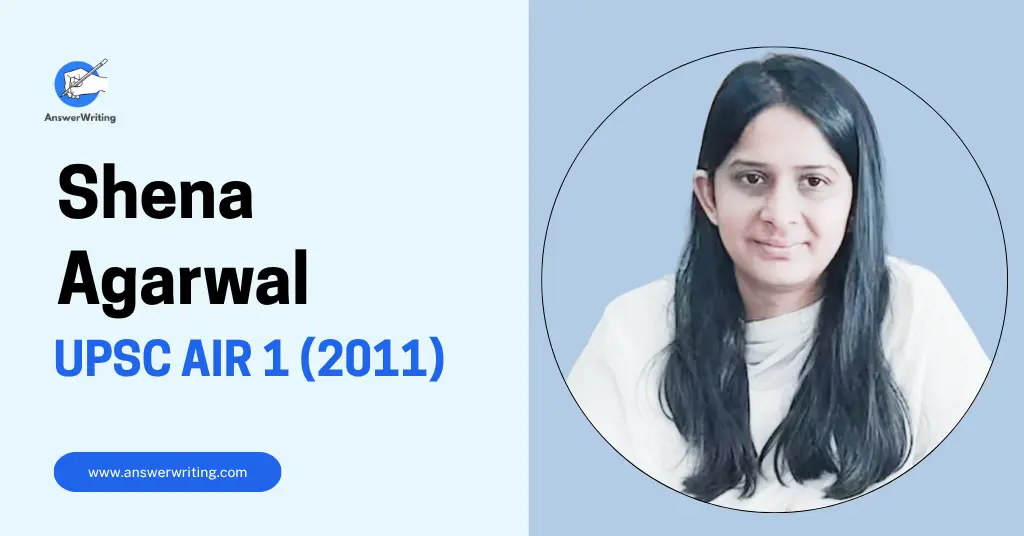
Dr. Shena Aggarwal’s story is not about a first-time lucky break. It is about a systematic, serial achiever who applied the same rigour to UPSC that she had applied to medicine, and did it while already serving in a prestigious government role.
Who Is Dr. Shena Aggarwal?
Dr. Shena Aggarwal is from Yamunanagar, Haryana. She completed her MBBS from AIIMS, Delhi, and topped the UPSC Civil Services Examination 2011 with All India Rank 1. She is a Haryana cadre IAS officer allotted to the Punjab cadre.
| Detail | Information |
|---|---|
| Full Name | Dr. Shena Aggarwal |
| Hometown | Yamunanagar, Haryana |
| Education | MBBS, AIIMS Delhi |
| UPSC Exam Year | 2011 |
| All India Rank | 1 |
| Number of Attempts | 3 |
| Optional Subjects | Medical Science and Psychology |
| Service Allotted | Indian Administrative Service (IAS) |
| Cadre | Punjab (2012 Batch) |
She is married to IAS Sanyam Aggarwal, who secured AIR 12 in UPSC CSE 2012 and also belongs to the Punjab cadre. Together, they represent one of the most accomplished IAS couples in the Punjab cadre.
Dr. Shena Aggarwal’s UPSC Marksheet and Score Details
Detailed Prelims and Mains breakdowns for the 2011 batch are not comprehensively available in the public domain. The figures below reflect what has been widely reported. Aspirants should cross-check from official UPSC sources for complete accuracy.
| Component | Details |
|---|---|
| Prelims | Cleared (year: 2011) |
| Medical Science Optional (Paper 1 + Paper 2) | 417 out of 600 (as per available reports) |
| Psychology Optional | Not separately published in widely available sources |
| Final Rank | AIR 1, UPSC CSE 2011 |
Her score of 417 out of 600 in Medical Science optional is one of the standout figures from her result, and it reflects the advantage of choosing a subject rooted in years of academic training.
Educational Background and Early Life
Dr. Shena Aggarwal has been topping examinations long before UPSC entered the picture.
She secured 95% in her Class 10 and 92% in her Class 12 board examinations. She was also the topper of the CBSE Pre-Medical Test (PMT) in 2004. Topping the PMT that year earned her a seat at AIIMS, Delhi, which is among the most competitive medical admissions in the country.
She completed her MBBS from AIIMS in 2009. That same year, she attempted UPSC for the first time.
What motivated a doctor with an AIIMS degree to pursue civil services? During her medical training, firsthand exposure to rural India made her question gaps in public health, sanitation, women’s welfare, and education, issues that went far beyond clinical care and called for policy change. She realised that as a doctor, she could treat patients one at a time. As an IAS officer, she could shape the systems that determined whether those patients ever got care at all.
That clarity of purpose is worth noting. She did not come to UPSC out of uncertainty about medicine. She came with a precise understanding of what administration could achieve.
How Many Attempts Did Dr. Shena Aggarwal Take?
Dr. Shena Aggarwal took three attempts to secure AIR 1.
She attempted the exam in 2009, 2010, and 2011. Her first attempt in 2009 did not yield a strong result. In her second attempt in 2010, she secured AIR 305 and was allotted the Indian Revenue Service (Income Tax).
Here is where the story becomes remarkable. Rather than settling into the IRS, she chose to keep going.
She joined IRS (Income Tax) and was undergoing training at the National Academy of Direct Taxes in Nagpur when she appeared for UPSC 2011. Despite her busy IRS training schedule, she dedicated 5 to 6 hours a day to preparation.
The jump from AIR 305 to AIR 1 in one attempt is not common. What changed? Experience played a major role.
She noted that having taken the exam before gave her a certain edge, and there were no surprises in her third attempt. She knew the pattern, had already built her optional subject preparation, and could focus entirely on refining her answers and closing gaps.
This is a lesson aspirants who have cleared Mains once or twice must absorb. Prior attempts are not wasted years. They are data. The aspirant who treats each attempt as a diagnostic gets better with every cycle.
Dr. Shena Aggarwal’s Optional Subjects: Why Medical Science and Psychology Worked
Dr. Shena Aggarwal chose Medical Science and Psychology as her optional subjects. Her principle was simple: she chose subjects in which she was comfortable and refused to experiment.
This is a more nuanced strategy than it appears.
Medical Science was a natural extension of her MBBS degree from AIIMS. She had spent years mastering the subject and could write answers with clinical precision and depth. She scored 417 out of 600 in Medical Science optional, a strong performance that reflects the advantage of genuine subject mastery.
For Psychology, she was equally deliberate. In her widely referenced strategy piece for IAS Exam Portal, she advised aspirants on the subject. She recommended choosing Psychology not because it is considered easy or scoring, but only if the aspirant genuinely develops an interest in it. She emphasised that only genuine interest leads to the best effort.
Her approach to Psychology preparation was methodical. She advised starting by going through the syllabus thoroughly, since UPSC tends to stay within it. Paper 1 covers theoretical aspects and basic principles, while Paper 2 focuses on applied psychology. She recommended completing Paper 1 before moving to applied content, building a timeline and monthly schedule, and sticking to it to avoid deviation.
On coaching for optional subjects, her view was balanced. She noted that coaching can provide guidance and a competitive atmosphere, but the real effort has to come from the aspirant. She suggested identifying your individual study style first, whether classroom or self-study, and going accordingly.
The core lesson: your optional subject should be a strength, not a gamble. If your academic background gives you a head start in a subject, use it.
UPSC Preparation Strategy of Dr. Shena Aggarwal
Dr. Shena Aggarwal’s preparation was built on consistency, not intensity.
She relied primarily on self-study but also sought guidance from teachers when required. She read newspapers and magazines to stay current on events. Even while undergoing IRS training in Nagpur, she maintained 5 to 6 hours of daily study.
A few elements of her approach are worth unpacking for aspirants.
Self-study as the foundation. She did not depend on coaching as her primary preparation mode. This matters because it meant her preparation was driven by her own understanding of the syllabus, not by someone else’s notes or schedule.
Current affairs through primary sources. Newspapers and magazines were her current affairs tools. This keeps analysis closer to original reporting and builds the habit of connecting events to GS themes, something coaching shortcuts often miss.
Leveraging prior experience. Having cleared the exam once to AIR 305, she approached her third attempt without anxiety about unknowns. She focused on refinement, not reinvention.
She used to prepare a broad frame first, then develop monthly and daily schedules, and would try to stick to them. She noted that this approach helps maintain focus and prevents deviation from the task at hand.
On balance and isolation. She believed that aspirants should live in isolation to stay focused, but also recommended participation in sports, cultural activities, and movies. The balance between deep focus and mental recovery is something many aspirants ignore to their detriment.
Books and Resources Recommended by Dr. Shena Aggarwal
Specific booklists from Dr. Shena Aggarwal are not comprehensively documented in publicly available sources. The table below reflects resources consistent with her optional subject choices and preparation approach, based on widely reported information. Aspirants should verify through her interviews directly.
| Subject | Book / Resource | Notes |
|---|---|---|
| Medical Science Optional | Standard MBBS textbooks (subject-specific) | Leveraged from AIIMS degree |
| Psychology Optional | Standard Psychology texts (Paper 1 and Paper 2) | Syllabus-bound study recommended |
| Psychology Optional | Notes by Mukul Pathak | Widely read by Psychology optional aspirants and considered comprehensive, available through coaching or market |
| Current Affairs | National newspapers and magazines | Primary current affairs source |
| General Studies | NCERT textbooks | Standard foundation recommended |
Mains Answer Writing Approach
Dr. Shena Aggarwal’s answer writing philosophy was rooted in discipline: stay within the syllabus and build clarity rather than attempting to cover everything.
She emphasised going through the syllabus topic by topic and completing one unit at a time, focusing on developing a basic understanding rather than memorising figures or names. This approach translates directly to Mains answers that are conceptually sound rather than superficially loaded with facts.
Her structured schedule, with monthly and daily targets, meant she practised writing regularly rather than saving it for the end of preparation. For optional subjects especially, she built content progressively, completing Paper 1 before layering in Paper 2 applied content.
For aspirants working on their own Mains writing today, consistent practice with feedback is the single biggest differentiator. Platforms like AnswerWriting.com offer an AI-powered Answer Evaluator that gives detailed feedback on structure, content, and UPSC scoring parameters, making it possible to practise daily and track improvement without waiting for a mentor’s schedule. The Daily Answer Writing feature also helps aspirants build the habit that Dr. Shena Aggarwal exemplified: writing regularly, reviewing, and refining.
The core principle she demonstrated: knowing the syllabus deeply and writing from genuine understanding always scores better than padding answers with borrowed phrases.
Interview (Personality Test) Experience
Detailed verified information about Dr. Shena Aggarwal’s interview board composition or specific questions asked is not available in the public domain. Aspirants should cross-check from official or primary interview records.
What is known is that her Detailed Application Form (DAF) would have offered rich material for the board. A candidate with an AIIMS MBBS degree, experience in the Indian Revenue Service, and a clear articulated reason for choosing IAS over continuing in medicine presents a genuinely compelling interview profile.
Her transition from medicine to administration, grounded in her rural health exposure during training, would have given her authentic, experience-based answers to questions on public health policy, governance, and her motivation for civil services. That authenticity, knowing why you are there and being able to articulate it clearly, is what separates strong interview performers from average ones.
Service and Cadre Allotted to Dr. Shena Aggarwal
Dr. Shena Aggarwal was allotted the Indian Administrative Service and the Punjab cadre, 2012 batch.
Her career in Punjab has spanned several significant postings. She has served as Commissioner of Municipal Corporation Ludhiana, Special Secretary of Social Security Women and Child Development, and Director of Social Security Women and Child Development in Punjab.
As of late 2024, she was appointed Joint Development Commissioner of IRD in addition to Commissioner of NREGA, while continuing her responsibilities in Social Security Women and Child Development.
Her postings reflect a consistent engagement with social welfare, governance, and urban administration, areas closely aligned with the public health and policy motivations that drove her to UPSC in the first place.
Key Lessons Every UPSC Aspirant Can Take from Dr. Shena Aggarwal
- Play to your academic strengths in optional subject selection. Dr. Shena Aggarwal chose Medical Science because she had an AIIMS degree. She did not chase a trending optional. Your academic background is a legitimate competitive advantage. Use it.
- A prior rank is not a ceiling. Moving from AIR 305 to AIR 1 in one attempt is proof that each cleared attempt improves your knowledge of the exam, not just the syllabus. Treat your previous performance as a baseline to beat, not a definition of your limit.
- Consistency beats intensity. Five to six hours daily, maintained even through demanding IRS training, produced AIR 1. Sustainable daily effort outperforms irregular cramming sessions every time.
- Syllabus discipline is non-negotiable. She repeatedly emphasised going topic by topic and staying within what UPSC actually tests. Covering less but covering it deeply is more effective than broad, shallow preparation.
- Know your why. Her shift from medicine to administration was not accidental or opportunistic. It came from a precise understanding of what policy change could achieve that clinical work could not. That clarity shapes interview performance, essay writing, and GS answers alike.
FAQs About Dr. Shena Aggarwal
1. What was Dr. Shena Aggarwal’s optional subject in UPSC?
Her optional subjects were Medical Science and Psychology. She chose both based on comfort and genuine familiarity rather than trends.
2. How many attempts did Shena Aggarwal take to clear UPSC?
She took three attempts: 2009, 2010 (AIR 305, allotted IRS), and 2011 (AIR 1).
3. Which cadre and service did Shena Aggarwal get?
She was allotted the IAS and the Punjab cadre in the 2012 batch.
4. Where did Shena Aggarwal study medicine?
She completed her MBBS from AIIMS, Delhi.
5. Was Shena Aggarwal in a government job before becoming IAS?
Yes. She was undergoing IRS (Income Tax) training at the National Academy of Direct Taxes in Nagpur when she secured AIR 1 in the 2011 exam.
6. Where is Dr. Shena Aggarwal currently posted?
As of late 2024, she is serving as Joint Development Commissioner of IRD and Commissioner of NREGA in Punjab, alongside her responsibilities in Social Security Women and Child Development.
7. Did Shena Aggarwal attend coaching for UPSC?
She primarily relied on self-study, while also seeking guidance from teachers when needed. She did not depend on formal coaching as the core of her preparation.