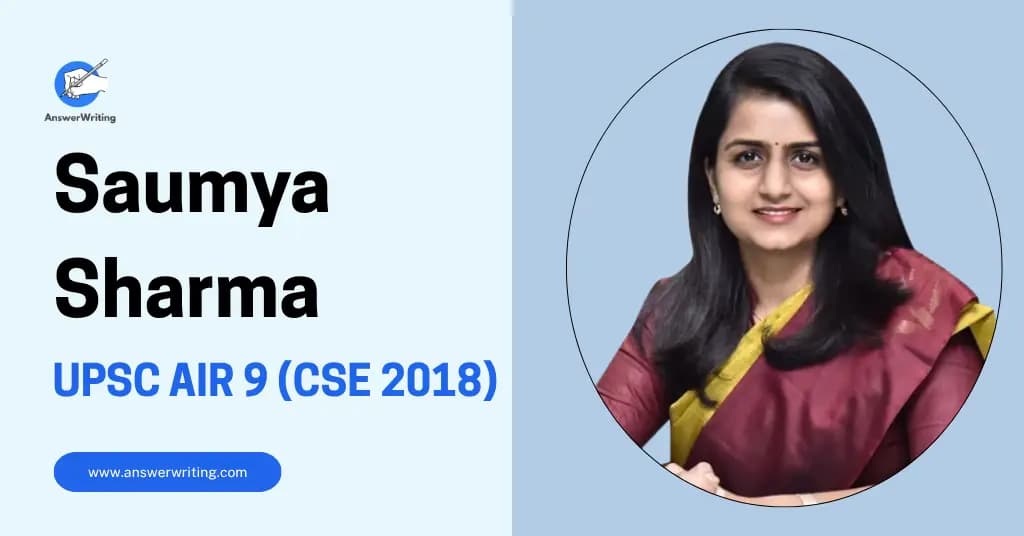
Imagine a student who spent only four months of dedicated preparation for the world’s toughest exam. Now imagine that same student suffered from 90% hearing loss since the age of 16 and refused to use any disability reservation, competing instead in the General category.
Saumya Sharma did exactly this, securing an All India Rank of 9 in her very first attempt. Her story is not just one of academic brilliance, but of an iron will that refused to be sidelined by physical setbacks.
Who Is Saumya Sharma?
Saumya Sharma is an IAS officer of the 2018 batch. Born and raised in Delhi, she is a trained lawyer who bypassed the traditional multi-year UPSC grind. She is currently recognized as one of the most efficient and resilient officers in the Maharashtra cadre.
| Feature | Details |
| Full Name | Saumya Sharma |
| All India Rank | 9 |
| Year of Result | 2018 (CSE 2017) |
| Attempt Number | 1st Attempt |
| Optional Subject | Law |
| Service Allotted | Indian Administrative Service (IAS) |
| Home State | Delhi |
| Cadre Allotted | Maharashtra |
Saumya Sharma UPSC Marksheet and Score Details
Saumya’s scores reflect a high level of consistency across all General Studies papers, coupled with a dominant performance in her optional subject, Law.
| Paper | Marks Obtained |
| Essay | 138 |
| General Studies I | 115 |
| General Studies II | 115 |
| General Studies III | 103 |
| General Studies IV (Ethics) | 108 |
| Optional Paper I (Law) | 145 |
| Optional Paper II (Law) | 148 |
| Mains Written Total | 872 |
| Personality Test (Interview) | 185 |
| Final Total Score | 1057 / 2025 |
Educational Background and Early Life
Saumya grew up in a family of doctors in Delhi. Her life changed significantly at the age of 16 when she suddenly lost nearly all of her hearing. Despite the sudden transition to a world of silence and the need for hearing aids, she maintained her academic trajectory.
She attended the National Law University (NLU), Delhi, where she excelled in her B.A. LL.B. (Hons) degree. Her legal education provided her with the analytical depth required to dissect complex UPSC syllabus topics, especially in Governance and International Relations.
How Many Attempts Did Saumya Sharma Take?
Saumya cleared the UPSC CSE in her first attempt. What makes this extraordinary is her timeline. While most candidates spend two to three years in a dedicated “cycle” of preparation, Saumya began her focused study only in September 2017.
With the Prelims already behind her (which she cleared with minimal specific prep during her final year of law), she had roughly four months to master the vast Mains syllabus. She treated every hour as a precious resource, often studying for 16 hours a day to bridge the gap between her and veteran aspirants.
Saumya Sharma Optional Subject: Law Mastery
Choosing Law was a strategic decision for Saumya. Since she was already a topper at NLU Delhi, she did not have to start from scratch. She focused on the “UPSC version” of Law, which requires a blend of legal theory and current landmark judgments.
For Paper 1, she mastered Constitutional Law and International Law. For Paper 2, she focused on the Law of Crimes, Torts, and Contracts. Her ability to quote relevant articles and cases naturally improved her GS Paper 2 (Polity) scores as well.
UPSC Preparation Strategy of Saumya Sharma
Saumya’s strategy was defined by “Smart Self-Study.” She famously avoided the coaching hubs of Rajinder Nagar and Mukherjee Nagar. Instead, she stayed at home, curated her own notes from the internet, and focused on the previous year’s question papers.
She followed a very tight revision cycle. Because her preparation time was short, she couldn’t afford to read multiple books for one subject. She picked one standard resource, read it multiple times, and immediately shifted to testing her knowledge.
Books and Resources Recommended by Saumya Sharma
| Subject | Book/Resource | Author/Publication |
| Polity | Indian Polity | M. Laxmikanth |
| Modern History | A Brief History of Modern India | Spectrum |
| Environment | Environment Booklet | Shankar IAS |
| Law Optional | Constitution of India | P.M. Bakshi / V.N. Shukla |
| Law Optional | Law of Torts | R.K. Bangia |
| Economy | Economic Survey & Budget | Government of India |
Mains Answer Writing Approach
Saumya’s Mains experience is the stuff of UPSC legend. She was suffering from a severe viral fever with a temperature of 103°F during the exam week. She was so weak that she had to be given saline drips three times a day in the breaks between her morning and afternoon papers.
She practiced writing answers with a focus on speed and legibility. Since students have limited time, they can use tools like the AI Mains Answer Evaluator on platforms like AnswerWriting.com to get instant, AI-driven feedback on her structure and content. This allowed her to refine her writing style without waiting days for manual evaluations, which was crucial during her four-month sprint.
Interview (Personality Test) Experience
Despite her hearing impairment, Saumya was exceptionally confident during her interview. She used hearing aids and informed the board of her condition at the beginning. The board was impressed by her decision to compete in the General category despite being eligible for the PwBD (Persons with Benchmark Disabilities) quota.
The questions focused on her legal background, her views on the judicial system, and women’s empowerment. Her score of 185 is considered quite high and was a deciding factor in her breaking into the top 10.
Service and Cadre Allotted to Saumya Sharma
Saumya was allotted the Indian Administrative Service (IAS) and received the Maharashtra Cadre. She has since served in various capacities, including a notable tenure as the CEO of Zila Parishad Nagpur and the Municipal Commissioner of Amravati. She is known for her digital-first approach to governance and her accessibility to the public.
Key Lessons Every UPSC Aspirant Can Take from Saumya Sharma
- Mind Over Matter: Physical illness or disabilities are obstacles, not dead ends. Saumya’s performance with a high fever proves that mental grit can sustain you when the body fails.
- Strategic Selection: Use your graduation subject as an optional if you have a strong grip on it. It can save you months of foundational reading.
- Quality over Quantity: You don’t need years to clear UPSC if you have a laser-focused plan. Saumya proved that four months of high-intensity, “smart” work can beat years of passive reading.
To implement a high-intensity strategy like Saumya’s, having a personal guide is essential. Aspirants can use the AI Mentor at AnswerWriting.com to get immediate doubt resolution and personalized study plans, ensuring that even a short preparation window is used to its maximum potential.
FAQs About Saumya Sharma
How many hours did Saumya Sharma study?
During her four-month preparation sprint, she studied for 15 to 16 hours a day.
Did Saumya Sharma use any reservation?
No, despite having 90% hearing loss, she opted to compete in the General category and secured Rank 9.
What was Saumya Sharma’s optional subject?
Her optional subject was Law, which she had previously studied at NLU Delhi.
How did Saumya Sharma prepare for UPSC in 4 months?
She focused on self-study, limited her resources to one book per subject, and spent the majority of her time on answer writing and revision.
Who is Saumya Sharma’s husband?
She is married to her batchmate, Archit Chandak, who is an IPS officer.