S. Divyadharshini: UPSC AIR 1 (2010), Strategy, and the Chennai Law Graduate Who Proved the Second Attempt
When S. Divyadharshini secured All India Rank 1 in UPSC CSE 2010, she was a six-month-old SBI clerk who had failed to clear Prelims in her very first attempt. She was 24 years old.
No IIT degree. No elite coaching pedigree. No first-attempt luck. Just a law graduate from Chennai who decided she would keep attempting until she had exhausted every chance, rebuilt her strategy after her first failure, and came back to top the country.
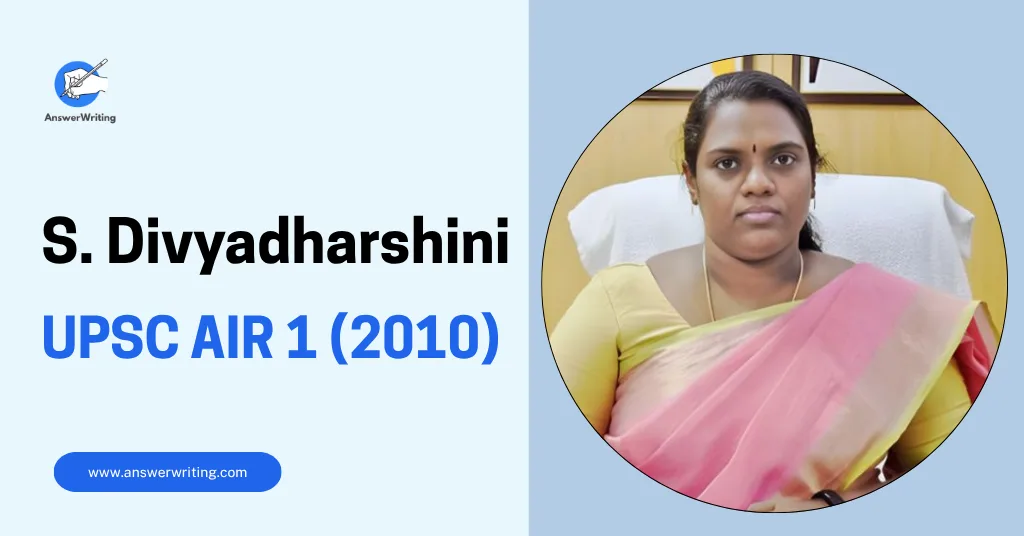
Who Is S. Divyadharshini?
S. Divyadharshini was born on 21 May 1987 in Chennai, Tamil Nadu. She completed her schooling in Chennai and went on to pursue a BA BL (Hons) degree from the School of Excellence in Law, Dr. Ambedkar Law University, Chennai.
She attempted UPSC CSE for the first time and could not clear Prelims. She spent the next year rebuilding her preparation, cleared SBI’s clerical recruitment exam to stay financially grounded, and returned to crack UPSC CSE 2010 with All India Rank 1.
| Detail | Information |
|---|---|
| Full Name | S. Divyadharshini |
| Date of Birth | 21 May 1987 |
| Hometown | Chennai, Tamil Nadu |
| Education | BA BL (Hons), School of Excellence in Law, Dr. Ambedkar Law University, Chennai |
| UPSC Exam Year | 2010 |
| All India Rank | 1 |
| Number of Attempts | 2 |
| Optional Subjects (Mains) | Public Administration and Law |
| Service Allotted | Indian Administrative Service (IAS) |
| Cadre | Tamil Nadu (2011 batch) |
| Prior Employment | SBI Clerical cadre (6 months) |
S. Divyadharshini’s UPSC Marksheet and Score Details
As per available reports, S. Divyadharshini scored a total of 1334 marks in UPSC CSE 2010. Paper-wise breakdowns are not comprehensively available in the public domain. Aspirants should cross-check official UPSC sources for complete accuracy.
| Component | Details |
|---|---|
| Total Marks Scored | 1334 (as per available reports) |
| Optional Subjects (Mains) | Public Administration and Law |
| Final Rank | AIR 1, UPSC CSE 2010 |
| Attempts | 2 |
The score of 1334 at 24 years of age, in just the second attempt and with a law degree as the academic base, tells a clear story. Strategic optional subject choice and full syllabus coverage drove this result more than any single brilliant insight.
Educational Background and Early Life
Divyadharshini grew up in Chennai in a middle-class household. Her father, V. Shanmugam, works as a customs consultant. Her mother, S. Padmavathi, is a homemaker. She has an elder sister, Priyadarshini, and a younger brother, Gokulnath.
She completed her schooling at Asan Memorial Senior Secondary School, Chennai, where she scored 74% in Class 10 and 86% in Class 12.
She then enrolled in the BA BL (Hons) programme at the School of Excellence in Law under Dr. Ambedkar Law University, Chennai. It was during her third year of this five-year integrated law course that she made the definitive decision to appear for the UPSC Civil Services Examination.
That timing matters. She did not come to UPSC after aimlessly trying other options. She identified the goal while still in college and built her preparation around it from within her degree itself. Her law studies became the foundation of her optional subject strategy rather than an obstacle to overcome.
She also pursued a Master’s degree in Public Policy after joining the IAS, adding depth to the governance and policy skills she had already developed through her optional subjects.
How Many Attempts Did S. Divyadharshini Take?
S. Divyadharshini took two attempts. The first ended at Prelims itself.
That outcome at the first attempt is important to understand correctly. Failing Prelims does not mean poor preparation. It often means the aspirant underestimated the specific demands of that stage, particularly the pattern of MCQ framing, negative marking, and the gap between knowing content and applying it under timed conditions.
After that first setback, she did not rush back immediately. She took a full year to review her approach. During this period, she cleared the SBI Clerical Recruitment Exam in 2010 and worked with the bank for six months. This was not a detour. It was a deliberate choice to stay financially supported while continuing her UPSC preparation without pressure.
She said in a widely reported interview: “It’s a way to go forward with confidence and belief in yourself. It’s not too easy but neither too hard. Right amount of effort would pay good results.”
That balance, between acknowledging difficulty and refusing to dramatise it, shaped how she structured her second attempt. She went back, covered the full syllabus more systematically, sharpened her optional subject preparation, and returned to secure AIR 1.
The jump from a Prelims failure to AIR 1 in one subsequent attempt is rare. It happened because she treated the first attempt as diagnostic data rather than evidence of inadequacy.
S. Divyadharshini’s Optional Subjects: Why Law and Public Administration Worked
For Prelims, Divyadharshini selected Public Administration as her optional subject. Her reasons were practical and specific: easy availability of books and study materials, ready access to guidance, and genuine interest in the subject.
For Mains, she chose Public Administration and Law.
Law was the natural choice. She had spent five years studying it at degree level. The syllabus was familiar territory. She could cover it efficiently because the foundational concepts were already built in. She did not need to start from scratch the way an aspirant choosing an entirely new subject would.
She explicitly said that she chose Law because “she had done her graduation in Law and found the syllabus feasible enough to be covered within the available time.” That phrase, feasible within available time, is a practical consideration most aspirants underweight when choosing their optional.
Public Administration complemented Law effectively. It overlaps significantly with General Studies Paper 2 (Governance, Constitution, Polity) and General Studies Paper 4 (Ethics and Integrity). Every hour spent on Public Administration was simultaneously strengthening her GS preparation. That kind of cross-paper synergy reduces total preparation time without reducing depth.
Together, these two optionals gave her a Mains strategy that was efficient, sustainable, and built on genuine understanding rather than borrowed notes.
The core principle she demonstrated: an optional subject you have already studied for years will almost always outperform one you pick for its reputation, regardless of what the toppers’ trend lists say.
UPSC Preparation Strategy of S. Divyadharshini
Divyadharshini’s preparation had a clear philosophy at its centre. She said: “Adopt your own strategy and no one can be a better judge of yourself than you.”
This was not an instruction to avoid guidance. It was an instruction to take ownership of how you prepare rather than copying someone else’s schedule without understanding if it fits your strengths.
She took initial guidance from Prabhas IAS Academy in Chennai, acknowledging her mentor Coach Prabhakaran Sir as an important figure in her preparation. She credited coaching for helping her understand where to start and how to assess her standing through test series. But she was clear that the real effort came from her own disciplined study.
Her preparation approach had several consistent elements. She read newspapers daily, treating them not just as current affairs sources but as material for essay writing. She believed that newspaper reading builds ideas, and ideas are what separate average essays from strong ones.
She covered the entire syllabus systematically, preparing concrete points for each topic rather than vague impressions. This approach to thoroughness, knowing that any topic in the syllabus is fair game, prevented the gaps that often cause aspirants to lose marks on questions they “almost knew.”
She emphasised note-making, particularly for revision closer to the exam. Notes compress months of reading into accessible material when time is short.
She also used the test series at her coaching centre to identify her weaknesses early rather than discovering them in the actual exam. That self-assessment habit is one of the most underused tools in UPSC preparation.
Books and Resources Recommended by S. Divyadharshini
A comprehensive verified booklist from S. Divyadharshini is not available in the public domain. The table below reflects resources consistent with her optional subjects, preparation approach, and widely reported guidance. Aspirants should verify through her interviews and available accounts directly.
| Subject | Resource | Notes |
|---|---|---|
| Public Administration Optional | Standard Public Administration texts | Chosen for availability of books and guidance |
| Law Optional | Standard Law degree textbooks and notes | Built on BA BL (Hons) degree foundation |
| Current Affairs and Essay | National English newspapers (daily) | Primary source for idea development |
| General Studies | NCERT textbooks | Standard foundational reading |
| Revision | Self-made notes (subject-wise) | Strongly recommended for exam-time revision |
| Test Practice | Prabhas IAS Academy test series | Used for self-assessment and gap identification |
Mains Answer Writing Approach
Divyadharshini’s approach to Mains writing was built on two principles: complete syllabus coverage and concrete point preparation for every topic.
She did not rely on vague familiarity with subjects. For each topic in the syllabus, she prepared specific, concrete points she could deploy in an answer. This made her writing structured and precise rather than impressionistic.
Her daily newspaper reading fed directly into her essay answers. She said that newspaper reading builds the ideas that make essay writing strong. This is a connection many aspirants miss. An essay is not a summary of GS knowledge. It requires independent thought, current examples, and a perspective that can only come from consistent reading over time.
For aspirants building this habit today, AnswerWriting.com offers a Daily Answer Writing feature that provides fresh prompts every day and lets you track your progress over time. Pair that with the platform’s Answer Evaluator, which gives detailed AI feedback on structure, content, and UPSC scoring parameters, and you have a system that mirrors exactly what Divyadharshini practised: regular writing, followed by honest assessment of where the answer stands.
The discipline of writing answers regularly, not saving it for the last two months, is what separates aspirants who perform well in Mains from those who know the content but cannot translate it under exam conditions.
Interview (Personality Test) Experience
Detailed verified information about S. Divyadharshini’s interview board composition or specific questions asked is not available in the public domain. Aspirants should cross-check primary interview records for accuracy.
What is clear is that her Detailed Application Form (DAF) offered rich, distinctive material for the board.
A law graduate from Chennai who failed Prelims in her first attempt, spent six months as an SBI clerk, and returned to top the country in her second attempt is a genuinely compelling profile. Each of those facts, her educational background, her work experience, her recovery from failure, would have anchored substantive interview conversations.
Her law background would have invited questions on constitutional provisions, governance, and judicial processes. Her SBI experience would have offered entry points into financial inclusion and banking sector topics. Her Tamil Nadu roots would have opened discussions on state-level governance, social welfare schemes, and development challenges specific to the region.
Her clearly articulated self-confidence, evident in her public quotes, suggests she would have handled the board with directness rather than rehearsed caution.
Service and Cadre Allotted to S. Divyadharshini
S. Divyadharshini was allotted the Indian Administrative Service and the Tamil Nadu cadre, 2011 batch.
She began her IAS career as Assistant Collector in Coimbatore from 2012 to 2013. She then served as Sub Collector in Mayiladuthurai, Nagapattinam district from 2013 to 2015.
She subsequently served as Managing Director of the Tamil Nadu Corporation for Development of Women, where she focused on financial inclusion, skill training, and women-led enterprise promotion. She also served as Chief Executive Officer of the Tamil Nadu Rural Transformation Project and Tamil Nadu State Rural Livelihoods Mission, working on poverty alleviation and rural community development.
As of early 2025, she has been appointed as Director in the Department of Economic Affairs, Ministry of Finance, Government of India, under the Central Staffing Scheme, where she is involved in coordination with global financial institutions and international development agencies.
Her career arc, from district administration to women’s empowerment to economic policy at the national level, reflects a consistent engagement with governance, development, and public finance.
Key Lessons Every UPSC Aspirant Can Take from S. Divyadharshini
- Failing Prelims is not the end of your attempt cycle, it is the beginning of your understanding of the exam. Divyadharshini failed Prelims in her first attempt and came back to secure AIR 1. The data from a failed attempt is more valuable than no attempt at all, if you use it honestly.
- Choose your optional subject based on what you already know, not what is trending. Law was her optional because she had five years of it behind her. That familiarity produced efficiency and depth that no short-term preparation of a popular subject can match.
Adopt your own strategy. She said it directly and meant it. Copying a topper’s timetable without examining whether it fits your learning style, your subject background, and your life circumstances is preparation theatre, not preparation.
Newspaper reading is essay preparation, not just current affairs coverage. She made this connection explicitly. Ideas for essays do not come from GS notes. They come from daily, engaged reading of how events and issues are being understood and debated.
Full syllabus coverage beats deep coverage of selected topics. She emphasised covering the entire syllabus and preparing concrete points for each topic. UPSC rewards breadth of preparation combined with the ability to write structured, specific answers rather than brilliant essays on a narrow range of chosen topics.
FAQs About S. Divyadharshini
1. What was S. Divyadharshini’s optional subject in UPSC?
She chose Public Administration for Prelims and Public Administration and Law for Mains. Law was a natural extension of her BA BL (Hons) degree, while Public Administration complemented her GS preparation significantly.
2. How many attempts did S. Divyadharshini take to clear UPSC?
She took two attempts. She failed to clear Prelims in her first attempt, spent a year rebuilding her preparation while working briefly at SBI, and secured AIR 1 in her second attempt at the age of 24.
3. Which coaching did S. Divyadharshini attend?
She took guidance from Prabhas IAS Academy in Chennai, where she credited Coach Prabhakaran Sir as an important mentor. She used the academy’s test series for self-assessment while relying primarily on self-study for content coverage.
4. What was S. Divyadharshini’s total score in UPSC?
As per available reports, she scored a total of 1334 marks in UPSC CSE 2010. Paper-wise breakdowns are not comprehensively verified in public sources.
5. What is S. Divyadharshini’s current posting?
As of early 2025, she has been appointed as Director in the Department of Economic Affairs, Ministry of Finance, Government of India. Aspirants should verify current posting status from official sources as transfers are routine.
6. Was S. Divyadharshini working before cracking UPSC?
Yes. She cleared the SBI Clerical Recruitment Exam in 2010 and worked as a clerk at the State Bank of India for approximately six months while continuing her UPSC preparation. She received AIR 1 in UPSC CSE 2010 during this period.