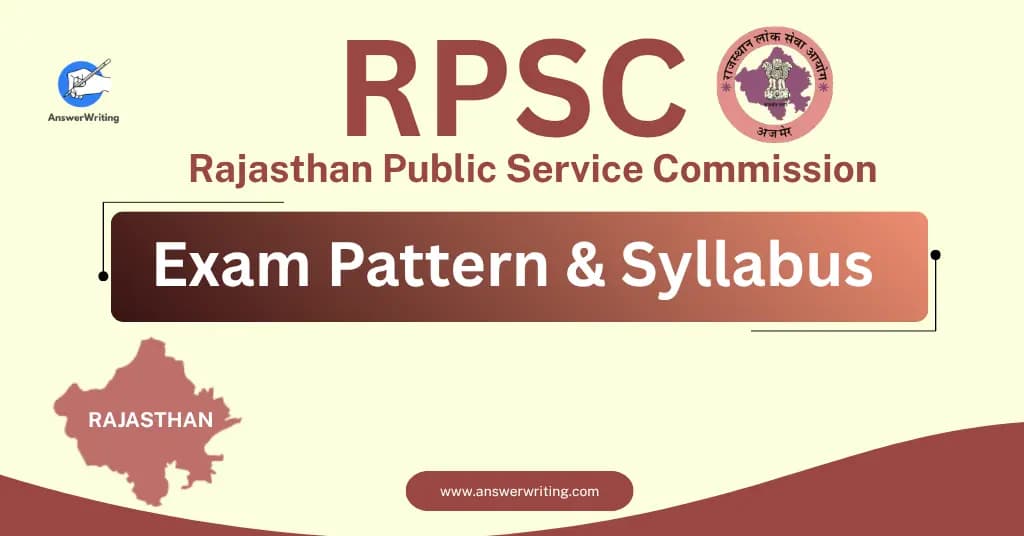
The Rajasthan Administrative Services (RAS) exam is conducted by the Rajasthan Public Service Commission (RPSC) to recruit candidates for administrative positions in the Rajasthan government. The recruitment process includes 3 stages:
- Preliminary Examination
- Mains Examination
- Interview / Personality Test
Stage I: Preliminary Examination
There will be only one paper in the RAS Preliminary Examination based on General Knowledge, consisting of 150 questions carrying 200 marks.
| Feature | Details |
| Type of Exam | Objective type (Multiple Choice Questions) |
| Number of Papers | 1 |
| Number of Questions | 150 |
| Total Marks | 200 |
| Duration | 3 hours |
| Negative Marking | 1/3 mark deducted for each wrong answer |
| Nature | Screening test only marks not counted for final merit |
The marks scored in the Prelims exam will not be counted in the merit list, as this is the screening stage for selecting candidates for the Mains Examination.
Prelims Syllabus
Section 1: History, Art, Culture, Literature, Tradition and Heritage of Rajasthan
Pre-historical sites of Rajasthan from Palaeolithic to Chalcolithic and Bronze Age; Historical Rajasthan: Important historical centres of Early Christian Era; Society, Religion and Culture in Ancient Rajasthan; Political and Cultural achievements of prominent rulers of major dynasties Guhila, Pratihar, Chauhan, Parmar, Rathore, Sisodiya and Kachchawa; Administrative and Revenue System in Medieval Rajasthan; Emergence of Modern Rajasthan: Agents of Social Awakening in Rajasthan during 19th to 20th Centuries; Political Awakening: role of newspapers and political institutions; Tribal and Peasant movements in the 20th century; Praja Mandal movements in various princely states during the 20th century; Integration of Rajasthan.
Architectural Tradition of Rajasthan temples, forts, palaces and man-made water bodies; Various schools of paintings and handicrafts; Performing Art: Classical Music and Classical Dance; Folk Music and Instruments; Folk Dances and Drama; Language and Literature: Dialects of Rajasthani Language, Literature of Rajasthani language and Folk literature; Religious Life: Religious Communities, Saints and Sects in Rajasthan; Folk Deities of Rajasthan; Social Life in Rajasthan: Fairs and festivals, Social customs and traditions, attires and ornaments; Leading Personalities of Rajasthan.
Section 2: Indian History and Culture
Cultural Foundations of India Indus and Vedic Age; Renunciatory tradition and new religious ideas of 6th Century BC Ajivakas, Buddhism and Jainism; Achievements of prominent rulers of major dynasties: Maurya, Kushan, Satavahan, Gupta, Chalukya, Pallava and Chola; Art and Architecture in Ancient India; Development of Language and Literature in Ancient India: Sanskrit, Prakrit and Tamil; Sultanate Period: Achievements of prominent Sultanate Rulers; Cultural achievements of Vijaynagar; Mughal Period: Political challenges and reconciliation Afghan, Rajput, Deccan States and Maratha; Development of Art and Architecture, Paintings and Music during medieval period; Religious and Literary contribution of Bhakti and Sufi movement.
Evolution of Modern India and Emergence of Nationalism: Intellectual awakening; Press; Western education.
Section 3: Geography of the World and India
Topics covering world geography, Indian geography including natural resources, river systems, climate, and other physical and human features.
Section 4: Geography of Rajasthan
Natural Resources of Rajasthan – Climate, Natural Vegetation, Forests, Wildlife, and Biodiversity; Major irrigation projects; Agriculture, Horticulture, Forestry and Animal Husbandry with special reference to Rajasthan; Development of Science and Technology with special reference to Rajasthan.
Section 5: Indian Constitution, Political System and Governance
Topics covering the Rajasthan Public Service Commission, State Human Rights Commission, Lokayukt, State Election Commission, State Information Commission; Public Policy, Legal Rights and Citizen’s Charter; Basic Knowledge of Budgeting, Banking, Public Finance, Goods and Service Tax, National Income, Growth and Development; Accounting Concept, Tools and Uses in Administration.
Section 6: Political and Administrative System of Rajasthan
Topics covering state-level political institutions, administrative set-up, and governance in Rajasthan.
Section 7: Economic Concepts and Indian Economy
Major Sectors of Economy – Current Status, Issues and Initiatives of Agriculture, Industry, Service and Trade sectors; Major Economic Problems and Government Initiatives; Economic Reforms and Liberalization; Poverty and Unemployment – Concept, Types, Causes, Remedies and Current Flagship Schemes.
Section 8: Economy of Rajasthan
Macro overview of Economy; Major Agricultural, Industrial and Service Sector Issues; Growth, Development and Planning; Infrastructure and Resources; Major Development Projects; Major Welfare Schemes of State Government for SC/ST/Backward Classes/Minorities/Disabled Persons, Destitute, Women, Children, Old Age People, Farmers and Labourers.
Section 9: Science and Technology – Basics of Everyday Science
Topics covering general scientific principles, recent developments, and everyday applications.
Section 10: Reasoning and Mental Ability
Logical Reasoning (Deductive, Inductive, Abductive).
Section 11: Current Affairs
Major Current Events and Issues of Rajasthan, India and International Importance; Persons, Places and Institutions in News; Games and sports-related activities.
Stage II: Mains Examination
The candidates who qualify the Prelims exam are eligible to appear for the Mains exam. The number of candidates will be based on 15 times the number of total vacancies. The Mains Exam will be a descriptive-type paper. There will be 4 papers and all papers are compulsory to be attempted. The marks obtained in the Mains Exam will be counted in preparing the merit list. There will be 2 Short Questions, 5 Medium Questions, and 10 Long Questions per paper.
| Paper | Subject | Marks | Duration |
| Paper I | General Studies I | 200 | 3 hours |
| Paper II | General Studies II | 200 | 3 hours |
| Paper III | General Studies III | 200 | 3 hours |
| Paper IV | General Hindi and General English | 200 | 3 hours |
| Total | 800 |
The Mains exam has four subjective papers, including three General Studies papers and one Hindi/English Language paper.
Mains Syllabus
Paper I: General Studies I
Paper I is divided into 3 sections: History, Economics, and Sociology, Management, Accounting and Auditing.
Unit I: History
Part A – History, Art, Culture, Literature, Tradition and Heritage of Rajasthan: Major landmarks in the History of Rajasthan from Prehistoric time to close of 18th Century; Important dynasties, their administrative and revenue system; Salient events of the 19th and 20th centuries: Peasant and Tribal Movements; Political Awakening, Freedom Movement and Integration; Heritage of Rajasthan: Performing and fine Art, Handicraft and Architecture; Fairs, Festivals, Folk Music and Folk Dance; Important works of Rajasthani Literature and Dialects of Rajasthan; Saints, Lok Devtas and eminent personalities of Rajasthan.
Part B – Indian History and Culture: Fine Art, Performing Art, Architecture and Literature from Indus Civilization to British Era; Religious Movements and religious philosophy in Ancient and Medieval India.
History of Modern India from beginning of 19th Century to 1965 AD: Significant events, personalities and issues; Indian National Movement its various stages and streams, important contributors and contributions from different parts of the country; Socio-religious reform movements in the 19th and 20th century; Post-Independence consolidation and reorganisation – Accession of princely states and Linguistic reorganisation of the states.
Part C – History of the Modern World (up to 1950 AD): Renaissance and Reformation; American War of Independence; French Revolution; Industrial Revolution; Russian Revolution; and other major world events up to 1950 AD.
Unit II: Economics
Part A – Indian Economy: Major Sectors of Economy – Current Status, Issues and Initiatives of Agriculture, Industry, Service and Trade sectors; Major Economic Problems and Government Initiatives; Economic Reforms and Liberalization; Poverty and Unemployment Concept, Types, Causes, Remedies and Current Flagship Schemes.
Recent Trends in Indian Economy: Role of Foreign Capital, MNCs, PDS, FDI, Exim Policy, Poverty alleviation schemes.
Part B – World Economy: Topics covering global economic structures, international trade, and economic institutions.
Part C – Economy of Rajasthan: Agriculture, Horticulture, Forestry, Dairy and Animal Husbandry with special reference to Rajasthan; Industrial Sector Growth and recent trends; Growth, Development and Planning with special reference to Rajasthan; Recent development and issues in the service sector of Rajasthan; Major Development Projects of Rajasthan their objectives and impact; Public-Private Partnership Model for Economic Transformation in Rajasthan; Demographic Scenario of the State and its impact on Rajasthan Economy.
Basic Knowledge of Budgeting, Banking, Public Finance, Goods and Service Tax, National Income, Growth and Development; Accounting Concept, Tools and Uses in Administration.
Unit III: Sociology, Management, Accounting and Auditing
Part A Sociology: Caste and Class in Indian Society: Nature, Origin, Functions and Challenges; Processes of Change: Sanskritization, Westernization, Secularization and Globalization; Challenges before Indian Society: Issues of Dowry, Divorce and Child Marriage, Corruption, Communalism, Poverty, Unemployment, Drug Addiction, Vulnerable sections especially Dalit, Elderly and Disabled; Tribal community of Rajasthan: Bhil, Mina (Meena) and Garasia Problems and Welfare.
Part B Management: Management Scope, concept, functions of Management Planning, Organizing, Staffing, Direction, Coordination and Control; Decision-Making: concept, process and techniques; Modern concept of Marketing, Marketing Mix Product, Price, Place and Promotion; Supply Chain Management; E-Commerce and E-Marketing; Business and Corporate Ethics; Concept and Main theories of Leadership and Motivation, Communication; Basics of recruitment, selection, induction, training and development and appraisal system.
Part C – Business Administration (Accounting and Auditing): Wealth Maximization, Sources of Finance Short and Long Term, Capital Structure, Cost of Capital; Techniques of analysis of financial statements, Basics of Working Capital Management, Responsibility and Social Accounting; Meaning and Objectives of Auditing, Internal Control, Social, Performance and Efficiency Audit; Basics of different types of Budgeting, Budgetary control.
Paper II: General Studies II
Paper II is divided into units covering: Administrative Ethics, General Science and Technology, and Earth Science (Geography and Geology).
Unit I: Administrative Ethics
Ethics and Human Values: Lessons from the lives and teachings of great leaders, reformers and administrators; Role of family, society and educational institutions in inculcating values; Ethical concepts Rit and Rin, the concept of Duties, the concept of Good and Virtues; Ethics in private and public relationships Behaviour, Moral and Political attitudes of administrators, Philosophical basis of Integrity; Ethics of Bhagavad Geeta and its role in Administration.
Unit II: General Science and Technology
Agriculture, Horticulture, Forestry, Dairy and Animal Husbandry with special reference to Rajasthan.
Topics also cover basic physics, chemistry, biology, and developments in Science and Technology including space, computers, IT, biotechnology, and everyday science.
Unit III: Earth Science (Geography and Geology)
Earthquakes and Volcanoes: Types, distribution and their impact; Earth and its Geological time scale; Climate Origin of Monsoon, Seasonal Climatic conditions, Distribution of rainfall and climatic regions; Non-Metallic Minerals – Types, distribution, Industrial uses and their conservation; Energy Resources: Conventional and Non-conventional; Population and Tribes.
Paper III: General Studies III
Paper III is divided into units covering: Indian Political System, World Politics and Current Affairs, Concepts, Issues and Dynamics of Public Administration and Management, Sports and Yoga, Behaviour and Law.
Unit I: Indian Political System
Topics covering the Constitution of India, fundamental rights and duties, structure and functioning of Parliament, the President, Prime Minister, Council of Ministers, State Secretariat and Chief Secretary, District Administration including the role of District Collector and Superintendent of Police, Sub-divisional and Tehsil administration.
Rajasthan Public Service Commission, State Human Rights Commission, Lokayukt, State Election Commission, State Information Commission; Public Policy, Legal Rights and Citizen’s Charter.
Unit II: World Politics and Current Affairs
Foreign Policy of India: Evolution, Determinants, India’s relations with USA, China, Russia and European Union; India’s role in UN, NAM, BRICS, G-20, G-77 and SAARC; Geo-political and Strategic developments in South Asia, South East Asia and West Asia and their impact on India.
Major Current Events and Issues of Rajasthan, India and International Importance; Persons, Places and Institutions in News; Games and Sports-related activities.
Unit III: Concepts, Issues and Dynamics of Public Administration and Management
Administration and Management: Meaning, nature and significance; its role in developed and developing societies; Evolution of Public Administration as a discipline; New Public Administration; Approaches to the study of Public Administration; Concepts of power, authority, legitimacy, responsibility and delegation; Principles of Organization: Hierarchy, Span of Control and Unity of Command; Functions of Management; Corporate governance and social responsibility; New dimensions of New Public Management; Change Management; Attitude and Values of Civil Services: ethics, integrity, impartiality and non-partisanship, dedication to public service, relationship between Generalists and Specialists; Control over Administration: Legislative, Executive and Judicial — Various Means and Limitations.
Unit IV: Sports and Yoga, Behaviour and Law
Topics covering sports activities and yoga, as well as behavioural aspects and important laws relevant to administration.
Paper IV: General Hindi and General English
The Mains exam includes one Hindi/English Language paper. The standard of General Hindi and General English will be that of Senior Secondary level.
General Hindi (in Devanagari script): Covers Hindi grammar, comprehension, précis writing, essay writing, and translation.
General English: Covers English grammar, vocabulary, comprehension, précis writing, paragraph writing, and letter/report writing.
Stage III: Interview / Personality Test
The Interview or Personality Test is the final stage of the RAS examination process. This stage carries 100 marks. Candidates’ overall personality, communication skills, problem-solving abilities, and general awareness are evaluated.
| Feature | Details |
| Total Marks | 100 |
| Purpose | Assess mental calibre, personality, and general awareness |
In this stage, the candidates will be assessed for their communication skills, physique, knowledge of the concerned field, and also tested on specific knowledge of Rajasthani Culture. There is no specific syllabus prescribed by the commission for the personal interview.
The final merit list will be based on the marks scored in the Mains Exam and Interview round.
Marks Distribution
| Stage | Marks | Counted for Merit? |
| Preliminary Examination | 200 | No – Screening only |
| Mains Examination | 800 | Yes |
| Interview / Personality Test | 100 | Yes |
| Grand Total (Final Merit List) | 900 | – |