Uttar Pradesh is not a cadre for the faint-hearted. It is India’s most populous state, home to over 200 million people, with one of the most complex law and order environments in the country. Political pressures on the police force are real and constant. Corruption within the system is documented and widely discussed. Honest policing in UP does not happen automatically. It requires officers who choose integrity repeatedly, under conditions where compromise would be far easier.
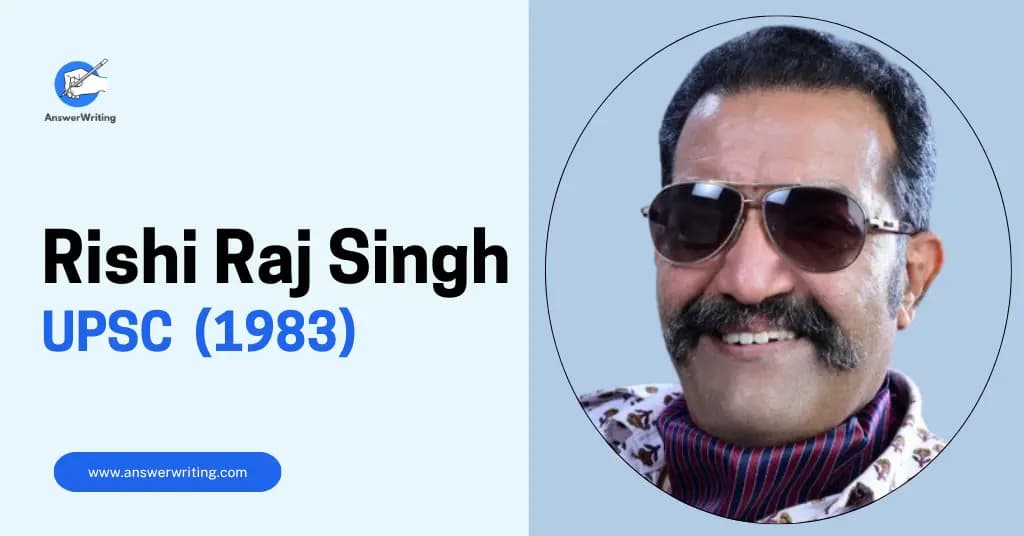
Rishi Raj Singh joined the Indian Police Service in 1983 and spent the bulk of his career navigating exactly that environment. He is not a topper whose rank and marksheet are widely published. He is a civil servant whose operational record and professional conduct made him a recognisable name in UP administrative circles. For UPSC aspirants, his career is a study in what public service looks like when it is practiced seriously, under difficult conditions, without the comfort of national headlines or international awards.
Who Is Rishi Raj Singh?
Rishi Raj Singh is a 1983 batch Indian Police Service officer from the Uttar Pradesh cadre. He served across multiple postings in UP over the course of his career, with a particular association with anti-corruption work and law enforcement operations in one of India’s most challenging administrative environments.
| Detail | Information |
|---|---|
| Full Name | Rishi Raj Singh |
| Service | Indian Police Service (IPS) |
| Batch | 1983 |
| Cadre | Uttar Pradesh |
| Known For | Anti-corruption work, law enforcement operations, senior UP postings |
| UPSC Examination Year | Approximately 1982 (as per available reports) |
| AIR | Not verified in widely available public sources |
| Educational Background | To be verified from official biographical sources |
Details such as his exact AIR rank, educational institution, optional subject, and specific posting dates are not consistently documented in widely available public sources. Aspirants are advised to cross-check these details from official government records or verified biographical sources.
A Note on This Profile and Why It Matters for UPSC Aspirants
This profile does not follow the conventional topper strategy format. Rishi Raj Singh’s preparation details, marksheet, and attempt history are not publicly documented in the way that recent UPSC toppers’ journeys are.
What is documented, through administrative records, news coverage, and public commentary, is his career as a serving IPS officer in UP cadre. And that career, viewed carefully, contains more useful material for a future civil servant than many preparation strategy articles.
UPSC preparation teaches you how to clear the examination. Officers like Rishi Raj Singh demonstrate what the examination is selecting you for. Understanding the difference between those two things is one of the most important mindset shifts an aspirant can make.
The sections that follow focus on what his career reveals about policing, governance, integrity, and administrative courage. Each section connects directly to UPSC syllabus areas where these lessons apply.
The Uttar Pradesh Cadre: Understanding the Arena He Served In
To understand what Rishi Raj Singh’s career means, you first need to understand what the UP cadre demands of its officers.
Uttar Pradesh is India’s largest state by population. It has historically ranked among the states with the highest rates of reported crimes, pending cases in courts, and documented instances of police-public tension. The sheer scale of administration in UP is difficult to communicate in numbers alone. A district magistrate or superintendent of police in UP manages a population that would constitute a mid-sized country in most parts of the world.
The political environment in UP has historically been one where pressure on the police administration is direct and frequent. Officers are expected to deliver results that satisfy political superiors, maintain public order, and simultaneously uphold the law. These three objectives do not always point in the same direction. The gap between them is where an officer’s character is tested.
For IPS officers posted in UP, the daily reality includes managing communal sensitivity, addressing organised crime networks, handling VIP security, responding to farmer and labour disputes, and maintaining law and order during elections, which in UP are among the most closely watched democratic exercises in the world.
An officer who maintained professional integrity across a full career in this environment did something genuinely difficult. That is the starting point for understanding Rishi Raj Singh’s record.
The Making of a Police Officer: Early Career and Foundational Postings
IPS officers from the 1983 batch joined the service at a time when India’s police administration was operating under frameworks that had changed little since the colonial era. The Police Act of 1861, drafted by the British after the 1857 uprising, remained the governing legislation. Many of the structural problems that police reform commissions have since identified were already present and well-entrenched.
A new IPS officer in the early 1980s entered a system with clear hierarchies, significant autonomy at the district level, and limited external accountability mechanisms. The quality of policing in a district depended heavily on the individual officer in charge. There were no RTI provisions, no social media scrutiny, and limited civil society oversight. An officer could choose to do the minimum, and face little consequence for it.
This context matters because it frames the choice that officers like Rishi Raj Singh made. Serving with integrity in a system that did not mandate it, and in an environment that often actively discouraged it, was a deliberate professional decision.
Early career postings for IPS officers typically include sub-divisional and district-level assignments where they manage law and order, supervise investigations, and build their understanding of ground-level policing. As per available reports, Rishi Raj Singh served across multiple districts in UP during his career, building operational experience in the kind of diverse, high-pressure environment that UP consistently provides.
Specific posting details and dates should be verified from official government records, as complete career histories for officers of his batch are not consistently available in public sources.
Anti-Corruption Work and Operational Record
Rishi Raj Singh developed a reputation, as per available reports and public commentary, for his work in areas related to anti-corruption enforcement and law and order operations in UP. His name appears in public discourse in the context of officers who pursued cases and operations without being deterred by the political or administrative complexity of the targets involved.
Anti-corruption work in a state like UP requires a specific combination of legal knowledge, operational courage, and political navigation. The cases that matter most are rarely the easy ones. They involve powerful interests, connected individuals, and institutional resistance. An officer who pursues such cases consistently, across postings and across administrations, demonstrates something that the UPSC examination directly tests for: the ability to hold a principled position under sustained pressure.
For UPSC aspirants, this is not an abstract observation. GS Paper 4 directly asks about the challenges facing ethical administration in India. The challenges that UP cadre officers face, including political interference, systemic corruption, resource constraints, and public trust deficits, are the real-world version of the case studies that appear in your examination.
Understanding how officers navigated these challenges, what they prioritised, where they drew lines, and how they sustained their effectiveness over full careers, gives your GS4 answers a grounding that no textbook can provide.
Specific case details and operational outcomes attributed to Rishi Raj Singh should be cross-checked from official records and verified news sources. The general character of his record, as a senior UP cadre officer associated with anti-corruption and law enforcement work, is widely reported.
Integrity Under Pressure: The UP Context
Integrity in public service is a concept that UPSC tests extensively in GS Paper 4. It appears in questions about ethical decision-making, in case studies about conflicting loyalties, and in essay prompts about the relationship between individual conscience and institutional obligation.
What UPSC tests as a concept, Rishi Raj Singh lived as a daily professional reality.
The pressure on police officers in UP to accommodate political interests is structural, not incidental. It does not arrive as an explicit instruction. It arrives as context: the phone call from a senior politician’s office, the suggestion from a superior that a particular case be handled carefully, the knowledge that a transfer order can follow a decision that displeases the right people.
Officers who navigate this environment with their professional integrity intact do so through a combination of legal knowledge, documented procedure, and the willingness to accept professional consequences for correct decisions. They understand that integrity is not a single dramatic moment. It is a series of small decisions, made consistently, over years.
This is the version of integrity that matters in actual administrative careers. And it is the version that GS Paper 4 is ultimately trying to assess, even when it frames the question in abstract terms.
For aspirants writing GS4 answers on integrity, probity, or ethical dilemmas in public service, the UP policing context provides a rich and specific anchor. An answer that defines integrity and then situates it in the documented challenges of UP policing is far more compelling than one that stays at the level of definition.
Rishi Raj Singh and GS Paper 4 (Ethics): Values His Career Demonstrates
Rishi Raj Singh’s career maps directly to several GS Paper 4 concepts that appear regularly in UPSC Mains. The following table shows how his professional record connects to specific ethical values and examination themes.
| GS4 Value | How It Appears in His Career Context | Examination Relevance |
|---|---|---|
| Integrity | Pursuing anti-corruption work in a high-pressure political environment | Direct: questions on probity and integrity in public life |
| Moral Courage | Maintaining professional position under institutional pressure | Direct: questions on courage of conviction in civil servants |
| Impartiality | Applying law enforcement without regard to political affiliation | Direct: questions on neutrality and rule of law |
| Dedication to Public Service | Full career commitment to law enforcement in a demanding cadre | Direct: questions on civil service values and motivation |
| Emotional Intelligence | Managing diverse stakeholder pressures in complex situations | Direct: questions on empathy and communication in administration |
| Accountability | Operating within legal frameworks and documented procedures | Direct: questions on transparency and accountability mechanisms |
When you write GS4 answers, the examiner is not looking for a list of definitions. They are looking for evidence that you understand how these values function in real administrative contexts. Grounding your answers in the documented realities of UP policing, and in the conduct of officers who served there with integrity, demonstrates exactly that understanding.
Lessons for Aspirants on Policing, Governance, and Public Administration
Rishi Raj Singh’s career offers several specific lessons about public administration that connect directly to UPSC syllabus areas beyond GS Paper 4.
On police reform and GS Paper 2: The structural challenges facing UP’s police force, political interference, inadequate resources, outdated legislation, and public trust deficits, are exactly the issues that UPSC GS Paper 2 tests aspirants on. Understanding these challenges from the perspective of an officer who worked within them gives your answers operational depth.
The Prakash Singh judgment of 2006, in which the Supreme Court issued seven directives for police reform across India, is directly relevant here. Officers of Rishi Raj Singh’s generation served in the period that preceded this judgment and shaped the conditions that made it necessary. Understanding that context enriches your answers on police reform significantly.
On federalism and Centre-State relations: Law and order is a State subject under the Seventh Schedule of the Constitution. The IPS is an All India Service, meaning officers are recruited centrally but serve under state governments. This creates a structural tension between central service values and state government pressures. UP is one of the states where this tension has been most visible and most documented. Understanding it is essential for GS Paper 2 questions on federalism and Centre-State relations.
On accountability mechanisms: The absence of effective accountability mechanisms for the police force is a documented governance gap in India. Right to Information applications, National Human Rights Commission complaints, and judicial oversight through High Court interventions are the primary accountability tools available. Understanding how these work, and their limitations, is directly relevant to GS Paper 2 questions on governance and accountability.
On ethics in public administration: Senior officers in challenging cadres make dozens of decisions every week that have ethical dimensions. Resource allocation, investigation priorities, personnel management, and public communication all involve ethical trade-offs. An officer who navigates these consistently and professionally over a full career demonstrates a level of applied ethics that classroom case studies cannot replicate.
How to Use His Career in UPSC Mains Answers and Essays
The most practical question for an aspirant reading this profile is: how do I use this in my answers?
Here are specific applications across GS papers and the Essay paper.
GS Paper 2 (Governance, Polity, Social Justice):
Questions on police reform, accountability mechanisms, and political interference in administration can be anchored in the UP policing context. You do not need to name individual officers. You can reference the documented challenges of UP policing and the Prakash Singh judgment as your factual base.
Example framing: “The structural challenges facing state police forces, as documented in Uttar Pradesh across multiple decades and addressed by the Supreme Court in the Prakash Singh case, illustrate why police reform requires both legislative change and individual officer integrity.”
GS Paper 4 (Ethics, Integrity, Aptitude):
Questions on moral courage, integrity under pressure, and the conflict between institutional loyalty and individual conscience can be grounded in the UP cadre context. The documented pattern of political pressure on UP police provides a real-world backdrop for discussing these values.
Example framing: “The daily reality of IPS officers in politically sensitive cadres like Uttar Pradesh demonstrates that integrity in public service is not a single dramatic act but a series of consistent professional choices made under sustained pressure.”
Essay Paper:
Essay topics on governance, accountability, the role of the civil servant, and the relationship between law and ethics can all draw on the UP policing context. Essays that ground abstract arguments in documented administrative realities score better than those that remain entirely theoretical.
For aspirants working on essay writing, getting honest evaluation of how well your arguments are grounded and structured is essential. The Essay Evaluator on AnswerWriting.com gives in-depth feedback on argument structure, use of examples, and overall coherence, which is exactly what you need when you are trying to move from a decent essay to a high-scoring one.
Books and Resources for Aspirants Interested in Policing and Governance
Understanding policing and governance in India requires going beyond the standard GS booklist. The following resources will strengthen your answers on police reform, accountability, and civil service ethics significantly.
| Subject | Book / Resource | Author / Source |
|---|---|---|
| Police Reform in India | Rakshak: Stories of the Indian Police | Aditya Sinha |
| Governance and Administration | Breaking Through: A Memoir | K.P. Singh |
| Civil Service Ethics | Ethics, Integrity and Aptitude | G. Subba Rao and P.N. Roy Chaudhury |
| Indian Polity (Police as State Subject) | Indian Polity | M. Laxmikanth |
| Accountability Mechanisms | Second Administrative Reforms Commission Reports | Government of India |
| Prakash Singh Judgment | Supreme Court Judgment on Police Reforms (2006) | Supreme Court of India |
| UP Administration Context | Reports of State Police Commissions | Various State Governments |
| Criminal Justice Reform | India’s Legal System: Can It Be Saved? | Fali S. Nariman |
| Ethics in Public Life | Lexicon for Ethics, Integrity and Aptitude | Chronicle Publications |
A specific recommendation: read the Prakash Singh vs Union of India judgment summary carefully. It is a primary source document that directly addresses the structural problems in Indian policing that officers like Rishi Raj Singh navigated throughout their careers. It appears frequently in GS Paper 2 questions on police reform and is worth understanding in detail.
The Second Administrative Reforms Commission reports, particularly the volumes on ethics in governance and public order, provide systematic analysis of the governance challenges that UP cadre officers face. They are government documents, which means examiners recognise and value them as credible references in answers.
Mains Answer Writing: Applying These Lessons
Strong Mains answers on governance and ethics share a common structure. They define the concept, situate it in a real administrative context, apply it to the specific question, and close with a constructive observation about reform or improvement.
Rishi Raj Singh’s career context gives you the “real administrative context” component for a wide range of questions. But the quality of your answer depends on how well you write it, not just on how much you know.
Many aspirants have the right knowledge but structure their answers poorly. The introduction does not signal the argument clearly. The body paragraphs do not flow logically from one to the next. The conclusion restates the question rather than synthesising the answer. These are structural problems that knowledge alone cannot fix.
The Answer Evaluator on AnswerWriting.com gives detailed feedback on exactly these structural elements, covering how your introduction sets up the argument, whether your body paragraphs are coherent and connected, and how your conclusion functions. For GS Paper 4 answers in particular, where the examiner is assessing both content knowledge and ethical reasoning, this kind of specific structural feedback makes a measurable difference in your scores.
Key Lessons Every UPSC Aspirant Can Take from Rishi Raj Singh
- Understand the cadre you are entering, not just the examination you are clearing. Rishi Raj Singh’s career in UP cadre demonstrates that the examination is a selection process, not an end point. The environment you will work in after selection is complex, politically charged, and operationally demanding. Knowing this going in changes how you prepare and how you think about the service.
- Integrity is a daily practice, not a single moment. His career illustrates that professional integrity in a challenging environment is built through consistent small decisions, not through one dramatic stand. When you write about integrity in GS Paper 4, anchor your answers in this operational reality rather than in abstract definitions.
- Police reform is a live governance issue, not a static syllabus topic. The challenges documented in UP policing over the past four decades, political interference, resource constraints, accountability gaps, are the same challenges that UPSC asks you to analyse and propose solutions for. Study them as live problems, not as examination bullet points.
- Senior civil servants’ careers are a resource for your preparation. Documented administrative careers contain more applied governance knowledge than most preparation books. Read about how officers navigated difficult situations, what institutional mechanisms they used, and where the system failed them. This knowledge enriches every governance-related answer you write.
- The gap between what UPSC tests and what administration demands is smaller than it looks. GS Paper 4 case studies are not invented to trick you. They reflect real administrative dilemmas that officers face. Officers like Rishi Raj Singh lived those dilemmas across full careers. Understanding that connection makes your preparation more grounded and your answers more credible.
FAQs About Rishi Raj Singh IPS
Who is Rishi Raj Singh IPS?
Rishi Raj Singh is a 1983 batch Indian Police Service officer from the Uttar Pradesh cadre. He is known for his anti-corruption work and law enforcement record during his career in UP. He is not a recent UPSC topper but a senior IPS officer whose career is relevant for aspirants studying governance and police administration.
Which batch and cadre is Rishi Raj Singh from?
He is from the 1983 IPS batch and served in the Uttar Pradesh cadre. Specific posting and career details should be verified from official government records.
What is Rishi Raj Singh known for in UP policing?
As per available reports and public commentary, he is associated with anti-corruption enforcement and law and order operations during his career in UP. Specific operational details should be cross-checked from verified news sources and official records.
How is Rishi Raj Singh relevant for UPSC preparation?
His career is directly relevant for GS Paper 2 (governance, police reform, federalism), GS Paper 4 (integrity, moral courage, ethics in public service), and Essay topics on accountability and civil service values. The UP cadre context he served in is one of the most frequently referenced environments in governance-related UPSC questions.
What UPSC topics does studying UP policing help with?
Understanding UP policing covers several key UPSC areas: police reform and the Prakash Singh judgment for GS Paper 2, political interference and accountability mechanisms for governance questions, integrity and moral courage under pressure for GS Paper 4, and the tension between Centre and State in law enforcement for federalism-related questions.
What is the Prakash Singh judgment and why is it important for UPSC?
The Prakash Singh vs Union of India judgment (2006) is a Supreme Court ruling that issued seven directives for police reform across India, including fixed tenures for police chiefs, separation of investigation from law and order functions, and establishment of Police Complaints Authorities. It is a primary source document for UPSC questions on police reform, judicial activism, and governance accountability.
Which books should I read to understand Indian policing for UPSC?
The Second Administrative Reforms Commission reports on public order and ethics in governance, the Prakash Singh judgment summary, M. Laxmikanth’s Indian Polity for the constitutional framework, and G. Subba Rao’s Ethics, Integrity and Aptitude for GS Paper 4 are the most directly useful resources. The complete list is in the Books and Resources section above.
A Final Word for Aspirants
Rishi Raj Singh’s career does not come with a viral interview, a widely shared rank card, or a YouTube strategy session. It comes with decades of documented service in one of India’s most demanding administrative environments.
That is precisely what makes it useful. The UPSC examination is not selecting people to achieve high ranks. It is selecting people to manage the kind of complexity that UP policing represents, day after day, under pressure, without the benefit of public applause.
When you study for GS Paper 4, you are not studying ethics in the abstract. You are preparing to make difficult decisions in exactly the kind of environment that officers like Rishi Raj Singh navigated throughout their careers. Understanding that connection makes your preparation more honest, your answers more grounded, and your future service more purposeful.
The examination is the beginning. The career is the point.