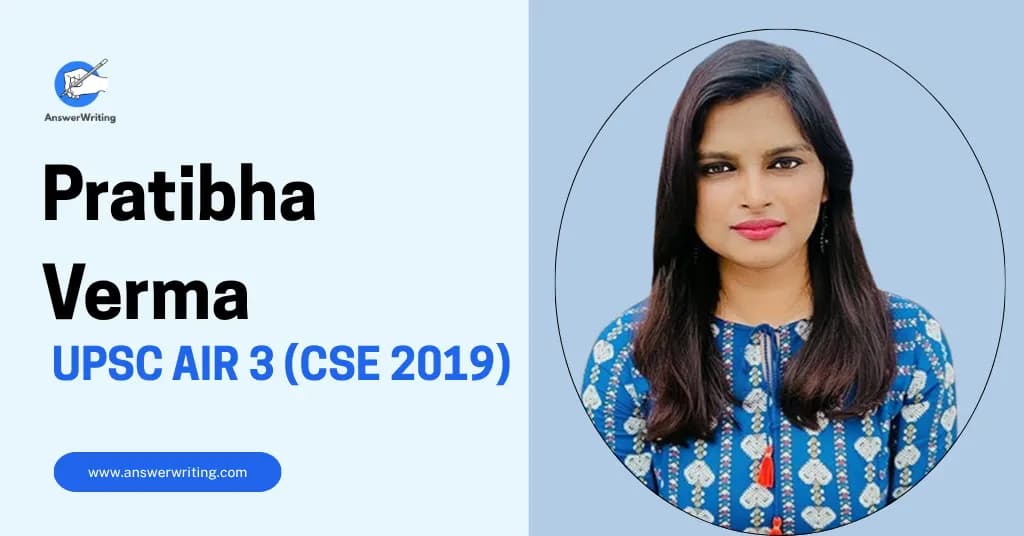
Barabanki is a small district in Uttar Pradesh that most people outside the state would struggle to locate on a map. Pratibha Verma grew up there, studied Zoology at Lucknow University, and in 2019, finished third in the UPSC Civil Services Examination, ahead of thousands of candidates from metros, premier institutions, and well-resourced coaching environments.
Her story is not about exceptional privilege. It is about exceptional preparation.
Who Is Pratibha Verma?
Pratibha Verma is from Barabanki district in Uttar Pradesh. She completed her graduation and post-graduation in Zoology from Lucknow University. She is one of the highest-ranking women in the UPSC Civil Services Examination 2019, finishing AIR 3 overall in the country.
Her profile is particularly significant for aspirants from state universities and smaller cities, because it demonstrates that the exam rewards preparation quality, not institutional brand.
| Detail | Information |
|---|---|
| Full Name | Pratibha Verma |
| Home District | Barabanki, Uttar Pradesh |
| Educational Qualification | B.Sc and M.Sc in Zoology, Lucknow University (as per available reports) |
| UPSC Exam Year | 2019 |
| AIR (All India Rank) | 3 |
| Number of Attempts | 3 (as per widely reported sources) |
| Optional Subject | Zoology |
| Service Allotted | IAS |
| Cadre Allotted | As per available reports, Kerala cadre (readers should verify from official UPSC allotment data) |
Pratibha Verma UPSC Marksheet and Score Details
UPSC does not publish granular paper-wise marks in an officially accessible public format. The figures below are drawn from widely reported media sources and interviews. Readers should cross-check these from verified sources before citing them.
| Component | Marks (Approx., as per media reports) |
|---|---|
| Mains Written (GS Papers + Optional + Essay) | Approx. 895+ out of 1750 |
| Interview (Personality Test) | Approx. 176 out of 275 |
| Final Total | Approx. 1071+ out of 2025 |
Her Mains written performance, particularly in the Zoology optional papers, is widely credited as the foundation of her final rank. Her interview score was competitive and consistent with a well-prepared candidate who knew her DAF thoroughly.
Educational Background and Early Life
Pratibha Verma completed her schooling in Uttar Pradesh before pursuing B.Sc and M.Sc in Zoology from Lucknow University, as per available reports. Lucknow University is a well-regarded state institution with a strong science faculty, but it is not the kind of campus that typically produces UPSC toppers in large numbers.
This is precisely what makes her academic background noteworthy. She did not have access to the peer networks, mock interview panels, or preparation ecosystems that students at DU, JNU, or IITs often benefit from. She built her preparation largely through discipline and self-direction.
Her science background in Zoology gave her a structured, evidence-based way of thinking. Biology demands precision: definitions matter, classifications matter, diagrams matter. These habits translated directly into her UPSC Mains approach, where structured, precise answers consistently score well.
How Many Attempts Did Pratibha Verma Take?
Pratibha Verma cleared the UPSC Civil Services Examination in her third attempt, as per widely reported sources.
Her first two attempts gave her a working understanding of the exam’s demands. Like most serious candidates, she used those experiences to recalibrate rather than restart. She did not abandon her optional subject or her core reading list between attempts.
What changed, based on her interviews, was the quality of her answer writing and the depth of her revision. In earlier attempts, she had covered the syllabus adequately but had not practised writing answers at the volume and quality the Mains demands. She corrected this in her final attempt by making answer writing a daily, non-negotiable habit.
She has also spoken about managing her mindset across attempts. Repeated preparation cycles test mental endurance as much as intellectual capacity. She stayed focused by keeping her daily routine consistent and avoiding comparisons with other candidates.
Pratibha Verma’s Optional Subject: Zoology and Why It Worked
Zoology is not a common UPSC optional. It falls under the science optionals category, alongside subjects like Chemistry, Physics, and Botany. A small fraction of candidates choose it each year, which means competition within the optional is relatively limited.
Pratibha’s choice of Zoology was a natural extension of her academic background. She had studied it for five years at the undergraduate and postgraduate level. She did not need to build her optional from scratch. She needed to align her existing knowledge with the UPSC syllabus and develop the ability to present it in the structured, analytical format the exam demands.
This is a critical insight for science graduates considering UPSC. Your degree subject, studied deeply and mapped carefully to the UPSC optional syllabus, can be a significant advantage. You walk into the exam with years of conceptual foundation that other candidates have to build from zero.
Zoology optional covers two papers. Paper 1 deals with non-chordata, chordata, cell biology, genetics, evolution, and related areas. Paper 2 covers applied zoology, including areas like wildlife, environmental biology, and animal physiology. Both papers reward candidates who can combine factual accuracy with clear diagram-based explanations.
For Zoology optional preparation, standard university-level textbooks used during B.Sc and M.Sc form the primary source base. UPSC previous year question papers for the optional are essential for understanding what the exam actually tests.
UPSC Preparation Strategy of Pratibha Verma
Pratibha Verma’s preparation strategy by her final attempt was built around three pillars: syllabus-mapped study, consistent revision, and high-volume answer writing.
Study Hours: She followed a structured daily schedule, as per available reports. She has spoken about the importance of sustained, focused study over erratic long hours. Quality of engagement with material mattered more to her than raw hour count.
Coaching vs. Self-Study: She attended some coaching, particularly in earlier attempts, but her preparation in the final attempt was heavily self-directed. She used coaching as a reference point rather than as her primary content source.
Sources for GS Papers:
| GS Paper | Key Sources |
|---|---|
| GS 1 (History, Society, Geography) | NCERTs, Bipan Chandra, Nitin Singhania, G.C. Leong |
| GS 2 (Polity, Governance, IR) | M. Laxmikanth for Polity, The Hindu for governance and IR |
| GS 3 (Economy, Environment, Security) | NCERT Economics, Economic Survey, PIB, Down to Earth for environment |
| GS 4 (Ethics) | Lexicon for Ethics, regular case study practice |
| Essay | Full-length timed essay writing throughout preparation |
Revision: She built revision into her weekly schedule rather than treating it as a separate phase. After completing each topic, she revisited it at regular intervals to ensure retention. She maintained short, crisp notes that she could review quickly before the exam.
Current Affairs: The Hindu was her primary source for daily current affairs. She mapped news stories directly to GS syllabus headings, which kept her reading purposeful and exam-oriented rather than broadly informational.
Books and Resources Recommended by Pratibha Verma
The following list is based on widely reported interviews and preparation discussions associated with her profile. The list is intentionally concise, reflecting her approach of going deep into fewer sources rather than skimming many.
| Subject | Book/Resource | Author |
|---|---|---|
| Indian Polity | Indian Polity | M. Laxmikanth |
| Modern India | India’s Struggle for Independence | Bipan Chandra |
| Ancient India | History of Ancient India | R.S. Sharma |
| Medieval India | History of Medieval India | Satish Chandra |
| Art and Culture | Art and Culture | Nitin Singhania |
| Geography | Certificate Physical and Human Geography | G.C. Leong |
| Ethics | Lexicon for Ethics | Chronicle Publications |
| Economy | Indian Economy | Ramesh Singh |
| Environment | Down to Earth Magazine + NCERT Environment | Various |
| Current Affairs | The Hindu (daily) + PIB | Various |
| Zoology Optional | Standard B.Sc and M.Sc university textbooks + UPSC PYQs | Various academic authors |
For Zoology optional specifically, she relied on the same textbooks she had studied during her degree, supplemented by careful analysis of previous year UPSC questions to understand what depth and format the exam expects.
Mains Answer Writing Approach
Pratibha Verma has specifically identified answer writing as the area where she made the most significant improvement between her earlier attempts and her final one.
Her approach in the final attempt involved writing answers daily, not just reading content and making notes. She would pick questions from previous year papers or mock tests, write complete answers under timed conditions, and evaluate them against model answers or discuss them with peers.
She paid particular attention to structure within each answer: a direct introduction that addressed the question without preamble, a body that covered multiple dimensions with specific examples, and a conclusion that added a forward-looking or analytical observation rather than simply summarising.
For Zoology optional answers specifically, she used diagrams wherever the syllabus warranted them. Labelled, clean diagrams in science optionals are not just decorative. They demonstrate conceptual understanding and often carry dedicated marks.
Aspirants who want to build this kind of disciplined writing habit will find AnswerWriting.com’s Answer Evaluator genuinely useful. It provides detailed AI-based feedback on Mains answers covering structure, content relevance, and UPSC scoring parameters, giving you the kind of specific, actionable critique that Pratibha built through peer review and self-assessment. Regular use of such a tool can accelerate the improvement cycle significantly, especially for candidates who do not have access to a strong peer group or mentor.
The core principle from her approach: write answers every single day, review them critically, and target one specific improvement area per week.
Interview (Personality Test) Experience
Pratibha Verma’s DAF presented a distinctive profile to the interview board. A woman from Barabanki, with a Zoology background from Lucknow University, choosing civil services, offered the board rich territory to explore.
Her preparation for the interview was rooted in knowing her DAF thoroughly. She prepared for questions about her optional subject, her home district, UP-specific governance and development issues, wildlife and environment topics linked to her Zoology background, and her motivation for civil services.
The board would naturally have been curious about her choice to pursue IAS from a science background, her views on environmental governance given her subject expertise, and what she hoped to do in administration. These are areas she would have been well-equipped to address given her academic depth.
Her interview score of approximately 176 out of 275 (as per available reports) was solid and contributed meaningfully to her final total alongside an already strong Mains written performance.
The lesson for aspirants: do not treat the interview as a current affairs quiz. Treat it as a structured conversation about who you are, what you have studied, where you come from, and why you want to serve. Your DAF is the script. Know it better than the board does.
Service and Cadre Allotted to Pratibha Verma
Pratibha Verma was allotted the IAS, the most sought-after service in the Civil Services Examination.
As per available reports, she was allotted the Kerala cadre, which is notable given that she is from Uttar Pradesh. Cadre allotment in the IAS follows a system based on preferences submitted by candidates and availability. Readers are advised to verify her cadre details from official UPSC allotment lists, as media reports on cadre allotments are sometimes inaccurate.
IAS officers complete their foundation and phase-wise training at LBSNAA in Mussoorie before proceeding to their allotted state for induction training and district-level postings.
Key Lessons Every UPSC Aspirant Can Take from Pratibha Verma
- Your institution does not define your ceiling. Pratibha finished AIR 3 from Lucknow University, ahead of candidates from IITs, DU, and JNU. The exam rewards preparation quality, not the name on your degree certificate.
- Choose your optional based on academic depth, not crowd preference. Her Zoology background gave her a five-year head start on her optional. Science graduates should seriously evaluate their degree subject before defaulting to popular choices like Public Administration or Sociology.
- Answer writing must be a daily habit, not a last-month sprint. Her biggest improvement between attempts came from writing answers every day under timed conditions. Build this habit from the first month of serious preparation.
- Revision deserves the same priority as new learning. She built revision cycles into her weekly schedule throughout her preparation, not just before the exam. Material you cannot recall under pressure is material you never really learned.
- Your DAF is your interview preparation plan. She prepared deeply for questions rooted in her background, district, optional subject, and motivation. Aspirants who know their DAF inside out walk into the interview with a significant advantage over those who prepare generically.
FAQs About Pratibha Verma
What was Pratibha Verma’s optional subject in UPSC? Pratibha Verma chose Zoology as her optional subject for the UPSC Civil Services Examination 2019. Her strong academic background in Zoology from Lucknow University was the foundation of this choice.
How many attempts did Pratibha Verma take to clear UPSC? She cleared the examination in her third attempt, as per widely reported sources.
Which college did Pratibha Verma attend? Pratibha Verma completed her B.Sc and M.Sc in Zoology from Lucknow University, as per available reports.
Where is Pratibha Verma from? She is from Barabanki district in Uttar Pradesh.
Which service and cadre was Pratibha Verma allotted? She was allotted the IAS. As per available reports, her cadre is Kerala. Readers should verify this from official UPSC allotment data.
Did Pratibha Verma attend coaching for UPSC? She attended some coaching, particularly in earlier attempts, but her final attempt preparation was largely self-directed, as per available reports.
What is Pratibha Verma’s rank and year in UPSC? Pratibha Verma secured AIR 3 in the UPSC Civil Services Examination 2019, making her one of the highest-ranking women in that year’s results.