

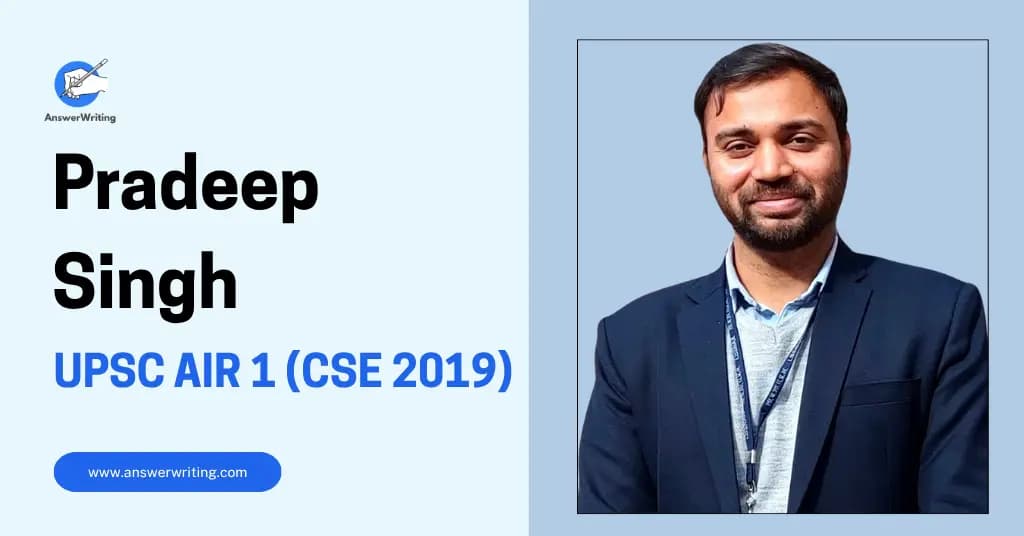
An IIT Bombay graduate in Civil Engineering sitting down to study medieval Indian history for hours every day sounds like an odd picture. But that is exactly what Pradeep Singh did, and it earned him the top rank in the UPSC Civil Services Examination 2019, the most competitive exam in India.
His story is not just about intelligence. It is about four attempts, honest self-assessment, and the courage to back an unconventional choice all the way to Rank 1.
Who Is Pradeep Singh?
Pradeep Singh is from Sonipat, Haryana. He completed his B.Tech in Civil Engineering from IIT Bombay, one of India’s premier technical institutions. After graduation, instead of pursuing a corporate career, he chose to prepare for the UPSC Civil Services Examination.
In his fourth attempt, in 2019, he secured AIR 1 across all categories, topping the entire country.
| Detail | Information |
|---|---|
| Full Name | Pradeep Singh |
| Home District | Sonipat, Haryana |
| Educational Qualification | B.Tech, Civil Engineering, IIT Bombay |
| UPSC Exam Year | 2019 |
| AIR (All India Rank) | 1 |
| Number of Attempts | 4 |
| Optional Subject | History |
| Service Allotted | IAS |
| Cadre Allotted | As per available reports, Uttar Pradesh (readers should verify from official UPSC allotment data) |
Pradeep Singh UPSC Marksheet and Score Details
Complete paper-wise marks are not officially released by UPSC in a granular public format. The figures below are based on widely reported media sources and interviews. Readers are advised to cross-check these from official or verified sources.
| Component | Marks (Approx., as per media reports) |
|---|---|
| Mains Written (GS + Optional + Essay) | Approx. 900+ out of 1750 |
| Interview (Personality Test) | Approx. 182 out of 275 |
| Final Total | Approx. 1072+ out of 2025 |
These figures placed him ahead of all other candidates in 2019. His Mains performance, particularly in History optional, is widely credited as the deciding factor.
Educational Background and Early Life
Pradeep Singh grew up in Sonipat, a town in Haryana that has produced several civil servants and sportspersons. His academic record was strong enough to clear the JEE and secure admission to IIT Bombay, which is a significant achievement in itself.
At IIT Bombay, he studied Civil Engineering. Engineering at an IIT trains you to break problems into components, work with precision, and handle pressure under deadlines. These habits, as Pradeep has acknowledged in interviews, proved useful during UPSC preparation.
After completing his degree, he made the decision to appear for the Civil Services Examination rather than pursue engineering roles or MBA programs. This was a deliberate, committed choice, not a fallback.
How Many Attempts Did Pradeep Singh Take?
Pradeep Singh took four attempts to clear the UPSC Civil Services Examination.
He first appeared in 2016. His subsequent attempts in 2017 and 2018 did not yield the result he was working toward. In 2019, he secured AIR 1.
What changed between attempts? Based on interviews he gave after his result, a few things stand out.
First, he became more disciplined about answer writing in Mains. In early attempts, he focused heavily on reading and note-making but did not practise writing structured answers under timed conditions consistently enough.
Second, he refined his approach to revision. Instead of expanding his reading list with each attempt, he tightened it. He read fewer sources but went deeper into each one.
Third, his confidence in his optional subject, History, grew with each attempt. By his fourth try, he had developed a thorough command of the subject rather than surface-level coverage.
Four attempts is not a failure story. It is a strategy story. Each attempt gave him a clearer map of where he stood and what needed fixing.
Pradeep Singh’s Optional Subject: Why an Engineer Chose History and How It Paid Off
This is the most discussed aspect of Pradeep Singh’s preparation, and rightly so.
Most engineering graduates who appear for UPSC gravitate toward technical optionals like Mathematics, Physics, or Public Administration. Pradeep chose History, a subject outside his academic background entirely.
His reasoning, as reported in interviews, was straightforward. He had a genuine interest in History. He found the subject engaging to study, which meant he could sustain long hours of preparation without burning out. He also felt that History had a well-defined syllabus with reliable standard sources, which made it manageable.
This is a critical lesson. Optional subject performance often determines whether a candidate makes it to the final list or not. Choosing a subject you can study with genuine engagement, rather than one that seems “safe” or popular, often produces better results.
For History optional, the key books he relied on include:
| Paper | Book/Resource | Author/Source |
|---|---|---|
| Ancient India | History of Ancient India | R.S. Sharma |
| Medieval India | History of Medieval India | Satish Chandra |
| Modern India | India’s Struggle for Independence | Bipan Chandra |
| Modern India | A Brief History of Modern India | Rajiv Ahir (Spectrum) |
| World History | Mastering Modern World History | Norman Lowe |
| Art and Culture | Nitin Singhania (for overlap with GS1) | Nitin Singhania |
He is also reported to have made his own notes from NCERT history books as a foundation before moving to standard texts.
UPSC Preparation Strategy of Pradeep Singh
Pradeep Singh’s strategy evolved across attempts. By his fourth attempt, it had the following shape.
Study Hours: He followed a structured routine of approximately 8 to 10 hours of focused study per day. He has cautioned against counting hours mechanically and instead emphasised productive hours over total hours.
Coaching vs. Self-Study: He attended coaching for some subjects in initial attempts but shifted heavily toward self-study in later attempts. He used coaching primarily for guidance on what to study rather than depending on it for content delivery.
Sources for GS Papers:
| GS Paper | Key Sources |
|---|---|
| GS 1 (History, Society, Geography) | NCERTs, Bipan Chandra, Nitin Singhania, G.C. Leong for Geography |
| GS 2 (Polity, Governance, IR) | Laxmikanth for Polity, The Hindu for current affairs |
| GS 3 (Economy, Environment, Security) | NCERT Economics, Economic Survey, PIB, The Hindu |
| GS 4 (Ethics) | Lexicon for Ethics, case study practice |
| Essay | Practised writing full essays under timed conditions |
Revision: He followed a strict revision schedule. After completing each topic, he would revise it at fixed intervals. He did not move to new material without ensuring the older material was consolidated.
Current Affairs: He relied on The Hindu newspaper daily and made short notes from it. He mapped current affairs directly to the GS syllabus so that his preparation stayed exam-focused rather than broadly informational.
Books and Resources Recommended by Pradeep Singh
| Subject | Book/Resource | Author |
|---|---|---|
| Indian Polity | Indian Polity | M. Laxmikanth |
| Modern India | India’s Struggle for Independence | Bipan Chandra |
| Ancient India | History of Ancient India | R.S. Sharma |
| Medieval India | History of Medieval India | Satish Chandra |
| World History | Mastering Modern World History | Norman Lowe |
| Geography | Certificate Physical & Human Geography | G.C. Leong |
| Art and Culture | Art and Culture | Nitin Singhania |
| Ethics | Lexicon for Ethics | Chronicle Publications |
| Economy | Indian Economy | Ramesh Singh |
| Current Affairs | The Hindu (daily) + PIB | Various |
| Prelims Practice | NCERTs + Previous Year Papers | Various |
These are consistent with what he has mentioned across multiple post-result interviews. Aspirants should note that the list is deliberately short. He focused on standard books read thoroughly rather than collecting multiple references.
Mains Answer Writing Approach
Pradeep Singh has specifically spoken about how answer writing was a weak point in his earlier attempts and how fixing it changed his trajectory.
His approach in his final attempt involved writing answers daily, not just reading content. He would take a question, write a full answer under timed conditions, and then compare it with model answers or discuss it with peers.
He focused on three things in each answer: a clear introduction that directly addresses the question, structured body paragraphs with specific examples and data points, and a balanced conclusion that avoids vague statements.
For aspirants working on the same habit, platforms like AnswerWriting.com offer an Answer Evaluator that gives detailed AI-based feedback on Mains answers, covering structure, content relevance, and UPSC scoring parameters. Practising regularly on such a platform can replicate the kind of structured feedback loop that Pradeep built through peer review and self-assessment.
The key insight from his approach: quantity of answers written matters less than the quality of reflection after each answer.
Interview (Personality Test) Experience
Pradeep Singh’s interview preparation was rooted in his DAF (Detailed Application Form). He had filled out his DAF thoughtfully, listing interests and experiences that he could speak about with genuine depth.
His background at IIT Bombay, his choice of History as optional despite being an engineer, and his Haryana roots all formed natural discussion points for the board.
He has mentioned in interviews that he prepared for questions on current affairs, governance issues, and his optional subject. He also prepared for why-IAS questions, which are standard in almost every UPSC interview.
His interview score of approximately 182 out of 275 (as per available reports) was competitive, though not the highest possible. His overall rank was secured primarily through a strong Mains written performance.
The lesson here is that the interview rewards authenticity. Boards respond better to candidates who know their DAF inside out and speak with genuine conviction than to those who recite prepared scripts.
Service and Cadre Allotted to Pradeep Singh
Pradeep Singh was allotted the IAS, the most sought-after service in the Civil Services Examination.
As per available reports, he was allotted the Uttar Pradesh cadre. Readers are advised to verify this detail from official UPSC allotment lists or reliable government sources, as cadre allotments are sometimes updated or reported inaccurately in media.
Post-training at LBSNAA (Lal Bahadur Shastri National Academy of Administration) in Mussoorie, IAS officers of his batch proceed to their allotted state for district-level postings.
Key Lessons Every UPSC Aspirant Can Take from Pradeep Singh
- Interest beats convention in optional subject choice. Pradeep chose History as an engineer. It worked because he was genuinely engaged with the subject. Pick your optional based on where you can sustain effort, not just where others have succeeded.
- Fewer sources, deeper preparation. He repeatedly emphasised a short, fixed reading list over an ever-expanding one. Depth beats breadth in UPSC Mains.
- Answer writing is a separate skill that needs daily practice. Reading content is not the same as being able to write it under exam conditions. Build the habit early, not in the final month.
- Each failed attempt is diagnostic data. He used his previous attempts to identify specific gaps, in answer writing, in revision, in optional depth, and addressed each one systematically. A failed attempt with no analysis is a wasted attempt.
- Authenticity in the interview matters more than polish. He did not try to project a manufactured persona. His board interaction was grounded in who he actually was, what he had studied, and what he genuinely believed.
FAQs About Pradeep Singh
What was Pradeep Singh’s optional subject in UPSC?
Pradeep Singh chose History as his optional subject for the UPSC Civil Services Examination 2019, despite having an engineering background from IIT Bombay.
How many attempts did Pradeep Singh take to clear UPSC?
He took four attempts. He appeared in 2016, 2017, 2018, and finally cleared in 2019 with AIR 1.
Which IIT did Pradeep Singh attend?
Pradeep Singh completed his B.Tech in Civil Engineering from IIT Bombay.
Which service and cadre was Pradeep Singh allotted?
He was allotted the IAS. As per available reports, his cadre is Uttar Pradesh, though readers should verify this from official sources.
Did Pradeep Singh attend coaching for UPSC?
He attended coaching in initial attempts for guidance but relied primarily on self-study, especially in his later and final attempt.
What books did Pradeep Singh recommend for UPSC preparation?
His core recommendations include Laxmikanth for Polity, Bipan Chandra for Modern India, R.S. Sharma for Ancient India, Satish Chandra for Medieval India, Norman Lowe for World History, and The Hindu for current affairs.
What is Pradeep Singh’s total score in UPSC 2019?
As per widely reported figures, his total score was approximately 1072 out of 2025, combining Mains written and interview marks. Readers should cross-check this from verified sources as UPSC does not publish individual scores officially in all formats.