Online vs Offline UPSC Preparation
In the winter of 2025, a young aspirant from a small village in Bihar secured a rank in the top 50 without ever stepping foot into a Delhi metro station. Ten years ago, this would have been considered a statistical anomaly; today, it is a testament to the shifting tectonic plates of the UPSC preparation ecosystem. The age-old debate of Online vs. Offline preparation is no longer about which is “better” in an absolute sense, but about which environment optimizes your specific cognitive strengths and lifestyle constraints.
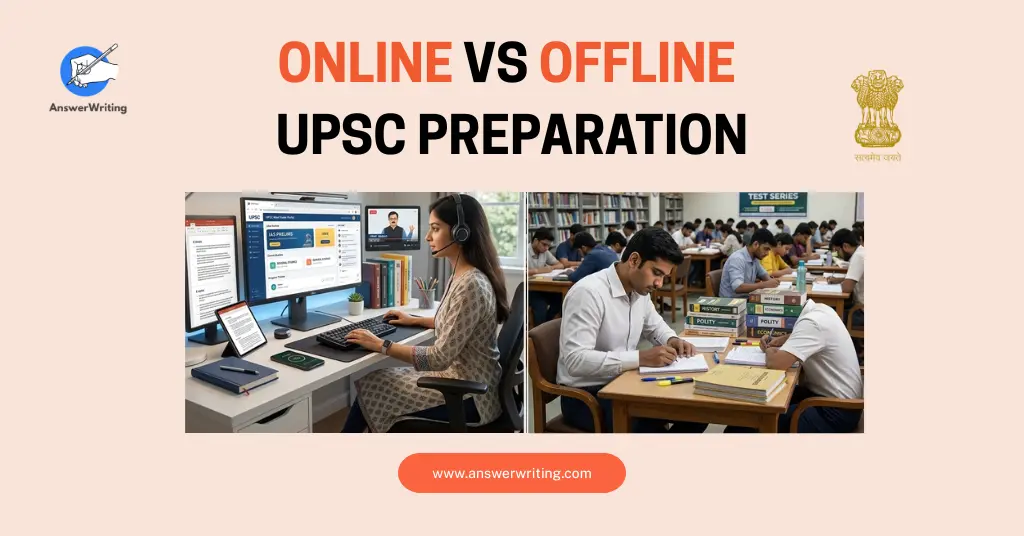
As we move through 2026, the traditional monopoly of coaching hubs like Old Rajinder Nagar (ORN) and Mukherjee Nagar is being challenged by high-speed internet and sophisticated digital platforms. Choosing between these two paths is the first-and perhaps most critical-strategic decision you will make in your civil services journey.
The Offline Experience: More Than Just a Classroom
For decades, the physical classroom has been the gold standard for competitive exams. The value of offline coaching is often less about the lectures and more about the invisible “osmotic” learning that occurs in a high-pressure environment.
The Accountability Loop
In an offline setup, the physical presence of a mentor and the gaze of four hundred peers create a natural psychological pressure. You cannot “pause” a live lecture to check social media, nor can you easily skip a morning class when you know your absence will be noticed by your study circle. This built-in discipline is invaluable for students who struggle with procrastination or find it difficult to maintain a routine in the comfort of their homes.
The Peer Ecosystem
Preparation in a hub like Delhi offers access to a “collective brain.” Whether it is a quick discussion over tea about the latest Supreme Court judgment or a heated debate in a library corridor regarding the nuances of the Green Hydrogen Mission, these interactions sharpen your analytical skills. You quickly learn where you stand in the national competition, which can be a powerful motivator or a necessary reality check.
The Ground Reality: Hidden Costs
However, the offline model comes with significant baggage. In 2026, the cost of a standard one-year Foundation Course in Delhi ranges from ₹1,50,000 to ₹2,50,000. When you add the cost of a decent single-room PG in ORN-which can easily cost ₹20,000 to ₹30,000 per month-the annual expenditure can skyrocket to ₹5,00,000 or more. For many, the “Delhi dream” ends up being a financial nightmare that adds immense mental pressure to an already stressful exam.
The Online Revolution: Precision and Flexibility
The digital-first approach has matured significantly. By 2026, online platforms are no longer just repositories of recorded videos; they are integrated learning ecosystems.
Time Efficiency and Customization
The most underrated advantage of online prep is the gift of time. An offline student in Delhi often spends two hours daily on commuting, managing domestic chores, or dealing with the logistics of city life. An online student reinvests those 700+ hours a year into active revision or answer writing. Furthermore, the ability to watch lectures at 1.5x speed or revisit complex topics like “Capital Account Convertibility” multiple times ensures that your pace of learning is dictated by your understanding, not the teacher’s schedule.
Solving the Feedback Gap
Historically, the biggest drawback of online preparation was the lack of quality feedback on descriptive answers. In a physical center, you could theoretically chase a teacher for a review. Today, technology has bridged this gap. Serious aspirants now use specialized platforms like AnswerWriting.com, which allow students from any corner of the country to have their handwritten answers evaluated with the same-if not higher-precision than a physical center. These platforms cater to the specific needs of UPSC, state PSCs, and other descriptive exams, ensuring that a student in a remote village receives the same quality of critique as one sitting in a premium Delhi classroom.
Financial Audit: A Comparative Breakdown (2026 Estimates)
To make an informed choice, you must look at the numbers. The following table provides a realistic comparison of the financial commitment required for one year of full-time preparation.
| Expense Head | Offline (Delhi/Metro) | Online (Home-based) |
| Tuition Fees (Full Course) | ₹1,50,000 – ₹2,50,000 | ₹50,000 – ₹1,20,000 |
| Accommodation & Food | ₹2,40,000 – ₹3,60,000 | Nominal (Home costs) |
| Study Material & Books | Included / ₹15,000 | ₹15,000 |
| Test Series & Evaluation | Included in premium | ₹10,000 – ₹25,000 |
| Commute & Misc. | ₹30,000 – ₹50,000 | Negligible |
| Total Annual Budget | ₹4,50,000 – ₹6,50,000 | ₹75,000 – ₹1,60,000 |
The Hybrid Model: The Middle Path
Recognizing the pros and cons of both, many top-tier institutes and successful candidates are moving toward a “Phygital” or Hybrid model. In this setup, students stay at home for the bulk of their static syllabus coverage (History, Geography, Polity) to save costs and maintain health. They then move to a coaching hub for a shorter duration-perhaps 3 to 4 months-specifically for Mains-focused answer writing groups, interview preparation, or intensive test series.
This model allows you to leverage the cost-effectiveness of digital tools while still gaining the “finishing school” benefits of a competitive physical environment.
Decision Matrix: Which Path Should You Take?
Choosing your mode of preparation is a deeply personal decision. Consider the following factors before you commit your time and money:
- Self-Discipline: If you can sit at a desk for 8 hours without external supervision, online is your best friend. If you need a “school-like” environment to function, choose offline.
- Financial Standing: If a ₹5 lakh investment puts your family’s security at risk, the stress will likely hamper your preparation. Online preparation is now high-quality enough that financial lack is no longer a barrier to a top rank.
- Current Status: Working professionals and college students almost always benefit more from the flexibility of online modules. Full-time aspirants may find the social isolation of home-based prep difficult over a 2-year cycle.
- Access to Evaluation: Regardless of your choice, ensure you have a robust system for Mains. If your offline center has 500 students per batch, your copies might not get the attention they deserve. In such cases, supplementing with a dedicated digital evaluation service like AnswerWriting.com can be a game-changer.
Frequently Asked Questions
1. Can I clear the UPSC exam strictly through self-study and online resources?
Yes. In recent years, several toppers have relied exclusively on YouTube, standard textbooks, and online test series. The key is to be extremely selective about your sources and maintain a rigorous schedule.
2. Is the “Delhi vibe” necessary for the Interview stage?
While mock interviews in Delhi can help you get used to the formal setting, they are not a prerequisite for success. Personality is built over years of reading and thinking, not in a week of mock sessions. However, visiting Delhi for a few days to attend 2 or 3 diverse mock panels is often recommended for confidence.
3. How do I handle screen fatigue during online preparation?
Follow the 20-20-20 rule: every 20 minutes, look at something 20 feet away for 20 seconds. Use physical books for the majority of your reading and reserve the screen only for lectures and specific data searches.
4. Are online test series as difficult as the real UPSC exam?
Most reputed online platforms design their tests to be slightly more difficult than the actual Prelims to ensure students are prepared for the worst-case scenario. The quality of questions is generally at par with offline centers.
Whether you choose the bustling lanes of Rajinder Nagar or the quiet corner of your study room, remember that the UPSC syllabus remains the same. The exam does not test where you studied; it tests how well you understood the complexities of the Indian state and how effectively you can articulate solutions on paper. Focus on the quality of your analysis and the consistency of your practice, and the medium will eventually become secondary to your merit.