NCERT Books for UPSC
Most UPSC aspirants own a stack of NCERTs. Very few read them the right way.
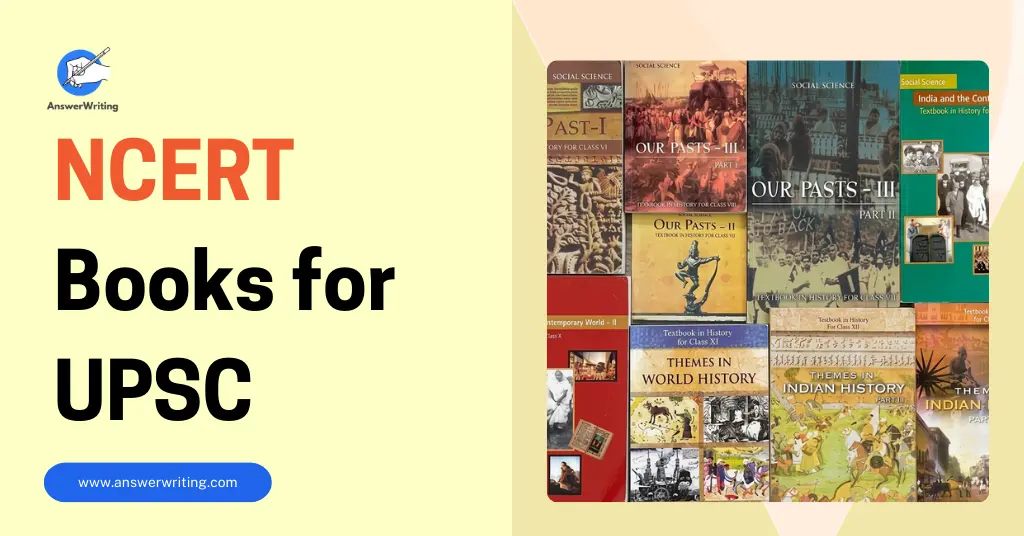
Walk into any serious aspirant’s room and you will find the same scene: a pile of books, some with sticky notes, some barely opened. The debate about which edition to read, Old or New, adds another layer of confusion on top of an already overwhelming preparation journey.
This guide cuts through that confusion. By the end, you will know exactly which books to read, in what order, and why. No vague advice. No “read everything” suggestions.
Why NCERTs Still Matter in the Age of Coaching Notes
Coaching institutes produce thick, well-organised notes. YouTube channels explain every concept with animations. So why do toppers still swear by NCERTs?
The answer is simple: NCERTs build the conceptual foundation that everything else rests on.
UPSC does not test memory alone. It tests your ability to connect ideas across subjects. A question on the Indus Valley Civilisation in Prelims may link to a question on urban planning in Mains. That connection becomes visible only when your base is strong.
NCERTs are also written by subject experts specifically for the Indian curriculum. The language is clear. The examples are India-specific. And UPSC has, for decades, drawn questions almost directly from NCERT content, especially in History, Geography, and Polity.
Coaching notes summarise. NCERTs explain. That difference matters enormously.
The Story Behind “Old” and “New” NCERTs
What Exactly Changed?
NCERT revised its textbooks in phases between 2005 and 2008, following the National Curriculum Framework (NCF) of 2005. The revision was not minor. Entire chapters were restructured. The tone shifted from factual and encyclopaedic to thematic and analytical.
For example, the Old History books (written by scholars like R.S. Sharma, Romila Thapar, and Bipan Chandra) were written as authoritative academic texts. They were dense with facts, dates, and interpretations. The New books, while more student-friendly, trimmed a significant amount of that factual depth.
For a school student, the new books are better. For a UPSC aspirant, that trimming is a problem.
Why Some Old Books Survived the Revision
Not all subjects suffered equally in the revision. New NCERT books for Geography (Class 11 and 12), Polity (Class 11), and Economy (Class 12) are widely considered superior or at least equal to their older counterparts.
The real loss happened in History. The old History textbooks remain unmatched for UPSC preparation. No new edition has replicated the analytical depth of R.S. Sharma on Ancient India or Bipan Chandra on Modern India.
This is the core of the Old vs New debate.
Subject-Wise Breakdown: Old NCERT vs New NCERT
History
This is where the debate is most intense, and where Old NCERTs win decisively.
| Aspect | Old NCERT | New NCERT |
|---|---|---|
| Authors | R.S. Sharma, Romila Thapar, Bipan Chandra, Satish Chandra | Various NCERT panels |
| Depth | High, academically rigorous | Moderate, thematic |
| Factual Coverage | Extensive (dates, dynasties, events) | Selective |
| UPSC Relevance | Very High | Moderate |
| Verdict | Must Read | Supplement only |
Specific Old NCERT books to read for History:
- Ancient India by R.S. Sharma (Class 11, Old)
- Medieval India by Satish Chandra (Class 11, Old)
- Modern India by Bipan Chandra (Class 12, Old)
- A History of the World by Arjun Dev (for World History, GS Mains Paper 1)
The New NCERT History books (Themes in Indian History, Parts 1, 2, 3) are thematic and good for understanding social history. Read them after the Old books, not instead of them.
Geography
Here, the picture flips. New NCERTs are excellent for Geography.
| Aspect | Old NCERT | New NCERT |
|---|---|---|
| Physical Geography | Basic, outdated diagrams | Comprehensive, well-illustrated |
| Indian Geography | Moderate | Strong, updated data |
| Human Geography | Limited | Well-covered |
| Maps and Diagrams | Dated | Clear and exam-relevant |
| Verdict | Skip | Must Read |
Specific New NCERT books for Geography:
- Fundamentals of Physical Geography (Class 11)
- India: Physical Environment (Class 11)
- Fundamentals of Human Geography (Class 12)
- India: People and Economy (Class 12)
These four books together build the complete Geography foundation for both Prelims and Mains.
Polity and Governance
This is straightforward. M. Laxmikanth’s Indian Polity is the go-to book, but you still need the NCERT base first.
| Aspect | Old NCERT | New NCERT |
|---|---|---|
| Constitutional Framework | Basic | Good coverage |
| Institutions | Limited | Better explained |
| Updated Content | Outdated | More current |
| Verdict | Optional | Preferred |
Recommended:
- Indian Constitution at Work (Class 11, New NCERT) is a well-written introduction to the Constitution. Read it before Laxmikanth.
- Political Theory (Class 11, New NCERT) is useful for understanding concepts like liberty, equality, and rights. These appear frequently in Ethics (GS Paper 4) as well.
Economy
New NCERT is the clear winner here too.
| Aspect | Old NCERT | New NCERT |
|---|---|---|
| Basic Concepts | Adequate | Better structured |
| Indian Economy | Outdated data | Relevant, updated |
| Development Economics | Thin | Good coverage |
| Verdict | Skip | Must Read |
Recommended:
- Indian Economic Development (Class 11, New NCERT)
- Introductory Macroeconomics (Class 12, New NCERT)
- Introductory Microeconomics (Class 12, New NCERT) for conceptual clarity
These three books are enough to build the economic reasoning needed for Prelims and GS Paper 3.
Science and Environment
For science, New NCERTs are sufficient for most aspirants.
| Subject | Recommended Books | Old or New |
|---|---|---|
| Biology | Class 11 and 12 (selected chapters) | New |
| Chemistry | Class 11 and 12 (basic concepts) | New |
| Physics | Class 11 (mechanics, optics basics) | New |
| Environment | Class 12 Biology + Class 11 Geography | New |
Focus on chapters related to ecology, genetics, disease, nutrition, and space science. These appear regularly in Prelims.
The Master NCERT Reading List for UPSC
Here is the consolidated reading list, ranked by priority.
| Subject | Book Title | Class | Old/New | Priority |
|---|---|---|---|---|
| Ancient India | R.S. Sharma | 11 | Old | High |
| Medieval India | Satish Chandra | 11 | Old | High |
| Modern India | Bipan Chandra | 12 | Old | Very High |
| World History | Arjun Dev | 11 | Old | Medium |
| Themes in Indian History (1, 2, 3) | NCERT | 12 | New | Medium |
| Physical Geography | Fundamentals of Physical Geography | 11 | New | Very High |
| Indian Geography | India: Physical Environment | 11 | New | Very High |
| Human Geography | Fundamentals of Human Geography | 12 | New | High |
| Indian People and Economy | India: People and Economy | 12 | New | High |
| Polity | Indian Constitution at Work | 11 | New | High |
| Political Theory | Political Theory | 11 | New | Medium |
| Economy | Indian Economic Development | 11 | New | High |
| Macroeconomics | Introductory Macroeconomics | 12 | New | High |
| Science (General) | Biology, Physics, Chemistry (selected) | 11, 12 | New | Medium |
| Sociology | Social Change and Development | 12 | New | Medium |
Priority Legend: Very High (read before anything else), High (complete before Mains), Medium (cover before Prelims)
The Right Reading Sequence (How Toppers Actually Read NCERTs)
The order in which you read NCERTs matters as much as which ones you read. Here is the sequence most successful candidates follow:
- Start with Class 6 to 10 History (New NCERT) for a basic chronological timeline of Indian history. This gives you orientation before you jump into the dense Old NCERTs.
- Read Old NCERT History (R.S. Sharma, Satish Chandra, Bipan Chandra) in sequence: Ancient, Medieval, then Modern.
- Move to Class 11 Geography (both Physical and Indian Geography) before studying economy, because many economic concepts (agriculture, industries, regions) make more sense with geographic context.
- Read Class 11 Polity (Indian Constitution at Work) next. This prepares you for Laxmikanth.
- Cover Economy NCERTs (Class 11 and 12) before reading The Hindu’s economy coverage or any advanced economy books.
- Science and Environment can be read in parallel. Treat them as supplementary reading, not primary preparation.
- Revisit Modern India (Bipan Chandra) before Mains. This book has enough material to anchor answers in GS Paper 1.
Common Mistakes Aspirants Make With NCERTs
Knowing what to avoid saves weeks of wasted effort.
- Collecting without reading. Many aspirants download every NCERT PDF but finish none. Six focused books beat twenty unread ones.
- Reading linearly like a novel. NCERTs should be read actively. Make margin notes. Link facts to current affairs. Ask “why” after every paragraph.
- Skipping Class 6 to 10 books. These foundational books, especially History and Science from Classes 6 to 10 (New NCERTs), are underrated. They cover a surprising amount of Prelims-relevant content.
- Ignoring maps in Geography NCERTs. Geography questions in Prelims are frequently map-based. Tracing and revising maps from NCERTs is a high-return activity.
- Treating NCERTs as one-time reads. The most effective preparation involves at least two reads: a detailed first read and a faster revision read before Prelims.
- Over-relying on NCERTs for Economy. NCERTs give you concepts. But Economy for UPSC also needs current data from the Economic Survey and Budget. NCERTs are the starting point, not the finish line.
How to Source Old NCERTs Legally and for Free
Old NCERTs are out of print. You cannot buy them in a bookstore. But there are reliable ways to access them.
Free Digital Access:
- NCERT’s official website (ncert.nic.in): Some old editions are archived here. Navigate to the “Old Textbooks” section.
- Internet Archive (archive.org): The complete set of old NCERT textbooks is freely available in PDF format. This is the most reliable source.
- Telegram channels and UPSC-specific communities: Many aspirants share scanned, searchable PDFs of old NCERTs. Verify the quality before relying on them.
Physical Copies:
Old NCERTs occasionally appear on OLX, secondhand bookstores near coaching hubs (Mukherjee Nagar in Delhi, Deccan Gymkhana in Pune), and library sales. If you prefer reading physical books, it is worth hunting for them.
Tip: For Old NCERT History, prioritise getting physical or clean digital copies. The books contain maps, timelines, and detailed content that loses clarity in poor-quality scans.
Beyond Reading: Getting the Most Out of NCERTs
Reading NCERTs is necessary. But it is not sufficient.
The real test is whether you can convert what you read into structured answers under time pressure. Many aspirants read Bipan Chandra cover to cover and still struggle to write a 250-word answer on the causes of the 1857 Revolt.
The gap between reading and writing is where most aspirants lose marks.
This is why answer writing practice has to begin early, even during the NCERT phase. When you finish a chapter on, say, the Mauryan Empire, try writing a 150-word note on its administrative structure. That exercise forces you to organise, prioritise, and express what you have read.
Platforms like AnswerWriting.com have built their entire system around this need. They allow UPSC aspirants to submit handwritten answers based on topics from the standard syllabus and get them evaluated by experienced mentors. For students in the NCERT phase, practising short conceptual answers and getting feedback on structure and content accuracy can dramatically improve both retention and writing quality. Teachers and evaluators on such platforms can also spot conceptual gaps that self-study alone cannot reveal.
The combination of strong NCERT reading and consistent answer writing practice is what separates aspirants who clear Mains from those who do not.
Making Notes from NCERTs: A Practical Approach
You do not need to make notes from every NCERT. That is a time trap.
Follow this approach instead:
For High-Priority Books (Old History, Geography): Make chapter-wise short notes with key facts, names, dates, and your own summaries. Keep them to one page per chapter.
For Medium-Priority Books (Economy, Polity): Underline and annotate within the book itself. Use a pencil so you can revise marks later. Write brief margin notes.
For Science and Environment: Create a single topic-wise fact sheet. For example, one sheet for “Human Diseases” combining content from Biology across classes.
For All Books: Maintain a separate “Current Affairs Link” column in your notes. When you read about a river in Geography NCERT, note down any recent news about that river (floods, interlinking projects, pollution). This linkage is what earns marks in Prelims and Mains.
Frequently Asked Questions
1. Can I skip Old NCERTs entirely and just read New NCERTs for History?
Not recommended. The New NCERT History books (Themes in Indian History) are thematic and cover selected topics in depth. They miss vast portions of political and administrative history that UPSC regularly tests. Old NCERTs by R.S. Sharma and Bipan Chandra remain irreplaceable for a complete History foundation.
2. How many months should I spend on NCERTs?
Most successful candidates dedicate 2 to 3 months to completing the priority NCERT list before moving to advanced books. Do not rush. Reading the Old History books carefully in 6 to 8 weeks is more valuable than speed-reading everything in one month.
3. Are Class 6 to 10 NCERTs really necessary?
Yes, especially for History and Science. The Class 6 to 8 History books provide an excellent chronological overview of ancient and medieval India. Class 9 and 10 Science books cover topics like atoms, cells, disease, and environment that appear directly in Prelims. Do not skip them.
4. Should I read the New History books (Themes in Indian History) in addition to Old NCERTs?
Yes, but treat them as supplementary. The Themes books cover social history, art, literature, and architecture in depth. These themes appear in GS Paper 1 Mains. Read them after completing Old NCERTs.
5. Which Geography NCERT is best for Map-based questions in Prelims?
India: Physical Environment (Class 11, New NCERT) and India: People and Economy (Class 12, New NCERT) together cover most map-relevant content. Practise marking rivers, passes, peaks, wildlife sanctuaries, and industrial regions on a blank map regularly.
6. Is Laxmikanth enough for Polity, or do I need NCERT too?
Read the NCERT (Indian Constitution at Work, Class 11) before Laxmikanth. It takes only 3 to 4 days and gives you the conceptual language to understand Laxmikanth much better. Laxmikanth without NCERT grounding often leads to mechanical memorisation without understanding.
The Right Way to Think About NCERTs
NCERTs are not a task to finish. They are a foundation to build.
Every advanced book you read later, every answer you write in Mains, every interview question you answer will draw on the base these books create. The aspirants who treat NCERTs as a chore to tick off are the ones who struggle when questions go beyond surface-level recall.
Read slowly. Think while you read. Connect what you read to current affairs and other subjects. And then write. Even short paragraph-length answers after each chapter will do more for your preparation than a second passive reading ever will.
The UPSC journey rewards those who understand deeply, not those who read widely but shallowly. NCERTs, read the right way, are where that deep understanding begins.