Write Confidently, Score Higher with AnswerWriting
Refine your UPSC/PCS Mains answers with clinical precision. Our AI-driven evaluation ensures clarity, relevance, and structured writing — helping you improve with every attempt.
Tip: Cite a recent SC judgement in the introduction to strengthen your opening.
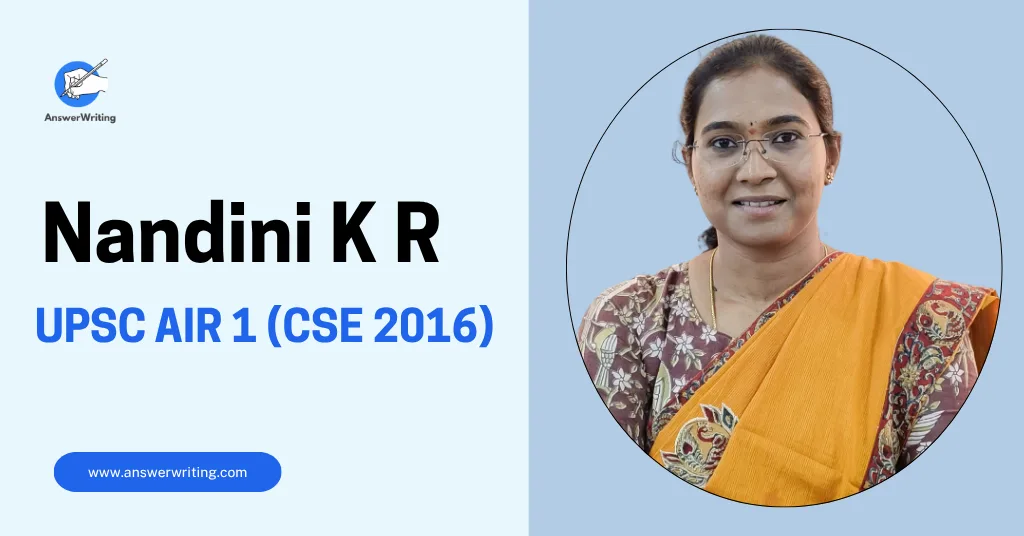
Nandini K R: AIR 1, UPSC CSE 2016, Strategy and Journey | AnswerWriting
Nandini K R: AIR 1, UPSC CSE 2016, Strategy and Journey
Most aspirants treat a fourth unsuccessful attempt as a signal to stop. Nandini K R treated it as preparation for a fifth. That fifth attempt made her the top-ranked IAS officer in the entire country in 2016.
Her father drove a KSRTC bus in Karnataka. She sat for UPSC five times. On the fifth, she topped India.
Who Is Nandini K R?
Nandini K R secured AIR 1 in the UPSC Civil Services Examination 2016. She was also the top-ranked woman candidate in that cycle, a double distinction that made her story one of the most widely covered in recent UPSC history.
She belongs to Karnataka and completed her engineering degree from the University Visvesvaraya College of Engineering (UVCE) in Bangalore. She chose Kannada Literature as her optional subject, her mother tongue, and converted that choice into one of the strongest optional performances of her cycle.
She was allotted the IAS with the AGMUT cadre (Arunachal Pradesh, Goa, Mizoram and Union Territories).
Quick Profile
Detail
Information
Full Name
Nandini K R
AIR
1 (CSE 2016)
Rank Among Women
1st (Top Woman Candidate)
Exam Year
UPSC CSE 2016
Attempts
5 (Fifth attempt)
Optional Subject
Kannada Literature
Service
IAS
Cadre
AGMUT
Educational Background
B.E., Industrial Engineering, UVCE Bangalore
Home State
Karnataka
Family Background
Father worked as KSRTC bus conductor
Nandini K R UPSC Marksheet and Score Details
As per widely reported figures, here is Nandini K R’s score breakdown:
Stage
Marks Obtained
Maximum Marks
Mains Written
1063
1750
Interview (Personality Test)
182
275
Final Total
1245
2025
Her final total of 1245 placed her at the top of the merit list across all candidates in CSE 2016. Her interview score of 182 was among the stronger Personality Test performances in that cycle and contributed meaningfully to her overall rank.
Individual GS paper-wise scores and Kannada Literature optional paper scores are not officially published in granular public detail. Aspirants should cross-check specific sub-scores from official UPSC marksheet disclosures or verified interview sources.
Educational Background and Early Life
Nandini grew up in Karnataka in a family of modest means. Her father worked as a bus conductor with KSRTC, the Karnataka State Road Transport Corporation. Her family background was not one of administrative connections, urban privilege, or prior civil services exposure.
She completed her schooling in Karnataka and went on to pursue a B.E. in Industrial Engineering from UVCE Bangalore, one of Karnataka’s oldest and most respected engineering institutions. Her engineering training gave her structured thinking and problem-solving habits that would later inform how she approached GS preparation.
What her background gave her, beyond academics, was a clear and personal understanding of why public administration matters at the ground level. That authenticity shaped both her preparation motivation and her interview performance.
How Many Attempts Did Nandini K R Take?
Nandini cleared UPSC CSE 2016 in her fifth attempt. This is the fact that defines her story more than any other.
Five attempts means five Prelims cycles, five rounds of Mains preparation, five years of sustained focus on a single goal while managing uncertainty, self-doubt, and external pressure. It means watching peers move into careers and life stages while staying committed to a path that had not yet delivered results.
As per available reports, she made incremental improvements across her attempts, refining her optional subject strategy, strengthening her GS answer writing, and sharpening her interview preparation each time. She did not repeat the same preparation and expect different results. Each attempt involved honest diagnosis of what had not worked and deliberate correction.
The shift to Kannada Literature as her optional subject is one of the most significant strategic pivots across her attempts. Whether this change came in her final attempt or earlier is not confirmed in granular detail across verified sources. Aspirants should cross-check this specific timeline from her directly reported interviews.
What is verified is the outcome: the adjustments she made across multiple attempts produced the highest rank in the country.
For aspirants on their second, third, or fourth attempt, this progression matters more than the final rank. The rank is the result. The diagnosis and correction across attempts is the process that created it.
Nandini K R’s Optional Subject: Kannada Literature
Why She Chose Kannada Literature
Nandini chose Kannada Literature as her optional subject, selecting her mother tongue over a science or engineering-related optional despite her technical academic background.
This decision was rooted in a clear strategic logic. Literature optionals in regional languages offer several structural advantages for the right candidate. The syllabus is contained and well-defined. A native speaker has an inherent depth of linguistic and cultural familiarity that no amount of coaching can fully replicate for a non-native learner. The subject rewards genuine engagement with texts rather than mechanical memorisation.
For Nandini, Kannada was not just a language she spoke. It was a literary tradition she had grown up within. That authentic relationship with the subject translated into answer writing that carried both analytical depth and cultural fluency.
The Case for Regional Language Literature Optionals
Kannada Literature, like other regional language literature optionals on the UPSC list, is chronically underestimated. Aspirants from the relevant linguistic backgrounds often bypass it in favour of more “mainstream” optionals because they assume examiners favour certain subjects or because coaching material is more readily available for other options.
Nandini’s AIR 1 with Kannada Literature is the most direct counter-argument to that assumption. A well-prepared literature optional from a native speaker can produce exceptional scores precisely because the competition within that optional is smaller and the preparation investment is more targeted.
Strategy and Books for Kannada Literature
Her preparation for Kannada Literature involved deep engagement with prescribed texts, critical literary theory relevant to the syllabus, and extensive answer writing practice in Kannada.
As per available reports and the general preparation framework for literature optionals, key resources include:
Prescribed texts listed in the official UPSC Kannada Literature syllabus
Standard Kannada literary criticism and history texts
Previous year UPSC question papers for Kannada Literature
Writing practice specifically in Kannada, with attention to literary analysis structure
Aspirants considering regional language literature optionals should obtain the current official UPSC syllabus for their language and build preparation around prescribed texts before supplementing with criticism and theory.
UPSC Preparation Strategy of Nandini K R
Coaching vs. Self-Study
As per available reports, Nandini followed a largely self-directed preparation approach. She did not depend on full-time integrated coaching as her primary preparation mode. This is consistent with the pattern seen across many Karnataka-based toppers who prepare outside Delhi’s coaching ecosystem.
Self-study demands stronger personal discipline around scheduling, resource selection, and progress tracking. Across five attempts, she developed and refined all three.
GS Paper Approach
For GS Paper 1, she used standard NCERT textbooks as her foundation for History, Geography, and Indian Society. She built conceptual understanding before moving to reference books, which is the correct sequencing that most toppers recommend regardless of background.
For GS Paper 2, Polity and governance formed the core, with M. Laxmikanth as the primary reference. She tracked government schemes and constitutional developments through newspapers and official sources.
For GS Paper 3, she covered Economy through standard texts and linked economic developments to current policy. Her engineering background gave her comfort with technical and infrastructure topics that many humanities aspirants find challenging.
For GS Paper 4, she focused on ethical frameworks and case study practice. Her personal background, growing up in a family that experienced public systems from the ground level, gave her authentic material to draw from in governance ethics answers.
Revision and Note-Making
Across her multiple attempts, she developed a revision system built on concise personal notes rather than repeated re-reading of full texts. By her later attempts, her notes were distilled, targeted, and exam-ready rather than comprehensive and unwieldy.
This evolution in note quality across attempts is itself a lesson. Early preparation notes are often too detailed. Experienced aspirants learn to make notes that serve revision rather than notes that try to capture everything.
Current Affairs
She followed newspapers consistently and integrated current affairs with static syllabus topics rather than treating them as a separate preparation track. This integration is what allows the same current affairs reading to serve multiple GS papers simultaneously.
Books and Resources Recommended by Nandini K R
As per her widely reported interviews and verified sources aligned with her preparation:
Subject
Book / Resource
Author / Source
Ancient and Medieval History
NCERT Textbooks (Class 6 to 12)
NCERT
Modern History
India’s Struggle for Independence
Bipan Chandra
Indian Polity
Indian Polity
M. Laxmikanth
Indian Economy
Indian Economy
Ramesh Singh
Geography
NCERT Geography (Class 11 and 12)
NCERT
Environment and Ecology
Shankar IAS Environment
Shankar IAS Academy
Ethics (GS4)
Lexicon for Ethics
Niraj Kumar
Current Affairs
The Hindu
Daily Reading
Kannada Literature Optional
UPSC Prescribed Texts
Official Syllabus
Kannada Literature Optional
Previous Year Question Papers
UPSC
Cross-check this list against her official interviews. Specific book mentions for the Kannada Literature optional should be verified against the current UPSC syllabus for that subject.
Mains Answer Writing Approach
Nandini’s Mains written score of 1063 out of 1750 reflects consistent, well-structured answer writing across both GS and optional papers. Across five attempts, answer writing was not a skill she developed once. It was something she refined repeatedly based on what each attempt revealed about her gaps.
Her approach to GS answers followed a clear structure: a direct opening that addressed the question without preamble, organised body content using subheadings or numbered points where the question demanded it, relevant examples drawn from current affairs and Indian governance, and a conclusion that added analytical value rather than merely summarising.
For Kannada Literature answers, presentation followed literary analysis conventions: textual references, critical perspective, and coherent argument rather than descriptive retelling.
One of the most significant challenges for multi-attempt aspirants is that answer writing practice can become repetitive and self-reinforcing. You develop habits, including bad ones, and without external feedback, those habits calcify across attempts.
This is where structured evaluation makes a measurable difference. Platforms like AnswerWriting.com offer an AI-powered Answer Evaluator that provides objective feedback on structure, content, language, and UPSC scoring parameters. For aspirants on multiple attempts who risk repeating the same writing patterns without realising it, this kind of external evaluation is not a supplement. It is a correction mechanism.
Nandini’s incremental improvement across five attempts required honest assessment of what was not working. Answer writing evaluation is one of the clearest ways to get that assessment.
Interview (Personality Test) Experience
Nandini scored 182 out of 275 in the Personality Test, one of the stronger interview scores in CSE 2016. This performance reflects thorough preparation and confident, authentic engagement with the board.
As per available reports, her interview preparation involved thorough DAF review, staying current on Karnataka-specific issues and national governance developments, and preparing to speak honestly about her five-attempt journey.
Her personal background, the daughter of a KSRTC bus conductor who had appeared five times for the country’s most competitive examination, gave her a DAF and a personal narrative that was both distinctive and genuine. Boards respond to authenticity, and her story did not require embellishment.
As per available reports, she engaged with questions about her optional subject choice, her engineering background, her family, and her persistence across multiple attempts with directness and clarity. She did not treat her five attempts as a weakness to defend. She treated it as evidence of commitment and self-correction, which is precisely how the board would evaluate it.
Specific board member names and detailed question sets from her interview are not widely verified in public sources and will not be reproduced here. Aspirants should refer to her directly reported interview accounts for granular detail.
Service and Cadre Allotted to Nandini K R
Nandini K R was allotted the Indian Administrative Service (IAS) with the AGMUT cadre, which covers Arunachal Pradesh, Goa, Mizoram, and Union Territories including Delhi.
This is worth noting for Karnataka-based aspirants. Despite being from Karnataka, she was allotted the AGMUT cadre rather than the Karnataka cadre. Cadre allotment follows a structured process based on rank, preference, and vacancy availability. Aspirants should familiarise themselves with the cadre allotment policy and submit preferences accordingly, understanding that home state cadre is not guaranteed even at high ranks.
Her current posting and administrative assignments should be verified from official government or recent news sources, as postings change over time and this article does not carry potentially outdated placement information.
Key Lessons Every UPSC Aspirant Can Take from Nandini K R
Five attempts is not failure extended. It is preparation compounded. Each of Nandini’s attempts added information about what needed to change. Aspirants who diagnose and correct across attempts are not failing repeatedly. They are refining progressively. The rank at the end reflects all of it.
Your mother tongue can be your strongest optional. Regional language literature optionals are underused by aspirants who qualify linguistically for them. Native fluency, cultural familiarity, and smaller competition within the optional combine to make this a strategically sound choice for the right candidate.
Background is context, not ceiling. The daughter of a bus conductor, preparing outside Delhi, without family connections to administration, topped the country. Circumstances shape the starting point. They do not determine the destination.
Note quality should evolve across attempts. Early preparation produces comprehensive notes. Good preparation produces targeted ones. If you are on a second or later attempt, your notes from the previous attempt are raw material to refine, not content to repeat.
Own your journey in the interview room. Nandini did not walk into the Personality Test apologising for five attempts. She walked in with five attempts worth of clarity about why she wanted civil services. That conviction is what 182 out of 275 looks like.
FAQs About Nandini K R
What was Nandini K R’s optional subject in UPSC? She chose Kannada Literature as her optional subject, her mother tongue, and used it to score competitively in CSE 2016. Her success with this choice reinvigorated interest in regional language literature optionals among aspirants from Karnataka and other states.
How many attempts did Nandini K R take to clear UPSC? She cleared UPSC CSE 2016 in her fifth attempt and secured AIR 1 overall and Rank 1 among all women candidates.
Which college did Nandini K R attend? She completed her B.E. in Industrial Engineering from the University Visvesvaraya College of Engineering (UVCE), Bangalore.
What is Nandini K R’s family background? Her father worked as a bus conductor with KSRTC, the Karnataka State Road Transport Corporation. She is widely cited as an example of a first-generation civil services aspirant from a modest family background.
Which cadre was Nandini K R allotted? She was allotted the IAS with the AGMUT cadre, despite being from Karnataka. Cadre allotment depends on rank, preference, and vacancy availability.
What was Nandini K R’s total score in UPSC CSE 2016? As per widely reported figures, her final total was 1245 out of 2025, including 1063 in Mains written and 182 in the Personality Test.
Can regional language literature optionals help score high in UPSC? Nandini K R’s AIR 1 with Kannada Literature is the clearest available answer to this question. For native speakers of languages included in the UPSC optional list, literature optionals offer a manageable syllabus, inherent linguistic advantage, and genuine scoring potential.