Namrata Jain: UPSC Rank 12, Strategy, and Journey
While most news from Dantewada once centered on conflict and Naxalite insurgency, Namrata Jain changed the narrative in 2018. She grew up in Geedam, a small town in one of India’s most restive regions. Today, she serves as an IAS officer in her home state. Her journey proves that your pin code does not define your potential.
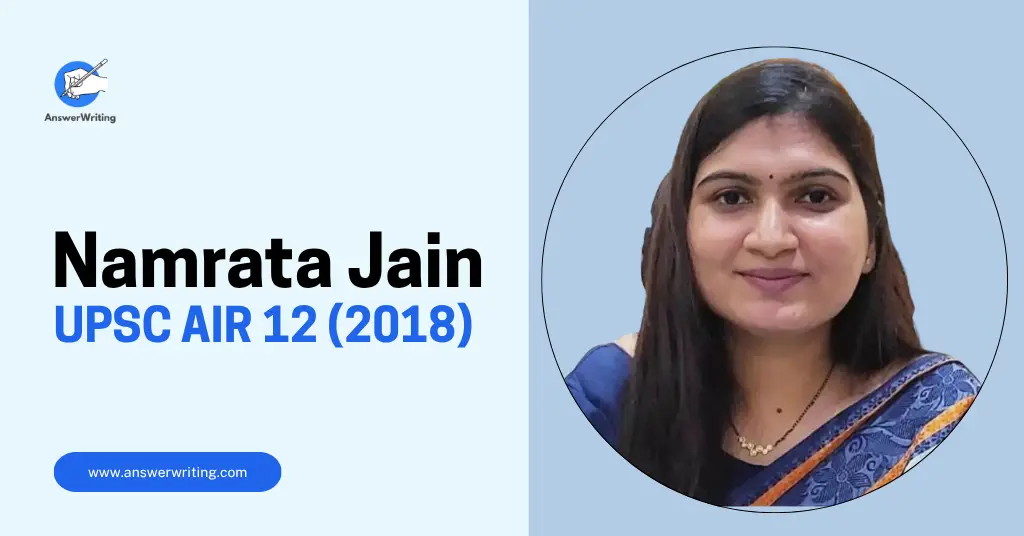
Who Is Namrata Jain?
Namrata Jain is a 2019-batch IAS officer of the Chhattisgarh cadre. She secured All India Rank (AIR) 12 in the UPSC Civil Services Examination (CSE) 2018. Her success is a landmark for the Bastar division. She is one of the few candidates from this region to break into the top 20.
| Feature | Details |
| Full Name | Namrata Jain |
| UPSC Rank | AIR 12 |
| Exam Year | 2018 |
| Service | Indian Administrative Service (IAS) |
| Cadre | Chhattisgarh |
| Optional Subject | Anthropology |
| Hometown | Geedam, Dantewada (Chhattisgarh) |
Namrata Jain UPSC Marksheet and Score Details
Namrata’s jump from Rank 99 in her previous attempt to Rank 12 was fueled by a massive score in the Mains and Optional papers. She consistently maintained high standards in her written expression.
| Paper | Marks Obtained |
| Essay | 134 |
| General Studies I | 114 |
| General Studies II | 108 |
| General Studies III | 102 |
| General Studies IV (Ethics) | 111 |
| Optional I (Anthropology) | 158 |
| Optional II (Anthropology) | 153 |
| Written Total | 880 |
| Personality Test | 193 |
| Final Total | 1073 |
Educational Background and Early Life
Namrata attended a local school in Geedam up to class 10. She later moved to Bhilai for higher secondary education. She holds a Bachelor of Engineering (B.E.) degree in Computer Science from the Bhilai Institute of Technology.
Growing up in Dantewada influenced her deeply. She witnessed the challenges of administration in conflict zones firsthand. Her family provided a stable environment despite the surrounding volatility. Her father is a businessman, and her mother is a homemaker. Their support allowed her to focus entirely on her goal.
How Many Attempts Did Namrata Jain Take?
Namrata reached the IAS through a journey of three distinct attempts. Each attempt taught her a different lesson about the UPSC process.
- First Attempt: She did not clear the Prelims. She realized that her preparation lacked depth and factual accuracy.
- Second Attempt (2016): She secured AIR 99. She was allotted the Indian Police Service (IPS). While she joined the training, her heart remained set on the IAS.
- Third Attempt (2018): She aimed for the top. She analyzed her previous marks and identified where she could gain an extra 50 to 60 marks. This precision led her to AIR 12.
Her mindset shift was crucial. She moved from “trying to pass” to “trying to excel.” She focused on the quality of her answers rather than just covering the syllabus.
Namrata Jain Optional Subject: Anthropology
Namrata chose Anthropology as her optional subject. She found it interesting and scoring. The syllabus is relatively concise compared to subjects like History or Geography.
Her strategy for Anthropology included:
- Physical Anthropology: Focus on clear diagrams of human evolution and genetics.
- Social Anthropology: Memorizing the names of thinkers and their specific theories.
- Tribal India: Since she belongs to Chhattisgarh, she used real-life examples of tribal communities she had seen.
She used standard books like P. Nath for Physical Anthropology and Nadeem Hasnain for Tribal India. She emphasized that Anthropology requires a mix of scientific facts and social analysis.
UPSC Preparation Strategy of Namrata Jain
Namrata’s strategy was built on self-discipline. She spent some time in Delhi for coaching initially but later moved back to her home state to study.
- Integrated Approach: She did not study for Prelims and Mains separately. She covered a topic and then looked at it from both factual (Prelims) and analytical (Mains) perspectives.
- Current Affairs: She relied heavily on The Hindu and monthly compilations. She made digital notes to keep them organized and easy to update.
- Revision: She followed a strict revision cycle. She reviewed her weekly notes every Sunday.
- Self-Study: While coaching gave her a foundation, she believes self-study is where the actual learning happens. She spent 8 to 10 hours daily during peak preparation months.
Books and Resources Recommended by Namrata Jain
Namrata kept her resource list limited. She practiced the “one book, ten times” rule rather than “ten books, one time.”
| Subject | Book/Resource | Author/Source |
| History (Modern) | A Brief History of Modern India | Spectrum |
| Polity | Indian Polity | M. Laxmikanth |
| Economy | Indian Economy | Ramesh Singh / Mrunal Patel videos |
| Geography | NCERT Class 11 & 12 | NCERT |
| Environment | Environment | Shankar IAS Academy |
| Ethics | Lexicon for Ethics, Integrity & Aptitude | Chronicle |
| Ancient History | Old NCERT | R.S. Sharma |
Mains Answer Writing Approach
Namrata believes that Mains is where the battle is won. She focused on making her answers visually appealing. She used flowcharts, maps, and bullet points to ensure the examiner could find the main points quickly.
She recommends that aspirants start writing early. Waiting to “finish the syllabus” is a mistake because the syllabus is never truly finished. For those practicing at home, using tools like the Answer Evaluator on AnswerWriting.com can be a game changer. It provides the kind of structured feedback on content and language that she sought through peer reviews during her journey.
Namrata also practiced Daily Answer Writing to improve her speed. She focused on the “Introduction, Body, Conclusion” format. She always tried to end her answers with a positive, forward-looking suggestion or a government scheme.
Interview (Personality Test) Experience
Namrata’s interview was a test of her confidence and regional knowledge. Since she comes from a Naxal-affected area, she expected questions on internal security.
The board asked her about:
- Solutions for the Naxal problem in Bastar.
- The role of women in the police force (since she was already in IPS training).
- Her hobbies and educational background.
She remained calm and honest. When she didn’t know an answer, she politely admitted it. Her high score of 193 reflects her ability to communicate complex ideas with clarity.
Service and Cadre Allotted to Namrata Jain
Namrata Jain was allotted the Indian Administrative Service (IAS). She received her home cadre of Chhattisgarh. This was a significant moment for her. She wanted to work for the development of the region she grew up in.
She has served in various capacities within the state. Her work as an SDO in Saraipali was highly praised. She focuses on grassroots implementation of education and healthcare schemes.
Key Lessons Every UPSC Aspirant Can Take from Namrata Jain
- Analyze Your Failures: Namrata didn’t just retake the exam. She analyzed her marks to see why she was AIR 99 and not AIR 10.
- Context Matters: She used her background in Dantewada as a strength in her Optional and Interview rather than a limitation.
- Precision over Volume: Her booklist was small. She mastered the basics instead of chasing every new material in the market.
- Discipline Over Motivation: Motivation fades, but her 10-hour study schedule was a non-negotiable habit.
FAQs About Namrata Jain
What was Namrata Jain’s optional subject?
Her optional subject was Anthropology. She scored 311 marks in her optional papers in 2018.
How many attempts did Namrata Jain take?
She took three attempts. She failed the first, got AIR 99 in the second, and AIR 12 in the third.
Which coaching did Namrata Jain attend?
She initially took coaching in Delhi but did most of her core preparation through self-study and test series.
Where is Namrata Jain posted now?
She is currently serving in her home cadre of Chhattisgarh. She has held positions like SDO and is involved in district administration.
Is Namrata Jain from a rural background?
Yes, she hails from Geedam, a small town in the Dantewada district of Chhattisgarh, which is known as a rural and Naxal-affected area.