List of Optional Subjects in UPSC All 48 Subjects Explained
Every year, lakhs of aspirants clear the UPSC Prelims and face the same critical question: which optional subject should I choose for Mains?
The answer begins with knowing what is available. UPSC offers 48 optional subjects across sciences, humanities, social sciences, engineering, medicine, law, and Indian languages. Each carries 500 marks across two papers of 250 marks each.
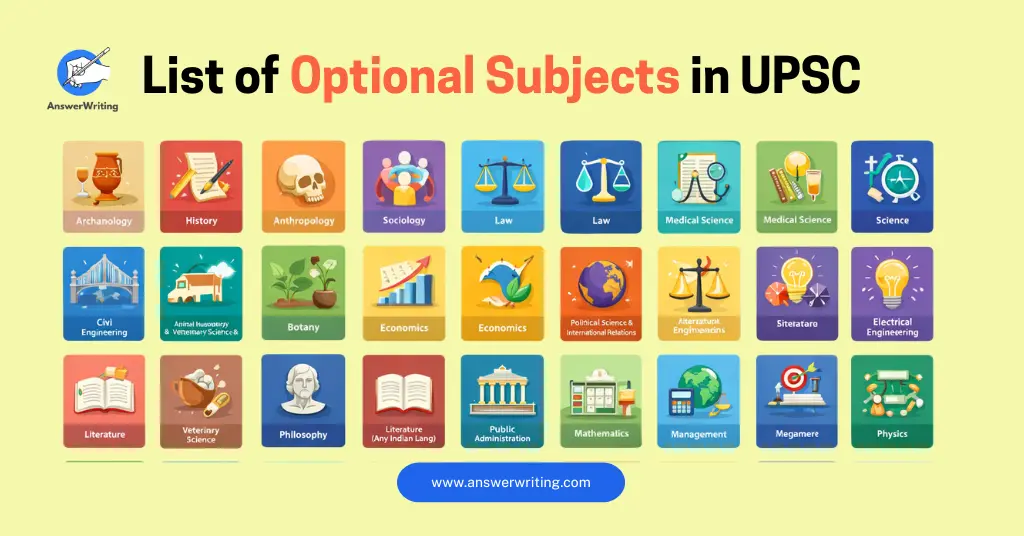
This post gives you the complete list, organised by category, with honest notes on each group to help you navigate the choice intelligently.
How the Optional Paper Works
Before the list, a quick structural note. In UPSC Mains, you choose one optional subject. That subject has two papers: Optional Paper I and Optional Paper II. Each paper carries 250 marks. Together, they contribute 500 marks to your total Mains score of 1,750 marks.
The optional examiner is a subject matter expert, not a generalist. This means your answers must demonstrate conceptual depth, correct use of subject-specific terminology, and familiarity with the standard literature of the discipline.
You can find the official and updated list of optional subjects on the UPSC website at upsc.gov.in. Always cross-check before your application, as UPSC has the authority to revise this list.
Category 1: Social Sciences
These are among the most popular optionals. They overlap well with GS papers and have abundant study material.
Anthropology One of the most consistently recommended optionals. The syllabus is compact, the content is relatively objective, and scoring trends have been strong. It covers physical anthropology, social and cultural anthropology, and Indian anthropology. A good choice for aspirants from science or social science backgrounds.
Sociology A favourite among humanities graduates. The syllabus covers sociological theory, research methods, and Indian society. It overlaps heavily with GS1 (Indian society) and GS2 (social justice). Conceptually accessible but requires genuine theoretical depth to score well.
Political Science and International Relations Covers political theory, comparative politics, Indian government and politics, and international relations. Overlaps significantly with GS2. A natural choice for political science graduates and aspirants with a strong interest in governance and foreign policy.
Public Administration Directly relevant to administrative work. Covers administrative theory, Indian administration, and comparative public administration. Overlaps with GS2 and GS4. Popular among management graduates and aspirants interested in governance. Requires updated policy knowledge given the contemporary focus of Paper II.
Psychology Covers psychological theory, methods, and applied psychology. Less common than Sociology or Anthropology but has a dedicated aspirant community. Requires genuine interest in behavioural science. Limited GS overlap but develops analytical thinking useful across the exam.
Category 2: Humanities and Liberal Arts
History A traditional favourite. Covers ancient, medieval, and modern Indian history, as well as world history. Overlaps heavily with GS1. The syllabus is long and demands historiographical depth. Best suited to history graduates or aspirants with strong reading habits and genuine historical curiosity.
Geography Consistently one of the top-performing optionals. Covers physical geography, human geography, economic geography, and regional planning. Overlaps strongly with GS1 and GS3. Rewards visual learners who can produce accurate maps and diagrams. A strong choice for science graduates comfortable with spatial reasoning.
Philosophy A compact, intellectually demanding syllabus covering Western and Indian philosophy, ethics, and logic. Overlaps partially with GS4 (ethics). Requires genuine philosophical engagement rather than rote preparation. Coaching options are limited but the subject rewards deep independent thinkers.
Economics Covers micro and macroeconomics, statistical methods, and Indian economic policy. Overlaps strongly with GS3. A natural fit for economics graduates. The quantitative component can produce very high scores for strong candidates but creates risk for those without a solid mathematical foundation.
Commerce and Accountancy Covers financial accounting, cost accounting, business management, and taxation. A practical choice for commerce graduates and CA aspirants. Limited GS overlap but the content is familiar and scoring is relatively objective for well-prepared candidates.
Management Covers management theory, organisational behaviour, human resource management, and strategic management. Suited to MBA graduates and management professionals. Overlaps partially with Public Administration.
Law Covers constitutional and administrative law, international law, and jurisprudence. A natural choice for law graduates. Requires precise legal reasoning and familiarity with landmark judgments. Overlaps with GS2 on constitutional topics.
Category 3: Pure and Applied Sciences
Mathematics Has the highest ceiling of any optional. Strong mathematics candidates can score exceptionally high because marking is objective and precise. But the floor is equally unforgiving. Recommended only for aspirants with a strong mathematics or engineering background who enjoy the subject genuinely.
Physics Covers classical mechanics, thermodynamics, electrodynamics, quantum mechanics, and modern physics. Suited to physics graduates and engineers. Objective marking but demanding syllabus. Limited GS overlap.
Chemistry Covers physical, organic, and inorganic chemistry. A natural choice for chemistry graduates and those with a science background. Objective marking with a well-defined syllabus.
Botany Covers plant biology, ecology, genetics, and plant physiology. Suited to life science graduates. Diagrams are essential and heavily rewarded. Limited GS overlap but a manageable syllabus for those with the background.
Zoology Covers animal biology, genetics, ecology, and evolution. Similar profile to Botany. Suits life science and veterinary graduates. Accurate scientific diagrams are critical.
Agriculture Covers agronomy, soil science, plant breeding, and agricultural economics. Overlaps with GS3 themes on agriculture and food security. A strong choice for agriculture graduates and those from farming backgrounds.
Animal Husbandry and Veterinary Science Covers animal nutrition, breeding, and disease management. Suited to veterinary science graduates. A niche but focused syllabus with objective content.
Geology Covers mineralogy, petrology, structural geology, and economic geology. Suited to geology graduates. Rewards diagram and map-based answers. Some overlap with physical geography in GS1.
Statistics Covers probability theory, statistical inference, sampling, and design of experiments. A quantitative optional suited to mathematics and statistics graduates. Objective marking with high scoring potential for strong candidates.
Category 4: Engineering Subjects
These optionals are suited exclusively to engineering graduates with strong technical foundations. They are rarely chosen outside their respective engineering disciplines.
Civil Engineering: Covers structural analysis, fluid mechanics, soil mechanics, and construction management.
Electrical Engineering: Covers circuit theory, control systems, power systems, and electronics.
Mechanical Engineering: Covers thermodynamics, manufacturing technology, machine design, and industrial engineering.
Chemical Engineering: Covers process calculations, thermodynamics, mass transfer, and chemical reaction engineering.
Each of these has a highly technical syllabus. Scoring is relatively objective for genuinely strong candidates. Limited GS overlap but deep familiarity for those who studied these disciplines.
Category 5: Medical Sciences
Medical Science Covers anatomy, physiology, biochemistry, pathology, medicine, surgery, and public health. Suited to MBBS graduates. A demanding but focused syllabus with objective content. Some overlap with GS3 themes on public health. One of the few optionals that directly leverages a professional degree.
Category 6: Indian Language Literatures
UPSC offers literature optionals in 22 Indian languages. These are listed in the Eighth Schedule of the Constitution. The complete list is:
Assamese, Bengali, Bodo, Dogri, Gujarati, Hindi, Kannada, Kashmiri, Konkani, Maithili, Malayalam, Manipuri, Marathi, Nepali, Odia, Punjabi, Sanskrit, Santhali, Sindhi, Tamil, Telugu, and Urdu.
English Literature is also available as a separate literature optional.
Literature optionals require deep engagement with the language, its literary tradition, and its critical scholarship. They are best suited to aspirants who have studied the language at graduation or postgraduate level, or who have a strong personal and cultural connection to it.
Scoring in literature optionals can be subjective and depends significantly on examiner preferences. However, aspirants who are genuinely at home in their chosen language often find these optionals deeply satisfying to prepare and uniquely differentiating in the exam.
A Quick Reference Summary
| Category | Subjects |
|---|---|
| Social Sciences | Anthropology, Sociology, Political Science and IR, Public Administration, Psychology |
| Humanities | History, Geography, Philosophy, Economics, Commerce and Accountancy, Management, Law |
| Pure Sciences | Mathematics, Physics, Chemistry, Botany, Zoology, Agriculture, Animal Husbandry, Geology, Statistics |
| Engineering | Civil, Electrical, Mechanical, Chemical Engineering |
| Medical | Medical Science |
| Literature | 22 Indian language literatures plus English Literature |
How to Use This List
Do not treat this list as a menu to browse casually. Treat it as the starting point of a serious research process.
Shortlist two or three subjects based on your academic background and genuine interest. Read the full UPSC syllabus for each. Attempt one previous year question per subject without preparation and compare how close you are to the expected depth. Talk to aspirants who have seriously prepared each subject.
Then decide. And commit fully.
The right optional, chosen after honest self-assessment and verified against the criteria that actually matter, is one of the most powerful advantages you can build into your UPSC preparation.