Kiran Bedi: India’s First Woman IPS Officer, Her Journey, and What UPSC Aspirants Must Learn from Her
A girl from Amritsar who grew up in a conservative Punjab household became the officer who towed the Prime Minister’s car for a parking violation. She then walked into one of India’s most dangerous prisons and turned it into a meditation centre. Kiran Bedi did not just crack a competitive examination. She redefined what a civil servant could be.
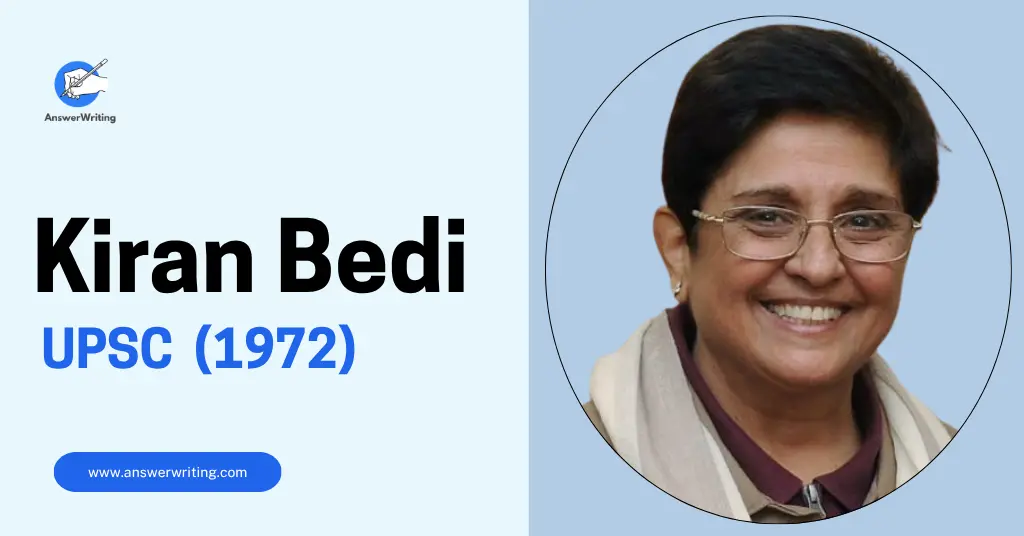
For UPSC aspirants, her story is not just inspirational. It is a live case study in administration, ethics, integrity, and leadership that directly maps to the GS syllabus.
Who Is Kiran Bedi?
Kiran Bedi is India’s first woman Indian Police Service (IPS) officer. She joined the IPS in 1972, at a time when the service had never seen a woman in its ranks. Over a career spanning nearly three decades, she served in some of the most challenging postings in the country and earned global recognition for her administrative innovations.
| Detail | Information |
|---|---|
| Full Name | Kiran Bedi |
| Date of Birth | June 9, 1949 |
| Birthplace | Amritsar, Punjab |
| IPS Batch | 1972 |
| Cadre | AGMUT (Arunachal Pradesh, Goa, Mizoram, Union Territories) |
| Notable Postings | DCP Traffic Delhi, IG Tihar Jail, DG BPR&D, UN Civilian Police Adviser |
| Highest Award | Ramon Magsaysay Award (1994) |
| Education | BA, MA (Political Science), LLB, PhD (IIT Delhi) |
| Post-Service Role | Lieutenant Governor of Puducherry (2016-2021) |
Her story is not one of a topper chasing a rank. It is one of a person who entered public service and changed the institutions she served.
A Note on Kiran Bedi and the UPSC Examination
Kiran Bedi did not appear for the UPSC Civil Services Examination as it exists today in its current format. She was selected into the IPS through the competitive examination of 1972. The structure and format of that examination were different from what aspirants face today.
However, she remains one of the most searched civil servant profiles among UPSC aspirants, and for very good reason. Her story teaches things that no textbook covers: how to handle hostile institutions, how to innovate within bureaucratic constraints, and how integrity functions as a career strategy, not just a moral choice.
For the purposes of this profile, the focus is on her journey, her administrative record, and the direct lessons aspirants can extract for their own preparation and future careers.
Kiran Bedi’s Educational Background and Early Life
Kiran Bedi was born on June 9, 1949, in Amritsar, to Parkash Lal Peshawaria and Prem Lal. Her father was a cloth merchant with a forward-thinking outlook. In a time when educating daughters was not a universal priority, her father insisted all four of his daughters receive the best possible education. That decision shaped everything that followed.
She completed her schooling in Amritsar and went on to pursue a Bachelor of Arts in English from Government College for Women, Amritsar. She then moved to Punjab University, Chandigarh, for her Master of Arts in Political Science, which she completed in 1970.
She was not just academically strong. She was a national-level tennis player who won the National Women’s Tennis Championship in 1966. Tennis gave her discipline, competitive drive, and the ability to lose and come back harder. These are qualities that define civil servants who last.
She later completed an LLB and, while serving in the IPS, earned a PhD in Social Sciences from the Indian Institute of Technology (IIT) Delhi. Her thesis examined drug abuse and domestic violence. The fact that she pursued a doctoral degree while managing one of the most demanding careers in India says something about her relationship with knowledge: it was not instrumental, it was genuine.
How Kiran Bedi Entered the IPS in 1972
In 1972, Kiran Bedi appeared for the Indian Police Service examination. She cleared it and was selected, becoming the first woman ever to join the IPS. The service had no precedent for a woman officer. There was no uniform designed for women, no protocol, and significant institutional resistance.
The selection in 1972 was remarkable not just for her but for what it meant structurally. The government had opened the IPS to women for the first time, and she walked through that door. She was posted to Chanakyapuri in Delhi as a sub-divisional police officer.
What followed was not a smooth ascent. She faced resistance from male colleagues, scepticism from superiors, and occasionally hostile public situations. She handled each of them with what would become her trademark: direct, principled action backed by thorough preparation.
For aspirants reading this: the examination is the beginning, not the summit. Kiran Bedi’s career demonstrates that what you do after clearing the exam defines your legacy.
The Making of a Civil Servant: Values That Drove Her
Kiran Bedi has spoken extensively in interviews and in her books about the values that guided her career. Three stand out consistently across everything she has said and done.
Integrity without exception. She was known for applying rules without fear or favour. This was not a performance. When she towed a car parked illegally outside a diplomatic function, she did not check whose car it was. It turned out to belong to the Prime Minister’s convoy. She did not rescind the action. This incident made headlines globally and became a defining moment in her career.
Preparation as a discipline. Whether it was managing traffic in Delhi or reforming Tihar Jail, she prepared thoroughly before acting. She studied the system she was entering, identified the pressure points, and moved with information. This is a quality the UPSC examination itself tests: the ability to analyse a system and suggest reforms.
Human dignity as a policy principle. Her work at Tihar was not rooted in toughness alone. It was rooted in the belief that every prisoner had a human core worth reaching. This perspective produced results that toughness alone never could. For GS Paper 4 aspirants, this is ethics in action, not ethics on paper.
Kiran Bedi’s Most Landmark Postings and Administrative Innovations
DCP Traffic, Delhi: The “Crane Bedi” Chapter
In 1988, Kiran Bedi was posted as Deputy Commissioner of Police (Traffic) in Delhi. Delhi’s traffic situation at the time was chaotic. Illegal parking was rampant, and enforcement was inconsistent and often influenced by the status of the vehicle owner.
She introduced a system of towing vehicles strictly based on violation, regardless of who owned them. When a car from the Prime Minister’s convoy was towed, the story went national. The press called her “Crane Bedi.” The nickname stuck, and so did the message: under her watch, the law applied equally.
She also restructured traffic management systems, improved signalling, and worked on public awareness. This posting demonstrated that a single committed officer, with institutional backing and personal courage, can change the experience of an entire city.
For aspirants writing answers on urban governance, traffic management, and rule of law, this is a concrete, verifiable Indian example worth citing.
Inspector General, Tihar Jail: Where Administration Became Transformation
This is the posting that made Kiran Bedi internationally known. In 1993, she was appointed Inspector General of Tihar Jail in Delhi, one of the largest prisons in Asia. The prison was overcrowded, violent, and deeply dysfunctional. Drugs circulated openly. Prisoners were idle and aggressive. Staff morale was low.
What she did over the next two years became a case study taught in universities worldwide.
She introduced Vipassana meditation for prisoners. This was not a cosmetic gesture. She partnered with the Art of Living Foundation and Vipassana teachers to conduct intensive courses inside the prison. Thousands of prisoners participated. Violence inside the jail measurably decreased.
She launched literacy programmes, vocational training, and legal aid camps. She published a newsletter edited by prisoners. She set up a system where prisoners could write to her directly with grievances, bypassing the usual chain of command that could suppress complaints.
She introduced yoga, agricultural activities, and a de-addiction programme for inmates dependent on drugs. Tihar, under her leadership, moved from a warehouse for convicted individuals to something approximating a space for rehabilitation.
Her book “It’s Always Possible” documented this transformation in detail. It was not a claim of perfection. The challenges were immense and continued after she left. But the proof-of-concept she established changed how India thought about prison reform.
For UPSC aspirants, Tihar under Kiran Bedi is directly relevant to:
- GS Paper 2 topics on prison reform, correctional facilities, and criminal justice
- GS Paper 4 topics on empathy, compassion, and service delivery
- Essay topics on rehabilitation, human dignity, and governance innovation
UN Civilian Police Adviser: India on the Global Stage
In 2003, Kiran Bedi was appointed as the United Nations Civilian Police Adviser, making her the first Indian and the first woman to hold that position. She worked with UN peacekeeping missions across conflict zones, advising on civilian policing in post-conflict situations.
This role placed India’s policing expertise on the global stage. For aspirants, it is a reminder that the IPS is not just a domestic service. It carries international responsibilities, and officers with strong records can represent India in global institutions.
Kiran Bedi and GS Paper 4 (Ethics): Why She Is a Case Study You Cannot Ignore
GS Paper 4 is where many aspirants struggle to move beyond abstract definitions. Examiners want values anchored in real situations. Kiran Bedi’s career offers precisely that.
Here is how her career maps to GS4 concepts:
Integrity: The PM convoy towing incident is the single clearest example of a public servant upholding integrity without exception. It is not theoretical. It happened, it was documented, and it had consequences.
Empathy: Her approach to Tihar prisoners was rooted in empathy. She saw people, not offenders. Her decision to introduce Vipassana was not a soft measure. It was a recognition that aggression has an inner cause that coercive methods alone cannot address.
Courage: Facing resistance from the system, from superiors, and from public opinion required sustained moral courage. She held positions that were unpopular within the police establishment because she believed they were correct.
Probity in public life: Her financial dealings, her public conduct, and her refusal to use her position for personal benefit are all documented aspects of her career.
Compassionate administration: The legal aid camps, the grievance boxes, the literacy programmes in Tihar all represent what compassionate administration looks like when it is actually implemented.
When you write GS4 answers, ground your points in examples like these. An answer that defines “empathy in administration” and then cites Kiran Bedi’s Tihar approach is far stronger than one that defines the term and leaves it there.
Books Written by Kiran Bedi (Essential Reading for Aspirants)
Kiran Bedi has written and co-authored several books that are valuable for UPSC preparation, particularly for ethics, governance, and essay writing.
| Book | Relevance for UPSC |
|---|---|
| It’s Always Possible | Prison reform, compassionate administration, GS2 and GS4 |
| I Dare! | Autobiography; values, integrity, public service |
| As I See It | Social perspectives, governance commentary |
| What Went Wrong (co-authored) | Criminal justice system and reform |
“It’s Always Possible” is the most directly useful. It documents the Tihar transformation with enough operational detail to give aspirants a thorough understanding of how reform works at the ground level.
Kiran Bedi’s Approach to Discipline and Time
Kiran Bedi has spoken at length in public talks and interviews about her personal discipline. A few principles emerge consistently.
She maintained physical fitness throughout her career, a habit rooted in her years as a competitive tennis player. She has connected physical discipline directly to mental clarity and decision-making capacity.
She read widely and continuously. Her academic pursuits, including her PhD, were not pauses in her career. They ran alongside it. She treated knowledge as a tool of administration, not an ornament of qualification.
She was meticulous about preparation before a new posting. Before taking charge at Tihar, she spent time understanding the institution before she began changing it. This sequencing, observe then act, is a principle she has articulated explicitly.
For aspirants, this translates simply. Know the syllabus deeply before you begin writing. Understand the question before you answer it. The principle is the same whether you are running a prison or attempting a UPSC Mains paper.
Mains Answer Writing: How to Use Kiran Bedi as an Example
Strong Mains answers are built on three things: a clear structure, relevant content, and anchoring examples. Kiran Bedi is a versatile anchor who can serve in multiple GS papers.
In GS Paper 2 (Governance, Policing, Prison Reform): Use Tihar as a case study for questions on criminal justice reform, overcrowding in prisons, or the rehabilitation versus punishment debate.
In GS Paper 4 (Ethics, Integrity, Aptitude): Use the PM convoy incident for integrity. Use Tihar’s Vipassana programme for empathy and compassion. Use her entire career arc for moral courage and probity.
In Essay Paper: Questions on “Compassion in governance,” “Can institutions be humanised?”, or “Leadership as service” can all be structured around her example.
The challenge in Mains answer writing is moving from knowing an example to deploying it correctly. The example must fit the question, support the argument, and be presented concisely. This is a skill that requires regular practice.
Platforms like AnswerWriting.com provide structured daily answer writing practice with AI-powered feedback that tells you exactly where your argument weakens, whether your example fits the question, and how your answer compares to UPSC scoring parameters. For GS4 in particular, where examples need to be grounded and specific, this kind of regular practice with feedback makes a measurable difference.
Awards and Recognition
Kiran Bedi’s work has been recognised at the national and international level. The most significant recognition came in 1994.
| Award | Year | Reason |
|---|---|---|
| Ramon Magsaysay Award | 1994 | Government service; Tihar Jail reform |
| President’s Police Medal for Gallantry | 1979 | Handling of communal situation |
| President’s Police Medal for Distinguished Service | 1994 | Outstanding service |
| Joseph Beuys Award (Germany) | 2004 | Social transformation work |
| Mahavir Chakra Equivalent (several state honours) | Various | Service citations |
The Ramon Magsaysay Award is considered Asia’s Nobel Prize equivalent. It placed Kiran Bedi and India’s prison reform experiment on the global map. It also validated an approach to governance that was genuinely innovative at the time.
Life After IPS: Politics and the Puducherry Chapter
Kiran Bedi retired from the IPS in 2007 after a voluntary retirement. Her departure was linked to concerns about being sidelined for promotion, a matter that became publicly discussed. She has spoken about this period with candour.
After retirement, she became involved in civil society work, including the India Against Corruption movement led by Anna Hazare in 2011, which was a nationwide campaign for a strong anti-corruption law. Her public presence grew significantly during this period.
In 2015, she joined the Bharatiya Janata Party and contested the Delhi Legislative Assembly elections as the Chief Ministerial candidate. She lost the election.
In 2016, she was appointed Lieutenant Governor of Puducherry, a post she held until 2021. Her tenure in Puducherry was marked by public disagreements with the elected government, a situation that raised constitutional questions about the relationship between LGs and elected legislatures in Union Territories.
For UPSC aspirants, this chapter of her life is relevant to GS Paper 2 topics on constitutional positions, Centre-State relations, and the governance of Union Territories. It also offers a candid lesson: a distinguished career does not guarantee a smooth transition to every new role. Institutions are complex, and political contexts create constraints that even the most capable individuals must navigate.
What UPSC Aspirants Can Directly Apply from Kiran Bedi’s Approach
Kiran Bedi’s career is not just a biographical fact. It is a preparation resource. Here are five direct applications.
- Use her as a GS4 anchor, not just a biographical name. Every major event in her career maps to a GS4 value. Learn the Tihar details well enough to describe what she actually did, not just that she reformed the prison. Specificity is what earns marks.
- Understand that integrity is operational, not just aspirational. The PM convoy incident shows integrity in action under pressure. When writing about probity or rule of law, this is the kind of concrete example that demonstrates you understand the concept at a functional level.
- Study Tihar as a systems reform case. She did not change Tihar by issuing orders. She changed it by changing the inputs: the activities, the mindset, the culture. This is a governance approach worth understanding for any question on institutional reform.
- Read “It’s Always Possible” before your Mains. It is not a long or difficult book. It is an operational account of how one person managed institutional change under resource constraints and in a hostile environment. It is one of the most directly UPSC-relevant books written by an Indian civil servant.
- Build physical and mental discipline into your preparation routine. Kiran Bedi has consistently linked athletic discipline to professional effectiveness. This is not incidental. A preparation routine that includes physical activity, regular sleep, and structured breaks produces better results than one that sacrifices health for study hours.
FAQs About Kiran Bedi
Was Kiran Bedi the first woman IPS officer in India? Yes. Kiran Bedi became the first woman to join the Indian Police Service in 1972. No woman had been part of the IPS before her.
What is Kiran Bedi most famous for? She is most famous for two things: towing a vehicle from the Prime Minister’s convoy for a parking violation, and transforming Tihar Jail during her tenure as Inspector General from 1993 to 1995.
What is Kiran Bedi’s optional subject for UPSC? Kiran Bedi appeared for the IPS examination in 1972, not the modern Civil Services Examination with its current format. Optional subjects as a separate, structured component are part of the modern Mains format. As per available reports, she does not have an “optional subject” in the way aspirants today would understand the term.
Which award did Kiran Bedi receive for her prison reform work? She received the Ramon Magsaysay Award in 1994 for government service, primarily for her work in transforming Tihar Jail.
Did Kiran Bedi attend any coaching for the IPS examination? There is no widely reported information about formal coaching for her 1972 examination. Information from official or verified biographical sources should be cross-checked for specific preparation details.
What cadre did Kiran Bedi serve in? She served in the AGMUT cadre, which covers the Union Territories of Arunachal Pradesh, Goa, Mizoram, and various Union Territories including Delhi.
Is Kiran Bedi’s story relevant for UPSC preparation today? Highly relevant. Her career is a direct resource for GS Paper 2 (governance, policing, prison reform), GS Paper 4 (ethics, integrity, compassion), and the Essay paper. She is also one of the most recognisable Indian civil servants for questions on women in public service and institutional reform.
A Final Word for Aspirants
Kiran Bedi did not have a template to follow. No woman had walked that path before her. She built her career on preparation, discipline, and a refusal to let the institution define the limits of what was possible.
UPSC preparation is, in a sense, the same exercise. There is no guaranteed formula. There is only thorough preparation, honest self-assessment, and the willingness to keep going when it is not easy.
The examination selects people who can think clearly under pressure and serve with integrity under inconvenient circumstances. Kiran Bedi’s career is a forty-year demonstration of exactly those qualities.
Study the exam. But also study the careers it can lead to. The two are not separate.