Most candidates who finish in the top five of UPSC have at least one previous attempt behind them. That prior attempt gives them something invaluable: a real understanding of where they fell short and what needs fixing.
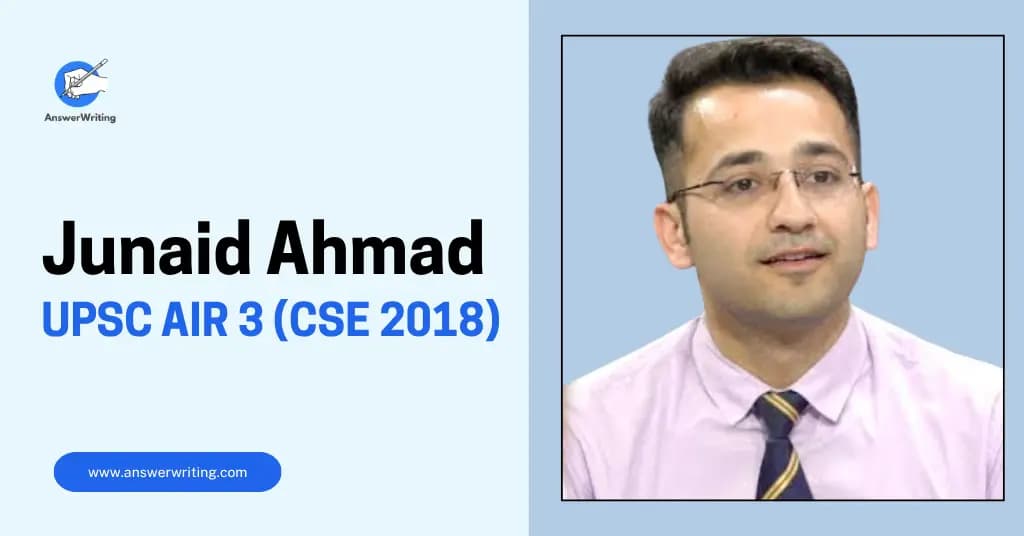
Junaid Ahmad did not have that. He finished AIR 3 in the UPSC Civil Services Examination 2018 on his very first attempt, with Sociology as his optional, coming from Saharanpur in Uttar Pradesh. No prior attempt. No benchmark from a previous cycle. Just one shot, and third in the country.His story is a powerful reminder that your past academic record does not define your future in the civil services.
Who Is Junaid Ahmad?
Junaid Ahmad is a 2019 batch IAS officer from the Uttar Pradesh cadre. Born in the small town of Bijnor, UP, he grew up in a middle-class family where education was valued but not forced. Junaid often describes himself as an ordinary student who found his extraordinary drive only after entering the UPSC cycle.
| Detail | Information |
| Rank | AIR 3 |
| Year of Exam | UPSC CSE 2018 |
| Service Allotted | Indian Administrative Service (IAS) |
| Attempt Number | 5th Attempt |
| Optional Subject | Geography |
| Home State | Uttar Pradesh |
Junaid Ahmad UPSC Marksheet and Score Details
Junaid’s success was built on a massive written score. His performance in Geography and General Studies Paper 2 was particularly high, providing him with a significant lead before the interview stage.
| Paper | Marks Obtained |
| Essay | 132 |
| General Studies 1 | 102 |
| General Studies 2 | 111 |
| General Studies 3 | 100 |
| General Studies 4 (Ethics) | 110 |
| Optional Paper 1 | 158 |
| Optional Paper 2 | 163 |
| Written Total | 876 |
| Personality Test | 184 |
| Final Total | 1060 |
Educational Background and Early Life
Junaid’s early academic life was modest. He attended St. Mary’s School in Bijnor and later Aligarh Muslim University (AMU). He completed his graduation in Electronics and Communication Engineering from Sharda University.
Throughout his school and college years, he was never a “topper.” He scored around 60% in his 10th and 12th boards. This background makes his UPSC success even more relatable for millions of aspirants who feel they lack the “elite” academic pedigree often associated with the IAS.
How Many Attempts Did Junaid Ahmad Take?
Junaid Ahmad cleared the UPSC in his fifth attempt. His journey was a long, five-year marathon that tested his mental strength:
- Attempts 1, 2, and 3: He could not clear the Prelims. This was a dark phase where many advised him to quit.
- Attempt 4: He finally broke the barrier, clearing all stages to secure Rank 352. He was allotted the Indian Revenue Service (IRS).
- Attempt 5: While in IRS training, he gave one last shot with a refined strategy and secured Rank 3.
He often says that those first three failures taught him more than his eventual success. They forced him to look at his preparation with brutal honesty.
Junaid Ahmad Optional Subject: Why Geography?
Junaid chose Geography as his optional subject. It is known for its vast syllabus, but Junaid liked its semi-scientific nature. He believed that if one understands the concepts of physical geography, the marks are predictable.
His Geography strategy included:
- Map Mastery: He practiced drawing the map of India and the world in under 30 seconds.
- Current Linkages: He connected human geography topics with current economic and social issues.
- Standard Resources: He relied on Savindra Singh for Physical Geography and Majid Husain for Indian Geography.
UPSC Preparation Strategy of Junaid Ahmad
Junaid Ahmad’s preparation was built on structured self-study, selective use of coaching resources, and a clear source discipline that prevented the common trap of reading too many books without mastering any.
Prelims: He followed the standard NCERTs-first approach for History, Geography, Polity, Economy, and Science. For Current Affairs, consistent editorial reading from The Hindu formed the backbone of his daily routine. His IIT background gave him a natural advantage in CSAT, reducing the time he needed to spend on that paper. For aspirants building Prelims accuracy, structured MCQ practice with topic-level performance tracking is what converts reading into reliable exam-day marks.
Mains GS Papers: He approached each GS paper with a defined source list and resisted the urge to keep adding new material. For GS Paper 1, standard History and Society references formed the base. For GS Paper 2, Laxmikanth for Polity was supplemented with government reports and scheme-specific reading. GS Paper 3 drew on Economy standard texts with Current Affairs integration. GS Paper 4 was prepared using Lexicon combined with regular case study practice.
Optional: Daily engagement with Sociology material was non-negotiable. He treated the optional not as a subject to read and revise periodically but as a skill to be maintained through consistent writing and application.
Revision: He prioritized completing revision cycles over consuming new material in the months approaching the examination. Deep familiarity with a limited source set consistently outperforms shallow familiarity with a wide one.
Test Series: Enrolling in a Mains test series was part of his preparation, as per available reports. Writing full answers under timed examination conditions before the actual exam is a discipline that virtually every serious topper shares.
Books and Resources Recommended by Junaid Ahmad
| Subject | Book/Resource | Author/Source |
| Polity | Indian Polity | M. Laxmikanth |
| Modern History | A Brief History of Modern India | Spectrum |
| Geography | NCERTs and GC Leong | NCERT / GC Leong |
| Economics | Mrunal’s Videos and Ramesh Singh | Mrunal Patel / Ramesh Singh |
| Environment | Shankar IAS Notes | Shankar IAS |
| Ethics | Lexicon and Case Studies | Chronicle |
Mains Answer Writing Approach
Junaid realized late in his journey that Mains is not a test of how much you know, but how well you communicate. In his successful attempts, he focused heavily on the structure of his answers. He used maps, diagrams, and flowcharts even in General Studies papers to make his answers visually appealing.
He recommends that answer writing should become a daily habit. One cannot wait to “finish the syllabus” before writing. Using the Daily Answer Writing feature on AnswerWriting.com can help build this consistency. It allows you to tackle fresh prompts every day and track your progress over months. Getting your answers evaluated by the Answer Evaluator ensures that you are adding the right amount of UPSC-specific keywords and maintaining the correct word limit, just as Junaid did to jump from Rank 352 to Rank 3.
Interview (Personality Test) Experience
Junaid scored a solid 184 marks in his interview. He was interviewed by the Air Marshal A.S. Bhonsle board. The questions were diverse, covering his background in Bijnor, his engineering degree, and his experience in the IRS.
He was appreciated for his honesty. When he didn’t know an answer, he simply said so instead of trying to guess. He believes the interview is about your “suitability” for the job, which includes your honesty, composure, and clarity of thought.
Service and Cadre Allotted to Junaid Ahmad
Junaid Ahmad was allotted the Indian Administrative Service (IAS) and received his home cadre, Uttar Pradesh. He has since been serving in his home state, where he is known for being an accessible and empathetic officer. His journey from an average student to a high-ranking officer in his own state makes him a local hero in Bijnor and beyond.
Key Lessons Every UPSC Aspirant Can Take from Junaid Ahmad
- Treat your first attempt as your best attempt, not as a trial run. Junaid’s AIR 3 on the first attempt was not luck. It was the result of preparing with the completeness and seriousness that most aspirants only develop after a failed attempt. Ask yourself honestly whether your preparation is complete before you sit, not after.
- Choose your optional for its strategic fit, not its popularity. Sociology is popular, but Junaid chose it because it genuinely complemented his thinking, filled gaps in his understanding of Indian society, and overlapped with the GS papers he needed to score in. Popularity is a secondary factor. Strategic fit is the primary one.
- Source discipline beats source volume. He worked from a defined, limited set of books and mastered them rather than constantly adding new material. A well-revised limited source set consistently outperforms a loosely read wide one.
- Engineering thinking is a transferable asset in UPSC. Analytical problem-solving, structured reasoning, and the ability to break complex systems into components are skills that IIT training builds and UPSC rewards. If you have an engineering background, recognize it as an advantage across GS papers and the essay, not just in optional selection.
- Writing practice must begin early, not close to Mains. Reading Sociology for months and then practicing answers in the final weeks before the examination is a preparation model that consistently underperforms. Writing is a skill that needs daily repetition across the entire preparation period.
FAQs About Junaid Ahmad
What were Junaid Ahmad’s marks in 10th and 12th?
He was an average student and scored around 60% in his board exams.
How many attempts did he take?
He cleared the exam in his fifth attempt.
What was Junaid Ahmad’s optional subject?
His optional subject was Geography.
Which cadre was allotted to him?
He was allotted the Uttar Pradesh (UP) cadre.
Did Junaid Ahmad clear Prelims in his first attempt?
No, he failed to clear the Prelims stage in his first three attempts.
Where did he do his graduation?
He completed his B.Tech from Sharda University.