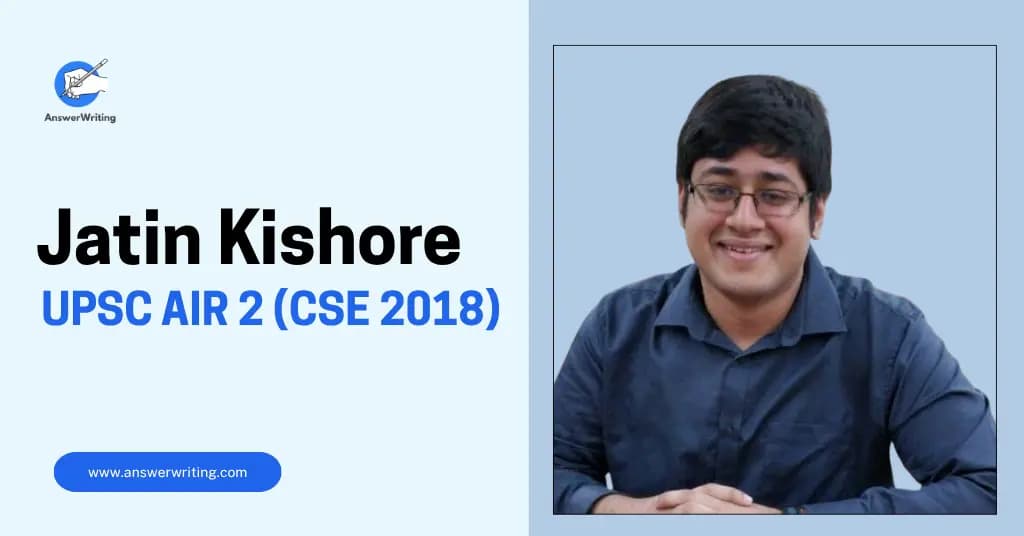
Most IIT graduates appearing for UPSC gravitate toward Mathematics, Physics, or Public Administration as their optional subject. Jatin Kishore did none of that. He chose Hindi Literature, scored exceptionally well in it, and finished second in the entire country in the UPSC Civil Services Examination 2018.
That single choice tells you almost everything you need to know about his preparation philosophy.
Who Is Jatin Kishore?
Jatin Kishore is an IIT Bombay graduate in engineering who cleared the UPSC Civil Services Examination 2018 with AIR 2. He is from Uttar Pradesh, as per widely reported sources, and was allotted the IAS after his result.
His profile stands out not just because of the rank, but because of the path he took to get there.
| Detail | Information |
|---|---|
| Full Name | Jatin Kishore |
| Home State | Uttar Pradesh (as per available reports) |
| Educational Qualification | B.Tech, IIT Bombay |
| UPSC Exam Year | 2018 |
| AIR (All India Rank) | 2 |
| Number of Attempts | 3 (as per widely reported sources) |
| Optional Subject | Hindi Literature |
| Service Allotted | IAS |
| Cadre Allotted | As per available reports, Uttar Pradesh (readers should verify from official UPSC allotment data) |
Jatin Kishore UPSC Marksheet and Score Details
UPSC does not publish granular paper-wise marks in an officially accessible public format. The figures below are based on widely reported media sources and interviews. Readers should cross-check these from verified sources before citing them.
| Component | Marks (Approx., as per media reports) |
|---|---|
| Mains Written (GS Papers + Optional + Essay) | Approx. 890+ out of 1750 |
| Interview (Personality Test) | Approx. 175 out of 275 |
| Final Total | Approx. 1066+ out of 2025 |
His Mains written score, particularly in the Hindi Literature optional papers, is widely credited as the pillar of his final rank.
Educational Background and Early Life
Jatin Kishore completed his B.Tech from IIT Bombay, one of India’s most competitive engineering institutions. Clearing JEE and studying at IIT builds a particular kind of thinking: structured problem-solving, comfort with long preparation cycles, and the ability to work under pressure.
He is from Uttar Pradesh, a state with a strong tradition of Hindi language and literature. This background almost certainly shaped his comfort with Hindi as a medium of serious academic engagement.
After completing his engineering degree, he made the deliberate choice to prepare for the Civil Services Examination. His engineering training gave him analytical rigour. His linguistic and cultural roots gave him the foundation for his optional subject choice.
How Many Attempts Did Jatin Kishore Take?
Jatin Kishore cleared the UPSC Civil Services Examination in his third attempt, as per widely reported sources.
His first two attempts gave him experience with the exam structure and helped him identify where his preparation was falling short. Between attempts, he did not change his optional subject or radically overhaul his reading list. Instead, he refined what he already had.
This is an important distinction. Many aspirants respond to a failed attempt by abandoning their strategy entirely and starting from scratch. Jatin’s approach was different. He diagnosed specific gaps, in answer writing quality, in revision depth, and in current affairs integration, and fixed those without discarding the foundation he had built.
By his third attempt, his preparation was layered rather than new. That layering is what produced AIR 2.
Jatin Kishore’s Optional Subject: Hindi Literature and Why an Engineer Chose It
This is the most discussed and most instructive part of Jatin Kishore’s preparation.
Hindi Literature as an optional is chosen by a small fraction of UPSC candidates each year. It is perceived as difficult to score in, demanding a deep literary sensibility, and suitable only for candidates from humanities backgrounds. Jatin Kishore’s result challenged all three assumptions.
His reasoning for choosing Hindi Literature, as reported in interviews, was rooted in genuine command over the subject. He had grown up with Hindi as a primary language, had read widely in Hindi literature, and felt that he could write analytically about it at the level the UPSC Mains demands. He did not choose it because it was easy. He chose it because it was his.
This is a principle worth applying regardless of your background. An optional subject you understand deeply, and can write about with precision and insight, will always outperform an optional you chose for perceived safety.
For Hindi Literature optional, the preparation broadly covers two papers: one focused on the history of Hindi literature and literary forms, and one focused on prescribed texts and their analysis. Standard academic texts in Hindi literary criticism form the core of preparation for this optional.
Aspirants considering Hindi Literature as optional should note that answer quality, literary analysis depth, and language precision matter far more than rote coverage of facts.
UPSC Preparation Strategy of Jatin Kishore
Jatin Kishore’s strategy by his final attempt had three defining features: a tight source list, consistent revision, and disciplined answer writing practice.
Study Hours: He followed a structured daily routine. He has spoken about the importance of productive hours over clock hours, focusing on what gets absorbed rather than how long one sits at the desk.
Coaching vs. Self-Study: His preparation was primarily self-driven. He sought guidance at specific points but did not depend on classroom coaching for content delivery. This is consistent with his overall approach of internalising material rather than passively receiving it.
Sources for GS Papers:
| GS Paper | Key Sources |
|---|---|
| GS 1 (History, Society, Geography) | NCERTs, Bipan Chandra, Nitin Singhania, G.C. Leong |
| GS 2 (Polity, Governance, IR) | M. Laxmikanth for Polity, The Hindu for current affairs and governance |
| GS 3 (Economy, Environment, Security) | NCERT Economics, Economic Survey, PIB, The Hindu |
| GS 4 (Ethics) | Lexicon for Ethics, case study practice |
| Essay | Regular full-length essay writing under timed conditions |
Revision: He treated revision as a non-negotiable, not an optional activity to squeeze in before the exam. He revisited completed topics at fixed intervals and consolidated his notes rather than writing new ones repeatedly.
Current Affairs: The Hindu was his primary newspaper. He maintained the habit of linking every current affairs story to a GS syllabus topic, which kept his reading purposeful rather than general.
Books and Resources Recommended by Jatin Kishore
The following list is based on widely reported interviews and preparation discussions associated with his profile. Aspirants should note that the list is deliberately concise.
| Subject | Book/Resource | Author |
|---|---|---|
| Indian Polity | Indian Polity | M. Laxmikanth |
| Modern India | India’s Struggle for Independence | Bipan Chandra |
| Ancient India | History of Ancient India | R.S. Sharma |
| Medieval India | History of Medieval India | Satish Chandra |
| Art and Culture | Art and Culture | Nitin Singhania |
| Geography | Certificate Physical and Human Geography | G.C. Leong |
| Ethics | Lexicon for Ethics | Chronicle Publications |
| Economy | Indian Economy | Ramesh Singh |
| Current Affairs | The Hindu (daily) + PIB | Various |
| Hindi Literature Optional | Standard Hindi literary criticism texts and prescribed UPSC texts | Various academic authors |
For the Hindi Literature optional specifically, readers are advised to consult the detailed UPSC syllabus and identify the prescribed texts listed there, as these form the core of both papers.
Mains Answer Writing Approach
Jatin Kishore has emphasised answer writing as a distinct skill that requires separate, dedicated practice. Reading content prepares your mind. Writing answers under timed conditions prepares you for the actual exam.
His approach involved writing full answers regularly, reviewing them critically, and identifying specific weaknesses: whether the introduction was too vague, whether examples were specific enough, whether the conclusion added something beyond summarising the body.
He also focused on structure within answers. A good UPSC Mains answer has a clear entry point, a body that addresses all dimensions of the question, and a conclusion that does not merely repeat what was already said.
For aspirants looking to build this habit systematically, AnswerWriting.com‘s Daily Answer Writing feature provides fresh prompts every day with the ability to track writing progress over time. Consistent daily practice on a structured platform can replicate the kind of disciplined writing routine that separates toppers from candidates who read well but write poorly under exam pressure.
The key principle from Jatin’s approach: write more answers, reflect on each one, and fix one specific weakness per week rather than trying to fix everything at once.
Interview (Personality Test) Experience
Jatin Kishore’s DAF (Detailed Application Form) presented a genuinely interesting profile to the interview board. An IIT Bombay engineer who chose Hindi Literature as his optional, from Uttar Pradesh, is not a profile boards encounter every day.
This uniqueness is both an opportunity and a responsibility. The board would naturally ask about the reasoning behind his optional subject choice, his views on Hindi language and literature in contemporary India, and how his engineering background informs his approach to governance and public service.
He has spoken about preparing for his interview by going deep into his DAF rather than trying to prepare for every possible current affairs question. He knew his optional subject thoroughly, which gave him confidence when literary or cultural questions came up.
His interview score of approximately 175 out of 275 (as per available reports) was solid. Combined with a strong Mains written performance, it placed him at AIR 2.
The lesson for aspirants is clear. Your DAF is your interview. Know everything in it, especially the choices that seem unusual, because those are the ones boards explore most carefully.
Service and Cadre Allotted to Jatin Kishore
Jatin Kishore was allotted the IAS, the most sought-after service in the Civil Services Examination.
As per available reports, he was allotted the Uttar Pradesh cadre, which is also his home state. Readers are advised to verify this from official UPSC allotment lists, as cadre details are sometimes reported inaccurately in media.
After completing foundation training at LBSNAA (Lal Bahadur Shastri National Academy of Administration) in Mussoorie, IAS officers proceed to their allotted state for district-level postings and induction training.
Key Lessons Every UPSC Aspirant Can Take from Jatin Kishore
- Choose your optional for depth, not for safety. Jatin chose Hindi Literature as an IIT engineer because he genuinely commanded it. An optional you know deeply will always beat one you chose because it seemed popular or safe.
- Failed attempts are diagnostic tools, not dead ends. He did not abandon his strategy after earlier attempts. He identified specific gaps and fixed them without starting from zero. Treat each attempt as data, not as defeat.
- Revision is not a last-minute activity. His consistent revision schedule, built into his daily routine rather than reserved for exam month, is what made his preparation durable across multiple attempts.
- Answer writing needs daily practice, not occasional effort. He treated writing as a separate skill from reading. Build the habit of writing full answers under timed conditions from early in your preparation, not in the final weeks.
- Your interview identity starts with your DAF. His unusual profile, an IIT engineer with a Hindi Literature optional, became an asset in his interview because he had prepared for it honestly. Fill your DAF thoughtfully and know every entry inside out.
FAQs About Jatin Kishore
What was Jatin Kishore’s optional subject in UPSC?
Jatin Kishore chose Hindi Literature as his optional subject for the UPSC Civil Services Examination 2018, an uncommon choice for an IIT engineering graduate that contributed significantly to his AIR 2.
How many attempts did Jatin Kishore take to clear UPSC?
He cleared the examination in his third attempt, as per widely reported sources.
Which college did Jatin Kishore attend?
Jatin Kishore completed his B.Tech from IIT Bombay.
Which service and cadre was Jatin Kishore allotted?
He was allotted the IAS. As per available reports, his cadre is Uttar Pradesh. Readers should verify this from official UPSC allotment data.
Did Jatin Kishore attend coaching for UPSC?
His preparation was primarily self-driven. He may have sought guidance at specific points, but he did not rely on full-time classroom coaching, as per available reports.
Why did Jatin Kishore choose Hindi Literature as his optional despite being an engineer?
As reported in interviews, he chose Hindi Literature because he had a genuine command over the subject rooted in his language background and reading habits. He prioritised depth of understanding over perceived exam safety.
What books did Jatin Kishore recommend for UPSC preparation?
His core recommendations include Laxmikanth for Polity, Bipan Chandra for Modern India, Nitin Singhania for Art and Culture, G.C. Leong for Geography, and The Hindu for daily current affairs. For Hindi Literature optional, the UPSC-prescribed texts and standard Hindi literary criticism works form the foundation.