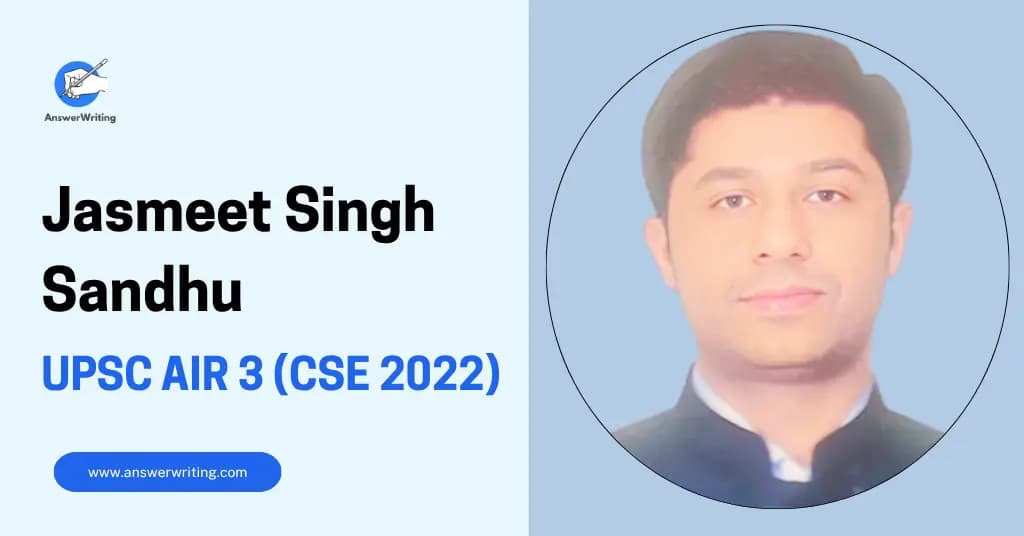
An IIT Roorkee graduate in Civil Engineering who picked Anthropology as his optional subject, cleared UPSC on his third attempt, and finished third in the entire country. That combination alone tells you something important: in UPSC, the smartest move is rarely the most obvious one.
How does a candidate already serving in the Indian Revenue Service (IRS) find the drive to sit for the exam again? For Jasmeet Singh Sandhu, the fourth attempt was not about desperation, but about reaching his true potential. In 2015, he achieved the remarkable feat of securing All India Rank (AIR) 3, proving that persistence is the most important trait for a civil services aspirant.
Who Is Jasmeet Singh Sandhu?
Jasmeet Singh Sandhu is a 2016 batch IAS officer. Born and raised in Delhi, he comes from a family where public service was deeply respected. His father worked with the Indian Council of Agricultural Research (ICAR). Jasmeet’s journey is often cited by mentors as a prime example of “incremental success,” where each attempt taught him a lesson that led to his final top 3 finish.
| Detail | Information |
| Rank | AIR 3 |
| Year of Exam | UPSC CSE 2015 |
| Service Allotted | Indian Administrative Service (IAS) |
| Attempt Number | 4th Attempt |
| Optional Subject | Punjabi Literature |
| Cadre | Rajasthan |
Jasmeet Singh Sandhu UPSC Marksheet and Score Details
Jasmeet’s marks in 2015 were a significant jump from his previous attempts. His ability to score 140+ in the Essay and high marks in his Optional subject provided the necessary cushion to enter the top 10.
| Paper | Marks Obtained |
| Essay | 145 |
| General Studies 1 | 102 |
| General Studies 2 | 111 |
| General Studies 3 | 114 |
| General Studies 4 (Ethics) | 111 |
| Optional Paper 1 | 134 |
| Optional Paper 2 | 144 |
| Written Total | 861 |
| Personality Test | 190 |
| Final Total | 1051 |
Educational Background and Early Life
Jasmeet completed his schooling at Sacred Heart School in Ludhiana and later moved to Delhi. He is an alumnus of the prestigious Indian Institute of Technology (IIT) Roorkee, where he earned his degree in Civil Engineering.
His technical background gave him a strong logical foundation. However, he realized early on that the UPSC Civil Services Examination required a shift from a purely “formula-based” mindset to a more “humanistic” and “socially aware” perspective. This transition was visible in how he eventually chose his optional subject.
How Many Attempts Did Jasmeet Singh Sandhu Take?
Jasmeet cleared the exam in his fourth attempt. His journey was a gradual climb:
- Attempts 1 & 2: He could not clear the initial stages, which he attributed to a lack of focused answer writing and choosing an optional subject (Psychology) that he had not fully mastered.
- Attempt 3: He secured Rank 332 and joined the Indian Revenue Service (IRS).
- Attempt 4: While undergoing IRS training at the National Academy of Customs, Indirect Taxes and Narcotics (NACIN), he appeared one last time and secured AIR 3.
This trajectory shows that he never changed his core goal. He simply refined his methods until the results matched his efforts.
Jasmeet Singh Sandhu Optional Subject: Why Punjabi Literature?
One of the most strategic moves Jasmeet made was switching his optional subject to Punjabi Literature. Despite being an engineer, he chose his mother tongue. He felt he could express his thoughts more naturally and deeply in Punjabi than in any other subject.
His strategy involved:
- Reading Original Texts: He focused on the classic works of Punjabi poets and writers.
- Writing Practice: He spent hours improving his handwriting and speed in the Gurmukhi script.
- Scoring Potential: He realized that literature subjects often have a better scoring trend if one has a genuine interest in the language.
UPSC Preparation Strategy of Jasmeet Singh Sandhu
Jasmeet’s strategy was unique because he had to balance it with his IRS training. He didn’t have 12 hours a day to study. Instead, he focused on “smart work.”
He prioritized the newspaper, specifically The Hindu and The Indian Express. He did not make bulky notes for every topic. Instead, he made “pointer notes” that were easy to revise during his travel or breaks at the academy. He emphasized that for Prelims, one must solve as many MCQs as possible to get the “feel” of the exam. Using tools like MCQ Practice for Prelims can help aspirants simulate this environment and track their accuracy across different subjects.
Books and Resources Recommended by Jasmeet Singh Sandhu
| Subject | Book/Resource | Author/Source |
| Polity | Indian Polity | M. Laxmikanth |
| History (Modern) | A Brief History of Modern India | Spectrum |
| History (Ancient) | NCERTs and Tamil Nadu Board | NCERT / TN Board |
| Economy | Economic Survey and Mrunal | Govt of India / Mrunal Patel |
| Geography | NCERT Class 11 & 12 | NCERT |
| Ethics | Lexicon and Previous Year Papers | Chronicle |
Mains Answer Writing Approach
Jasmeet believed that an answer should be balanced. It should not be too technical nor too simple. He focused on a “multi-dimensional” approach: if a question was asked about an economic issue, he would include its social, political, and environmental impacts.
He was a firm believer in the power of feedback. In his earlier attempts, he wrote answers but didn’t know where he was losing marks. To bridge this gap, modern aspirants can use the Answer Evaluator on AnswerWriting.com. It provides detailed AI-powered feedback on structure, content, and UPSC scoring parameters. This ensures that every answer you practice brings you closer to the quality expected of a topper.
Interview (Personality Test) Experience
Jasmeet was interviewed by the Vinay Mittal board. Having faced the board before, he was calm and confident. The questions were diverse, ranging from the problems in Punjab, his experience in IRS training, to the technical aspects of civil engineering.
He kept his answers brief and honest. He suggests that aspirants should not try to “bluff” the board. If you don’t know an answer, admit it politely. The board is looking for your personality and your ability to handle pressure, not just your factual knowledge.
Service and Cadre Allotted to Jasmeet Singh Sandhu
With Rank 3, Jasmeet comfortably secured his first choice: the Indian Administrative Service (IAS). He was allotted the Rajasthan Cadre. He has since served in various important roles in the state, including postings that allowed him to work on rural development and administrative reforms.
Key Lessons Every UPSC Aspirant Can Take from Jasmeet Singh Sandhu
- Don’t Fear Multiple Attempts: Each attempt is a learning curve. Use the experience of your previous failure to fuel your next success.
- Choose Your Optional Wisely: Don’t pick a subject because it is “popular.” Pick one where you can express yourself best, as Jasmeet did with Punjabi Literature.
- Consistency over Hours: Even if you are working or in training, 4-5 hours of focused study can be more effective than 10 hours of distracted reading.
- Use Modern Tools: Guidance is no longer limited to physical classrooms. Whether it is resolving doubts through an AI Mentor on AnswerWriting.com or getting your essays checked online, leverage technology to save time.
FAQs About Jasmeet Singh Sandhu
What was Jasmeet Singh Sandhu’s rank?
He secured All India Rank (AIR) 3 in the 2015 UPSC Civil Services Examination.
How many attempts did he take?
He cleared the exam in his fourth attempt.
What was his optional subject?
His optional subject was Punjabi Literature. He switched to it from Psychology.
Which cadre was allotted to IAS Jasmeet Singh Sandhu?
He was allotted the Rajasthan Cadre.
Was Jasmeet Singh Sandhu already in service?
Yes, during his fourth attempt, he was undergoing training for the Indian Revenue Service (IRS).
Which engineering college did he attend?
He graduated in Civil Engineering from IIT Roorkee.