Jagrati Awasthi: AIR 2 in UPSC CSE 2020, Strategy, and the Story Behind the Rank
An electronics engineer from Bhopal picks Sociology as her optional subject. She sits for UPSC twice. In her second attempt, she lands All India Rank 2 in one of the most competitive examinations on the planet.
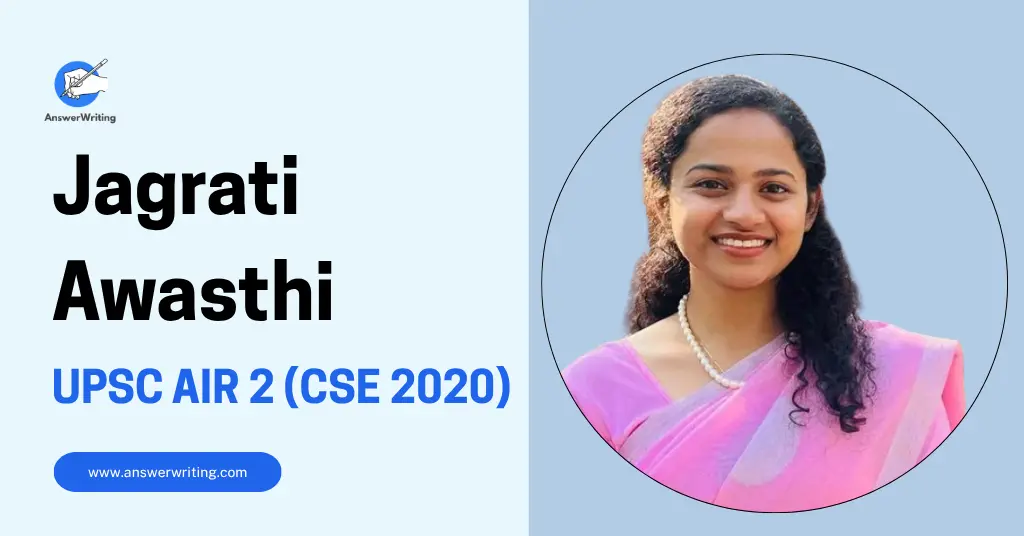
That is Jagrati Awasthi’s story in three lines. But the details matter a great deal more.
Who Is Jagrati Awasthi?
Jagrati Awasthi secured All India Rank 2 in the UPSC Civil Services Examination 2020, results for which were declared in 2021. She hails from Bhopal, Madhya Pradesh, and completed her engineering degree in Electronics and Communication from OIST Bhopal.
She cleared the exam in her second attempt and was allocated the Indian Administrative Service (IAS). As per widely reported sources, she was allotted the Madhya Pradesh cadre.
Her achievement is particularly notable because she is an engineer who chose a humanities optional, cracked Mains with strong scores, and made a dramatic leap from her first attempt to a top-2 finish.
Quick Profile:
| Detail | Information |
|---|---|
| Full Name | Jagrati Awasthi |
| AIR | 2 |
| Exam Year | UPSC CSE 2020 |
| Attempts | 2 |
| Optional Subject | Sociology |
| Service | IAS |
| Cadre | Madhya Pradesh (as per available reports) |
| Educational Background | B.Tech, Electronics and Communication, OIST Bhopal |
| Hometown | Bhopal, Madhya Pradesh |
Jagrati Awasthi UPSC Marksheet and Score Details
Exact paper-wise breakdowns for all UPSC toppers are released by the Union Public Service Commission after the final result. The figures below are as reported across widely circulated sources. Aspirants are advised to cross-check from the official UPSC marksheet notification.
| Component | Marks (Reported) | Maximum Marks |
|---|---|---|
| Essay (GS Paper 1 equivalent) | As per available reports | 250 |
| General Studies Paper 1 | As per available reports | 250 |
| General Studies Paper 2 | As per available reports | 250 |
| General Studies Paper 3 | As per available reports | 250 |
| General Studies Paper 4 (Ethics) | As per available reports | 250 |
| Optional Paper 1 (Sociology) | As per available reports | 250 |
| Optional Paper 2 (Sociology) | As per available reports | 250 |
| Interview (Personality Test) | As per available reports | 275 |
| Total (Written + Interview) | Strong aggregate placing her at AIR 2 | 1750 |
UPSC publishes individual marksheets on its official website. Aspirants can access the exact figures at upsc.gov.in after logging in with their roll number details.
Educational Background and Early Life
Jagrati grew up in Bhopal, a city that is home to many UPSC aspirants but has produced fewer toppers compared to metros like Delhi or Hyderabad. That context matters.
She pursued B.Tech in Electronics and Communication Engineering from OIST Bhopal. An engineering background typically prepares students well for the analytical and scientific components of the GS papers, particularly GS Paper 3 (Science and Technology, Economy, Environment).
What shaped her thinking toward civil services, as she has mentioned in widely reported interactions, was a desire to contribute to public administration and policy. The shift from engineering to UPSC preparation required a completely different intellectual orientation, particularly for Sociology as her optional.
How Many Attempts Did Jagrati Awasthi Take?
Jagrati cleared UPSC in her second attempt.
Her first attempt did not result in a final selection. Rather than treating this as a failure, she used it as a diagnostic exercise. The first attempt told her where her preparation was weak, how the actual exam pressure feels, and what needed to change.
Between her first and second attempt, she made deliberate corrections. She strengthened her answer writing, worked on structuring her Sociology answers with better conceptual clarity, and sharpened her Prelims accuracy.
This one-attempt gap between trying and succeeding is something many toppers share. The first attempt rarely goes to waste. It is, more often, the most valuable feedback mechanism available.
Jagrati Awasthi’s Optional Subject: Sociology
Why Sociology as an Engineer?
This is perhaps the most searched aspect of Jagrati’s preparation. Choosing a humanities optional as an engineer is unconventional. But it was a calculated decision.
Sociology has a concise, well-defined syllabus. The overlap with General Studies papers, especially GS Paper 1 (Indian Society) and GS Paper 4 (Ethics), is significant. A candidate who understands sociological theory also writes better GS answers on topics like poverty, gender, caste, and social movements.
For an engineer without a humanities background, Sociology is also considered more learnable from scratch than subjects like History or Political Science, which reward years of prior reading.
Strategy for Sociology
Jagrati’s reported approach to Sociology was built on three pillars:
Conceptual clarity first. She focused on understanding core thinkers (Marx, Weber, Durkheim, Parsons) and their frameworks before attempting answers. Rote memorization does not work in Sociology Mains answers. Examiners reward the ability to apply a thinker’s framework to a contemporary issue.
Answer structure. Sociology answers require a balance of theory, examples, and critical analysis. She practiced structuring answers with an introduction that defines the concept, a body that presents multiple perspectives, and a conclusion that connects to Indian society.
Indian Sociology as a priority. Paper 2 of Sociology (Indian Society) is often the differentiator. Knowing thinkers like M.N. Srinivas, Yogendra Singh, and A.R. Desai with enough depth to link their work to current affairs is essential.
Books Used for Sociology (as per available reports)
| Paper | Book | Author/Source |
|---|---|---|
| Paper 1 | An Introduction to Sociology | Anthony Giddens |
| Paper 1 | Sociological Theory | George Ritzer |
| Paper 2 | Social Change in Modern India | M.N. Srinivas |
| Paper 2 | Modernization of Indian Tradition | Yogendra Singh |
| Both Papers | IGNOU Notes (Sociology) | IGNOU |
| Both Papers | Previous Year Questions (PYQs) | UPSC Official |
UPSC Preparation Strategy of Jagrati Awasthi
Self-Study Over Coaching
Jagrati’s preparation was primarily self-driven. She used selective online resources and standard reference books rather than enrolling in a full-time classroom coaching program. This does not mean coaching is ineffective. It means the discipline of structured self-study, when executed consistently, can be equally powerful.
Study Hours
As per widely reported interviews, she maintained a consistent study schedule of 8 to 10 hours daily. She did not advocate extreme hours. She emphasized quality of study and regular revision over simply clocking hours.
Revision as a Non-Negotiable
One of her widely discussed strategies was cycling through her notes multiple times. Reading a source once is insufficient for UPSC. She reportedly went through her notes at least three times before the examination, with each cycle getting faster as familiarity grew.
Prelims Approach
For Prelims, she relied heavily on NCERTs as the foundation, followed by standard reference books for each subject. Mock tests formed a critical part of her Prelims preparation. Solving previous year questions in timed conditions helped her understand the pattern and eliminate tricky distractors.
Mains GS Approach
For GS Papers 1 through 4, she studied each topic with an eye on answer writing. Reading a chapter and then immediately writing a practice answer on a related question from that chapter is a technique many toppers, including Jagrati, recommend.
For Ethics (GS Paper 4), her Sociology background gave her an advantage. Understanding social structures and values at a theoretical level makes it easier to analyze ethical dilemmas with depth and nuance.
Books and Resources Recommended by Jagrati Awasthi
These are widely reported recommendations. Aspirants should cross-check from official interviews.
| Subject | Book / Resource | Author / Source |
|---|---|---|
| Indian History | History of Modern India | Bipan Chandra |
| Indian History | India’s Struggle for Independence | Bipan Chandra |
| Indian Polity | Indian Polity | M. Laxmikanth |
| Indian Economy | Indian Economy | Ramesh Singh |
| Geography | Certificate Physical and Human Geography | G.C. Leong |
| Environment | Environment by Shankar IAS | Shankar IAS Academy |
| Science and Technology | The Hindu newspaper + PIB | Daily reading |
| Ethics (GS 4) | Lexicon for Ethics | Chronicle Publications |
| Current Affairs | The Hindu, Indian Express | Daily reading |
| Sociology Optional | IGNOU Sociology Notes | IGNOU |
| Sociology Optional | Sociological Theory | George Ritzer |
| Essay | Previous Year Essays + practice | UPSC PYQs |
Mains Answer Writing Approach
Answer writing is where most UPSC aspirants lose marks without realizing it. Knowing the content is not enough. The way content is presented in 150 or 250 words determines the score.
Jagrati’s approach to answer writing, as reported, focused on three things: structure, balance, and relevance. Every answer needs a clear beginning, a substantive middle section with multiple dimensions, and a conclusion that goes slightly beyond the obvious.
She practiced answer writing regularly throughout her preparation, not just in the weeks before the exam. This is a distinction many serious aspirants overlook.
For aspirants looking to build a similar discipline, platforms like AnswerWriting.com offer structured daily answer writing practice with AI-powered feedback on parameters that UPSC examiners actually evaluate: content coverage, structure, language, and analytical depth. Getting your handwritten answers evaluated with specific, actionable feedback, much like topper-recommended peer review, can significantly sharpen your Mains performance before the actual exam.
The discipline of writing, getting feedback, and rewriting is what separates candidates who score 110+ per GS paper from those stuck at 85 to 90.
Interview (Personality Test) Experience
The UPSC Interview, also called the Personality Test, is worth 275 marks. With a strong Mains performance, Jagrati entered the Interview stage well-positioned.
UPSC interviews are largely DAF-driven (Detailed Application Form). The board asks questions based on the candidate’s educational background, home state, hobbies, and optional subject. For Jagrati, being an engineer from Bhopal who chose Sociology as optional would have made her DAF an interesting one for the board.
Key areas the board likely explored, based on her profile:
Her transition from engineering to civil services and the reasoning behind it. Madhya Pradesh-specific administrative and developmental issues. Sociology-related questions connecting theory to current social issues. Her views on technology’s role in governance, given her engineering background.
As per available reports, she performed confidently in the Interview stage, consistent with her overall rank.
Aspirants preparing for the Interview should remember that the board is not testing subject knowledge in depth. They are assessing communication, composure, intellectual honesty, and whether the candidate has the temperament to serve in a public role.
Service and Cadre Allotted to Jagrati Awasthi
Jagrati Awasthi was allotted the Indian Administrative Service (IAS). As per widely reported sources, she was allocated the Madhya Pradesh cadre, which is her home state.
IAS officers from the MP cadre work across the state in district administration, secretariat positions, and various state government departments. For an IAS officer of her rank, early postings typically involve district-level administration, which is considered the most important training ground for understanding ground-level governance.
Current posting details, as of the time of writing, should be verified from official government sources, as postings change over time.
Key Lessons Every UPSC Aspirant Can Take from Jagrati Awasthi
Your educational background does not limit your optional choice. An electronics engineer choosing Sociology and scoring well in it demonstrates that optional selection should be based on interest, syllabus fit, and overlap with GS, not on your undergraduate degree.
The first attempt is preparation for the second. Jagrati’s jump from an unranked first attempt to AIR 2 in the second is not luck. It is the result of treating the first attempt as live feedback. If you do not clear in your first attempt, use the data ruthlessly.
Revision beats reading new sources. Covering fewer books multiple times outperforms reading many books once. Toppers consistently point to their revision cycles, not their booklist length, as the real differentiator.
Answer writing is a daily practice, not a pre-exam sprint. Building the habit of structured answer writing from the first month of preparation, rather than starting two months before Mains, creates a measurable quality difference in the actual exam.
Self-study works, but only with structure. Jagrati’s success without full-time coaching is not an argument against coaching. It is an argument for discipline and structure. Whatever path you choose, the consistency of daily effort matters more than the mode of preparation.
FAQs About Jagrati Awasthi
What was Jagrati Awasthi’s optional subject? She chose Sociology as her optional subject for UPSC CSE 2020.
What rank did Jagrati Awasthi get in UPSC? She secured All India Rank 2 in UPSC Civil Services Examination 2020.
How many attempts did Jagrati Awasthi take to clear UPSC? She cleared UPSC in her second attempt.
Did Jagrati Awasthi take coaching for UPSC? As per widely reported information, she primarily followed a self-study approach rather than enrolling in full-time coaching. She used standard books and online resources.
Which service and cadre was Jagrati Awasthi allotted? She was allotted the Indian Administrative Service (IAS) and, as per available reports, the Madhya Pradesh state cadre.
What is Jagrati Awasthi’s educational background? She completed a B.Tech in Electronics and Communication Engineering from OIST Bhopal before transitioning to UPSC preparation.
Which books did Jagrati Awasthi recommend for Sociology optional? She reportedly relied on IGNOU Sociology notes, George Ritzer’s Sociological Theory, M.N. Srinivas’s Social Change in Modern India, and Yogendra Singh’s Modernization of Indian Tradition, among other standard references.