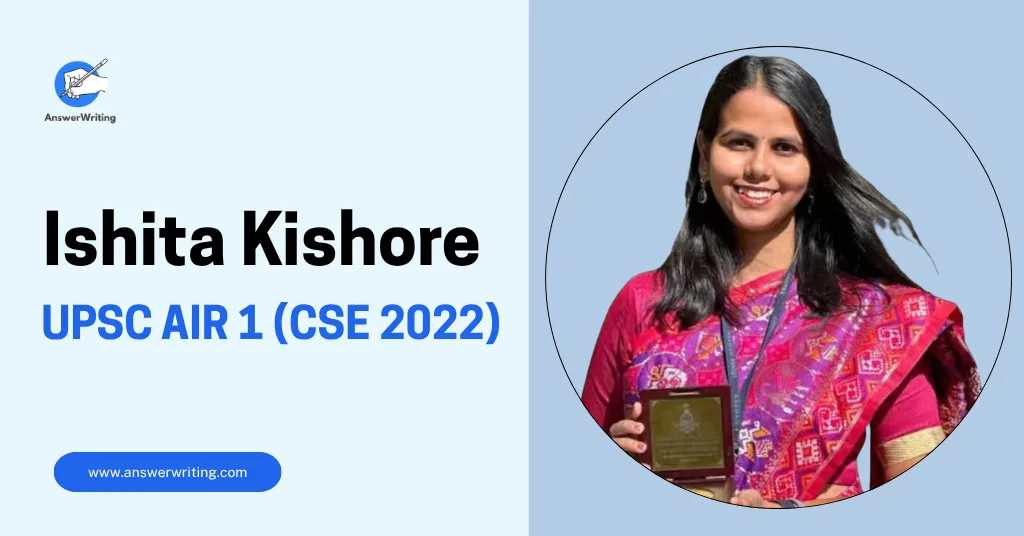
Ishita Kishore: UPSC AIR 1 (CSE 2022), Strategy, and the Comeback That Topped the Country
She failed to clear UPSC Prelims in her first attempt. Then she failed again in her second. Two attempts, two Prelims failures, zero Mains appearances.
Her third attempt produced AIR 1.
Ishita Kishore topped UPSC CSE 2022 with a total score of 1094 out of 2025. She was part of a historic batch where all four top ranks went to women. But the detail that matters most for every aspirant reading this is not the rank. It is the two Prelims failures that came before it.
Prelims is not a verdict on your UPSC potential. Ishita Kishore is the most conclusive proof of that.
Who Is Ishita Kishore?
| Parameter | Details |
|---|---|
| Full Name | Ishita Kishore |
| AIR | 1 |
| Exam Year | UPSC CSE 2022 |
| Total Score | 1094 out of 2025 |
| Number of Attempts | 3 |
| Optional Subject | Political Science and International Relations (PSIR) |
| Medium | English |
| Birthplace | Begumpet, Hyderabad, Telangana |
| Grew Up | Delhi |
| Service Allotted | IAS, Uttar Pradesh cadre |
| Schooling | Air Force Bal Bharati School, Lodhi Road, New Delhi (Class 12: 97.25%) |
| Graduation | B.A. Economics (Hons.), Shri Ram College of Commerce (SRCC), Delhi University, 2017 |
| Work before UPSC | Risk Analyst, Ernst and Young (E&Y), approximately 2 years |
Her father, Wing Commander Sanjay Kishore, served in the Indian Air Force and passed away in 2004 when Ishita was a child. Her mother, Jyoti Kishore, is a retired teacher. Her brother, Ishan Harsh, is an advocate.
Growing up in an Air Force household shaped her understanding of public service, discipline, and structured living in ways that most aspirants only encounter abstractly through textbooks.
Ishita Kishore UPSC Marksheet and Score Details
| Component | Marks |
|---|---|
| Prelims GS Paper 1 | 113.13 (as per available reports) |
| Prelims CSAT (GS Paper 2) | 91.97 (as per available reports) |
| Written Score (Mains) | 901 |
| Interview (Personality Test) | 193 |
| Grand Total | 1094 |
Her written score of 901 is exceptionally strong and was the primary driver of her final rank. A Mains written total of 901 out of 1750 (as per available reports) reflects consistent performance across Essay, all four GS papers, and both PSIR optional papers.
Her interview score of 193 out of 275 is a solid performance that reflects a well-prepared, personality-rich DAF and composed communication under board questioning.
Individual paper-wise Mains scores are not officially published by UPSC for all candidates. Cross-check the detailed breakdown from official UPSC publications and verified interview transcripts.
Educational Background and Early Life
Ishita completed her Class 12 from Air Force Bal Bharati School, Lodhi Road, New Delhi, scoring 97.25%. That school, attached to the Air Force community, instilled a culture of discipline and structured effort that ran through her entire preparation later.
She then secured admission to Shri Ram College of Commerce (SRCC), Delhi University, for a B.A. Economics (Hons.), graduating in 2017. SRCC is consistently ranked among India’s top undergraduate colleges and its peer environment, particularly through the Economics Society and Literary Society that Ishita was part of, built her analytical and written communication abilities.
Beyond academics, she was a national-level football player, representing her school at the Subroto Cup in 2012. She also pursued Madhubani painting and was involved in the Rotary Interact Club and United Nations simulation meetings at school level.
Those extracurriculars are not incidental. They built the multi-dimensional profile that made her DAF genuinely interesting to a Personality Test board, and her interview score of 193 reflects that.
After graduation, she joined Ernst and Young (E&Y) in Delhi as a Risk Analyst. She worked there for approximately two years before resigning in 2019 to prepare for UPSC full-time. That decision to leave a structured corporate career at 23 was driven by a clear and long-held motivation toward public service, one rooted in watching her father serve the nation in uniform.
How Many Attempts Did Ishita Kishore Take?
Ishita took three attempts. She did not clear Prelims in either of her first two attempts.
That detail is worth sitting with. She appeared for Prelims twice, did not reach Mains either time, and came back for a third attempt that produced the top rank in the country.
Between her failed attempts and her third, she made two significant recalibrations.
The first was on Prelims strategy. Prelims failure twice is almost always a signal of one of three problems: insufficient current affairs integration, weak MCQ elimination technique, or poor time management within the two-hour paper. She worked specifically on all three in her third cycle, using mock tests not just for practice but for diagnosing exactly where she was losing marks.
The second recalibration was on Mains answer writing. Because she had never appeared for Mains in her first two attempts, she had to build her answer writing ability from scratch in her third preparation cycle. She enrolled with ForumIAS for their Mains Guidance Programme (MGP) specifically for structured writing practice and feedback.
The combination of a fixed Prelims strategy and a deliberately built Mains answer writing habit changed the trajectory entirely.
For aspirants who have faced Prelims failures, Ishita’s three-attempt arc offers a concrete framework. Failure at Prelims is a calibration problem, not a capability verdict. Identify which of the three failure modes applies to you and fix that specifically.
Ishita Kishore’s Optional Subject: Why an Economics Graduate Chose PSIR
Ishita graduated in Economics from one of India’s best Economics departments. The logical assumption would be that she chose Economics as her optional. She did not.
She chose Political Science and International Relations, a subject outside her formal degree, and she scored strongly enough on it to anchor a written total of 901.
Her reasoning was deliberate. PSIR overlaps directly with GS Paper 2, which covers governance, polity, constitutionalism, and international relations. Those are also core PSIR syllabus areas. Choosing PSIR meant that her optional preparation was simultaneously reinforcing her GS2 preparation rather than running parallel to it as a separate body of content to master.
Her Economics background was not wasted. Economics reasoning and quantitative thinking supported her GS Paper 3 preparation covering economic development, infrastructure, and internal security. She got the benefit of both her graduation subject and her optional subject without having to formally choose between them.
PSIR also rewards analytical writing and structured argumentation, skills that SRCC’s academic environment and her involvement in debate and literary societies had already developed in her.
Standard books that aspirants use for PSIR optional, aligned with the preparation approach Ishita followed, include:
- M. Laxmikanth’s Indian Polity for foundational polity and GS2 layer
- Andrew Heywood for political theory and ideologies
- Norman Barry for political theory depth
- B.L. Fadia for Indian government and politics
- Mohit Bhattacharya for public administration overlap
- Previous years’ UPSC PSIR papers for answer pattern calibration
The core lesson from her optional choice: the right optional is not necessarily your graduation subject. It is the subject that offers the most overlap with GS papers while playing to your analytical strengths.
UPSC Preparation Strategy of Ishita Kishore
Ishita’s preparation strategy is distinguished by one principle that most aspirants struggle to accept: quality of study hours matters more than quantity.
She deliberately capped her study time at 40 to 45 hours per week. That works out to roughly six to seven hours per day, not the twelve to fourteen hour days that UPSC preparation culture often glorifies. Her reasoning was straightforward. Sustained comprehension and retention require recovery time. Hours spent reading while mentally exhausted do not convert into exam performance.
That cap forced her to be extremely selective about what she studied within those hours. It eliminated low-value activities, passive reading, repetitive note-making, and content not directly tied to the syllabus, more effectively than any time management framework could.
Self-made notes. She made her own notes rather than relying on pre-printed material or coaching notes. Self-made notes require you to process and synthesize information rather than just copy it. That processing is where actual learning happens.
Limited sources. She restricted herself to a small set of reliable books per subject and mastered those completely rather than browsing across multiple resources. The temptation to keep adding new sources is one of the most common preparation mistakes. Ishita’s approach was the opposite.
Previous Year Questions (PYQ) as the compass. She used PYQs to understand what UPSC actually tests before deciding what to study in depth. PYQs reveal both the pattern of questioning and the level of depth required. Studying without this filter leads to over-preparation on low-yield topics and under-preparation on high-frequency ones.
Mock tests for Prelims diagnosis. After two Prelims failures, she used mock tests not just for practice but as diagnostic tools to identify exactly where she was losing marks. She tracked her performance across mock attempts and adjusted her preparation accordingly.
Current affairs integration. She linked current affairs to static GS syllabus topics rather than treating them as a separate stream. Every current affairs item was tagged to a GS heading. That integration made both the static content and the current affairs more retrievable under exam conditions.
Books and Resources Recommended by Ishita Kishore
| Subject | Book / Resource | Author / Source |
|---|---|---|
| Indian Polity | Indian Polity | M. Laxmikanth |
| Modern History | India’s Struggle for Independence | Bipan Chandra |
| Ancient and Medieval History | NCERT Class 6 to 12 | NCERT |
| Geography | Certificate Physical and Human Geography | G.C. Leong |
| Indian Economy | Indian Economy | Ramesh Singh |
| Environment and Ecology | Shankar IAS Environment | Shankar IAS |
| Ethics (GS4) | Ethics, Integrity and Aptitude | G. Subba Rao and P.N. Roy Chowdhury |
| Current Affairs | The Hindu (daily) | Newspaper |
| Science and Technology | NCERT Class 8 to 12 Science | NCERT |
| PSIR Optional | Indian Polity | M. Laxmikanth |
| PSIR Optional | Political Theory | Andrew Heywood |
| PSIR Optional | Indian Government and Politics | B.L. Fadia |
| PSIR Optional | Previous Years UPSC PSIR Papers | UPSC |
| Mains Answer Practice | ForumIAS MGP (Mains Guidance Programme) | ForumIAS |
Cross-check this list against her published interviews, as specific recommendations may vary by paper and preparation phase.
Mains Answer Writing Approach
Ishita had never appeared for UPSC Mains before her third attempt. She had to build her answer writing ability from zero, not improve it. That context makes her written total of 901 even more significant.
She enrolled with ForumIAS for their Mains Guidance Programme (MGP), which provided structured answer writing practice with evaluator feedback on each test copy. The feedback loop was the key element. She was not just writing answers in isolation. She was writing, receiving evaluation, identifying gaps, and correcting them before the next test.
Her answer structure followed a consistent format throughout. A direct introduction that frames the question without restating it, an organized body with clearly separated sub-points backed by data, constitutional references, government schemes, or Supreme Court judgments where relevant, and a conclusion that connects to policy direction or constitutional values. That structure, applied consistently across all GS papers, is what produces a reliable written total rather than a variable one.
She used diagrams and flowcharts selectively in GS Paper 3 answers on economy, infrastructure, and disaster management, and in PSIR answers where relationships between concepts or institutions benefited from visual representation. Diagrams were a communication tool, not a habit.
One challenge she specifically worked to overcome was over-writing. Early in her Mains practice, she tended to write beyond the expected word limit, which sacrifices time on subsequent answers. She practiced strict word limit discipline through her ForumIAS test series until it became automatic.
For aspirants building their answer writing independently, getting consistent external feedback is the hardest part of the process. Platforms like AnswerWriting.com offer an Answer Evaluator that gives structured AI feedback on Mains answers covering content, structure, language, and UPSC scoring parameters. For aspirants who want the kind of regular evaluated practice that Ishita built through ForumIAS MGP but do not have access to a formal programme, that kind of systematic feedback tool can serve the same function.
Interview (Personality Test) Experience
Ishita scored 193 out of 275 in the Personality Test. That score reflects a candidate with a genuinely distinctive profile and the preparation to present it clearly.
Her DAF offered the board an unusually rich set of threads to pull. A national-level football player. An Economics graduate from SRCC who chose PSIR as her optional. A former Ernst and Young Risk Analyst. A Madhubani painter. The daughter of an Indian Air Force Wing Commander. Each of those elements invites a different line of questioning, and she had prepared for all of them.
She attended multiple mock interview sessions before the actual board appearance (as per available reports). Her preparation focused on presenting her choices, leaving E&Y, choosing PSIR over Economics, pursuing UPSC after two Prelims failures, as coherent and considered decisions rather than as things that happened to her.
She also prepared specifically for current affairs questions linked to her profile. An Air Force background invites questions on defence policy. An Economics degree invites questions on monetary policy and fiscal management. A national-level sport invites questions on sports governance and policy. She anticipated those connections and prepared along each axis.
Her 193 reflects a candidate who was self-aware, consistent, and genuinely interested in the conversation rather than anxious to get through it.
Service and Cadre Allotted to Ishita Kishore
Ishita Kishore was allotted the IAS with the Uttar Pradesh cadre, which she had listed as her cadre preference. UP cadre is one of the most sought-after and also one of the most demanding, given the scale and complexity of governance in India’s most populous state.
Her batch, the UPSC CSE 2022 batch, was historic. The top four ranks, AIR 1 (Ishita Kishore), AIR 2 (Garima Lohia), AIR 3 (Uma Harathi N), and AIR 4 (Smriti Mishra), all went to women. That outcome attracted national attention and became one of the most discussed results in recent UPSC history.
Current posting details should be verified from official government sources, as administrative postings change with tenure and transfers.
Key Lessons Every UPSC Aspirant Can Take from Ishita Kishore
- Two Prelims failures do not close the door. Ishita failed Prelims in her first two attempts and came back to secure AIR 1 on her third. Prelims is a specific skill set. If you are failing it, treat it as a calibration problem with a specific solution, not as evidence that UPSC is not for you.
- Quality of study hours beats quantity. She capped her preparation at 40 to 45 hours per week deliberately. Six to seven focused hours per day outperform twelve unfocused hours consistently. Build your timetable around sustainable, recoverable blocks, not around maximizing seat time.
- Your optional does not have to match your degree. She studied Economics at SRCC and chose PSIR. The right optional is the one with the most GS overlap and the best alignment with your analytical strengths, not the one that matches your graduation subject on paper.
- Build your Mains answer writing before you need it. Because she had never appeared for Mains before her third attempt, she had to construct her answer writing ability from scratch. That required a formal programme and disciplined practice over months. Do not leave answer writing for the last stretch. It takes time to build and cannot be rushed.
- Use your DAF as a preparation document, not just a form. Her interview score of 193 came from months of anticipating and preparing for every thread her DAF could generate. Every hobby, every work experience, every educational choice in your DAF is a question waiting to be asked. Prepare accordingly.
FAQs About Ishita Kishore
What is Ishita Kishore’s UPSC rank? She secured AIR 1 in UPSC Civil Services Examination 2022, results declared May 23, 2023.
What was Ishita Kishore’s optional subject in UPSC? Her optional subject was Political Science and International Relations (PSIR).
How many attempts did Ishita Kishore take to clear UPSC? She took three attempts. She did not clear Prelims in her first two attempts and secured AIR 1 on her third.
What is Ishita Kishore’s total UPSC score? Her total score is 1094, comprising a written score of 901 and an interview score of 193 out of 275.
Which college did Ishita Kishore attend? She studied B.A. Economics (Hons.) at Shri Ram College of Commerce (SRCC), Delhi University, graduating in 2017.
Did Ishita Kishore attend coaching for UPSC? She primarily prepared through self-study. She enrolled with ForumIAS for their Mains Guidance Programme (MGP) for structured answer writing practice and feedback. She did not attend full-time classroom coaching, as per available reports.
What cadre was Ishita Kishore allotted? She was allotted the IAS with the Uttar Pradesh cadre, which was her stated preference.