Iqbal Dhaliwal: UPSC Rank 1, Economics Strategy, and Global Impact
What happens when the mind that topped India’s toughest competitive exam meets the world’s most pressing developmental challenges? Iqbal Dhaliwal provides the answer. Long before he became a global leader in evidence-based policy at MIT, he set a record by securing All India Rank 1 in the 1995 UPSC Civil Services Examination in his very first attempt.
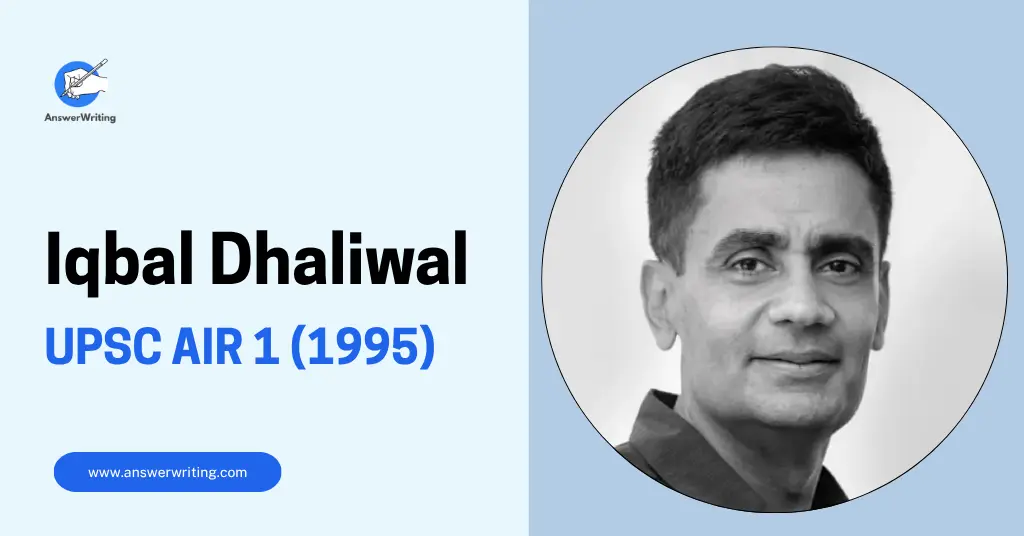
Who Is Iqbal Dhaliwal?
Iqbal Dhaliwal is a former IAS officer of the 1996 batch from the Tamil Nadu cadre. Today, he is the Global Executive Director of the Abdul Latif Jameel Poverty Action Lab (J-PAL) at the Massachusetts Institute of Technology (MIT). He works alongside Nobel laureates Abhijit Banerjee and Esther Duflo to transform how governments fight poverty through scientific data.
| Feature | Details |
| Full Name | Iqbal Dhaliwal |
| UPSC Rank | AIR 1 |
| Exam Year | 1995 |
| Attempt | First Attempt |
| Service Allotted | Indian Administrative Service (IAS) |
| Cadre | Tamil Nadu |
| Current Role | Global Executive Director, J-PAL (MIT) |
Iqbal Dhaliwal UPSC Marksheet and Score Details
In the 1995 exam cycle, Iqbal Dhaliwal emerged as the undisputed topper. His scores in the Economics optional are still discussed in academic circles for their depth and technical accuracy. He managed to secure a significant lead in the written Mains, which made his AIR 1 rank almost a certainty even before the interview results were out.
| Component | Performance Level |
| General Studies | Top Percentile |
| Optional 1 (Economics) | Record-Breaking |
| Optional 2 (Public Admin) | Exceptional |
| Interview | Highly Rated |
| Final Result | All India Rank 1 |
Educational Background and Early Life
Iqbal Dhaliwal’s success was built on a foundation of intense academic rigor. He completed his B.A. in Economics from St. Stephen’s College, Delhi, followed by an M.A. in Economics from the prestigious Delhi School of Economics (DSE).
His time at DSE was particularly influential. It trained him to look at social problems through the lens of data and economic theory. This analytical background allowed him to approach the UPSC syllabus not as a collection of facts to be memorized, but as a series of interconnected systems to be understood.
How Many Attempts Did Iqbal Dhaliwal Take?
Iqbal Dhaliwal is a first-attempt topper. He did not treat the exam as a gamble. Instead, he treated it as a professional project with a strict deadline.
He emphasizes that a first-attempt success requires “zero-defect” preparation. You cannot afford to make common mistakes in the Prelims or leave sections of the Mains syllabus untouched. For many aspirants today, achieving this level of precision on the first try is difficult without guidance. Utilizing an AI Mentor like the one on AnswerWriting.com can help bridge this gap by providing personalized strategies that mirror the disciplined approach Iqbal took.
Iqbal Dhaliwal Optional Subject: The Power of Economics
Choosing Economics was a strategic masterstroke for Iqbal. Having studied it at two of India’s best institutions, he had a massive advantage.
- Conceptual Depth: He moved beyond standard guidebooks and referred to original research papers and advanced academic texts.
- Linkage with GS: Economics covers a huge portion of the General Studies syllabus, especially in areas of development, agriculture, and international trade.
- Public Administration: His second optional, Public Administration, complemented his Economics background by providing the “how-to” of government functioning.
His strategy was to ensure that his optional scores were so high that they would act as a safety net for any fluctuations in the General Studies papers.
UPSC Preparation Strategy of Iqbal Dhaliwal
Iqbal’s strategy was rooted in “evidence-based preparation.” He analyzed previous years’ question papers to identify the “core” topics that the UPSC consistently favored.
- Macro-Focus: He focused on the big picture. Instead of memorizing isolated events, he studied trends in the Indian economy and society.
- Concise Notes: He converted entire chapters into single-page flowcharts. This made his revision cycles extremely fast.
- Balanced Routine: He was known for maintaining a balanced life during preparation, avoiding the burnout that many candidates face by keeping his study sessions intense but focused.
Books and Resources Recommended by Iqbal Dhaliwal
While the UPSC syllabus has changed, the core economic texts Iqbal recommended remain the gold standard for conceptual clarity.
| Subject | Resource | Author/Source |
| Indian Economy | The Indian Economy | Bimal Jalan / Mishra & Puri |
| Microeconomics | Modern Microeconomics | A. Koutsoyiannis |
| Public Admin | Public Administration | Mohit Bhattacharya |
| Polity | Indian Constitution | M.V. Pylee / D.D. Basu |
| Current Affairs | Economic and Political Weekly (EPW) | Journal |
Mains Answer Writing Approach
Iqbal Dhaliwal’s answers were characterized by a “policy-maker’s perspective.” He did not just describe problems; he proposed data-backed solutions.
- Structure: He used a scientific approach, starting with a clear definition, followed by an analysis of the “why” and “how,” and ending with a pragmatic conclusion.
- Precision: He avoided fluff. Every sentence in his answer was designed to add value or provide a new insight.
In today’s competitive environment, getting this level of feedback is crucial. Tools like the Answer Evaluator on AnswerWriting.com are designed to provide this exact type of forensic analysis. By getting feedback on structure and content quality, aspirants can learn to write the kind of sophisticated, high-scoring answers that defined Iqbal’s Mains performance.
Interview (Personality Test) Experience
Coming from a background of high academic excellence, the interview board expected Iqbal to be intellectually sharp. He lived up to that expectation by providing nuanced answers on economic liberalization and social justice.
He advised that the interview is a test of “intellectual honesty.” If he didn’t have the data to support a claim, he would state his opinion as a hypothesis rather than a fact. This level of self-awareness and maturity is what often separates a topper from a regular candidate.
Service and Cadre Allotted to Iqbal Dhaliwal
Iqbal was allotted the Tamil Nadu cadre. During his time in the IAS, he worked on several important assignments, including roles in the Revenue Department. However, his passion for deeper research led him to pursue a Master’s in Public Affairs from Princeton University.
He eventually transitioned from the IAS to global policy research. As the head of J-PAL at MIT, he now influences government policies across dozens of countries, proving that the skills learned during UPSC preparation can lead to a worldwide impact.
Key Lessons Every UPSC Aspirant Can Take from Iqbal Dhaliwal
- Data is King: Whether in the exam or in administration, use data to support your arguments. It adds a layer of objectivity that examiners love.
- The “First-Time” Mindset: Don’t plan for five attempts. Plan for one, and prepare with the intensity required to finish the journey in a single year.
- Academic Rigor: Do not rely on “easy notes” from coaching centers alone. Read the standard books and develop your own understanding of the subjects.
- Policy Perspective: When writing answers, think like an officer. Don’t just complain about issues; provide a roadmap for improvement.
FAQs About Iqbal Dhaliwal
What was Iqbal Dhaliwal’s UPSC rank?
He secured All India Rank (AIR) 1 in the 1995 Civil Services Examination.
How many attempts did he take?
He cleared the exam in his very first attempt.
What is his current role?
He is the Global Executive Director of J-PAL at MIT.
Which optional subjects did he choose?
He chose Economics and Public Administration.
Which cadre did he belong to?
He was an IAS officer of the Tamil Nadu cadre.
What is his educational background?
He studied at St. Stephen’s College, Delhi School of Economics, and Princeton University.