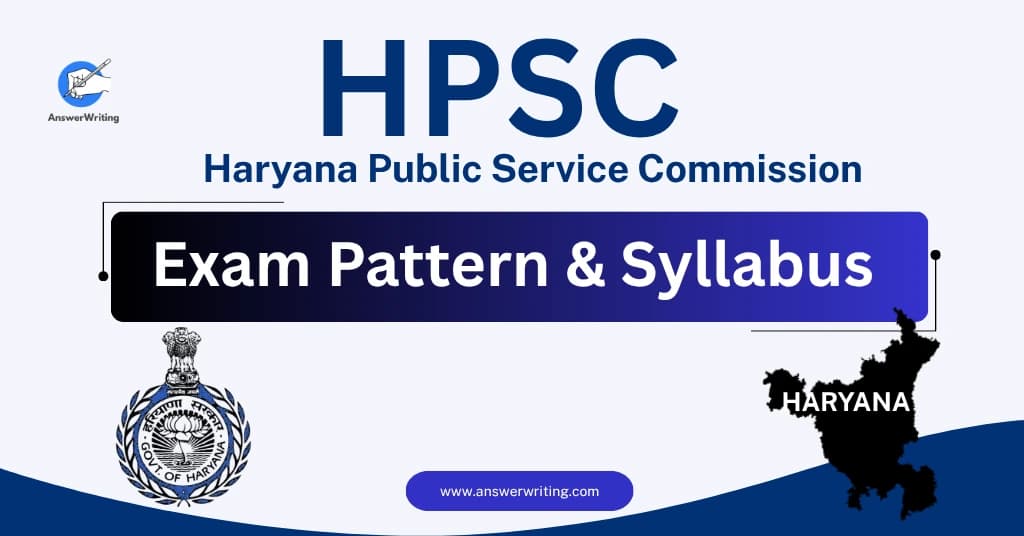
The HCS exam is conducted by the Haryana Public Service Commission (HPSC) in three stages:
- Preliminary Examination
- Mains Written Examination
- Personality Test/Viva-Voce.
Stage I: Preliminary Examination (Total: 200 Marks)
Two objective-type (MCQ) papers, bilingual (English & Hindi), 2 hours each, with 0.25 negative marking per wrong answer.
| Paper | Subject | Marks |
| Paper I | General Studies | 100 |
| Paper II | CSAT (qualifying) | 100 |
Only Paper I marks count for shortlisting. Minimum 33% required in CSAT to qualify. Candidates equal to 12 times the number of vacancies are shortlisted for Mains.
Important Note: Each question has 5 options (A–E). Candidates must darken E if not attempting a question. Leaving more than 10% of questions without darkening any circle leads to disqualification.
Paper I: General Studies Syllabus
General Science – Everyday scientific understanding expected of a generally educated person, without requiring specialised knowledge.
Current Affairs – Significant national and international events of importance.
History of India & National Movement – Broad understanding of India’s social, economic, and political history; nature of 19th-century resurgence; growth of nationalism and attainment of independence.
Indian & World Geography – Physical, social, and economic geography of India; key features of Indian agriculture and natural resources; broader world geography.
Indian Culture, Polity & Economy – India’s political system and Constitution; Panchayati Raj; social systems; economic developments in India.
General Mental Ability – Reasoning and analytical thinking.
Haryana – Economy & People : Social, economic, and cultural institutions, and languages of Haryana.
Paper II: CSAT Syllabus (Qualifying – 33% required)
Comprehension, interpersonal and communication skills, logical reasoning, analytical ability, decision-making, problem-solving, general mental ability, basic numeracy (Class X level), and data interpretation (charts, graphs, tables – Class X level).
Stage II: Mains Written Examination (Total: 600 Marks)
The HCS Mains has been revamped to mirror the UPSC Civil Services pattern. The optional subject has been removed and four separate General Studies papers introduced, including a new Ethics paper.
| Paper | Subject | Marks | Duration |
| Paper I | English & English Essay | 100 | 3 hours |
| Paper II | Hindi & Hindi Essay (Devanagari) | 100 | 3 hours |
| Paper III | General Studies – I | 100 | 3 hours |
| Paper IV | General Studies – II | 100 | 3 hours |
| Paper V | General Studies – III | 100 | 3 hours |
| Paper VI | General Studies – IV | 100 | 3 hours |
Answers may be written in Hindi or English (except language papers). Minimum 45% overall and 33% each in Hindi and English papers required to qualify for the Personality Test.
Paper I: English & English Essay
Tests reading comprehension, précis writing, essay composition, vocabulary, and general grammar. Essays must stay on topic, be logically structured, and demonstrate precise expression.
Paper II: Hindi & Hindi Essay (Devanagari Script)
Covers translation of English passages into Hindi, letter and précis writing, explanation of Hindi prose and poetry passages, composition (idioms and corrections), and essay writing on a given topic.
Paper III: General Studies – I
Indian Heritage, History & Geography
- Indian art, literature, and architecture from ancient to modern times
- Modern Indian history from the mid-18th century — key events and personalities
- Freedom struggle: stages and contributions from across the country
- Post-independence consolidation and reorganisation of states
- World history from the 18th century: industrial revolution, world wars, colonisation, decolonisation, and major political ideologies
- Indian society: diversity, women’s roles, population issues, poverty, urbanisation, and globalisation’s effects
- Social empowerment: communalism, regionalism, and secularism
- World physical geography; natural resource distribution; industrial location factors
- Geophysical events: earthquakes, tsunamis, volcanic activity, cyclones; changes in water bodies, ice caps, flora, and fauna
- Haryana-specific issues
Paper IV: General Studies – II
Governance, Constitution, Polity & International Relations
- Indian Constitution: evolution, core features, amendments, and basic structure
- Federalism: Union-State responsibilities, devolution of power and finances
- Separation of powers; dispute resolution mechanisms
- Comparison of India’s Constitution with other countries
- Parliament and State Legislatures: structure, powers, and functioning
- Executive and Judiciary: organisation and role; ministries; pressure groups
- Representation of People’s Act; constitutional posts and bodies
- Statutory and quasi-judicial bodies; government development policies
- Role of NGOs, SHGs, and civil society in development
- Welfare schemes for vulnerable sections; social sector issues (health, education, human resources)
- Poverty and hunger; governance transparency, e-governance, and citizen charters
- Role of civil services in a democracy
- India’s neighbourhood relations; bilateral, regional, and global agreements
- Impact of global politics on India; key international institutions
- Haryana-specific issues
Paper V: General Studies – III
Technology, Economy, Environment & Security
- Indian economy: planning, resource mobilisation, growth, and employment
- Inclusive growth; government budgeting
- Agriculture: crop patterns, irrigation, storage, transport, subsidies, MSP, food security
- Food processing industries and supply chain management
- Land reforms; effects of liberalisation on industry
- Infrastructure: energy, ports, roads, airports, railways
- Science and technology in everyday life; Indian achievements in S&T; indigenous technology
- IT, space, computers, robotics, nanotechnology, biotechnology, intellectual property rights
- Environmental conservation, pollution, degradation, and impact assessment
- Disaster management
- Internal security: extremism, role of media, social networks, cyber security, money laundering
- Border management; organised crime and terrorism linkages
- Security forces and their mandates
- Haryana-specific issues
Paper VI: General Studies – IV
Ethics, Integrity & Aptitude
- Ethics in human life: its dimensions, consequences, and role in public and private relationships; lessons from great leaders and reformers; role of family and educational institutions in value formation
- Attitude: its formation, influence on behaviour, and social dimensions
- Civil service values: integrity, impartiality, objectivity, empathy, and compassion toward weaker sections
- Emotional intelligence and its use in governance
- Contributions of moral thinkers from India and the world
- Public service ethics: dilemmas, accountability, RTI, codes of conduct, citizen charters, work culture, anti-corruption measures
- Probity in governance: transparency, proper use of public funds, ethical governance
- Case studies on all the above themes
Stage III: Personality Test / Viva-Voce (75 Marks)
Assesses mental alertness, analytical thinking, depth of interest, leadership qualities, social traits, and intellectual and moral integrity.
Final Selection
The merit list is prepared out of a grand total of 675 marks (600 Mains + 75 Interview). In case of a tie, the older candidate is ranked higher.