How to Self-Evaluate Your Answers for UPSC Mains
Here is a hard truth: most UPSC aspirants write 500+ answers during their preparation but genuinely evaluate fewer than 10. They write, they move on. They write more, they move on again. And then they wonder why their marks do not improve.
Answer writing without evaluation is like practising cricket in a dark room. You are swinging the bat, but you cannot see where the ball is going.
Self-evaluation is the feedback loop that turns practice into progress. This post gives you a clear, practical system to evaluate your own answers, spot your blind spots, and write better every single time.
Why Most Aspirants Write Answers But Never Improve
The problem is not effort. Most serious aspirants are working hard. The problem is the habit of measuring output (number of answers written) instead of quality (how good each answer actually was).
Writing 10 answers a day feels productive. Sitting with one answer for 20 minutes, dissecting what went wrong, feels slow. But that slow, uncomfortable review session is where real improvement happens.
There is also a confidence issue. Many aspirants are afraid to honestly assess their own work. They would rather not know. But UPSC Mains is brutally competitive, and self-awareness is a non-negotiable skill.
What Does UPSC Actually Look For in a Mains Answer?
Before you can evaluate your answers, you need to understand the examiner’s mindset. UPSC does not reward rote reproduction. It rewards structured thinking, analytical depth, and clarity of expression.
The Examiner’s Lens
UPSC examiners read thousands of answers. They are looking for answers that stand out through structure, not through length. An answer that addresses all dimensions of a question in clean, organised paragraphs will always outscore a long, rambling one.
Here are the core parameters on which your answer is silently judged:
| Evaluation Parameter | What the Examiner Checks | Common Mistake |
|---|---|---|
| Question Demand | Did you answer what was actually asked? | Answering a related topic instead of the exact question |
| Structure | Is there a clear intro, body, and conclusion? | Writing in one long block with no breaks |
| Content Accuracy | Are facts, data, and examples correct? | Vague statements with no supporting evidence |
| Analytical Depth | Do you go beyond description to explain “why” and “so what”? | Listing points without connecting them to the issue |
| Multidimensionality | Have you covered social, economic, political, ethical angles where relevant? | One-dimensional treatment of a complex issue |
| Presentation | Is it readable, with diagrams or flow charts where useful? | Dense text with no visual aids |
| Word Limit | Are you within the prescribed limit? | Significantly over or under the word count |
Keep this table in mind every time you pick up your pen.
The 5-Step Self-Evaluation Framework
Use this framework immediately after writing an answer. Do not wait until the end of the day. Review it while the thought process is still fresh.
Step 1: Check the Demand of the Question
Read the question again. Slowly. Identify the directive word: “Analyse,” “Critically examine,” “Discuss,” “Evaluate,” or “Comment.”
Each directive demands a different response structure. “Analyse” requires breaking down components. “Critically examine” requires presenting both strengths and weaknesses. “Discuss” requires covering multiple perspectives.
Now ask yourself: did my answer actually do what the directive asked? If the question said “critically examine” and you only described the topic, you have already lost significant marks regardless of content quality.
Step 2: Audit Your Structure
A UPSC Mains answer should have three clear parts: an introduction that frames the issue, a body that addresses it from multiple angles, and a conclusion that offers a forward-looking or balanced takeaway.
Read your answer out loud. Does it flow? Is there a logical progression from one paragraph to the next? If you struggle to follow your own argument, an examiner certainly will.
Check if you have used subheadings or bullet points where appropriate. For 15-mark and 20-mark answers, visual organisation is not optional; it is expected.
Step 3: Test Your Content Depth
Go through each paragraph and ask: “What is the evidence here?” A strong answer backs every major claim with a fact, a data point, a committee recommendation, a constitutional article, or a landmark judgment.
For example, if you are writing about judicial activism, citing the Kesavananda Bharati case (1973) or the Vishaka Guidelines judgment (1997) instantly signals to the examiner that your knowledge is specific and reliable.
If you find paragraphs with vague statements like “the government has taken several steps,” flag them. Replace vagueness with specifics.
Step 4: Evaluate Your Analysis and Original Thought
This is the step most aspirants skip, and it is the most important one. Description is the floor, not the ceiling.
Ask yourself: did I explain the “why” behind the issue? Did I connect the topic to broader themes such as governance, constitutional values, or sustainable development? Did I offer a balanced view with a reasoned conclusion?
UPSC rewards answers that show the aspirant is thinking, not just recalling. Even one or two sentences of genuine insight, a connection to a current event or a related policy, can push your answer into a higher band.
Step 5: Review Presentation and Time
Count your approximate word count. A 10-mark answer should be around 150 words. A 15-mark answer should be around 200 to 250 words. Overshooting consistently means you are wasting time that other questions need.
Check your handwriting and spacing. Is it legible? Are paragraphs clearly separated? Did you use a diagram or flowchart where it would have added value, for instance in questions on geography, polity structures, or economic processes?
Time yourself on the next attempt. UPSC gives you roughly 7 to 9 minutes per 10-mark answer. Staying within that window is a skill in itself.
The Most Common Answer-Writing Mistakes (And How to Spot Them)
Go through this checklist after every answer:
- Starting with a definition dump: Examiners do not want a dictionary. Open with a contextual statement or a relevant fact instead.
- Ignoring the conclusion: Many aspirants run out of time and leave answers without a conclusion. A two-line, forward-looking conclusion is always better than an abrupt end.
- Only one dimension: If a question touches governance, always check whether there are social, economic, environmental, or ethical angles worth adding.
- No examples or data: Vague answers score in the lower bands. Specific examples, even brief ones, lift the quality immediately.
- Repeating the introduction in the conclusion: Your conclusion should add something, a way forward, a balanced judgment, or a policy recommendation.
- Exceeding word limits significantly: It signals poor time management and can frustrate the examiner.
Get Instant Feedback with AnswerWriting.com
Self-evaluation is powerful, but it has one honest limitation: you can only catch what you already know to look for. Blind spots, by definition, are invisible to you.
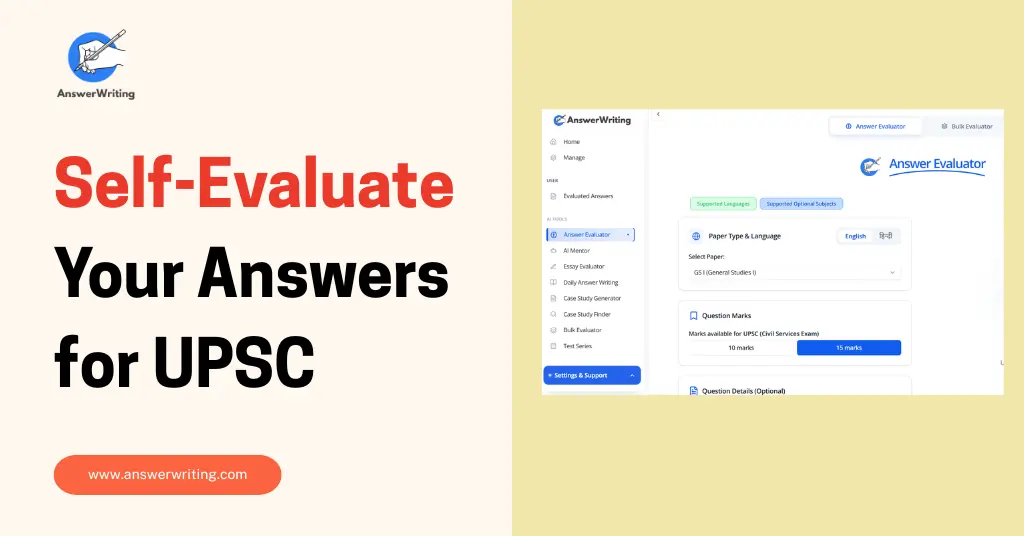
This is where AnswerWriting.com becomes genuinely useful for UPSC aspirants. It is an AI-powered answer evaluation platform that gives you instant, structured feedback on your handwritten answers. You upload your answer, and the platform analyses it across the same parameters that matter in the actual exam: structure, content depth, analytical quality, and presentation.
What makes it particularly valuable is the speed. You do not have to wait days for a mentor’s review. You get feedback immediately, which means you can course-correct and rewrite within the same study session. For aspirants who do not have access to high-quality coaching or a dedicated mentor, this kind of instant, objective feedback is a real leveller.
Teachers and mentors using platforms like AnswerWriting.com also report that it helps them identify patterns in student errors more efficiently, allowing them to focus their guidance on what actually needs fixing rather than general advice.
If you are writing answers seriously and want a reliable feedback mechanism beyond your own judgment, AnswerWriting.com is worth incorporating into your weekly practice routine.
Building a Weekly Answer Review Habit
Knowing a framework is one thing. Actually using it every week is another. Here is a simple routine that works:
Daily: After writing each answer, spend 5 minutes on a quick self-check using Steps 1 and 2 of the framework above.
Weekly: Pick your three weakest answers from the week. Do a deep review using all five steps. Identify one recurring mistake. Work on fixing only that mistake the following week.
Monthly: Look at 10 to 15 answers together. Track whether your content depth, structure, and analytical scores are improving over time. Use AnswerWriting.com’s feedback history if you are using the platform, as it helps you see patterns you might miss answer by answer.
Improvement in answer writing is not dramatic or overnight. It is the result of consistent, honest review, week after week. The aspirants who crack UPSC Mains are rarely the ones who wrote the most answers. They are the ones who learned the most from each one.
FAQs
Q1. How do I know if my answer is good enough for UPSC Mains?
A good benchmark is whether your answer addresses the exact question demand, uses specific evidence, covers multiple dimensions, and stays within the word limit. If it does all four, it is in a solid band. Tools like AnswerWriting.com can also give you a more objective assessment instantly.
Q2. Should I evaluate every answer I write, or only selected ones?
Ideally, do a quick 5-minute review after every answer. Save the deep, 20-minute evaluations for your weakest answers of the week. Trying to deeply analyse every answer daily is unsustainable.
Q3. My handwriting is poor. Does it really affect marks?
Yes, presentation matters. Examiners cannot give marks for content they cannot read. Work on legibility, not calligraphy. Clear, consistently sized letters with proper spacing is enough.
Q4. How do I improve my analytical depth if I am weak at it?
Start reading editorial opinions in newspapers like The Hindu or Indian Express. Focus on how the writer connects a current event to a larger argument. Try to replicate that structure in your own answers.
Q5. Is it okay to use bullet points throughout the answer?
Not entirely. UPSC expects a mix of paragraphs and lists. Pure bullet-point answers can seem shallow. Use bullets for listing items or steps, but use paragraphs for explanation and analysis.
Q6. How many answers should I write per day during Mains preparation?
Quality beats quantity. Three to five well-evaluated answers per day will serve you better than ten rushed ones. Build the evaluation habit first, then increase volume gradually.