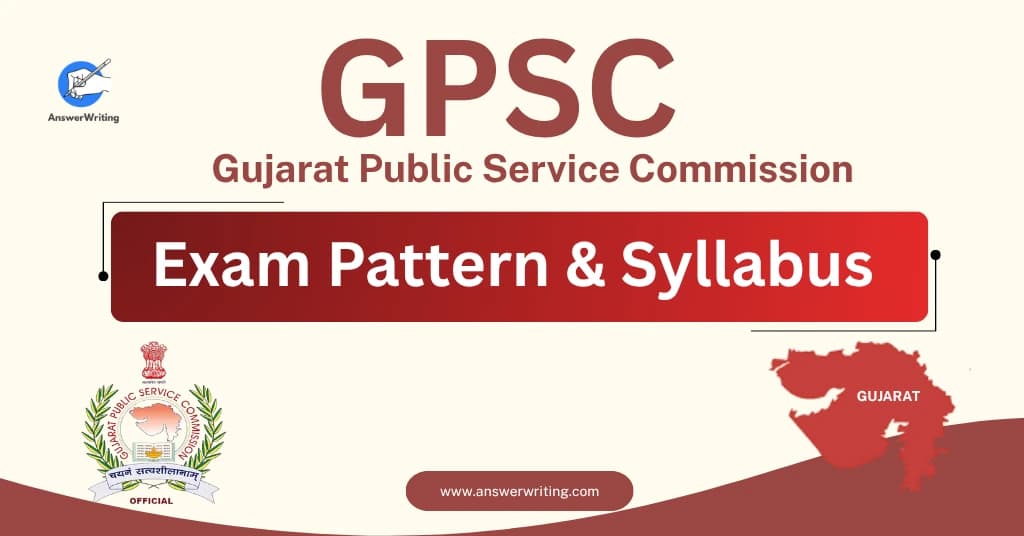
The exam is conducted in English and Gujarati. In case of any difference in interpretation, the English version is considered final.
Stage I: Preliminary Examination (Total: 400 Marks)
Two objective-type papers, each with 200 questions and 200 marks, completed in 3 hours each. One-third negative marking applies for every wrong answer.
| Paper | Subject | Questions | Marks | Duration |
| GS-1 | General Studies | 200 | 200 | 3 hours |
| GS-2 | General Studies | 200 | 200 | 3 hours |
Prelims GS-1 Syllabus (200 Marks)
A. History
- Indus Valley Civilisation: key features, sites, society, culture, art, religion, and its connection to Gujarat
- Vedic Age, rise of Jainism and Buddhism
- Foreign invasions and their impact on India
- Mauryan and Gupta Empires: administration, society, religion, economy, arts, and science
- Kanishka, Harsha, and major South Indian dynasties
- Delhi Sultanate, Vijayanagara Empire, Mughal Empire
- Bhakti Movement and Sufism
- Gujarat’s ancient dynasties: Chavada, Solanki, and Vaghela – their rulers, administration, economy, society, religion, literature, arts and architecture
B. Indian Polity & Constitution (continuing from GS-1)
- Constitutional authorities: powers, functions, and responsibilities
- Panchayati Raj
- Public policy and governance
- Impact of liberalisation, privatisation, and globalisation on governance
- Statutory, regulatory, and quasi-judicial bodies
- Rights issues: human rights, women’s rights, SC/ST rights, and child rights
- India’s foreign policy, international relations, key global institutions and their mandates
- Important policies and schemes of Central and State Governments
C. General Mental Ability
- Logical reasoning and analytical ability
- Number series, coding-decoding
- Relationship problems
- Shapes, sub-sections, and Venn diagrams
- Clock, calendar, and age-based problems
- Number systems and order of magnitude
- Linear equations (one and two variables)
- Ratio, proportion, and variation
- Averages (mean, median, mode, weighted mean)
- Powers, squares, square roots, cube roots, HCF and LCM
- Percentages, simple and compound interest, profit and loss
- Time-work, time-distance, speed-distance
- Area, perimeter, volume and surface area of geometrical shapes
- Lines, angles, triangles, Pythagoras theorem, quadrilaterals
- Algebra: BODMAS and simplification
- Data interpretation, analysis, sufficiency, and probability
Prelims GS-2 Syllabus (200 Marks)
A. Indian Economy & Planning
- Indian economy at independence; evolution of planning; post-reform economic changes; NITI Aayog’s role and functions
- Agriculture: land reforms, crop patterns, irrigation, pricing, food security, green revolution, sustainable and organic farming
- Industrial policy: public sector performance, privatisation debates, SEZs, foreign investment, competition policy
- Infrastructure: water supply, energy, rural and urban connectivity (ports, roads, airports, railways, telecom), social impact assessment
- Population: growth trends, poverty, inequality, unemployment, development indicators (HDI, Gender Development Index, Human Poverty Index, National Happiness Index)
- Public finance: tax system, public debt, subsidies, Centre-State financial relations, GST, fiscal and monetary policy
- Foreign trade: structure, direction, balance of payments in post-reform era
- Gujarat economy: social sector (education, health, nutrition); comparison with other major states; challenges in agriculture, water, forests, mining, industry, and services; infrastructure development policies
B. Geography
- General: Earth’s place in the solar system, landforms, atmosphere, climate, ocean characteristics, hydrological disasters
- Physical (World, India & Gujarat): major physical divisions, earthquakes, landslides, drainage, monsoon, vegetation, soil types, parks and sanctuaries, rocks and minerals
- Social (World, India & Gujarat): population distribution, density, literacy, sex ratio, occupational structure, tribal and religious groups, urbanisation, migration
- Economic (World, India & Gujarat): key sectors agriculture, industry, services; agro, mineral, forest, and fuel-based industries; trade and transport
C. Science & Technology
- Science and its relevance to daily life; national science policy; key scientific institutions; contributions of Indian scientists
- ICT: scope, e-governance programmes, cybersecurity, National Cybercrime Policy
- Space & Defence: ISRO’s history and achievements; satellite programmes (telecom, navigation, remote sensing, defence, education); DRDO’s vision and activities
- Energy: India’s energy needs, resources, and dependence; government energy policies
- Nuclear policy: India’s nuclear programme; cooperation with other nations; NSG, NPT, CTBT, FMCT; Nuclear Security Summit
- Environmental science: pollution, climate change, biodiversity, international environmental treaties, forest and wildlife laws, biotechnology, nanotechnology, genetic engineering, health-environment linkages
D. Current Events – Regional, national, and international importance
Stage II: Mains Examination (Total: 900 Marks)
| Paper | Subject | Marks |
| Paper 1 | Gujarati (Qualifying) | 150 |
| Paper 2 | English (Qualifying) | 150 |
| Paper 3 | Essay | 150 |
| Paper 4 | GS-1: History, Culture & Geography | 150 |
| Paper 5 | GS-2: Polity, Public Administration & Ethics | 150 |
| Paper 6 | GS-3: Science, Economy & Current Events | 150 |
| Total | 900 |
GS papers have 20 questions each – 10 worth 5 marks (60-70 words) and 10 worth 10 marks (130–140 words).
Mains: English Paper (150 Marks, 3 Hours)
| Task | Marks |
| Essay (250–300 words, one from five topics) | 20 |
| Formal letter writing (~150 words) | 10 |
| Press release / appeal (~150 words) | 10 |
| Report writing (~150 words) | 15 |
| Writing on visual information (graph/chart/table, ~150 words) | 15 |
| Formal speech (~150 words) | 15 |
| Précis writing (~100 words from a 300-word passage) | 15 |
| Reading comprehension (250-word passage, MCQs + short answers) | 15 |
| English Grammar (MCQs: tenses, voice, narration, articles, prepositions, phrasal verbs, idioms, synonyms/antonyms, one-word substitution, connectives, affixes, homophones) | 20 |
| Translation (Gujarati to English, ~150 words) | 15 |
Mains: Gujarati Paper (150 Marks, 3 Hours)
Covers essay writing, précis, passage comprehension, speech and press release drafting, letter writing, report writing, visual description, dialogue writing, translation (English to Gujarati), and Gujarati grammar (idioms, proverbs, compound analysis, metre, figures of speech, spelling, Sandhi, and sentence transformation).
Mains: Essay Paper (150 Marks, 3 Hours)
Candidates write three essays (~800 words each, one per section) in English or Gujarati. Topics span current affairs, socio-political and socio-economic issues, environmental matters, cultural and historical themes, civic awareness, and reflective topics. Marks are awarded for structured arguments, coherent expression, grammatical correctness, and originality.
Mains: GS-1 – History, Culture & Geography (150 Marks, 3 Hours)
A. History of India
- Indus Valley Civilisation and key excavated sites
- Vedic period, Jainism, Buddhism, Nanda Dynasty
- Foreign invasions and their effects
- Major ancient dynasties: Mauryas, Sungas, Satavahanas, Kushanas, Guptas, Chalukyas, Rashtrakutas, Vijayanagara, Pallavas, Cholas — covering administration, art, architecture, literature, and science
- Ancient educational centres: Takshshila, Nalanda, and Vallabhi
- Accounts of foreign travellers
- Harshvardhana and his ties to Gujarat
- Rajput period, Solankis of Gujarat, invasions of Ghazni and Ghori
- Delhi Sultanate (1206–1526); Bhakti Movement and Sufism
- Mughal Empire (1526–1707); rise and fall of the Maratha Empire
- European arrival; British rule from 1757 to 1856; land revenue systems (Permanent Settlement, Ryotwari, Mahalvari)
- 1857 Revolt and Queen Victoria’s Proclamation
- 19th century social and religious reform movements in India and Gujarat
- Rise of Indian nationalism; Indian National Congress (1885–1920)
- Mahatma Gandhi’s philosophy and its impact on India’s social, political, economic, and cultural life
- Sardar Patel’s role in freedom movement and post-independence integration
- Indian revolutionaries, Indian National Army, Subhash Chandra Bose
- Dr. B.R. Ambedkar’s contribution to the Indian Constitution
- Post-independence reorganisation of states; Maha Gujarat Movement
B. Cultural Heritage
- Indian art forms, literature, architecture, and sculpture from ancient to modern times; diversity of Indian society
- Gujarat’s arts and crafts; socio-cultural contributions
- Gujarati folk theatre (Bhavai) and its cultural context
- Gujarat’s folk culture and oral traditions
- Influence of Indian cinema and theatre on society
- Gandhian philosophy and its contemporary relevance
- Coastal and tribal cultures of Gujarat
- Gujarati women writers and their literary contributions
C. Geography
- Physical features of India and Gujarat: landforms, climate, soil, rivers, vegetation, land, rocks, minerals, and water resources
- Economic geography: primary (agriculture, livestock, fisheries, mining), secondary (manufacturing), tertiary (trade, transport, communication), and quaternary activities
- Social and demographic geography: population distribution, density, age-sex composition, rural-urban patterns, caste, tribe, religion, literacy, migration, and urbanisation
- Development and environmental issues: sustainable development, globalisation, smart cities, natural hazards (earthquakes, cyclones, tsunamis, floods, landslides, drought), climate change, pollution, and hazard management
Mains: GS-2 – Indian Polity, Constitution & Administration (150 Marks, 3 Hours)
A. Indian Polity & Constitution
- Core constitutional features and their significance
- Roles and responsibilities of the Union and State Governments
- Federalism: challenges, role of the Governor, distribution of powers across Union, State, and Concurrent Lists
- Rural and urban local self-governance under 73rd and 74th Constitutional Amendments
- Constitutional authorities: powers, functions, and responsibilities
- Panchayati Raj institutions
- Public policy and governance
- Impact of liberalisation, privatisation, and globalisation on governance
- Statutory, regulatory, and quasi-judicial bodies
- Rights issues: human rights, women’s rights, SC/ST rights, child rights
- India’s foreign policy and international relations; key global institutions
- Central and State government schemes and programmes
Stage III: Interview / Personality Test
The Interview carries 100 marks. Combined with the Mains score of 900, the final merit is decided out of 1000.
Eligibility: Any graduate (Arts, Commerce, or Science) from a recognised university. Final-year students are also eligible.
Age Limit: Minimum 20 years, Maximum 35 years.
- SC/ST: 5-year relaxation (up to 40 years)
- OBC: 3-year relaxation (up to 38 years)
Mains GS-2: Polity, Public Administration & Ethics (Continued)
Constitutional & Legislative Bodies
- Role and functions of constitutional authorities
- Parliament and State Legislatures: structure, business conduct, powers, and privileges
- Judiciary: structure, emergency provisions, constitutional amendments, judicial review, and Public Interest Litigation
B. Public Administration & Governance
- Evolution and nature of public administration in India; administrative thinking from Kautilya’s Arthashastra, Mughal era, and British legacy
- Role of civil services in a democracy
- Government development policies and challenges in their implementation
- Role of civil society, NGOs, and other stakeholders in development
- Statutory, regulatory, and quasi-judicial bodies
- Good governance and e-governance: transparency, accountability, Citizen’s Charter, RTI, Public Service Act, and social audit
C. Ethics in Public Service
- Ethics and human behaviour: its dimensions, consequences, integrity and accountability in public and private life; RTI and Public Service Act implications
- Attitude: its formation, influence on conduct, moral and political dimensions, social persuasion
- Emotional intelligence and its use in governance
- Human values: role of family, society, and educational institutions in nurturing values
- Ethical challenges: corruption, Lokpal, Lokayukta
- Case studies on all the above ethical themes
Mains GS-3: Science, Economy & Current Events (150 Marks, 3 Hours)
A. Science & Technology
- Role of science, technology, and innovation in improving human life; national science policy; India’s scientific contributions and challenges in applying technology for nation-building
- ICT: its advantages, e-governance initiatives, cybercrime, and security policies
- Indian Space Programme: ISRO’s achievements; satellite applications in health, education, weather, and defence; DRDO’s role
- India’s energy needs: clean energy resources, conventional and non-conventional sources, energy policy
- Nuclear policy: India’s nuclear programme, international nuclear agreements (NPT, CTBT, FMCT, NSG), and India’s stand on global nuclear issues
- Environment vs. Development: natural resource depletion, pollution, sustainable development, climate change, climate justice, environmental impact assessment, disaster management, and health-environment linkages
- Biotechnology and nanotechnology: scope, applications, ethical and legal issues, genetic engineering, and its human impact
- Indian achievements in science and technology; indigenous technology development
- Intellectual Property Rights in science and technology
B. Indian Economy & Planning
- Economic development since independence: national income trends, sectoral composition (primary, secondary, tertiary), Five-Year Plans, NITI Aayog
- Post-reform Indian economy: liberalisation, privatisation, globalisation, and their effects on development strategy
- Land reforms in India and Gujarat
- Agricultural growth: sustainable agriculture, Green Revolution, food security, agricultural pricing, procurement, and Public Distribution System
- Public finance: tax system, public expenditure, public debt, Centre-State financial relations, macroeconomic stabilisation, GST
- Industrial policy: structure, concentration issues, large vs. small industry, cottage industries, public sector performance, privatisation
- Population and human development: demographics, urbanisation, demographic dividend, education, health, family welfare
- Rural development: poverty trends and policies, inequality, employment, Skill India, Make in India, Start-Ups
- External sector: foreign trade trends, FDI and FII
- India in global indices: Global Innovation Index, HDI, Global Competitiveness Index, Global Gender Gap Report
- Gujarat economy: social sector (education, health, nutrition); challenges in agriculture, water, forests, mining, and industry; cooperative movement’s socio-economic impact
- Infrastructure: energy, ports, roads, airports, railways, telecommunications – and their social impact assessment
C. Current Events – Regional, national, and international importance
GPSC Prelims Cut-Off Marks (2017 Reference)
| Category | Cut-Off | With 10% PH Relaxation |
| General Male | 113.05 | 101.75 |
| General Female | 82.56 | 74.30 |
| SEBC Male | 113.05 | 101.75 |
| SEBC Female | 82.56 | 74.30 |
| SC Male | 113.05 | 101.75 |
| SC Female | 82.56 | 74.30 |
| ST Male | 75.89 | 68.30 |
| ST Female | 62.92 | 56.33 |
Cut-off = marks secured by the last selected candidate in merit order for that category.
Gujarat Administrative Service Final Results 2017
- Highest combined score (Mains + Interview out of 1000): 545.75 (54.57%)
- Lowest combined score among selected candidates: 391.75 (39.17%)
Pay Scale (7th Pay Commission)
- Class 1: ₹56,100 – ₹1,77,500 + allowances
- Class 2: ₹44,900 – ₹1,42,500 + allowances
Types of Posts Under GPSC
Group A Posts
- Deputy Director (Developing/Scheduled Class): Works for the educational and economic upliftment of socially backward classes, minorities, nomadic, and de-notified tribes; oversees health, housing, and social welfare activities.
- Assistant Commissioner (Tribal Development): Responsible for crime prevention, police training, and investigation management in the district.
Group B Posts
- Section Officer (Sachivalaya/GPSC): Distributes work among staff, provides training, maintains discipline, and coordinates section management.
- Mamlatdar: A gazetted state government officer who heads a Taluka and manages its local revenue administration.
- State Tax Officer: Functions under Gujarat’s Finance Department; responsible for all state tax matters.
- Section Officer / Taluka Development Officer: Oversees rural governance at the Taluka level within the Panchayati Raj system; supervises extension officers.
- Government Labour Officer: Handles human resource matters in government departments; implements labour laws and ensures proper working conditions.
- Tribal Development Officer: Works under the Taluka Development Commissioner to improve quality of life for Scheduled Tribes through education, healthcare, and income generation.
- District Inspector of Land Records: Technical advisor to the Collector; manages land revenue, survey records, and measurement-related work.
- Assistant Director (Food & Civil Supply): Operates under the Food, Civil Supplies, and Consumer Affairs Department; issues ration cards and manages Public Distribution System functions.
- Social Welfare Officer: A state government officer responsible for social welfare policies and ensuring citizens have access to basic amenities and rights.
- Municipal Chief Officer: A civil servant appointed by the state government to govern municipalities with large populations.