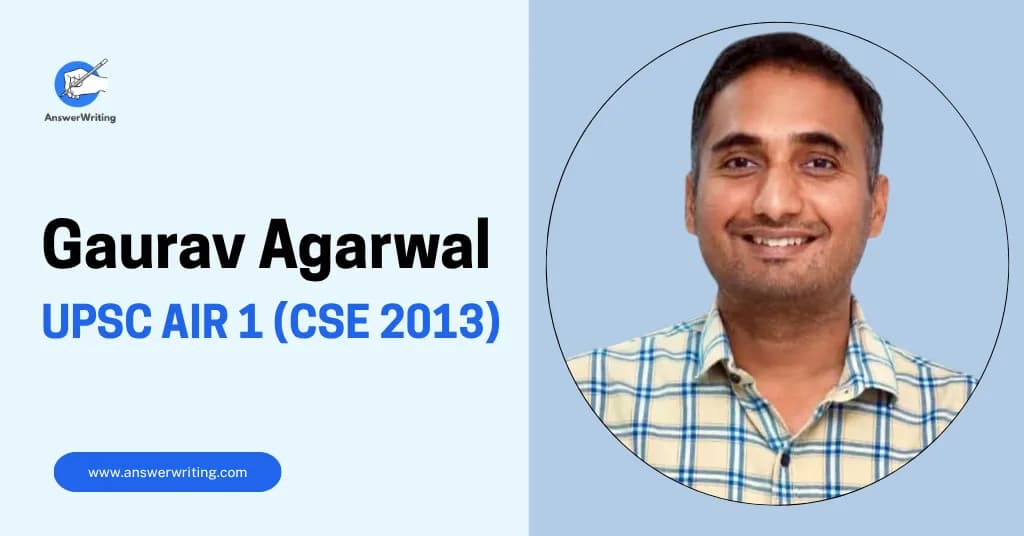
Can an investment banker in Hong Kong find his true calling in the dusty terrains of rural India? Gaurav Agarwal did exactly that. After a high-flying career in global finance, he returned to India to secure AIR 1 in the 2013 Civil Services Examination.
His journey is a masterclass in how analytical thinking, rather than just rote memorization, can conquer the toughest exam in the country.
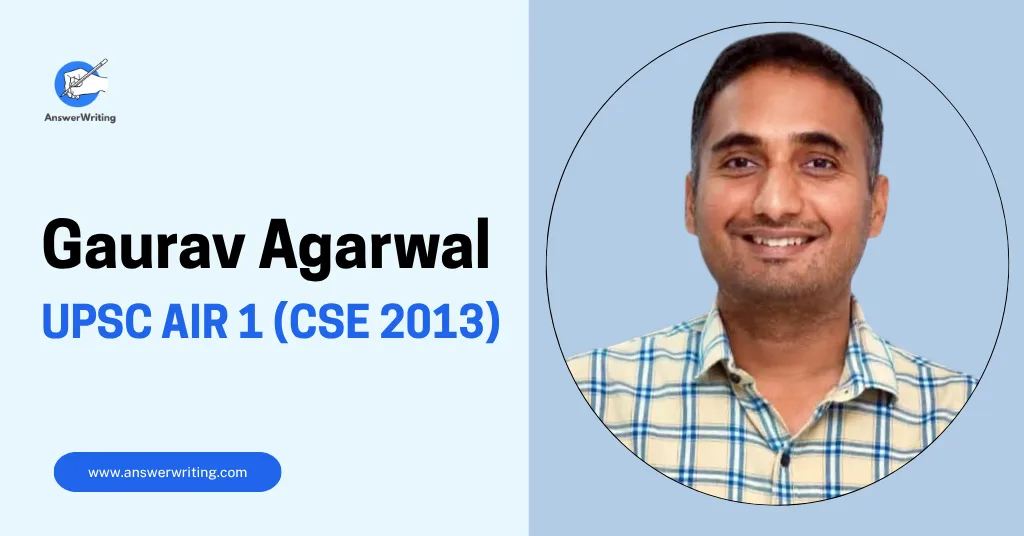
Who Is Gaurav Agarwal?
Gaurav Agarwal is a name synonymous with academic and professional excellence. Born in Jaipur, Rajasthan, he achieved the top rank in the UPSC CSE 2013. Before his IAS success, he was already an IPS trainee, having secured Rank 249 in his first attempt. He is widely respected for his transparent approach to sharing his notes and strategy through his personal blog.
| Feature | Details |
|---|---|
| Full Name | Gaurav Agarwal |
| UPSC Rank | AIR 1, CSE 2013 |
| Service Allotted | Indian Administrative Service (IAS) |
| Optional Subject | Economics |
| Hometown | Jaipur, Rajasthan |
| Education | B.Tech (IIT Kanpur), MBA (IIM Ahmedabad) |
Gaurav Agarwal UPSC Marksheet and Score Details
Gaurav’s performance in 2013 was historic because he was the first topper to cross the 50% mark in the new syllabus format introduced that year. His scores reflected a deep mastery of his optional subject and consistent performance across all General Studies papers.
| Paper | Marks Obtained |
|---|---|
| Essay | 135 |
| GS Paper 1 | 094 |
| GS Paper 2 | 098 |
| GS Paper 3 | 110 |
| GS Paper 4 (Ethics) | 102 |
| Optional 1 (Economics) | 134 |
| Optional 2 (Economics) | 162 |
| Written Total | 835 |
| Interview | 206 |
| Final Total | 1041 |
Educational Background and Early Life
Gaurav’s academic pedigree is formidable. He studied Computer Science at IIT Kanpur and followed it up with a PGDM from IIM Ahmedabad, where he was a gold medalist.
After his MBA, he worked as an investment banker in Hong Kong for several years. Despite the lucrative salary and prestigious position, he felt a disconnect from the social realities of his home country. This realization prompted him to quit his job and return to India to prepare for the Civil Services.
How Many Attempts Did Gaurav Agarwal Take?
Gaurav Agarwal cleared the UPSC exam in two attempts.
In his first attempt in 2012, he secured AIR 249. While this earned him a spot in the Indian Police Service (IPS), he was determined to get into the IAS. During his second attempt, he was actually undergoing rigorous training at the Sardar Vallabhbhai Patel National Police Academy.
The primary shift between his attempts was not just “reading more,” but “writing better.” He realized that while he had the knowledge, he needed to refine how he presented that knowledge to the examiner.
Gaurav Agarwal Optional Subject: Why Economics?
Choosing Economics was a natural fit for Gaurav given his IIM background and banking experience. However, UPSC Economics is highly academic and technical. He focused on linking core economic theories with current Indian developmental challenges.
| Source Type | Recommended Resource |
|---|---|
| Microeconomics | H.L. Ahuja / Varian |
| Macroeconomics | Richard Froyen |
| Indian Economy | Uma Kapila / Mishra & Puri |
| Current Affairs | Economic Survey / Budget |
UPSC Preparation Strategy of Gaurav Agarwal
Gaurav’s strategy was defined by “Vertical Integration.” Instead of studying subjects in isolation, he looked for links between History, Geography, and Economy.
- Mind Mapping: He used digital tools to create interconnected notes, ensuring he could see the “big picture” of any issue.
- Time Management: Since he was training as an IPS officer during his second attempt, he utilized every small break for revision.
- Analytical Depth: He moved away from just stating facts. He focused on the “Why” and “How” of every government policy.
- Self-Reliance: While he took guidance, he relied heavily on self-study and original thinking rather than just following coaching material blindly.
Books and Resources Recommended by Gaurav Agarwal
Gaurav emphasized quality over quantity. He believed in reading one book multiple times rather than multiple books once.
| Subject | Book/Resource | Author/Source |
|---|---|---|
| Polity | Indian Polity | M. Laxmikanth |
| Modern History | A Brief History of Modern India | Spectrum |
| Environment | Environment Notes | Shankar IAS |
| Art & Culture | Indian Art and Culture | Nitin Singhania |
| Current Affairs | The Hindu / PRS | Standard Sources |
Mains Answer Writing Approach
For Gaurav, the Mains exam is a test of communication as much as knowledge. He advocated for a highly structured approach:
- Point-wise Format: He almost always wrote in bullet points to make his answers readable.
- Multidimensionality: If a question asked about a social issue, he would include economic, political, and historical angles.
- Data and Diagrams: He used rough sketches and flowcharts to explain complex relationships.
During his preparation, he often emphasized that getting feedback is crucial. Modern aspirants can replicate this by using tools like the Answer Evaluator on AnswerWriting.com, which provides immediate, structured feedback on handwritten answers. Much like Gaurav sought peer reviews, having an AI-driven mentor helps in identifying whether your structure meets UPSC standards before the actual exam.
Interview (Personality Test) Experience
Gaurav faced the P.K. Misra board. His interview was heavily centered on his career transition and his understanding of the banking sector. He was asked why an IIM gold medalist wanted to leave a high-paying job.
His answers were characterized by humility and honesty. He didn’t try to sound like a “social reformer” but explained his desire for a more diverse and impactful work profile in India. His score of 206 remains one of the higher marks in the personality test.
Service and Cadre Allotted
Upon securing Rank 1, Gaurav Agarwal was allotted the Indian Administrative Service (IAS). He was assigned to his home state cadre, Rajasthan. Over the years, he has served in various capacities, including as the District Collector of districts like Ajmer, where he has been recognized for his data-driven approach to governance.
Key Lessons Every UPSC Aspirant Can Take from Gaurav Agarwal
- Identify Your Weaknesses: After his first attempt, Gaurav realized his answer structure was weak. He didn’t ignore it: he fixed it.
- Value of Professionalism: Treat your preparation like a 9-to-5 job. Discipline is more sustainable than occasional bursts of motivation.
- Analytical Thinking: Don’t just memorize the “What.” UPSC rewards those who understand the “So what?” of an event.
- Stay Grounded: Despite his elite background, Gaurav approached the syllabus with the curiosity of a beginner.
FAQs About Gaurav Agarwal
What was Gaurav Agarwal’s optional subject?
He chose Economics as his optional subject, leveraging his background in finance and management.
How many attempts did he take to top UPSC?
He topped the exam in his second attempt (2013). He had already cleared the exam in his first attempt (2012) with Rank 249.
Which coaching did Gaurav Agarwal attend?
Gaurav is largely known for his self-study approach. While he took mock interviews and joined some test series, he relied heavily on his own notes and analysis.
Is Gaurav Agarwal an IAS or IPS?
He is currently an IAS officer. He was previously an IPS trainee after his first attempt but resigned to join the IAS.
What is Gaurav Agarwal’s current posting?
As per available reports, he serves in the Rajasthan Cadre and has held various senior administrative positions, including District Collector and roles in the state’s finance departments.