Write Confidently, Score Higher with AnswerWriting
Refine your UPSC/PCS Mains answers with clinical precision. Our AI-driven evaluation ensures clarity, relevance, and structured writing — helping you improve with every attempt.
Tip: Cite a recent SC judgement in the introduction to strengthen your opening.
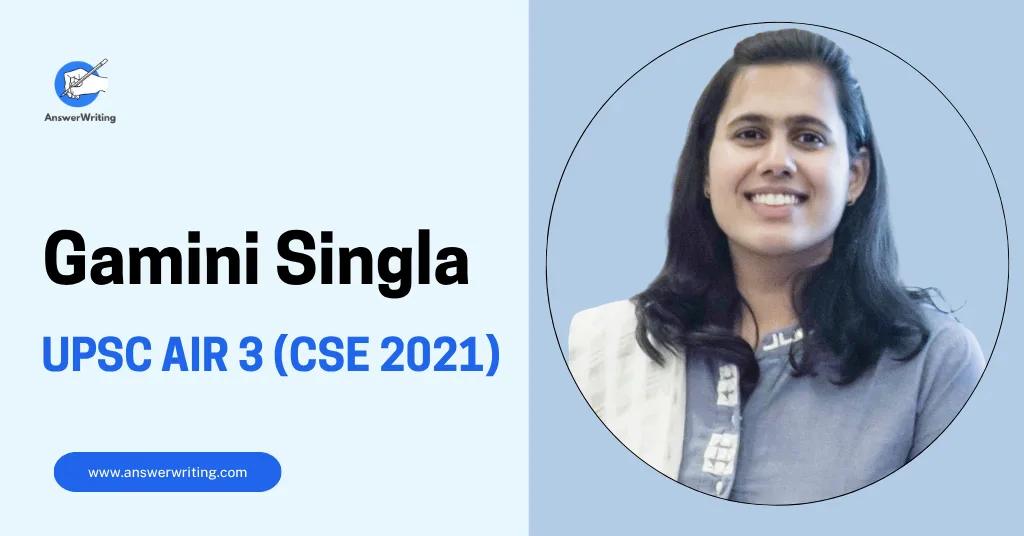
Gamini Singla: UPSC AIR 3 (CSE 2021), Strategy, and Journey | AnswerWriting
Gamini Singla: UPSC AIR 3 (CSE 2021), Strategy, and Journey
A Computer Science engineer with a JP Morgan offer in hand chose Sociology and civil services instead. She was 22 years old. Two years later, she had All India Rank 3 in UPSC CSE 2021, the highest interview score among the top three rankers that year, and a book on preparation strategy to her name.
Gamini Singla’s story is one of the clearest examples in recent UPSC history of what focused clarity of purpose looks like in practice.
Who Is Gamini Singla?
Gamini Singla hails from Anandpur Sahib, Punjab. She completed her B.Tech in Computer Science Engineering from Punjab Engineering College (PEC), Chandigarh, in 2019, turned down a Finance Analyst offer from JP Morgan, and began preparing for the Civil Services Examination immediately after graduation. She cleared it in her second attempt in 2021 at the age of 23, securing All India Rank 3.
Detail
Information
Hometown
Anandpur Sahib, Punjab
School
Primary at Anandpur Sahib; Mount Carmel School for senior secondary
Graduation
B.Tech, Computer Science Engineering, Punjab Engineering College (PEC), Chandigarh (2019)
Work Experience
Campus placement offer from JP Morgan (Finance Analyst), not accepted
UPSC Exam Year
CSE 2021 (results declared May 2022)
All India Rank
3
Number of Attempts
2
Optional Subject
Sociology
Service Allotted
Indian Administrative Service (IAS)
Cadre
Uttar Pradesh (as per available reports, 2022 batch)
Current Posting
Joint Magistrate, Sultanpur, Uttar Pradesh (as per available reports)
Book Authored
“How I Topped the UPSC and How You Can Too” (2022)
Her father, Dr. Alok Singla, and her mother, Dr. Neerja Singla, are both medical officers serving in the Himachal Pradesh government. Her brother is a graduate of IIT Kharagpur. In a family of doctors and engineers, Gamini was the one who chose civil services and Sociology.
Gamini Singla UPSC Marksheet and Score Details
Gamini scored a total of 1045 marks in UPSC CSE 2021. Her written Mains total was 858, and she scored 187 in the Personality Test (Interview).
Component
Marks Obtained
Written (Mains) Total
858
Interview (Personality Test)
187
Grand Total
1045 / 2025
Paper-wise subject scores are not consistently verified across credible public sources and have not been included here. Aspirants may verify the subject-level breakdown from the official UPSC marksheet.
One number stands out: 187 in the interview. That is the highest interview score among the top three women who dominated CSE 2021, higher than AIR 1 Shruti Sharma’s 173 and AIR 2 Ankita Agarwal’s 179. It is also among the highest Personality Test scores at the top-rank level in recent UPSC history. That score reflects both exceptional interview preparation and a Detailed Application Form (DAF) rich with interesting entry points.
Educational Background and Early Life
Gamini completed her primary schooling in Anandpur Sahib, Punjab, before moving to Mount Carmel School for her senior secondary education. From an early age, she was drawn to co-curricular activities. Her involvement in Model United Nations (MUN) throughout school and college was a formative experience. She participated in MUN simulations that model United Nations proceedings, requiring participants to think like delegates, argue positions, understand global policy, and communicate under pressure. That training in structured argumentation would directly shape her interview and answer writing approach years later.
At Punjab Engineering College in Chandigarh, she studied Computer Science Engineering from 2017 to 2019. She was the class representative and actively engaged in student organisations. In 2019, she served as Director-General of PECMUN 6.0, a major MUN event at her college. Her professor at PEC, Rajesh Bhatiya, has specifically noted that she received a job offer during campus placements but chose not to join because she had already decided to pursue civil services.
She came from a household shaped by public service. Both parents were government medical officers. Her brother had gone to IIT. The family valued both academic rigour and the idea of contributing to the country through a career. That environment supported her decision to take the civil services route, even when a JP Morgan offer was on the table.
Gamini has said she was inspired by IPS officers Kiran Bedi and Navjot Simmi, two figures known for integrity and public impact. Those role models pointed her toward IAS as her first preference and IPS as her second.
How Many Attempts Did Gamini Singla Take?
Gamini cleared UPSC in her second attempt. Her first attempt was in 2020, where she could not clear the Preliminary examination. She did not make the cut at the very first stage.
That outcome would have been deflating for anyone who had already passed up a JP Morgan placement to pursue this path. Gamini chose to treat it as a gap to fix. She returned home, restructured her preparation, increased her study hours, and prepared more systematically for her second attempt in 2021.
Her own statement to aspirants on failure is widely reported: reflect on why you failed in the previous attempt, carve out a unique strategy, and do not simply follow what someone else did. That last point is important. She explicitly said that aspirants should not blindly copy a topper’s approach but develop a strategy suited to their own strengths and gaps.
In her second attempt in 2021, she cleared all three stages and secured AIR 3 at the age of 23. She is one of the youngest candidates to finish in the top three in that batch.
Gamini Singla’s Optional Subject: Sociology
Gamini chose Sociology as her optional subject. Her graduation was in Computer Science Engineering. There is no direct academic connection between the two fields.
She chose Sociology because it genuinely interested her and because it connected naturally to the kind of work she wanted to do as an IAS officer. Understanding social structures, inequality, community dynamics, and institutional behaviour is directly relevant to governance at the ground level. For Gamini, Sociology was not just an exam subject. It was a lens through which she understood the country she wanted to serve.
Her approach to Sociology was precise. She paid particular attention to classical thinkers, especially Emile Durkheim, ensuring she could write structured and analytical answers rooted in sociological theory. She used standard reference texts as her foundation and supplemented them with internet resources when standard books could not sufficiently clarify a concept. She specifically credits this internet-supplemented approach as useful for Sociology, where conceptual depth matters more than rote recall.
Her combined Sociology score contributed to a written total of 858. The subject rewards clear thinking, structured arguments, and the ability to apply theoretical frameworks to real-world examples, all of which align with UPSC Mains expectations across GS papers as well.
The Sociology optional also prepared her for the essay and ethics papers. A candidate who thinks in terms of social theory, institutional analysis, and human behaviour has a natural advantage in GS Paper 4 and in essays that require multidimensional engagement with societal issues.
For engineering graduates considering UPSC, Gamini’s profile offers a clear takeaway: your degree subject does not limit your optional choice. What matters is genuine interest and the discipline to build depth in the subject from scratch.
UPSC Preparation Strategy of Gamini Singla
Gamini began preparing for the UPSC immediately after her graduation in 2019. She started at home with self-study as the foundation and took coaching from Vinod sir in Patiala for structured guidance. She has been clear that coaching was a supplement, not the core. Self-study was primary.
She studied for 9 to 10 hours every day and maintained a consistent timetable. She did not study in erratic long bursts. The structure was steady: fixed hours, fixed subjects, fixed revision cycles.
For the foundation of her GS preparation, she worked through NCERTs from Class 6 to Class 12. She has specifically recommended this to aspirants, stating that NCERTs build the conceptual base that advanced material depends on. Once the basics were clear, she moved to standard UPSC reference books for each subject.
For current affairs, she read newspapers daily and supplemented with monthly current affairs magazines. This dual approach covered both the depth of detailed news reading and the breadth of compiled monthly summaries. Her father played an active role in this part of her preparation. He read the newspaper every day, marked the items that were important for Prelims and Mains, and helped her focus without missing key points. This saved her significant time during an already demanding preparation schedule.
She took multiple mock tests throughout her preparation. Solving previous years’ Prelims question papers gave her a clear picture of the exam’s pattern and difficulty. She used the internet deliberately and purposefully: not for social media, which she deactivated during preparation, but to clarify concepts in Sociology and other subjects where standard books were insufficient.
Her preparation philosophy, stated directly in multiple interviews, centres on one principle: hard work has no substitute in this examination. Strategy matters, but it must be paired with consistent, honest effort.
Books and Resources Recommended by Gamini Singla
Gamini has shared her preparation resources in interviews and in her book. Her list reflects the principle of limited sources used deeply:
Subject/Area
Book/Resource
All Subjects (Foundation)
NCERT Textbooks, Class 6 to 12
Indian Polity
Indian Polity by M. Laxmikanth
Optional: Sociology
Haralambos and Holborn (Sociology: Themes and Perspectives)
Current Affairs
Daily newspapers + monthly current affairs magazines
Prelims Practice
Previous year UPSC Prelims question papers
Mains Practice
Answer writing practice + mock tests
Concept Clarification
Internet (used for topics not covered adequately in standard books)
Her Sociology reference is worth highlighting. Haralambos and Holborn is a comprehensive university-level Sociology text that covers classical and contemporary thinkers in depth. It is one of the most widely used references for the UPSC Sociology optional and aligns with the kind of analytical, theory-grounded answers the exam rewards.
Mains Answer Writing Approach
Gamini’s Mains preparation was anchored in answer writing practice. She has consistently named it as the central activity of her Mains strategy, not just a supplementary habit.
Her approach was to write answers that were structured, concise, and analytical. She did not aim for length or impressiveness. She aimed for clarity and directness. Her Sociology background helped here: the subject trains you to present arguments through frameworks, connect theory to examples, and write with conceptual precision rather than narrative sprawl.
She solved mock tests regularly to practice writing under time pressure. Time management in the Mains hall is a skill that only develops through repeated timed practice, not just through reading and note-making.
She used diagrams and structured formats where they added value. She read newspapers as preparation for essay writing as well, developing the habit of engaging with issues from multiple angles before she sat down to write.
For aspirants who want to build this kind of structured writing practice, AnswerWriting.com offers a Daily Answer Writing feature with fresh prompts and AI-powered evaluation. Getting consistent, specific feedback on your answers, covering structure, content, and UPSC scoring parameters, is how the habit actually converts into improved scores. Gamini’s test-heavy preparation approach works precisely because each mock was a diagnostic tool, not just a practice run.
The principle behind her writing strategy: write regularly, write to a structure, and treat every answer as a chance to sharpen your thinking, not just demonstrate it.
Interview (Personality Test) Experience
Gamini scored 187 in the Personality Test, the highest interview score among the top three rankers in CSE 2021. That result came from thorough preparation, a strong DAF, and the composure she had built through years of MUN participation.
Her DAF offered the interview board rich material. A B.Tech in Computer Science from a reputed engineering college, a JP Morgan placement offer declined for UPSC, Sociology as an optional, roots in Punjab, parents in government medical service, and a brother from IIT Kharagpur. Each of these is a thread the board could pull. She was prepared for all of them.
She attended mock interviews to build confidence and to practice thinking clearly under panel pressure. She has specifically stated that despite being a naturally confident person, she practiced extensively to ensure clarity of thought in the actual interview. Confidence without preparation is not enough. The Personality Test rewards both.
She stayed updated on current affairs through daily newspaper reading and discussed important topics regularly with her father during her preparation. That conversational habit of talking through issues, not just reading about them, likely contributed to her ability to articulate views clearly in the interview.
Her interview was held on May 12, 2022. The board would have had access to her full DAF, and as an engineering graduate who had chosen Sociology and civil services over a JP Morgan career, her choices were unusual enough to invite substantive questions about her motivations, her understanding of governance, and her vision as a future officer.
Service and Cadre Allotted to Gamini Singla
Gamini Singla was allotted the Indian Administrative Service (IAS). As per available reports, she is part of the 2022 IAS batch and has been posted in the Uttar Pradesh cadre. Her current posting, as per available reports, is as Joint Magistrate in Sultanpur, Uttar Pradesh. Aspirants should verify current posting details from official sources, as administrative assignments change over time.
She has stated her administrative focus clearly: working for the development of the country and the welfare of people at the grassroots level. Her interest in social issues, grounded in her Sociology optional and her MUN experience, gives her a strong orientation toward policy engagement and community-facing administration.
She has also contributed back to the aspirant community by publishing a book, “How I Topped the UPSC and How You Can Too,” released in 2022. Very few toppers translate their preparation experience into a structured guide for others. That contribution reflects a genuine sense of responsibility toward the lakhs of aspirants who look at toppers for direction.
Key Lessons Every UPSC Aspirant Can Take from Gamini Singla
Your engineering degree does not restrict your optional: Gamini chose Sociology with a B.Tech background and scored well enough to reach AIR 3. Choose the optional subject that genuinely interests you and that you can build analytical depth in, regardless of your undergraduate discipline.
Turning down a corporate offer is not a sacrifice, it is a decision: She refused JP Morgan at 22. That clarity of purpose, knowing what she wanted and acting on it early, meant she never wasted time second-guessing her path. Aspirants who enter UPSC preparation half-heartedly almost always leave mid-way.
Failure at Prelims is not the end of the attempt cycle: She did not clear Prelims in her first attempt. She came back, corrected her approach, and topped her second attempt. Every failure at a stage tells you exactly which part of your preparation needs more work.
Use the internet as a conceptual tool, not a distraction: She specifically used internet resources to supplement standard books where they fell short, particularly for Sociology. That purposeful use of online material, paired with deactivating social media, is a model for aspirants who struggle to draw the line between useful and distracting screen time.
Build your support system deliberately: Her father reading and marking newspapers for her every day was not luck. It was a family that understood what the preparation demanded and contributed actively. Aspirants should have honest conversations with their families about what they need during the preparation period.
FAQs About Gamini Singla
What rank did Gamini Singla get in UPSC? Gamini Singla secured All India Rank 3 in UPSC CSE 2021. The results were declared in May 2022. She scored a total of 1045 marks, with 858 in the written Mains and 187 in the interview.
What was Gamini Singla’s optional subject? She chose Sociology as her optional subject despite having a B.Tech in Computer Science Engineering. Her primary reference for Sociology was Haralambos and Holborn. She scored high enough in Sociology to finish third nationally.
How many attempts did Gamini Singla take to clear UPSC? She cleared the exam in her second attempt. In her first attempt in 2020, she could not clear the Preliminary examination. She restructured her preparation and cleared with AIR 3 in 2021.
Did Gamini Singla take coaching for UPSC? She primarily relied on self-study. She took coaching from Vinod sir in Patiala for structured guidance but has made clear that coaching was supplementary, not the foundation of her preparation.
What was Gamini Singla’s interview score? She scored 187 in the Personality Test, which was the highest interview score among the top three rankers in CSE 2021, higher than AIR 1 Shruti Sharma’s 173 and AIR 2 Ankita Agarwal’s 179.
Has Gamini Singla written a book for UPSC aspirants? Yes. She authored “How I Topped the UPSC and How You Can Too,” published in 2022. It is one of the few preparation guides written by a recent top-ranked IAS officer and draws directly from her own strategy.
Which college did Gamini Singla attend? She completed her B.Tech in Computer Science Engineering from Punjab Engineering College (PEC), Chandigarh, graduating in 2019. She was the class representative at PEC and received a campus placement offer from JP Morgan, which she declined to prepare for UPSC.