Dr. Shah Faesal: UPSC AIR 1 (2009), Strategy, and the Kashmiri Who Rewrote the Rules
Three days before his medical entrance exam in 2002, Shah Faesal’s father was shot dead by militants outside their home in Kupwara. He was 19 years old. He still sat the exam.
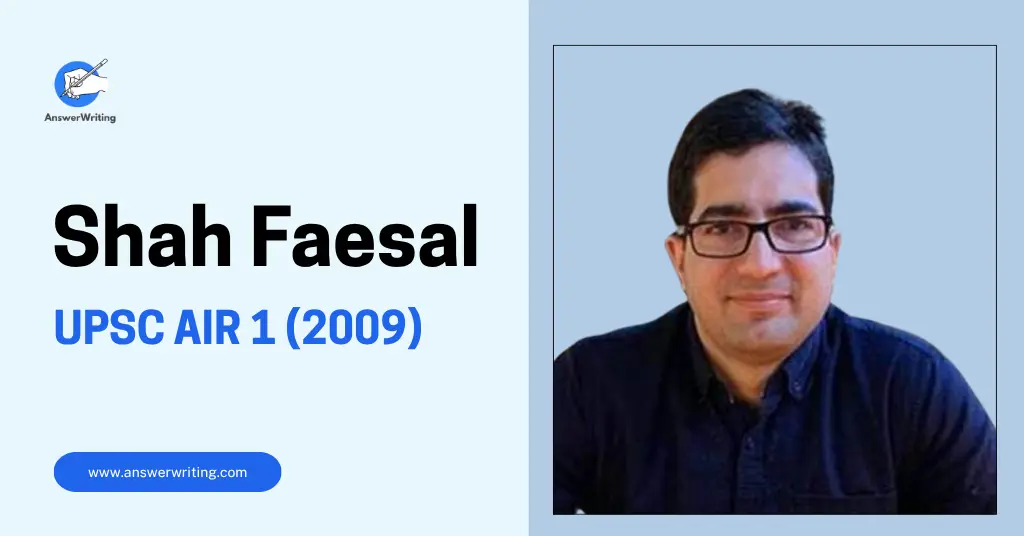
Seven years later, he topped India’s most competitive examination on his very first attempt, becoming the first Kashmiri to secure All India Rank 1 in the UPSC Civil Services Examination.
This is not a story about a gifted student who had it easy. It is a story about what happens when grief is converted into purpose, and purpose is backed by relentless preparation.
Who Is Dr. Shah Faesal?
Dr. Shah Faesal was born on 17 May 1983 in the Sogam area of Lolab Valley, Kupwara district, Jammu and Kashmir. He is an MBBS gold medalist from the Sher-i-Kashmir Institute of Medical Sciences (SKIMS), Srinagar, and holds a Master’s degree in Urdu.
In 2009, he cleared the UPSC Civil Services Examination in his very first attempt, securing All India Rank 1. He was the first Kashmiri to achieve this, and the fourth Muslim to top the civil services examination since Independence.
| Detail | Information |
|---|---|
| Full Name | Dr. Shah Faesal |
| Date of Birth | 17 May 1983 |
| Hometown | Sogam, Kupwara, Jammu and Kashmir |
| Education | MBBS, SKIMS Srinagar (Gold Medalist); MA in Urdu |
| UPSC Exam Year | 2009 |
| All India Rank | 1 |
| Number of Attempts | 1 |
| Optional Subjects | Public Administration and Urdu Literature |
| Service Allotted | Indian Administrative Service (IAS) |
| Cadre | AGMUT (J&K) |
| Current Posting | Deputy Secretary, Ministry of Culture (as of 2022) |
Dr. Shah Faesal’s UPSC Marksheet and Score Details
As per available reports, Dr. Shah Faesal scored a total of 1361 marks in the UPSC Civil Services Examination 2009. Paper-wise breakdowns are not comprehensively available in the public domain. Aspirants should cross-check official UPSC sources for complete details.
| Component | Details |
|---|---|
| Total Marks Scored | 1361 (as per available reports) |
| Optional Subjects | Public Administration and Urdu Literature |
| Final Rank | AIR 1, UPSC CSE 2009 |
| Attempts | 1 |
What stands out beyond the numbers is the context. A first-attempt AIR 1 from a conflict zone, with an unconventional optional combination, is a result that demanded both strategic preparation and exceptional articulation.
Educational Background and Early Life
Shah Faesal grew up in a family defined by education. His father, his mother, and his grandfather were all government school teachers. Learning was not optional in his household. It was the air the family breathed.
He completed his schooling from Soham High School in Kupwara, an Urdu medium institution. Even then, his love for Urdu literature and poetry, particularly the works of Faiz Ahmed Faiz and Mohammad Iqbal, was forming.
Then came 2002. His father, Ghulam Rasool Shah, was killed by unidentified militants because he refused to provide them shelter. This happened barely three days before the Common Entrance Test for medical college admissions.
He had only two choices, as he later said in an interview: “To be bogged down or to stand up and face the challenge.” He chose the latter. He sat the exam. He cleared it.
He went on to complete his MBBS from SKIMS, Srinagar, graduating as a gold medalist. He also pursued and completed a Master’s degree in Urdu, a subject that would later shape his optional subject strategy in a very deliberate way.
During his MBBS internship, he started writing for local English-language newspapers. That habit of structured writing, of translating complex thoughts into clear language, became one of his most valuable preparation assets.
How Many Attempts Did Dr. Shah Faesal Take?
Dr. Shah Faesal cleared UPSC CSE 2009 in his very first attempt.
This was not impulsive. After completing his MBBS, his well-wishers advised him to appear for the civil services examination. A meeting with Abdul Ghani Mir, an IPS officer from Kupwara who had served in Bihar and Jharkhand, helped settle his thinking.
He realised something important. As a doctor, he could heal individuals. As a civil servant, he could shape the systems that determined whether people had access to healthcare, education, and opportunity in the first place.
That clarity of purpose gave his preparation a direction that went beyond syllabus coverage.
He was also motivated by a larger mission. Very few Kashmiris had appeared for UPSC in the preceding 15 years. He wanted to challenge the stereotype that Kashmiris were not interested in, or capable of, integrating with national institutions. That motivation made his preparation feel like more than personal ambition.
He prepared without formal coaching for Prelims. He stayed at the Hamdard Study Circle in New Delhi, which provided affordable accommodation and a focused study environment. His preparation was self-directed, newspaper-driven, and rooted in genuine understanding rather than rote coverage.
Dr. Shah Faesal’s Optional Subjects: The Ideological Choice That Defined His Mains
Shah Faesal initially considered Public Administration and Geography as his optional combination. He changed course and chose Public Administration and Urdu Literature instead.
The reasons he gave for this change are worth understanding carefully.
He chose Urdu Literature not because it was considered a scoring subject, but to make a statement. As a science graduate and medical doctor, picking Urdu as an optional was unusual. That was precisely the point. He wanted to disprove the perception that Urdu was a “downtrodden and neglected language.” He wanted to demonstrate that deep engagement with Urdu literature could produce the kind of articulate, nuanced thinking that UPSC rewards.
He had never stopped reading Urdu literature even during his MBBS years. Faiz Ahmed Faiz and Allama Iqbal were constant companions. His Master’s degree in Urdu gave him the academic foundation. His passion gave him the depth.
Public Administration, on the other hand, was a strategic complement. It overlaps significantly with General Studies papers, particularly in governance, policy, and ethics themes. Many aspirants choose it for this reason, and it worked well for him as a grounding subject for understanding how the Indian state actually functions.
The combination of a literary optional and an administrative optional gave his Mains answers a rare quality: they were analytically sound and linguistically rich at the same time.
UPSC Preparation Strategy of Dr. Shah Faesal
Shah Faesal’s approach to preparation carried a philosophy that is easy to quote but harder to practise. He said: “Do not read for the examination, read for the knowledge. When you gain knowledge, any paper becomes easy to handle.”
This was not a motivational slogan. It was his actual method.
He did not attend formal coaching for Prelims. He relied on newspapers and stayed current with events not just as exam material, but as a habit of engaged citizenship. He built his understanding from the ground up, topic by topic.
During his MBBS internship, writing for local English newspapers had already sharpened his ability to structure arguments and communicate clearly within word limits. By the time he sat for Mains, that was a practised skill, not a newly acquired one.
He stayed at the Hamdard Study Circle in New Delhi, which gave him a structured environment, affordable facilities, and a peer group of serious aspirants. He made clear that this was for accommodation and atmosphere, not for classroom instruction.
His preparation advice to aspirants has consistently emphasised a few key points: complete the prescribed syllabus, read newspapers regularly, build communication skills deliberately, and approach each subject with the intent to understand rather than to memorise.
He also stressed confidence. “Expect the best but be ready for the worst,” he said. That balance between ambition and equanimity is harder to teach than any syllabus topic.
Books and Resources Recommended by Dr. Shah Faesal
A comprehensive verified booklist from Dr. Shah Faesal is not available in the public domain. The table below reflects resources consistent with his optional subjects and known preparation approach. Aspirants should verify through his interviews and available talks directly.
| Subject | Resource | Notes |
|---|---|---|
| Urdu Literature Optional | Standard Urdu literary texts (Faiz, Iqbal, classical prose) | His lifelong reading formed the base |
| Public Administration Optional | Standard Public Administration texts | Overlaps with GS governance themes |
| Current Affairs | National English newspapers | Primary daily preparation tool |
| General Studies | NCERT textbooks | Standard foundation recommended |
| Writing Practice | Local English newspaper writing (internship period) | Built answer structuring skills |
Mains Answer Writing Approach
Shah Faesal placed enormous weight on communication skills. He believed that command over language was not a soft advantage in UPSC Mains. It was a hard differentiator.
His years of reading Urdu poetry and prose, combined with writing for English newspapers during internship, gave him the ability to construct answers that were precise, well-structured, and expressive. That combination is rare and it showed in his scores.
He advised aspirants to invest in language development consistently, not just during the final months of preparation. Reading good writing, practising structured responses, and seeking feedback are all part of that investment.
For aspirants working on Mains today, AnswerWriting.com offers an AI-powered Answer Evaluator that gives detailed feedback on structure, content, and UPSC scoring parameters after every answer you submit. Given that Shah Faesal’s own preparation was shaped by regular writing and refinement, this kind of systematic practice, with clear feedback on each attempt, directly reflects the approach he advocated. The platform’s Daily Answer Writing feature makes it possible to build that habit without depending on a mentor’s availability.
The underlying principle remains what he demonstrated: answers that show genuine understanding of a topic, communicated with clarity and structure, will always score better than answers that recite borrowed phrases.
Interview (Personality Test) Experience
Detailed verified information about the composition of Shah Faesal’s interview board or specific questions asked is not widely available in the public domain. Aspirants should cross-check primary interview transcripts for accuracy.
What is clear is that his Detailed Application Form (DAF) offered extraordinarily rich material.
A Kashmiri candidate from a conflict-affected district. A gold medalist doctor who pivoted to civil services. A man who had lost his father to militancy at 19 and still cleared his medical entrance exam three days later. A science graduate who chose Urdu Literature as an optional to challenge a cultural stereotype. Each of these facts, on its own, would anchor a strong interview conversation.
His communication skills, noted consistently across all available interviews and accounts, would have made him comfortable articulating complex positions on Kashmir, governance, and public service without appearing rehearsed or defensive.
His widely reported interview quote captures his approach to the board well. He said the motivation to appear for UPSC was partly to “dispel the myth that Kashmiris are incompetent people and the profiling that goes on.” Saying something that direct, that specific, in an interview requires both preparation and genuine conviction.
Service, Cadre, and the Controversial Chapter
Dr. Shah Faesal was allotted the IAS and the AGMUT cadre, serving primarily in Jammu and Kashmir. His postings included Assistant Commissioner Revenue in Pulwama, Deputy Commissioner of Bandipora district, Director of School Education (Kashmir), and Managing Director of J&K State Power Development Corporation.
In 2018, he received the Fulbright-Nehru Masters Fellowship and went to Harvard Kennedy School.
Then came January 2019. He tendered his resignation from the IAS, citing what he described as “unabated killings” in Kashmir and broader disillusionment with his bureaucratic role. He announced his resignation through a Facebook post and subsequently launched the Jammu and Kashmir People’s Movement (JKPM) as a political platform.
When Article 370 was revoked in August 2019, he was stopped at the airport while attempting to travel and placed in preventive detention for several months.
He left politics in August 2020. In April 2022, the government accepted his application for reinstatement and he returned to the IAS. He was subsequently posted as Deputy Secretary in the Union Ministry of Tourism and later the Ministry of Culture.
This chapter of his life is factual and widely reported. It is neither a simple story of betrayal nor of redemption. It is the story of a person navigating a deeply complex set of institutional, political, and personal pressures in an equally complex region.
Key Lessons Every UPSC Aspirant Can Take from Dr. Shah Faesal
- Circumstance does not determine outcome. Losing a parent three days before a major exam, growing up in a conflict zone, coming from a region with minimal UPSC representation. None of it stopped him. Aspirants in difficult circumstances have more precedent for success than they often realise.
- Read for knowledge, not for the exam. His repeated advice on this point is not philosophical decoration. It explains why his answers were substantively strong rather than superficially comprehensive. Understanding a topic deeply produces better answers than memorising model responses.
- Optional subject choice can carry purpose beyond scoring. He chose Urdu Literature to make a statement, and it worked. When you genuinely care about a subject, the preparation is deeper and the answers are more authentic.
- Communication skills are a preparation category, not a byproduct. He built his writing and articulation skills through newspaper writing during his internship, years before his UPSC attempt. Language development needs deliberate, sustained effort, not last-minute polish.
- Clarity of motivation shapes the quality of preparation. He knew exactly why he was appearing for UPSC, what he wanted to achieve, and what he was trying to prove. That clarity made every hour of study purposeful rather than anxious.
FAQs About Dr. Shah Faesal
1. What was Shah Faesal’s optional subject in UPSC?
His optional subjects were Public Administration and Urdu Literature. He initially considered Geography as his second optional but switched to Urdu Literature deliberately, to challenge the perception that Urdu was a neglected or non-competitive language.
2. How many attempts did Shah Faesal take to clear UPSC?
He cleared UPSC CSE 2009 in his very first attempt, securing All India Rank 1.
3. Which coaching did Shah Faesal attend for UPSC?
He did not attend formal coaching for Prelims. He stayed at the Hamdard Study Circle in New Delhi, which provided affordable accommodation and a focused study environment, but his preparation was primarily self-directed.
4. Why did Shah Faesal resign from the IAS?
He resigned in January 2019, citing “unabated killings” in Kashmir and broader disillusionment with his role as a bureaucrat. He subsequently entered politics before returning to the IAS in April 2022.
5. What is Shah Faesal’s current posting?
As of 2022, he was reinstated as Deputy Secretary, posted in the Union Ministry of Tourism and subsequently the Ministry of Culture. Aspirants should verify his current posting from official sources as transfers are routine.
6. What is Shah Faesal’s total score in UPSC?
As per available reports, he scored a total of 1361 marks in UPSC CSE 2009. Paper-wise breakdowns are not comprehensively verified in public sources.
7. Was Shah Faesal the first Muslim to top UPSC?
No. He was the fourth Muslim to top the civil services examination since Independence, and the first candidate from Jammu and Kashmir to secure All India Rank 1.