Balvinder Kumar: The 1981 Batch IAS Officer Who Mastered Mind and Governance
Is it possible for a high-ranking bureaucrat, responsible for the vast machinery of the Delhi Development Authority (DDA) and the national Ministry of Mines, to find absolute stillness in the middle of political storms? Balvinder Kumar did more than just find it; he turned his bureaucratic career into a laboratory for spiritual and mental health research.
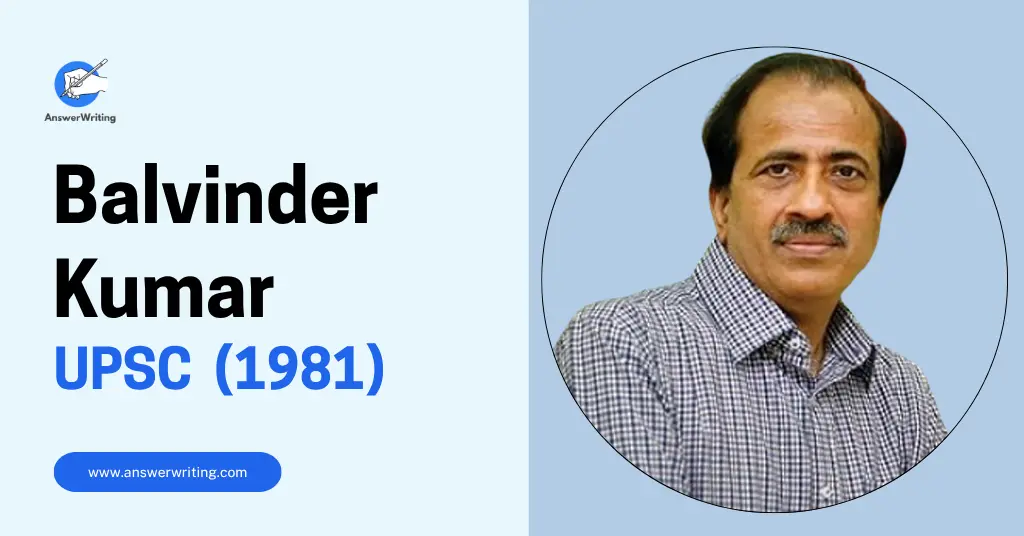
A 1981-batch IAS officer of the Uttar Pradesh cadre, his story is not just one of files and postings, but of a man who used a controversial suspension as a catalyst for a global movement in mindfulness and well-being.
Who Is Balvinder Kumar?
Balvinder Kumar is a retired IAS officer known as much for his integrity in administration as for his deep dives into neuroscience and spirituality. Serving through some of the most challenging decades of Indian administration, he rose to become the Secretary of Mines for the Government of India and the Vice-Chairman of the DDA. Today, he is a celebrated author and mental health advocate, bridging the gap between ancient wisdom and modern brain science.
| Feature | Details |
|---|---|
| Full Name | Balvinder Kumar |
| Exam Year / Batch | 1981 |
| Service | Indian Administrative Service (IAS) |
| Cadre | Uttar Pradesh (UP) |
| Major Postings | Secretary (Mines), VC (DDA), Chairman (Noida Authority) |
| Educational Background | M.Sc. Botany (Delhi University) |
| Interests | Neuroscience, Quantum Physics, Spirituality, Painting |
Balvinder Kumar UPSC Journey and Service Details
Balvinder Kumar belongs to a generation of officers who witnessed the transition of India from a controlled economy to a global player. His service record reflects a balance of hardcore field administration and high-level policy formulation.
| Tenure | Position / Organization | Key Contribution |
|---|---|---|
| Early Career | DM Moradabad, DM Rampur | Law and order, grassroots development |
| 2014-2015 | Vice-Chairman, DDA | Digitalization of land records and housing |
| 2015-2017 | Secretary, Ministry of Mines | Revamping the mining sector and transparency |
| Post-Retirement | Member, UP RERA | Protecting home-buyer rights |
Educational Background and Early Life
Balvinder Kumar’s foundation was built on the rigorous scientific principles of Botany. He completed his post-graduation (M.Sc.) from Delhi University, an experience he often credits for his methodical approach to problem-solving. Botany, being a subject of intricate classifications and logical structures, helped him develop the patience required for the long-haul preparation of the Civil Services.
His early life was rooted in a thirst for knowledge that went beyond the syllabus. Even while preparing for the UPSC, he was fascinated by how the human mind functions. This curiosity would later define his second career as a wellness expert and author.
How Many Attempts Did Balvinder Kumar Take?
Balvinder Kumar prepared for the UPSC during an era when resources were scarce and there was no internet to provide instant updates. While the exact number of his attempts is rarely the focus of his interviews, he emphasizes that he approached the exam with a “one-pointed focus.”
He often tells aspirants that the “mindset” during an attempt is more important than the “number” of attempts. In the 1980s, the competition was fierce and the pattern was vastly different, yet his success on the very first few tries highlights the power of structured thinking.
Balvinder Kumar Optional Subject: The Science Edge
In the 1981 examination cycle, science subjects were considered highly scoring if one had the accuracy to back them up. Balvinder chose Botany as one of his optional subjects, leveraging his academic background.
Choosing a science optional allowed him to:
- Minimize Subjectivity: Unlike humanities, science answers are either right or wrong, leaving less room for examiner bias.
- Leverage Existing Knowledge: Having mastered the subject at Delhi University, he only needed to adapt his knowledge to the UPSC format.
- Analytical Advantage: Science subjects train the brain to look for patterns, a skill highly useful in the General Studies papers.
UPSC Preparation Strategy of Balvinder Kumar
His strategy was built on mental resilience and conceptual depth. He advocates for a “minimalist resource” approach, which is more relevant today than ever.
- Deep Work: Long before the term became popular, he practiced 4-6 hours of intense, undistracted study rather than 12 hours of superficial reading.
- Health as a Priority: He believes that a stressed brain cannot retain information. He integrated long walks and early meditation into his routine to keep his cognitive functions sharp.
- Cross-Subject Linking: He didn’t see Geography, History, and Science as silos. He looked for the “connective tissue” between them, a technique that modern aspirants find essential for the Mains.
Managing the vast UPSC syllabus requires more than just books; it requires a guide. For today’s aspirants, having an AI Mentor like the one at AnswerWriting.com can provide the kind of personalized strategy and doubt resolution that Balvinder developed through years of self-reflection.
Books and Resources Recommended by Balvinder Kumar
While some of the 1980s specific guides have evolved, his foundational recommendations remain timeless.
| Subject | Resource | Significance |
|---|---|---|
| Botany (Optional) | Standard Textbooks (Singh, Pandey, Jain) | Technical depth |
| General Studies | NCERTs (Class 6-12) | Building the base |
| Current Affairs | The Hindu & Frontline | Analytical perspective |
| Mindset/Ethics | The Power of Now / Buddhist Philosophy | Managing exam stress |
Mains Answer Writing Approach
In the 1980s, Mains answers were long and descriptive. Balvinder focused on clarity of thought. He believed that if you cannot explain a concept to a child, you don’t understand it well enough for the UPSC.
- The Scientific Structure: He used headings and bullet points even when they weren’t the standard norm, making his answers scannable.
- Brevity: He avoided “filler” sentences, focusing instead on the core demand of the question.
- Interdisciplinary Insights: He would often use his knowledge of science to add weight to environmental or social questions in the GS papers.
Today, aspirants can replicate this level of precision by using the Answer Evaluator on AnswerWriting.com. Getting instant AI feedback on whether your answer is too wordy or lacks structure is a modern luxury that can significantly cut down preparation time.
Interview (Personality Test) Experience
Balvinder Kumar’s interview was a test of his composure. The board in the early 80s was known for being traditional and probing.
He recalls that the board wasn’t just checking his knowledge they were checking his “vibration” and his ability to stay calm under fire. When asked about complex administrative scenarios, he relied on his foundational values of honesty and logical reasoning. This calm demeanor later became his signature style during high-pressure postings.
Service and Cadre: From UP Districts to Central Ministries
Balvinder Kumar’s career is a masterclass in navigating the complexities of the Indian bureaucracy.
- The Raebareli Controversy: In 2008, he was caught in a political crossfire regarding a rail coach factory project and was suspended. Rather than becoming bitter, he used this time for a “spiritual retreat,” delving deep into meditation. He was eventually exonerated and returned to the service with even greater mental strength.
- DDA Vice-Chairman: He led the Delhi Development Authority during a crucial phase of urbanization, pushing for transparency and housing for all.
- Secretary of Mines: He was instrumental in introducing the “Mining Surveillance System” (MSS) to curb illegal mining through satellite technology.
Key Lessons Every UPSC Aspirant Can Take from Balvinder Kumar
- Crisis is Opportunity: His suspension taught him that professional setbacks are often redirections for personal growth.
- Master Your Mind: If you can control your distractions, you can master the syllabus. He advocates for “breathwork” to combat the anxiety of Prelims.
- Purpose Beyond the Post: The IAS is a means to serve, but your identity should be larger than your rank.
- Scientific Spirituality: Use logic to understand your emotions. A balanced officer is always more effective than a brilliant but stressed one.
FAQs About Balvinder Kumar
When did Balvinder Kumar clear the UPSC?
He cleared the exam in 1981 and belonged to the Uttar Pradesh cadre of the IAS.
What was his optional subject?
He chose Botany, which was his area of specialization during his M.Sc. at Delhi University.
Which books has Balvinder Kumar written?
He has authored several influential books, including Man’s Spiritual Journey and Awaken the Inner Self.
Why was he suspended in 2008?
He was suspended by the state government over a land allotment controversy for a rail coach factory in Raebareli, though he was later cleared of all charges.
What is he doing after retirement?
He is a wellness advocate, author, and public speaker focusing on the intersection of neuroscience and mindfulness.
What major positions did he hold in the Government of India?
He served as the Vice-Chairman of the DDA and the Secretary to the Government of India in the Ministry of Mines.