Ashima Mittal: UPSC CSE 2022 AIR 4, Strategy, Optional, and the IIT to IAS Story
An engineer from IIT Delhi who picked Anthropology as her optional subject, a subject she had never formally studied in college, and walked out of the UPSC Civil Services Examination 2022 with All India Rank 4. That is Ashima Mittal’s story in one sentence. But the preparation behind that sentence took years of disciplined work, one failed attempt, and a complete rethinking of strategy.
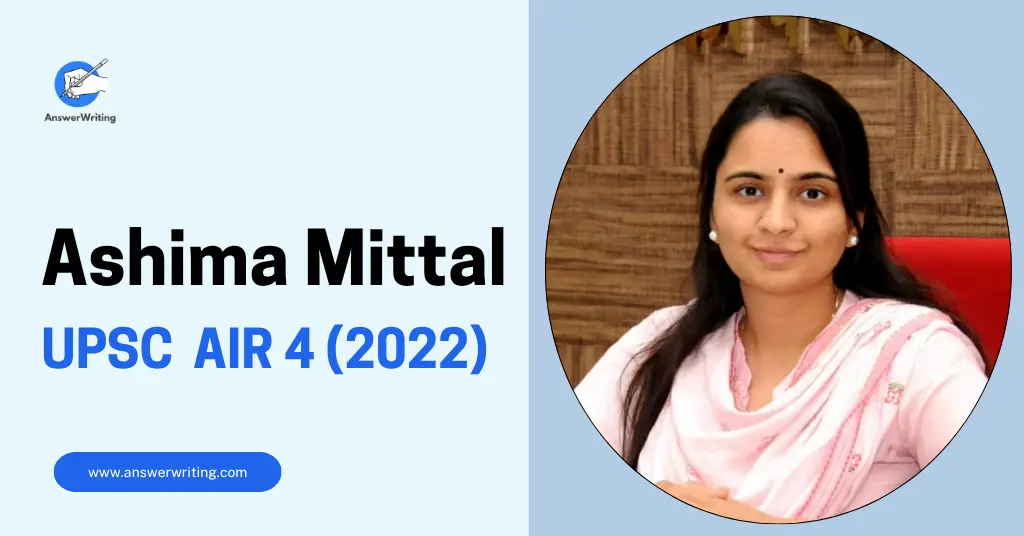
For aspirants from engineering or science backgrounds who wonder whether civil services is the right path, or whether Anthropology can work for someone without a humanities degree, Ashima Mittal’s preparation is worth studying in detail.
Who Is Ashima Mittal?
Ashima Mittal secured AIR 4 in the UPSC Civil Services Examination 2022, one of the top ranks in a year where competition was exceptionally strong. She is an IIT Delhi graduate who transitioned to civil services preparation after completing her engineering degree.
| Detail | Information |
|---|---|
| Full Name | Ashima Mittal |
| UPSC CSE Year | 2022 |
| All India Rank | 4 |
| Optional Subject | Anthropology |
| Number of Attempts | 2 (as per widely reported sources) |
| Educational Background | B.Tech, IIT Delhi |
| Home | Delhi |
| Service Allotted | Indian Administrative Service (IAS) |
Her rank placed her among the highest-performing candidates in UPSC 2022, a year in which women occupied several top positions. Her story gained significant attention because of the combination of an IIT background, a non-engineering optional subject, and a top-4 finish in just two attempts.
Ashima Mittal UPSC Marksheet and Score Details
Detailed paper-wise marks for UPSC CSE 2022 candidates are published by UPSC on its official website. Aspirants are strongly encouraged to cross-check the exact scores from the official UPSC marksheet portal at upsc.gov.in for the most accurate figures.
The UPSC does not publicly release Prelims marks for qualified candidates as a standard practice. Mains and Interview marks become available through the marksheet download facility after results are declared. Readers are advised to access official records for verified figures.
What is confirmed across multiple post-result interviews is that her Anthropology optional score was strong, a factor she herself has credited as a significant contributor to her final rank.
Educational Background and Early Life
Ashima Mittal completed her Bachelor of Technology from the Indian Institute of Technology, Delhi, one of India’s premier engineering institutions. IIT Delhi is among the most competitive undergraduate destinations in the country, with admission through the JEE Advanced examination, which itself tests a different kind of analytical rigour.
Her academic record at IIT gave her two things that proved directly useful in UPSC preparation. First, she developed the ability to handle large volumes of structured information under time pressure, a skill the IIT curriculum demands consistently. Second, she built a strong analytical framework, the habit of breaking down a problem before attempting to solve it.
What IIT did not give her was direct exposure to the humanities and social sciences that form the backbone of the UPSC GS syllabus. She had to build that from scratch. The fact that she did so successfully, and chose Anthropology as her optional subject despite having no formal background in it, is one of the more instructive aspects of her preparation story.
Many IIT graduates who attempt UPSC underestimate the transition required. The GS syllabus is not just a knowledge test. It requires the ability to form opinions, structure arguments, and write in a way that is analytical but also human in its perspective. Ashima made that transition effectively.
How Many Attempts Did Ashima Mittal Take?
Ashima Mittal cleared the UPSC Civil Services Examination in her second attempt in 2022. As per widely reported sources, her first attempt did not result in a final selection, which led her to reassess her preparation before returning for the second attempt.
This is a detail that aspirants should hold onto. AIR 4 came in attempt 2, not attempt 1. The first attempt was not a failure in the destructive sense. It was a data point. It told her what was working and what was not. The second attempt was built on that information.
The mindset shift between attempts is something she has addressed in post-result conversations. She moved from a preparation mode of trying to cover everything to one that prioritised depth, clarity, and revision. Coverage without retention does not produce marks. Revision with understanding does.
For aspirants on their second or third attempt, her rank is a direct reminder that the attempt number does not determine the outcome. The quality of preparation between attempts does.
What specifically changed in her second attempt is worth examining in detail:
- She tightened her optional subject preparation and focused on answer presentation, not just content coverage.
- She gave more attention to answer writing practice, particularly structured responses with examples.
- She worked on her interview preparation more systematically, building confidence around her IIT background and her decision to pursue civil services.
The leap from a first attempt that did not clear to AIR 4 in the second is not accidental. It is the result of honest self-assessment and deliberate course correction.
Ashima Mittal’s Optional Subject: Anthropology, Why She Chose It, and How She Scored
This is the section that most aspirants look for when they search for Ashima Mittal, and for good reason. An IIT graduate choosing Anthropology is a decision that raises immediate questions. Why not a science or engineering-adjacent optional? Why a subject with no overlap with her undergraduate degree?
Her reasoning, as reported across multiple interviews, was rooted in practicality and interest, not convention.
Why Anthropology
Anthropology has a relatively compact and stable syllabus compared to many other optional subjects. The syllabus does not expand unpredictably with current affairs. The core theories, schools of thought, and tribal studies sections remain consistent from year to year.
For someone starting optional subject preparation from scratch, this stability matters enormously. You can master the syllabus without constantly chasing new additions. The energy saved on syllabus management can go into depth of understanding and quality of answer writing.
Anthropology also has significant overlap with the UPSC GS syllabus, particularly in the following areas:
- Social issues (GS Paper 1): Tribal communities, caste, gender, social stratification
- Indian society and diversity (GS Paper 1): Racial and ethnic groups, kinship systems, cultural practices
- GS Paper 2: Welfare schemes for vulnerable sections, tribal rights, forest rights
- GS Paper 4 (Ethics): Moral relativism, cultural sensitivity, value systems across communities
This overlap means that studying Anthropology deeply is not just preparation for the optional paper. It actively strengthens GS Paper 1 answers and provides nuanced examples for ethics responses. That is a significant advantage.
How She Approached Anthropology
Ashima started with the NCERT foundation, which is often recommended for building conceptual clarity in Anthropology before moving to standard references. She built her understanding of physical anthropology, social and cultural anthropology, and Indian anthropology systematically.
Standard reference books for Anthropology optional include:
| Topic | Book | Author |
|---|---|---|
| Physical Anthropology | Introduction to Physical Anthropology | Anup Kumar Singh |
| Social Anthropology | Social and Cultural Anthropology | Peter Metcalf |
| Indian Anthropology | Indian Anthropology | Nadeem Hasnain |
| Tribal India | Tribal India | Nadeem Hasnain |
| Anthropological Theory | Anthropological Theory: An Introductory History | R. Jon McGee and Richard Warms |
As per available reports, she supplemented standard texts with notes from coaching material and previous years’ answer copies to understand how theoretical concepts should be applied in answer writing.
The key to scoring well in Anthropology, as she has indicated, is not just knowing the theories. It is the ability to connect theoretical frameworks to contemporary Indian examples. An answer that defines Boas’s cultural relativism and then connects it to current debates on tribal land rights is far stronger than one that stops at the definition.
Score in Anthropology Optional
Exact paper-wise optional marks should be verified from the official UPSC marksheet. As per widely reported sources, her Anthropology optional score was one of the strong contributors to her final total, which is consistent with the pattern seen among candidates who invest heavily in optional depth rather than breadth.
UPSC Preparation Strategy of Ashima Mittal
Prelims Approach
Ashima’s Prelims strategy was built around two pillars: NCERT mastery and consistent MCQ practice.
NCERTs form the non-negotiable base for Prelims. She covered the relevant NCERTs across History, Geography, Economics, Science, and Polity before moving to standard references. The NCERT reading was not passive. She made notes, identified key facts, and cross-referenced with previous years’ questions to understand how NCERT content gets tested.
For current affairs, she followed a focused approach rather than reading multiple newspapers. As per available reports, she relied on one primary newspaper and compiled monthly current affairs summaries. The compilation habit is important. Reading without consolidation means information does not stay accessible during revision.
She also gave mock tests regularly during Prelims preparation. Mock tests do two things that reading alone cannot: they simulate exam pressure, and they reveal factual gaps that you did not know existed. Both are valuable.
Aspirants preparing for Prelims can sharpen their MCQ accuracy significantly through consistent practice. Tools like the MCQ Practice feature on AnswerWriting.com offer topic-wise and full-length practice designed specifically for UPSC Prelims, which helps identify weak areas systematically rather than guessing where the gaps are.
Mains Approach
Her Mains strategy had three components: content building, answer writing practice, and revision.
Content building meant going deep into each GS paper’s syllabus using standard books and reliable online sources. She did not try to read every book that toppers recommended. She picked a core set of sources for each paper and read them thoroughly.
Answer writing practice was a daily discipline in her second attempt. She has mentioned in interviews that she wrote answers regularly and got them evaluated, either through peers or through structured feedback mechanisms. This practice builds the writing muscle that Mains demands.
Revision was structured in cycles. She did not read new material until she had revised what she had already covered. This approach prevents the common trap of endlessly consuming new content while old content fades.
Coaching vs Self-Study
As per available reports, Ashima did take guidance from coaching sources, particularly for her optional subject. However, her overall preparation leaned heavily on self-study. She used coaching notes and test series more than classroom instruction.
This is a pattern seen among many IIT-background UPSC aspirants. The analytical skills and self-directed study habits built at IIT translate well to a self-study model for UPSC. The key is building in feedback mechanisms, because self-study without feedback can reinforce mistakes.
Books and Resources Recommended by Ashima Mittal
The following books are drawn from widely reported interviews and preparation discussions. Aspirants should verify current editions and cross-check with recent topper recommendations, as syllabus emphases can shift.
| Subject | Book / Resource | Author / Source |
|---|---|---|
| History (Ancient and Medieval) | NCERT Class 11 and 12 | NCERT |
| History (Modern India) | India’s Struggle for Independence | Bipan Chandra |
| Indian Polity | Indian Polity | M. Laxmikanth |
| Indian Economy | Indian Economy | Ramesh Singh |
| Geography | NCERT Class 11 and 12 (Physical and Human) | NCERT |
| Environment and Ecology | Shankar IAS Environment | Shankar IAS Academy |
| Ethics (GS4) | Lexicon for Ethics | Chronicle Publications |
| Current Affairs | The Hindu / Indian Express | Daily newspaper |
| Anthropology (Optional) | Indian Anthropology | Nadeem Hasnain |
| Anthropology (Optional) | Introduction to Physical Anthropology | Anup Kumar Singh |
| Anthropology (Optional) | Previous years’ question papers | UPSC |
A note on book lists: no book works in isolation. The value of any book depends on how thoroughly you read it, how well you make notes from it, and how consistently you revise those notes. Ashima’s book list is a starting point, not a complete preparation plan.
Mains Answer Writing Approach
Answer writing is where UPSC rank is actually decided. The GS syllabus is largely common knowledge among serious aspirants. What separates ranks is execution in the answer sheet.
Ashima has spoken about her answer writing approach in post-result conversations. Several principles emerge consistently.
Structure first, content second. She focused on making her answers easy to read for the examiner. A well-structured answer with clear introduction, body paragraphs, and a conclusion reads better and scores better than an answer that has good content but poor organisation. She used subheadings, bullet points where appropriate, and diagrams in geography and environment answers.
Word limit discipline. UPSC Mains has word limits for a reason. Answers that significantly exceed the word limit may not be read fully. Answers that fall well short suggest thin content. She practiced staying within limits while covering key points, which requires knowing the core arguments for each topic well enough to express them concisely.
Contemporary examples in every answer. A GS answer that only cites theoretical points without connecting to current events or real-world examples is incomplete. She built a bank of examples from current affairs that she could deploy across multiple papers. For instance, a welfare scheme example can appear in both GS2 (governance) and GS4 (ethics of public policy).
Daily practice with evaluation. She wrote answers regularly and sought feedback. This is the part that most aspirants skip or delay. Writing without feedback does not improve your answers. It reinforces whatever habits you already have, including the bad ones.
Getting consistent feedback on your Mains answers is one of the most valuable things you can do in the final months before the examination. AnswerWriting.com offers an AI-powered Answer Evaluator that gives detailed feedback on structure, content, language, and how the answer maps to UPSC scoring parameters. For aspirants who do not have access to a regular mentor or test series, this kind of structured evaluation can fill a critical gap.
Optional answer writing as a separate discipline. She treated Anthropology answer writing differently from GS answer writing. Optional answers require more theoretical depth and explicit connection to established frameworks. She practiced writing Anthropology answers that defined the relevant theory, applied it to the question, and supported the argument with case studies or examples from Indian anthropological research.
Interview (Personality Test) Experience
The UPSC Interview, officially called the Personality Test, carries 275 marks. For AIR 4, the interview performance matters significantly. It is not just a test of knowledge. It is a test of confidence, self-awareness, and communication under pressure.
Ashima’s Detailed Application Form (DAF) would have prominently featured her IIT Delhi background, which almost certainly formed the centre of gravity for her interview questions. Boards typically explore why a candidate with an IIT degree is choosing civil services over engineering careers, consulting, or higher education abroad.
This is a question that many IIT-background aspirants find difficult to answer convincingly. The answer needs to be genuine and specific, not a rehearsed speech about serving the nation. Boards have heard generic answers thousands of times. What they look for is a specific, personal, and honest account of the decision.
As per available reports, Ashima prepared for her interview by reviewing her DAF thoroughly and preparing for questions on her academic background, her optional subject, her views on current affairs, and her understanding of administrative challenges. She also prepared for questions on her home state and on issues relevant to the service she was being considered for.
Specific board details and the exact questions asked are not widely reported with full verification. Aspirants are advised to cross-check from official interview accounts she may have given in documented forums.
General principles from her reported approach to interview preparation:
- Know your DAF better than any examiner. Every line is a potential question.
- Prepare your “why civil services” answer honestly and specifically. Avoid generic phrasing.
- Stay updated on current affairs in the two to three months before the interview. Boards test recent developments.
- Practice speaking clearly and at a measured pace. Nervousness often makes candidates rush.
- Be honest when you do not know an answer. Saying “I am not certain about this, but I think…” is better than bluffing.
Service and Cadre Allotted to Ashima Mittal
Ashima Mittal was allotted the Indian Administrative Service (IAS) based on her AIR 4 in UPSC CSE 2022. IAS allotment follows a combined process involving rank, service preference, and cadre availability.
As per available reports, her cadre allotment details should be cross-checked from official DoPT (Department of Personnel and Training) records or verified news sources, as cadre assignments are sometimes confirmed through official government notifications after the training process at LBSNAA (Lal Bahadur Shastri National Academy of Administration) in Mussoorie.
What is confirmed is that IAS rank 4 places her among the most senior officers of her batch, which has implications for future postings and career trajectory.
Key Lessons Every UPSC Aspirant Can Take from Ashima Mittal
- Your undergraduate degree does not define your optional subject. An IIT engineer choosing Anthropology and ranking 4th is proof that optional subject selection should be based on interest, syllabus stability, and strategic fit, not on educational background. Analyse the syllabus, your comfort with the subject, and the availability of quality resources before deciding.
- Second attempts are not setbacks. They are redirections. Ashima’s AIR 4 came in her second attempt. The first attempt gave her information about what needed to change. Use every attempt as an honest diagnostic, not a verdict.
- Depth beats breadth in both GS and optional. Covering fewer sources thoroughly and revising them multiple times produces better results than reading widely without consolidation. Her approach was built on mastering core sources, not chasing every new recommendation.
- Answer writing practice is not optional, it is the preparation. Knowledge without expression does not score in UPSC. Daily answer writing, combined with honest evaluation, is the single most high-return activity in Mains preparation. Build this into your routine from the beginning, not two months before the exam.
- The IIT to IAS transition requires deliberate humanities immersion. If you come from a STEM background, build in time to develop the analytical writing and social science perspective that UPSC demands. Read opinion pieces, practice forming nuanced views on policy issues, and engage with social science frameworks alongside your standard GS preparation.
FAQs About Ashima Mittal
What was Ashima Mittal’s optional subject in UPSC CSE 2022?
Ashima Mittal chose Anthropology as her optional subject for UPSC CSE 2022. Despite being an IIT Delhi engineer, she chose Anthropology for its stable syllabus, overlap with GS Paper 1, and its potential for strong scores with the right preparation approach.
How many attempts did Ashima Mittal take to clear UPSC?
As per widely reported sources, Ashima Mittal cleared the UPSC Civil Services Examination in her second attempt in 2022, securing AIR 4.
What is Ashima Mittal’s educational background?
Ashima Mittal is a B.Tech graduate from IIT Delhi, one of India’s most prestigious engineering institutions.
Did Ashima Mittal take coaching for UPSC?
As per available reports, she used coaching resources selectively, particularly for her Anthropology optional, while relying primarily on self-study for GS papers. Exact coaching institute details should be cross-checked from verified interview sources.
Which service was Ashima Mittal allotted?
Ashima Mittal was allotted the Indian Administrative Service (IAS) based on her AIR 4 in UPSC CSE 2022. Cadre allotment details should be verified from official DoPT records.
Why did Ashima Mittal choose Anthropology over an engineering-related optional?
As per available reports, she chose Anthropology because of its compact and stable syllabus, its significant overlap with the GS Paper 1 syllabus on Indian society and tribal issues, and because it offered strong scoring potential when prepared with the right strategy. It was a strategic choice, not a random one.
What books did Ashima Mittal recommend for UPSC preparation?
Her core booklist includes standard UPSC references: M. Laxmikanth for Polity, Ramesh Singh for Economy, Bipan Chandra for Modern History, NCERT texts for Geography and Ancient History, and Nadeem Hasnain’s books for Anthropology optional. The complete list is covered in the Books and Resources section above.
A Final Word for Aspirants
Ashima Mittal’s AIR 4 is the visible outcome. What is not visible in that number is the decision to start again after a first attempt that did not go as planned, the hours spent learning a subject she had never studied formally, and the discipline of daily answer writing when results were not yet certain.
The UPSC examination does not test only what you know. It tests how clearly you can think and how effectively you can express that thinking under pressure. Both of those skills are built through consistent, deliberate practice over a long period.
If you are from an engineering background wondering whether civil services is within reach, or whether a non-conventional optional can work for you, her story gives a clear answer. It can. But it requires honest preparation, not just motivated preparation. Know your gaps, address them systematically, and write every day.
The rank follows the preparation. Not the other way around.