Artika Shukla: UPSC AIR 1 (2015), Strategy, and How a Doctor Topped India on Her First Attempt
What does it take to top India’s hardest examination on your very first attempt, having spent the previous years completing one of the country’s most demanding professional degrees?
Artika Shukla answered that question in 2015. An MBBS graduate from Maulana Azad Medical College, one of India’s most competitive government medical colleges, she secured AIR 1 in the UPSC Civil Services Examination 2015 on her first attempt, with Medical Science as her optional subject.
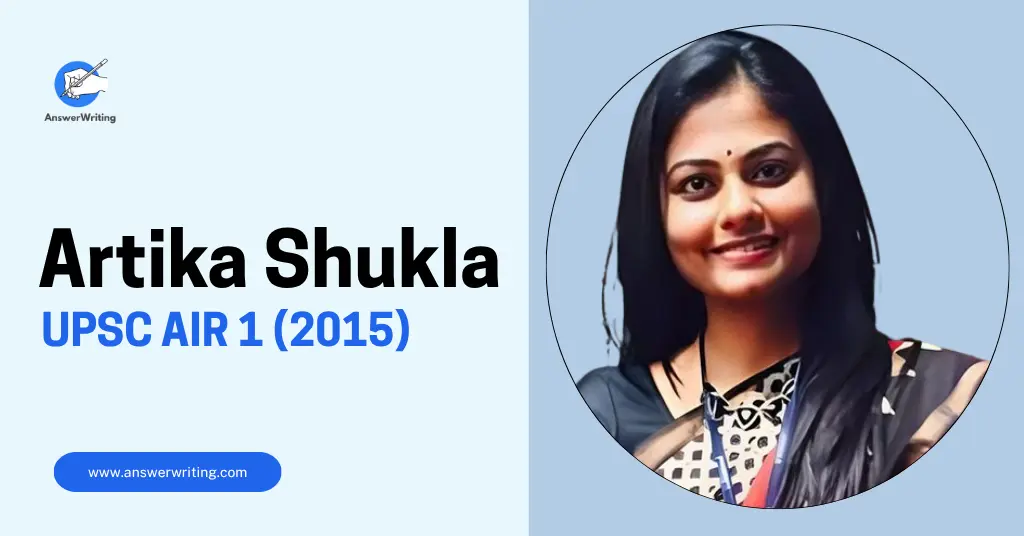
No prior attempt. No second chance needed. Just a complete, disciplined preparation cycle and the highest rank in the country.
Who Is Artika Shukla?
Artika Shukla is an IAS officer who secured AIR 1 in the UPSC Civil Services Examination 2015. She is from Agra, Uttar Pradesh, and comes from a middle-class family background, with her father reported to be a government employee, as per available sources. She completed her MBBS from Maulana Azad Medical College (MAMC), New Delhi, before transitioning to UPSC preparation.
Her story is particularly significant for the large community of medical graduates who consider civil services and wonder whether their professional degree can be an asset rather than a distraction in UPSC preparation. Her result settles that question clearly.
Here is a quick profile:
| Detail | Information |
|---|---|
| Full Name | Artika Shukla |
| AIR (Final Rank) | 1 (UPSC CSE 2015) |
| Total Attempts | 1 |
| Optional Subject | Medical Science |
| Service Allotted | Indian Administrative Service (IAS) |
| Cadre | AGMUT (Arunachal Pradesh, Goa, Mizoram, and Union Territories), as per available reports |
| Educational Background | MBBS, Maulana Azad Medical College, New Delhi |
| Home City | Agra, Uttar Pradesh |
Artika Shukla UPSC Marksheet and Score Details
Artika’s marks are a reflection of her academic brilliance. She scored exceptionally well in the Essay and her Optional subject, which pushed her into the top five of the merit list.
| Paper | Marks Obtained |
| Essay | 145 |
| General Studies 1 | 103 |
| General Studies 2 | 110 |
| General Studies 3 | 111 |
| General Studies 4 (Ethics) | 110 |
| Optional Paper 1 | 143 |
| Optional Paper 2 | 145 |
| Written Total | 867 |
| Personality Test | 193 |
| Final Total | 1060 |
Educational Background and Early Life
Artika Shukla grew up in Agra, a city more associated in public imagination with tourism than with producing UPSC toppers. That background matters. Access to quality coaching, peer networks, and preparation resources is structurally more limited in Agra than in Delhi or Hyderabad. She built her academic foundation and eventually her UPSC preparation without those metropolitan advantages.
She secured admission to Maulana Azad Medical College in New Delhi, one of the most difficult government medical colleges to get into in India. MAMC consistently ranks among the top medical colleges in the country, and admission requires exceptional performance in highly competitive entrance examinations. Getting in is itself a significant achievement.
Her MBBS years gave her more than a medical degree. They built the capacity to absorb and retain large volumes of complex technical information under sustained pressure, to work with precision in high-stakes environments, and to think systematically about problems. These are exactly the cognitive skills that UPSC preparation demands, and her medical training had already sharpened them over five-plus years.
After completing her MBBS and internship, she transitioned into UPSC preparation. The timing of this transition is one of the most commonly searched aspects of her story among medical aspirants, and it reflects a clear, deliberate choice: to take the skills and depth built through medicine and apply them to public administration.
How Many Attempts Did Artika Shukla Take?
Artika Shukla cleared UPSC in her first attempt, as per widely reported sources.
For medical aspirants especially, this is the fact that carries the most weight. MBBS is a five-and-a-half-year degree followed by a mandatory one-year internship. By the time a medical graduate finishes, they are typically in their mid-twenties, often feeling that their peers in other fields have already established careers. The fear of losing additional years to multiple UPSC attempts is real and frequently cited as a reason medical graduates hesitate to try.
Artika Shukla’s first-attempt AIR 1 directly addresses that fear. Not by minimizing the difficulty of UPSC, but by demonstrating that a medical graduate who prepares with genuine completeness can clear the examination without needing multiple cycles.
The key word is completeness. First-attempt success is not about being more talented than candidates who take multiple attempts. It is about entering the examination with a preparation that has no significant unaddressed gaps. Most candidates who take multiple attempts do so because their first attempt had gaps they only identified after sitting the examination. Artika’s preparation, by all available accounts, was structured to be complete before she sat for the first time.
This mindset shift, from treating the first attempt as exploratory to treating it as definitive, is available to every aspirant. It requires earlier and more thorough preparation, but it does not require exceptional ability.
Artika Shukla’s Optional Subject: Medical Science
Artika Shukla chose Medical Science as her optional subject, and this is the single most distinctive and widely searched element of her preparation story, particularly among MBBS graduates and medical students considering UPSC.
Who Medical Science works for:
Medical Science as a UPSC optional is only available to candidates who hold an MBBS degree or equivalent medical qualification. If you do not have that background, this optional is not accessible. For those who do have it, the question is whether it is worth choosing over more popular alternatives like Sociology, Anthropology, or Political Science.
The honest answer is that it depends on how seriously you pursued your MBBS and how comfortable you are with technical, clinical, and biomedical content under examination conditions.
Why Medical Science can be a high-scoring optional:
The syllabus is extensive but deeply familiar to any MBBS graduate. It covers General Medicine, Surgery, Obstetrics and Gynaecology, Community Medicine, Pharmacology, Pathology, Microbiology, Forensic Medicine, and related subjects. For someone who has spent five years studying these subjects and one year applying them in a clinical internship, this is not new material. It is a conversion exercise, taking existing knowledge and reshaping it into UPSC answer formats.
The examiner pool for Medical Science is smaller than for popular optionals. This narrower competition, combined with the technical precision that medical answers can demonstrate, creates a favorable scoring environment for well-prepared candidates.
Medical Science also has meaningful overlap with GS Paper 3, particularly in health policy, public health systems, disease control programs, and nutrition. Time invested in the optional actively strengthens GS preparation rather than pulling away from it.
What makes Medical Science demanding:
The syllabus is wide. Even for MBBS graduates, certain subjects require fresh revision and exam-specific preparation. Community Medicine and health policy sections require updating with current government programs and national health data. Answer writing in Medical Science requires a clinical precision that is different from the discursive style of social science optionals. Diagrams, flowcharts, and structured clinical presentations are expected and rewarded.
Key books for Medical Science optional:
| Paper | Book / Resource | Author / Publisher |
|---|---|---|
| General Medicine | Davidson’s Principles and Practice of Medicine | Brian R. Walker |
| Surgery | Bailey and Love’s Short Practice of Surgery | Norman Williams |
| Obstetrics and Gynaecology | DC Dutta’s Textbook of Obstetrics | Hiralal Konar |
| Community Medicine | Park’s Textbook of Preventive and Social Medicine | K. Park |
| Pharmacology | Essentials of Medical Pharmacology | K.D. Tripathi |
| Pathology | Robbins Basic Pathology | Kumar, Abbas, Aster |
| Microbiology | Medical Microbiology | Ananthanarayan and Paniker |
| Forensic Medicine | The Essentials of Forensic Medicine | K.S. Narayan Reddy |
| Current Health Policy | National Health Policy, NHP Schemes | Ministry of Health |
| Answer Writing Practice | Previous Year UPSC Medical Science Papers | Self-compiled |
One note for aspirants: Medical Science answers must be precise, structured, and clinically grounded. Vague descriptive answers do not score well. Practice writing answers that mirror the clarity and structure expected in clinical case presentations.
UPSC Preparation Strategy of Artika Shukla
Artika Shukla’s preparation is widely reported to have been measured in daily study hours, approximately 6 to 8 hours per day, as per available sources. This is notably less than the 12 to 14 hours some aspirants claim as a benchmark. Her result is a direct argument for quality of preparation over volume of hours.
Prelims: She followed the standard approach of building conceptual foundations from NCERTs before moving to standard GS references. Her medical background gave her a natural advantage in Biology and Health-related questions in both GS Prelims and CSAT. For Current Affairs, consistent newspaper reading formed the core of her daily routine. Aspirants looking to sharpen their Prelims accuracy should focus on topic-wise MCQ practice to identify and systematically address weak areas rather than reading more without testing retention.
Mains GS Papers: She approached GS preparation with a defined and limited source list. For GS Paper 1, standard History and Society references formed the base. For GS Paper 2, Laxmikanth for Polity was the primary source, supplemented with government scheme reading for governance. GS Paper 3 benefited directly from her medical background in health policy sections. GS Paper 4 was prepared using Lexicon combined with regular ethics case study practice.
Optional: Her Medical Science preparation drew on her MBBS textbooks, updated with current health policy and national program data. She focused on converting clinical and biomedical knowledge into structured, exam-ready UPSC answers rather than studying the content from scratch.
Revision: Multiple revision cycles took priority over adding new material as the examination approached. Her medical training had already conditioned her to revise and retain large volumes of technical content systematically, which served her well in the final preparation months.
Coaching: She is not prominently associated with any specific coaching institute as her primary preparation mode. Her approach was largely self-directed, with selective use of external resources where needed.
Books and Resources Recommended by Artika Shukla
The following table reflects books widely associated with her preparation, based on available reports and interviews. Aspirants should cross-check from verified interviews on credible platforms.
| Subject | Book / Resource | Author |
|---|---|---|
| Indian Polity | Indian Polity | M. Laxmikanth |
| Modern History | India’s Struggle for Independence | Bipan Chandra |
| Indian Economy | Indian Economy | Ramesh Singh |
| Geography | Certificate Physical and Human Geography | G.C. Leong |
| Environment | Shankar IAS Environment | Shankar IAS Academy |
| Ethics (GS4) | Lexicon for Ethics | Chronicle Publications |
| Art and Culture | Facets of Indian Culture | Spectrum |
| Current Affairs | The Hindu (daily editorial reading) | N/A |
| Optional | As listed in Medical Science section above | Multiple authors |
Mains Answer Writing Approach
Answer writing in UPSC Mains is where preparation is converted into rank. Artika Shukla’s approach to this conversion reflected both her medical training and her clear understanding of what UPSC examiners reward.
For GS Mains, she focused on writing answers that were directly responsive to the question, structured clearly, and concluded with a practical or policy-oriented perspective. The common mistake of writing comprehensively about a topic rather than precisely about what the question asks is one that her medical training had already corrected. Clinical training demands that you address the presenting complaint, not everything you know about the relevant organ system.
For Medical Science, answer writing had its own discipline. Technical content needed to be presented with clinical precision. Diagrams and flowcharts, where appropriate, were used to organize complex information visually. Community Medicine answers required integration of current health policy data and national program statistics, which she kept updated during preparation.
The challenge for Medical Science aspirants is that their answers need to be both technically accurate and accessible to examiners who may not all be clinicians. Writing with precision without descending into pure clinical jargon is a skill that requires deliberate practice.
For aspirants working on niche optionals like Medical Science, getting specific feedback on whether their answers meet UPSC standards is genuinely difficult. Generic writing feedback rarely helps with a technical optional. AnswerWriting.com’s Optional Evaluator is built specifically for this gap, evaluating answers against the standards of your chosen optional subject rather than applying a one-size-fits-all rubric. For medical aspirants who want to know whether their Medical Science answers are actually exam-ready, that kind of subject-specific feedback is worth building into the preparation process.
Interview (Personality Test) Experience
Artika Shukla’s DAF would have offered the interview board a rich and layered profile to engage with. An MBBS graduate from MAMC, from Agra, who chose Medical Science as her optional and cleared UPSC on her first attempt, presents multiple distinct lines of questioning.
The board likely explored her reasons for choosing civil services over a medical career, her understanding of India’s public health challenges and how administrative levers can address them, her Medical Science optional and its connection to health governance, her perspective on the role of doctors in policy-making, and her background from Agra and what it shaped in her worldview.
Her healthcare expertise would have made her interview unusually substantive. Questions on National Health Mission, health infrastructure gaps, disease burden, maternal mortality, and community health would have been natural territory for a board speaking to an MBBS topper. Boards often probe whether a candidate’s professional background is genuinely integrated into their administrative thinking, or whether it is simply a credential on paper. For Artika, the integration appears to have been genuine and deep.
She is reported to have prepared for the interview by thoroughly reviewing her DAF, reading extensively on health policy and public administration intersections, and preparing structured responses to personal and professional questions.
Specific board names and detailed question transcripts are not available in verified public form and are not included here. Aspirants should refer to her interviews on verified platforms for first-hand accounts.
Service and Cadre Allotted to Artika Shukla
Artika Shukla was allotted the Indian Administrative Service (IAS) with the AGMUT cadre, as per widely available reports. Aspirants should verify cadre details from official UPSC allotment notifications.
The AGMUT cadre covers Arunachal Pradesh, Goa, Mizoram, and Union Territories including the national capital territory of Delhi. For an officer with a medical background, postings in this cadre offer direct opportunities to engage with public health administration, urban governance, and health infrastructure at both state and central government levels.
Her medical expertise brings genuine value to administrative roles that intersect with health policy, which is increasingly recognized as one of the most consequential areas of public governance in India.
Current posting details, if any have been publicly updated since the time of this writing, should be verified from official government sources.
Key Lessons Every UPSC Aspirant Can Take from Artika Shukla
- Your professional degree is not a detour. It is an asset. An MBBS is not a reason to delay UPSC preparation or to feel disadvantaged against humanities graduates. Artika’s medical training built exactly the cognitive skills that UPSC rewards: precision, retention, systematic thinking, and the ability to perform under sustained pressure.
- Six to eight focused hours beats twelve unfocused ones. Her reported study schedule of 6 to 8 hours a day produced AIR 1 on a first attempt. Quality of engagement with material consistently outperforms raw hours on the desk. If your preparation hours are high but your retention and output quality are not improving, the problem is not the number of hours.
- Choose your optional based on genuine depth, not fear of difficulty. Medical Science is technically demanding and has a wide syllabus. But for an MBBS graduate, it is familiar territory being converted into a new format. Fear of the optional’s difficulty is a poor reason to abandon the strongest subject you have.
- Treat your first attempt as your only attempt. First-attempt success requires entering the examination with a preparation that is genuinely complete, not one that is exploratory. Build your preparation calendar as if there is no second chance. This is a mindset available to every aspirant regardless of background.
- Healthcare expertise in the IAS is increasingly relevant. India’s public health infrastructure, policy gaps, and the administrative dimensions of disease control are areas where an IAS officer with medical training can make a distinctive contribution. If you are a doctor considering UPSC, your expertise is not wasted. It becomes the lens through which you govern.
FAQs About Artika Shukla
What was Artika Shukla’s rank in UPSC 2015?
Artika Shukla secured AIR 1 in the UPSC Civil Services Examination 2015.
What was Artika Shukla’s optional subject?
Her optional subject was Medical Science.
How many attempts did Artika Shukla take to clear UPSC?
She cleared UPSC in her first attempt, as per widely reported sources.
Which college did Artika Shukla attend?
She completed her MBBS from Maulana Azad Medical College (MAMC), New Delhi, one of India’s most prestigious government medical colleges.
Which service and cadre was Artika Shukla allotted?
She was allotted the IAS with the AGMUT cadre, as per available reports. Aspirants should verify from official UPSC allotment notifications.
Can a doctor clear UPSC with Medical Science optional?
Artika Shukla’s AIR 1 in 2015 on her first attempt with Medical Science optional is the most direct answer to this question. For MBBS graduates with strong clinical and biomedical foundations, Medical Science can be a high-scoring optional that also reinforces GS Paper 3 health policy content.
How many hours did Artika Shukla study per day?
She is widely reported to have studied approximately 6 to 8 hours per day during her UPSC preparation, as per available sources. Her result is a strong argument that consistent, focused preparation matters more than raw study hours.