Anudeep Durishetty: UPSC AIR 1 (2017), Strategy, Notes, and the 5-Attempt Journey
Four failures. An engineering degree. No civil services background in the family. And then, on the fifth attempt, All India Rank 1 in the most competitive examination in the country.
Anudeep Durishetty’s story is not just about topping UPSC. It is about what happens when a person refuses to let repeated failure define their ceiling.
For the hundreds of thousands of aspirants who have failed once, twice, or more, Anudeep’s journey is not just inspirational. It is instructional.
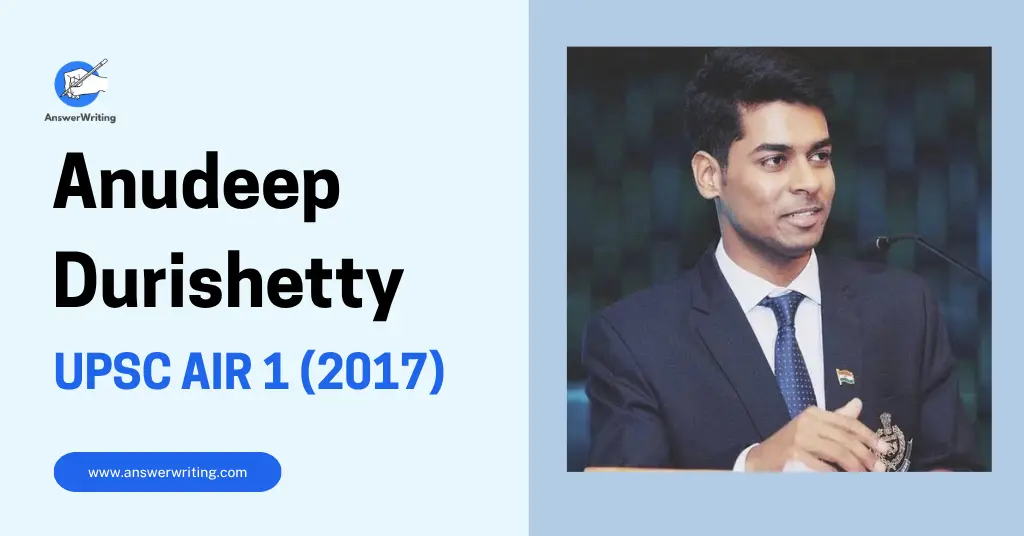
Who Is Anudeep Durishetty?
Anudeep Durishetty is an IAS officer of the 2017 batch, allotted to the Telangana cadre. He secured All India Rank 1 in the UPSC Civil Services Examination 2017, on his fifth attempt.
He completed his B.Tech in Computer Science from BITS Pilani, Hyderabad campus. His background is technical, not from humanities or the traditional arts stream that many assume dominates UPSC.
He chose Anthropology as his optional subject, a choice that played a significant role in his final score. After clearing the exam, he became widely known in the UPSC community for sharing his preparation notes publicly and free of cost.
Here is a quick snapshot:
| Detail | Information |
|---|---|
| Full Name | Anudeep Durishetty |
| UPSC Exam Year | 2017 |
| All India Rank | 1 |
| Number of Attempts | 5 |
| Optional Subject | Anthropology |
| Service Allotted | IAS |
| State Cadre | Telangana |
| Educational Background | B.Tech, Computer Science, BITS Pilani (Hyderabad) |
Anudeep Durishetty UPSC Marksheet and Score Details
Anudeep’s final score reflected strong performance across Mains and a particularly impressive showing in the Personality Test. The figures below are as per widely reported sources. Aspirants are encouraged to cross-check with the official UPSC marksheet portal.
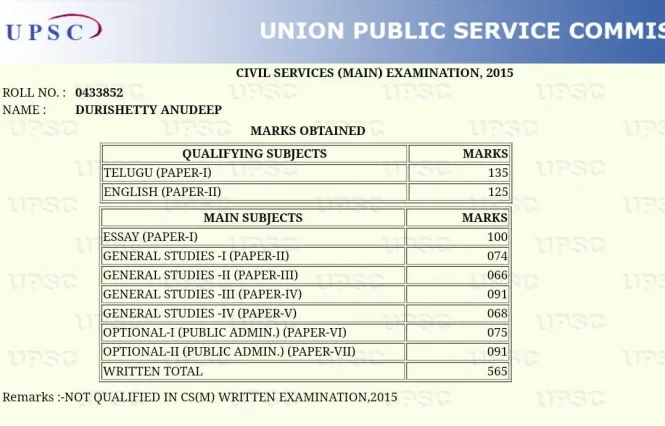
| Component | Marks (Approx.) |
|---|---|
| Essay (GS Paper) | 148 |
| GS Paper 1 | 107 |
| GS Paper 2 | 108 |
| GS Paper 3 | 110 |
| GS Paper 4 (Ethics) | 118 |
| Optional Paper 1 (Anthropology) | 163 |
| Optional Paper 2 (Anthropology) | 181 |
| Interview (Personality Test) | 206 |
| Total (Mains + Interview) | ~1126 |
His Interview score of 206 out of 275 stands out. It is among the highest reported in recent UPSC history and contributed significantly to his rank. His optional subject scores in Anthropology, particularly Paper 2, were exceptional.
Educational Background and Early Life
Anudeep grew up in Telangana and pursued engineering at BITS Pilani’s Hyderabad campus, one of India’s most respected technical institutions. He graduated with a B.Tech in Computer Science.
His academic background gave him strong analytical thinking and the ability to process large volumes of structured information. These skills translated directly into his UPSC preparation, particularly in GS Paper 3 (Technology, Economy, Environment) and in how he approached answer structuring.
He did not come from a family with a civil services tradition. His decision to attempt UPSC after an engineering degree was a deliberate choice, not a default path.
How Many Attempts Did Anudeep Durishetty Take?
Anudeep took five attempts to clear UPSC CSE. He did not clear in his first four tries.
This is one of the most important facts about his journey, and also one of the most misunderstood. Many aspirants know he topped on the fifth attempt. Fewer think about what those four attempts actually taught him.
Each failed attempt gave him data. He understood which areas were weak, what his answer writing was missing, and how his optional subject strategy needed to evolve. He did not repeat the same approach five times. He iterated.
By the fifth attempt, he had a preparation system that was tested, refined, and built specifically around his strengths and the exam’s demands. That is a very different thing from simply “trying again.”
For aspirants currently on their second or third attempt, this is the core lesson: failure is only useful if you treat it analytically, not emotionally.
Optional Subject: Why Anudeep Chose Anthropology and How He Scored
Anudeep chose Anthropology as his optional subject, and his scores in both papers reflect how well this choice worked for him.
Anthropology is considered a high-scoring optional for several reasons. The syllabus is relatively compact compared to subjects like History or Public Administration. It has strong overlap with GS Paper 1 (Society) and GS Paper 4 (Ethics). And it is a subject where a well-prepared candidate can score consistently high marks.
For an engineer without a humanities background, Anthropology offered a level playing field. It does not require years of prior academic study. It rewards clear understanding, good examples, and structured answers.
Anudeep’s Paper 2 score of 181 (as per available reports) is particularly notable. Paper 2 in Anthropology focuses on Indian context, which also connects naturally to current affairs and social issues. A candidate who follows the news regularly and reads the syllabus carefully can build strong answers in this paper.
His choice signals an important point for aspirants: optional subject selection is a strategic decision. It should account for your background, your available preparation time, the scoring pattern, and the overlap with GS papers.
UPSC Preparation Strategy of Anudeep Durishetty
Anudeep’s preparation was not built around coaching dependency. He used a largely self-study approach, supplemented by selective resources.
Approach to General Studies:
He followed standard sources: NCERT textbooks as the foundation, followed by standard reference books for each GS paper. He did not chase every new resource. He focused on depth over breadth.
For current affairs, he relied on newspapers (primarily The Hindu) and consolidated monthly compilations. He made his own notes, which later became the publicly shared resource many aspirants now use.
Revision System:
Anudeep placed heavy emphasis on revision. He did not treat reading as preparation. He treated revision as preparation. Going through material multiple times, in shorter cycles, ensured retention without burnout.
Test Series and Mock Practice:
He used test series to simulate exam conditions. Writing under time pressure, completing full-length papers, and reviewing his own answers critically were regular parts of his schedule.
Study Hours:
Specific daily hour counts are not uniformly verified across sources. However, consistent and focused study over a structured timetable, rather than marathon sessions, appears to have been his approach based on his interviews.
Books and Resources Recommended by Anudeep Durishetty
| Subject/Area | Book or Resource | Author/Source |
|---|---|---|
| History (Ancient, Medieval, Modern) | NCERT textbooks (Class 6 to 12) | NCERT |
| Modern History | India’s Struggle for Independence | Bipan Chandra |
| Geography | NCERT Geography (Class 11, 12) | NCERT |
| Polity | Indian Polity | M. Laxmikanth |
| Economy | Indian Economy | Ramesh Singh |
| Environment and Ecology | Shankar IAS Environment | Shankar IAS Academy |
| Ethics (GS Paper 4) | Lexicon for Ethics | Chronicle Publications |
| Anthropology (Optional) | Anthropology by Ember and Ember | Ember and Ember |
| Anthropology (Optional) | Anthropology UPSC notes | Anudeep’s own notes (publicly available) |
| Current Affairs | The Hindu (daily) | The Hindu |
| Essay | Practice and past year papers | Self-practice |
Note: This list is compiled from widely reported interviews and community sources. Aspirants should verify current editions and supplement based on their own gaps.
Mains Answer Writing Approach
Anudeep treated answer writing as a separate skill, not a by-product of reading. This distinction matters enormously in UPSC Mains.
He practiced writing answers regularly, focusing on structure: a clear introduction, body paragraphs with distinct points, and a conclusion that connected to either a policy angle or a values-based observation. He paid attention to word limits and did not overwrite.
He also focused on making answers “examiner-friendly.” This means clear handwriting, logical flow, and the selective use of underlines or small diagrams where relevant. A good answer is one the examiner can scan quickly and reward.
For aspirants building this skill, consistent practice with honest evaluation is the only path forward. Platforms like AnswerWriting.com are specifically designed for this: aspirants upload handwritten answers and receive structured feedback from evaluators, replicating the kind of peer and mentor review that toppers like Anudeep consistently recommend. Getting your answers evaluated by someone outside your own head is not optional. It is essential.
The gap between what you think your answer says and what an examiner actually reads is where most Mains marks are lost.
Interview (Personality Test) Experience
Anudeep’s Interview score of 206 out of 275 is one of the standout numbers in his marksheet. It is not common for a candidate to score this high in the Personality Test, and it contributed decisively to his AIR 1.
His interview preparation was rooted in his Detailed Application Form (DAF). UPSC interview boards draw heavily from what a candidate has filled in: educational background, hobbies, work experience, and home state. Anudeep, with an engineering background from BITS Pilani and roots in Telangana, would have faced questions spanning technology, regional governance, social issues in his state, and his own reasons for choosing civil services over an engineering career.
He prepared by mock interviews and by deeply understanding his own profile. He did not try to become someone else in the interview room. Authenticity, clarity of thought, and comfort with uncertainty are what interview boards respond to.
The lesson here is not to memorise answers. It is to know yourself well enough to speak honestly under pressure.
Anudeep Durishetty’s Free UPSC Notes: What They Cover and Where to Find Them
This is the part of Anudeep’s story that sets him apart from most toppers.
After securing AIR 1, Anudeep made his personal preparation notes publicly available, free of charge. In a preparation ecosystem where paid content dominates, this was a significant gesture.
His notes cover General Studies papers and Anthropology. They are widely regarded as concise, well-organised, and exam-relevant. They do not replicate textbooks. They are distilled summaries of what matters for the exam, built by someone who spent five attempts understanding exactly what UPSC tests.
These notes are available across UPSC forums and preparation communities. A simple search for “Anudeep Durishetty UPSC notes” will surface multiple sources. Aspirants should download from reliable communities and verify the content against standard sources, since unofficial versions may have edits or errors.
Why does this matter beyond generosity? It tells you something about how he prepared. His notes exist because he had a disciplined note-making habit. He did not just read. He synthesised. And that synthesis habit is something every aspirant can adopt, regardless of whether they use his notes or make their own.
Service and Cadre Allotted to Anudeep Durishetty
Anudeep Durishetty was allotted the IAS (Indian Administrative Service) and placed in the Telangana cadre. As an AIR 1 holder, he had the first choice of service and cadre.
His current posting details, as with most serving IAS officers, are subject to change through transfers and deputation. Aspirants interested in his current role can check official Telangana government sources or reliable civil services tracking platforms for the most updated information.
Key Lessons Every UPSC Aspirant Can Take from Anudeep Durishetty
- Failure is a feedback system, not a verdict. Four attempts before AIR 1 means four rounds of data collection. Use your failed attempts to understand the exam better, not to question whether you belong.
- Optional subject selection is strategy, not preference. Anudeep picked Anthropology because it suited his background, offered good scoring potential, and overlapped with GS. Make your optional choice the same way: analytically.
- Revision beats reading. Going through material once is not preparation. Going through it three or four times, in reducing time cycles, is. Anudeep’s approach was built on this principle.
- Answer writing is a standalone skill. Reading GS content and writing good GS answers are two different things. Practice writing. Get it evaluated. Close the gap between what you intend and what you produce on paper.
- Generosity scales. Anudeep shared his notes with thousands of aspirants for free. The UPSC community rewards this kind of openness. Build your preparation in networks, share what you learn, and do not hoard knowledge out of competitive anxiety.
FAQs About Anudeep Durishetty
What was Anudeep Durishetty’s AIR in UPSC CSE 2017?
Anudeep Durishetty secured All India Rank 1 in the UPSC Civil Services Examination 2017.
How many attempts did Anudeep Durishetty take to clear UPSC?
He cleared UPSC on his fifth attempt. His first four attempts were unsuccessful.
What was Anudeep Durishetty’s optional subject?
His optional subject was Anthropology. He scored exceptionally well in both papers, particularly Paper 2.
Did Anudeep Durishetty attend coaching for UPSC?
As per available reports, Anudeep followed a largely self-study approach. He did not depend heavily on classroom coaching. Aspirants should verify this from his own interviews for full context.
Where can I find Anudeep Durishetty’s UPSC notes?
His notes are available across UPSC preparation forums and communities. Search “Anudeep Durishetty UPSC notes” on platforms like Telegram groups, Reddit’s r/UPSC, and civil services preparation websites. Download only from reliable sources.
What is Anudeep Durishetty’s educational background?
He holds a B.Tech in Computer Science from BITS Pilani, Hyderabad campus.
Which cadre and service was Anudeep Durishetty allotted?
He was allotted the Indian Administrative Service (IAS) and placed in the Telangana state cadre.