Anu Kumari: AIR 2 and Top Woman, UPSC CSE 2017, Strategy and Journey
She was not studying in a library with eight uninterrupted hours ahead of her. She was preparing for UPSC around her toddler’s nap times, meal schedules, and bedtime routines. And she came back from that reality with AIR 2 in the entire country.
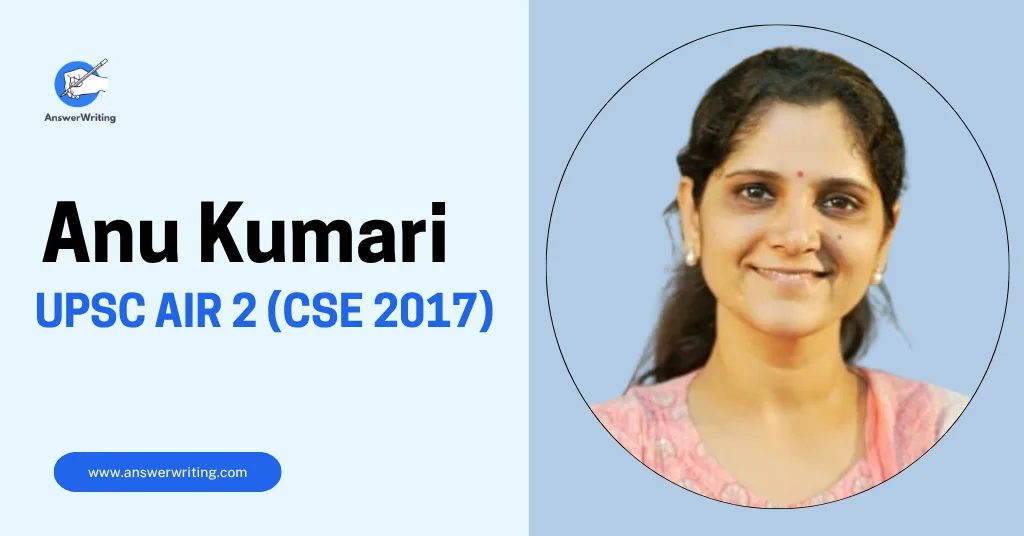
Anu Kumari’s story is not just inspirational. It is practically instructive for every aspirant who believes their circumstances are an obstacle to serious preparation.
Who Is Anu Kumari?
Anu Kumari secured AIR 2 in the UPSC Civil Services Examination 2017, with results declared in 2018. She was the top-ranked woman candidate in that cycle, a distinction that brought her significant national attention.
She belongs to Haryana and completed her undergraduate education at the University of Delhi. She chose Sociology as her optional subject despite holding a B.Sc. in Physics, a cross-disciplinary choice that worked strongly in her favour. She was allotted the IAS with the Haryana cadre.
Quick Profile
| Detail | Information |
|---|---|
| Full Name | Anu Kumari |
| AIR | 2 (CSE 2017) |
| Rank Among Women | 1st (Top Woman Candidate) |
| Exam Year | UPSC CSE 2017 |
| Attempts | 2 (Second attempt) |
| Optional Subject | Sociology |
| Service | IAS |
| Cadre | Haryana |
| Educational Background | B.Sc. Physics (Hons), University of Delhi |
| Home State | Haryana |
Anu Kumari UPSC Marksheet and Score Details
As per widely reported figures, here is Anu Kumari’s score breakdown:
| Stage | Marks Obtained | Maximum Marks |
|---|---|---|
| Mains Written | 1063 | 1750 |
| Interview (Personality Test) | 176 | 275 |
| Final Total | 1239 | 2025 |
Her Mains written score of 1063 is notably strong and reflects both GS preparation depth and a well-executed optional. Her interview score of 176 is solid and consistent with a confident, grounded personality test performance.
Individual GS paper-wise scores and Sociology optional paper scores are not officially published in granular public detail. Aspirants should cross-check specific sub-scores from official UPSC marksheet disclosures or verified interview sources.
Educational Background and Early Life
Anu Kumari completed her schooling in Haryana and went on to pursue B.Sc. Physics (Honours) from the University of Delhi, one of India’s most academically competitive undergraduate environments.
Her science background gave her analytical discipline and comfort with structured reasoning. These are traits that translate well into UPSC preparation, particularly for GS Paper 3 and for approaching essay writing with logical coherence.
After completing her degree, her life took a personal turn before UPSC preparation could become her primary focus. Marriage and motherhood followed. What happened next is where her story becomes genuinely instructive.
How Many Attempts Did Anu Kumari Take?
Anu cleared UPSC CSE 2017 in her second attempt. But the gap between her first and second attempt was not simply a matter of improving scores. It involved navigating marriage, becoming a mother, and rebuilding a preparation routine around an entirely new set of daily responsibilities.
Her first attempt did not result in selection. Rather than treating that outcome as a reason to step back, she restructured her preparation around her life as it actually was, not as she wished it would be.
This is the part of her story that most aspirants underreport when they reference her. The rank gets the headline. The restructuring is the actual lesson.
She has spoken in interviews about studying during her child’s nap times, early mornings before the household woke up, and late nights after family responsibilities were done. She did not wait for ideal conditions. She created workable ones.
For aspirants juggling jobs, families, or other commitments, this framing matters. The question is not “when will I have enough time to prepare properly.” The question is “how do I prepare effectively within the time I actually have.”
Anu Kumari’s Optional Subject: Sociology
Why a Physics Graduate Chose Sociology
This is the question aspirants ask most frequently about her preparation. Why Sociology, when her academic background was in the sciences?
Her reasoning, as reported across multiple interviews, was rooted in syllabus analysis and honest self-assessment. Sociology’s syllabus is well-defined and manageable within a reasonable preparation timeline. It overlaps significantly with GS Paper 1 (Indian society, social issues) and GS Paper 2 (social justice, vulnerable sections). These overlaps reduce the total preparation burden considerably.
She also recognised that Sociology rewards conceptual clarity and the ability to apply thinkers and theories to contemporary Indian realities. For someone with a strong general reading habit and an interest in social dynamics, this was a better fit than sticking with Physics, which demands a very different kind of exam-specific preparation.
The broader lesson here is one that Srushti Deshmukh also demonstrated with Anthropology: optional subject choice should follow syllabus compatibility, GS overlap, and honest personal strengths, not academic background alone.
Strategy for Sociology
She focused on building a strong theoretical foundation first, covering classical and modern sociological thinkers in depth. She then practised applying those theories to Indian social contexts, which is where Sociology answers gain their scoring edge.
For Paper II, which covers Indian society specifically, her preparation aligned naturally with GS Paper 1 content. She did not treat them as separate silos but prepared them in an integrated manner, reinforcing both simultaneously.
Answer presentation in Sociology matters considerably. She structured her answers with clear introductions, thinker references where relevant, and real-world Indian examples to ground abstract concepts.
Key Books for Sociology Optional
As per widely reported sources aligned with her preparation approach:
- “Sociology: Themes and Perspectives” by Haralambos and Holborn (foundational theory)
- IGNOU study material for Sociology (comprehensive and UPSC-aligned)
- Relevant chapters from “Social Change in Modern India” by M.N. Srinivas
- Previous year UPSC question papers for Sociology (pattern recognition and answer planning)
UPSC Preparation Strategy of Anu Kumari
Structuring Preparation Around Family Life
This is the section most aspirants come to her story for, and it deserves honest treatment rather than vague inspiration.
Anu did not have a conventional eight to ten hour uninterrupted study block available to her. She worked with smaller, focused windows of time and compensated through consistency and strategic prioritisation.
As per her widely reported interviews, she studied during early mornings before household activity began, during her child’s nap time in the afternoon, and after the child was asleep in the evening. These were not long sessions. They were disciplined ones.
The key was that she did not treat interrupted days as lost days. A two-hour focused session counted. It moved her forward. This cumulative approach across months produced the preparation depth that AIR 2 requires.
Coaching vs. Self-Study
Anu primarily followed a self-study model. As per available reports, she did not rely on full-time classroom coaching during her second attempt. She used standard recommended resources, made her own notes, and practised answer writing independently.
This model is particularly relevant for aspirants who cannot attend regular coaching due to location, cost, or personal responsibilities.
GS Paper Approach
For GS Paper 1, she used NCERTs as her base for History and Geography, supplemented by standard reference texts. For Indian Society topics, her Sociology optional preparation provided a strong parallel foundation.
For GS Paper 2, she focused on Polity through M. Laxmikanth and tracked government schemes and policies through newspapers and official sources.
For GS Paper 3, she covered Economy through standard texts and linked concepts to current policy developments. Environment and internal security topics were covered through dedicated resources.
For GS Paper 4, she paid careful attention to ethical frameworks and case study practice. This paper rewards aspirants who can think through real governance dilemmas clearly, and her Sociology background gave her useful conceptual vocabulary for this.
Revision Strategy
She revised her notes multiple times before the exam rather than reading new sources close to the examination. Revision over expansion is a principle that most toppers reinforce, and her approach was consistent with this.
Current Affairs
She followed newspapers daily and made concise notes linking current developments to static syllabus topics. This integration, rather than treating current affairs as a separate preparation track, is what allows aspirants to use the same material across multiple GS papers effectively.
Books and Resources Recommended by Anu Kumari
As per her widely reported interviews and verified sources:
| Subject | Book / Resource | Author / Source |
|---|---|---|
| Ancient and Medieval History | NCERT Textbooks (Class 6 to 12) | NCERT |
| Modern History | India’s Struggle for Independence | Bipan Chandra |
| Indian Polity | Indian Polity | M. Laxmikanth |
| Indian Economy | Indian Economy | Ramesh Singh |
| Geography | NCERT Geography (Class 11 and 12) | NCERT |
| Environment and Ecology | Shankar IAS Environment | Shankar IAS Academy |
| Ethics (GS4) | Lexicon for Ethics | Niraj Kumar |
| Current Affairs | The Hindu | Daily Reading |
| Sociology Optional | Haralambos and Holborn | Mike Haralambos |
| Sociology Optional | IGNOU Study Material | IGNOU |
Cross-check this list against her official interviews, as specific book mentions may vary across sources.
Mains Answer Writing Approach
Anu’s Mains written score of 1063 out of 1750 reflects strong, consistent answer writing across GS papers and optional. Her approach was deliberate and structured rather than instinctive.
She practised writing answers within strict time and word limits throughout her preparation. She did not wait until the final weeks to begin this practice. Answer writing was a regular activity from the early stages, which is how the skill develops into a reflex rather than a conscious effort under exam pressure.
Her answers were structured around clear openings that directly addressed the question, a body that used subheadings or organised points where appropriate, relevant examples drawn from current affairs or Indian governance realities, and conclusions that added perspective rather than simply restating the question.
One challenge she faced, which she has acknowledged in interviews, is that self-study aspirants without a peer group or mentor often lack objective feedback on their writing. You cannot accurately evaluate your own answers because you already know what you intended to write.
This is precisely why tools like AnswerWriting.com matter for self-study aspirants. The platform’s Answer Evaluator provides structured, objective feedback on Mains answers, covering content gaps, structural issues, language clarity, and UPSC scoring parameters. For aspirants preparing without a mentor or study group, this kind of consistent external feedback can be the difference between writing that feels good and writing that actually scores well.
Anu’s preparation demonstrated that self-study can produce AIR 2 results. But self-study without feedback has real limitations. Closing that gap is what separates good preparation from exceptional results.
Interview (Personality Test) Experience
Anu Kumari scored 176 out of 275 in the Personality Test, a confident and consistent performance.
She has spoken about her interview preparation in several widely reported interviews. Her approach centred on thorough DAF review, honest articulation of her personal journey including marriage and motherhood, and staying current on Haryana-specific governance and social issues relevant to her home state and cadre preference.
As per available reports, the board engaged with her background in Physics, her choice of Sociology as an optional, and her personal circumstances as a mother preparing for civil services. She approached these questions directly and without deflection, which is consistent with the board’s preference for genuine personality over rehearsed answers.
She has also mentioned that being clear about her motivations for civil services, rooted in her own social context in Haryana, helped her answer board questions with conviction rather than generic responses.
Specific board member names and detailed question sets from her interview are not widely verified and will not be reproduced here. Aspirants should refer to her directly reported interview accounts for granular detail.
Service and Cadre Allotted to Anu Kumari
Anu Kumari was allotted the Indian Administrative Service (IAS) with the Haryana cadre. Her rank of AIR 2 gave her strong positioning in the allotment process, and her home state cadre preference aligned with her allocation.
Her current posting and administrative assignments should be verified from official government or recent news sources, as postings change over time and this article does not carry potentially outdated placement information.
Key Lessons Every UPSC Aspirant Can Take from Anu Kumari
- Circumstances are a constraint to work within, not a reason to wait. Anu did not prepare under ideal conditions. She prepared under real ones. Aspirants who are waiting for the right time, the right city, or the right life situation are making a choice, not facing a limitation.
- Optional subject choice is about strategic fit, not academic loyalty. A Physics graduate chose Sociology and came second in India. Evaluate your optional based on syllabus manageability, GS overlap, and your genuine ability to write analytically in that subject, not based on what you studied in college.
- Consistency in small windows beats inconsistency in large ones. Two focused hours every day for twelve months produces more than occasional ten-hour sessions with weeks of gaps in between. Anu’s preparation was built on reliable daily effort within the time she had.
- Self-study works, but feedback cannot be optional. Her self-directed model produced outstanding results, but the gap in self-study is always the absence of objective evaluation. Seek feedback on your writing regularly, whether through peers, mentors, or dedicated evaluation platforms.
- The interview rewards authenticity over performance. She did not conceal or minimise the personal aspects of her journey in the Personality Test. She engaged with them directly. The board evaluates how you think and how you present yourself, not whether your life fits a conventional template.
FAQs About Anu Kumari
What was Anu Kumari’s optional subject in UPSC? She chose Sociology as her optional subject. Despite holding a B.Sc. in Physics, she selected Sociology for its manageable syllabus and strong overlap with GS papers on Indian society and social justice.
How many attempts did Anu Kumari take to clear UPSC? She cleared UPSC CSE 2017 in her second attempt and secured AIR 2 overall and Rank 1 among all women candidates.
Did Anu Kumari take coaching for UPSC? As per available reports, she followed a primarily self-directed preparation model during her second attempt and did not rely on full-time classroom coaching.
How did Anu Kumari prepare for UPSC as a mother? As per her widely reported interviews, she studied during early mornings, her child’s nap times, and late evenings after family responsibilities. She prioritised consistency over long uninterrupted sessions.
What was Anu Kumari’s total score in UPSC CSE 2017? As per available reports, her final total was 1239 out of 2025, including 1063 in Mains written and 176 in the Personality Test.
Which cadre was Anu Kumari allotted? She was allotted the IAS with the Haryana cadre, her home state.
Which college did Anu Kumari attend? She completed her B.Sc. Physics (Honours) from the University of Delhi.