Anmol Sher Singh Bedi: AIR 2, UPSC CSE 2017, Strategy and Journey
If you secured AIR 2 in the UPSC Civil Services Examination, most people would assume you walked away with IAS. Anmol Sher Singh Bedi chose IFS instead.
That decision was not an accident or a consolation. It was the destination he had been preparing for. And understanding that distinction is the first thing every aspirant should take from his story.
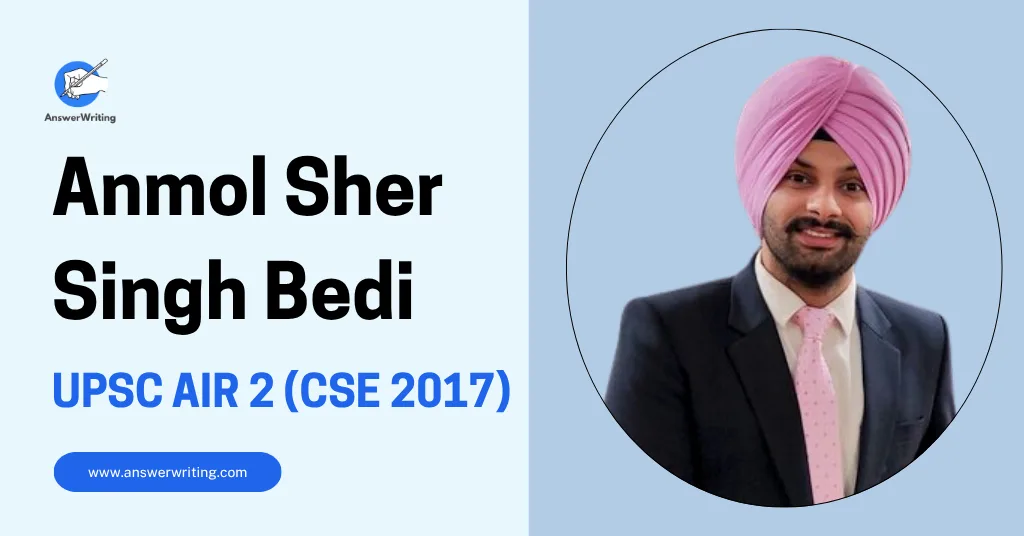
Who Is Anmol Sher Singh Bedi?
Anmol Sher Singh Bedi secured AIR 2 in the UPSC Civil Services Examination 2017, with results declared in 2018. He belongs to Punjab and completed his B.Tech from IIT Delhi, one of India’s most competitive technical institutions.
He chose Political Science and International Relations (PSIR) as his optional subject, despite his engineering academic background. He was allotted the Indian Foreign Service (IFS), his stated first preference, making him one of the rare top-two rankers in recent UPSC history to prioritise IFS over IAS.
Quick Profile
| Detail | Information |
|---|---|
| Full Name | Anmol Sher Singh Bedi |
| AIR | 2 (CSE 2017) |
| Exam Year | UPSC CSE 2017 |
| Attempts | 2 (Second attempt) |
| Optional Subject | Political Science and International Relations (PSIR) |
| Service | IFS (Indian Foreign Service) |
| Educational Background | B.Tech, IIT Delhi |
| Home State | Punjab |
Anmol Sher Singh Bedi UPSC Marksheet and Score Details
As per widely reported figures, here is Anmol Sher Singh Bedi’s score breakdown:
| Stage | Marks Obtained | Maximum Marks |
|---|---|---|
| Mains Written | 1080 | 1750 |
| Interview (Personality Test) | 176 | 275 |
| Final Total | 1256 | 2025 |
His Mains written score of 1080 is notably strong and reflects both effective GS preparation and a well-executed PSIR optional. His interview score of 176 is solid, particularly in the context of an IFS-targeted personality test where international affairs depth is closely evaluated.
Individual GS paper-wise scores and PSIR optional paper scores are not officially published in granular public detail. Aspirants should cross-check specific sub-scores from official UPSC marksheet disclosures or verified interview sources.
Educational Background and Early Life
Anmol grew up in Punjab and cleared the IIT-JEE to join IIT Delhi for his B.Tech. IIT Delhi is among the most demanding undergraduate environments in the country, and the analytical rigour it demands shaped how he approached information processing, structured reasoning, and exam strategy.
His engineering training gave him a particular advantage in GS Paper 3, where topics like infrastructure, science and technology, and economic development reward candidates who can think in systems and apply technical reasoning to policy questions.
What his background also gave him was comfort with self-directed learning. IIT graduates are trained to extract understanding from dense material independently, a skill that transfers directly to UPSC preparation where the reading load is significant and the synthesis demands are high.
How Many Attempts Did Anmol Sher Singh Bedi Take?
Anmol cleared UPSC CSE 2017 in his second attempt. His first attempt did not result in selection, and what happened between the two attempts is the strategically useful part of his story.
As per available reports, he used his first attempt as a genuine diagnostic exercise rather than treating it as a failed experience to move past quickly. He assessed which areas of his preparation had not translated into scores, identified specific gaps in his answer writing and optional subject coverage, and restructured his approach for the second attempt accordingly.
This pattern, honest diagnosis followed by targeted correction, is what separates productive multi-attempt preparation from repetitive effort. Aspirants who simply work harder in their next attempt without changing what is not working rarely see proportional improvement. Anmol’s jump to AIR 2 reflects the difference that strategic correction makes.
For aspirants currently on their second or third attempt, the question worth asking is not “am I working hard enough?” It is “have I correctly identified what specifically needs to change?”
Why Anmol Sher Singh Bedi Chose IFS Over IAS
This section deserves dedicated treatment because it is the most distinctive and widely discussed aspect of his profile.
Securing AIR 2 gave Anmol his choice of virtually any service and cadre combination. IAS with a top-tier state cadre was fully within reach. He chose IFS.
This was not a default outcome. As per available reports, IFS was his deliberate first preference from the outset of his preparation. His interest in international affairs, foreign policy, and diplomacy shaped both his optional subject selection (PSIR) and his preparation focus areas throughout.
This alignment between service preference and preparation strategy is something most aspirants underestimate. When your optional subject, your current affairs reading focus, your essay topics, and your interview preparation all point toward the same destination, the coherence shows in every stage of the examination.
For aspirants who are genuinely interested in IFS, Anmol’s approach offers a clear model. Do not prepare generically for civil services and then list IFS as a preference. Prepare specifically for the kind of thinking, writing, and conversation that IFS requires, and let that specificity strengthen every part of your attempt.
IFS officers work at the intersection of diplomacy, international law, trade negotiation, and bilateral relations. Candidates who demonstrate genuine depth in these areas, not just surface familiarity, stand out in both Mains and the Personality Test.
Anmol Sher Singh Bedi’s Optional Subject: PSIR
Why an IIT Graduate Chose Political Science and International Relations
PSIR is one of the most popular optional subjects in UPSC, and Anmol’s choice of it from an engineering background follows a logic that many aspirants share but fewer articulate clearly.
PSIR has a well-defined syllabus covering political theory, comparative politics, Indian government and politics, and international relations. The international relations component aligned directly with his IFS ambitions, making his optional preparation and his service preference mutually reinforcing rather than parallel tracks.
For an IIT graduate comfortable with analytical reasoning and structured argumentation, PSIR rewards exactly those skills. The subject does not require prior academic exposure in political science. It requires the ability to engage with ideas, build arguments, and apply theoretical frameworks to real-world political situations. These are transferable intellectual skills that strong engineering graduates carry naturally.
How PSIR Helped His Overall Preparation
The overlap between PSIR and GS Paper 2 is significant. Constitutional governance, political institutions, international organisations, and bilateral relations appear in both. Aspirants who prepare PSIR thoroughly often find that GS Paper 2 requires considerably less separate preparation as a result.
The international relations component of PSIR also feeds directly into essay writing and GS Paper 2 questions on foreign policy and India’s external relations. For an IFS-targeted candidate, this triple overlap across optional, GS, and essay is a genuine structural advantage.
Books and Strategy for PSIR
His preparation for PSIR involved standard reference texts used across serious PSIR preparation. As per available reports and widely recommended PSIR resources:
- “An Introduction to Political Theory” by O.P. Gauba (political theory foundation)
- “International Relations” by Pushpesh Pant (IR coverage aligned with UPSC syllabus)
- “Indian Government and Politics” by B.L. Fadia (Indian politics component)
- Previous year UPSC question papers for PSIR (pattern recognition and answer planning)
- Newspapers and journals for current international affairs (ongoing throughout preparation)
Aspirants choosing PSIR should note that answer writing in this subject rewards analytical depth over descriptive breadth. Knowing a theory is not enough. Applying it to a contemporary example with precision is what separates average PSIR answers from high-scoring ones.
UPSC Preparation Strategy of Anmol Sher Singh Bedi
Coaching vs. Self-Study
As per available reports, Anmol followed a structured but largely self-directed preparation approach. His IIT background gave him confidence in independent learning, and his preparation reflected that. He used coaching selectively for specific guidance rather than as his primary learning source.
This model works particularly well for candidates who can maintain discipline without external scheduling and who have the reading ability to extract understanding from standard UPSC resources independently.
GS Paper Approach
For GS Paper 1, he used standard NCERT textbooks as his foundation for History and Geography, building upward from there to reference books. His PSIR optional provided strong background for the Indian society and world history components of GS Paper 1.
For GS Paper 2, his PSIR preparation carried significant weight. Polity, governance, international relations, and bilateral issues were areas where his optional and GS preparation overlapped and reinforced each other. He used M. Laxmikanth for the constitutional and governance core.
For GS Paper 3, his engineering background proved useful. Infrastructure, technology, economic planning, and internal security topics that challenge many humanities graduates were areas he approached with analytical comfort.
For GS Paper 4, he focused on ethical frameworks and their application to governance scenarios. His PSIR background, which includes political philosophy and theories of justice, gave him useful conceptual vocabulary for this paper.
Current Affairs Strategy
Given his IFS focus, current affairs preparation carried additional weight for Anmol. He followed international developments closely, not just as exam preparation but as genuine engagement with the subject matter he was preparing to work in professionally.
This distinction matters. Aspirants who read current affairs only as exam material often retain it superficially. Aspirants who read it with genuine curiosity about the subject retain it more deeply and can deploy it more naturally in answers and interviews.
He followed newspapers consistently and supplemented with journals and government foreign policy documents to build depth in international relations coverage beyond what newspapers alone provide.
Revision Approach
As per his preparation model and widely reported interview accounts, he prioritised revision of core material over expanding to new sources close to the examination. Consolidation over addition in the final preparation phase is a principle that most successful multi-attempt candidates converge on.
Books and Resources Recommended by Anmol Sher Singh Bedi
As per his widely reported interviews and verified sources aligned with his preparation:
| Subject | Book / Resource | Author / Source |
|---|---|---|
| Ancient and Medieval History | NCERT Textbooks (Class 6 to 12) | NCERT |
| Modern History | India’s Struggle for Independence | Bipan Chandra |
| Indian Polity | Indian Polity | M. Laxmikanth |
| Indian Economy | Indian Economy | Ramesh Singh |
| Geography | NCERT Geography (Class 11 and 12) | NCERT |
| Environment and Ecology | Shankar IAS Environment | Shankar IAS Academy |
| Ethics (GS4) | Lexicon for Ethics | Niraj Kumar |
| Current Affairs | The Hindu and Indian Express | Daily Reading |
| PSIR: Political Theory | An Introduction to Political Theory | O.P. Gauba |
| PSIR: International Relations | International Relations | Pushpesh Pant |
| PSIR: Indian Politics | Indian Government and Politics | B.L. Fadia |
Cross-check this list against his official interviews, as specific book mentions may vary across sources.
Mains Answer Writing Approach
Anmol’s Mains written score of 1080 out of 1750 reflects strong, consistent performance across GS papers and optional. For an IFS-targeted candidate, the Essay paper also carries particular strategic weight because essay writing ability signals the kind of analytical and communicative depth that diplomatic work demands.
His approach to GS answers followed a structure that rewarded analytical framing over descriptive content: a direct opening that positioned his argument, body paragraphs that built the case with evidence and examples, and conclusions that offered perspective rather than summary.
For PSIR answers specifically, he applied theoretical frameworks to contemporary examples with precision, which is the defining characteristic of high-scoring answers in this optional. Knowing that Morgenthau defined power politics in a certain way is background knowledge. Applying that framework to analyse a current bilateral relationship is what earns marks.
One challenge that self-study aspirants consistently face is the absence of objective feedback on their writing. You develop blind spots over time. Patterns that feel natural to you may be structural habits that limit your scores without your awareness.
Platforms like AnswerWriting.com address this directly. For aspirants targeting IFS specifically, its Essay Evaluator is particularly relevant. Essays are evaluated for argument coherence, depth of analysis, language quality, and structural flow, which mirrors exactly what the UPSC essay paper rewards and what IFS interview boards look for in a candidate’s thinking. Getting structured feedback on full-length essays before the exam is a preparation step that most aspirants skip and most toppers wish they had done more of.
Interview (Personality Test) Experience
Anmol scored 176 out of 275 in the Personality Test, a strong performance that reflected thorough preparation and genuine depth in international affairs.
IFS-targeted interviews have a distinct character compared to standard IAS interviews. Boards tend to probe international relations, foreign policy positions, India’s bilateral relationships, and a candidate’s awareness of ongoing diplomatic developments more extensively. A candidate who lists IFS as their first preference and cannot engage substantively with these areas is at a significant disadvantage.
As per available reports, Anmol’s interview preparation involved thorough DAF review, deep engagement with current international affairs beyond newspaper headlines, and preparation to articulate clearly why he wanted IFS specifically rather than IAS.
His PSIR optional gave him a strong conceptual vocabulary for discussing international relations in the interview room. Theoretical frameworks from IR, applied to current events, produce the kind of nuanced, structured responses that interview boards find compelling.
He has emphasised, as per available reports, the importance of being genuinely informed about foreign policy rather than performing familiarity with it. Boards with experienced diplomats can distinguish between the two quickly.
Specific board member names and detailed question sets from his interview are not widely verified in public sources and will not be reproduced here. Aspirants should refer to his directly reported interview accounts for granular detail.
Service and Cadre Allotted to Anmol Sher Singh Bedi
Anmol Sher Singh Bedi was allotted the Indian Foreign Service (IFS), his stated first preference. Unlike IAS, IFS does not operate on a state cadre system. IFS officers are centrally allocated and posted across Indian missions abroad and in the Ministry of External Affairs in New Delhi.
His postings and current assignments should be verified from official government or recent news sources, as foreign service postings rotate regularly and this article does not carry potentially outdated placement information.
For aspirants who are considering IFS as a career, it is worth understanding that IFS involves mandatory foreign postings, rotational assignments between headquarters and missions abroad, and a career built around diplomacy, trade, and bilateral relations rather than district-level administration. This is a fundamentally different career profile from IAS, and Anmol’s deliberate preference for it reflects a clear-eyed understanding of that distinction.
Key Lessons Every UPSC Aspirant Can Take from Anmol Sher Singh Bedi
- Know which service you want before you begin preparing. Anmol did not prepare for civil services generically and then pick IFS at the end. His optional subject, his current affairs focus, his essay preparation, and his interview approach all pointed toward IFS from the start. That coherence strengthened every stage of his attempt.
- Optional subject and service preference should reinforce each other. PSIR and IFS are a natural pairing. When your optional overlaps with your GS papers and also builds the knowledge base for your target service, preparation becomes more efficient and more integrated. Evaluate your optional with this lens.
- Engineering backgrounds are assets in UPSC, not obstacles. Analytical reasoning, structured problem-solving, and comfort with technical content in GS Paper 3 are genuine advantages that engineering graduates bring. Do not treat your degree as irrelevant to your UPSC preparation.
- Diagnosis between attempts matters more than effort alone. His jump to AIR 2 in his second attempt came from identifying specifically what had not worked in the first and correcting it precisely. More effort without more clarity produces incremental improvement at best.
- Read current affairs with genuine curiosity, not just exam intent. Aspirants who engage with international affairs as a subject they find genuinely interesting retain and deploy that knowledge more naturally than those who consume it purely as exam material. For IFS aspirants especially, this distinction shows in the interview room.
FAQs About Anmol Sher Singh Bedi
What was Anmol Sher Singh Bedi’s optional subject in UPSC? He chose Political Science and International Relations (PSIR) as his optional subject. Despite having a B.Tech background from IIT Delhi, he selected PSIR for its alignment with his IFS ambitions and its overlap with GS Paper 2 content.
How many attempts did Anmol Sher Singh Bedi take to clear UPSC? He cleared UPSC CSE 2017 in his second attempt and secured AIR 2 overall.
Why did Anmol Sher Singh Bedi choose IFS over IAS despite getting AIR 2? As per available reports, IFS was his deliberate first preference from the beginning of his preparation. His interest in international affairs, diplomacy, and foreign policy drove both his service preference and his optional subject choice.
Which IIT did Anmol Sher Singh Bedi attend? He completed his B.Tech from IIT Delhi.
What was Anmol Sher Singh Bedi’s total score in UPSC CSE 2017? As per widely reported figures, his final total was 1256 out of 2025, including 1080 in Mains written and 176 in the Personality Test.
Did Anmol Sher Singh Bedi take coaching for UPSC? As per available reports, he followed a largely self-directed preparation approach and used coaching selectively rather than depending on full-time classroom instruction.
Is PSIR a good optional for IFS aspirants? Anmol Sher Singh Bedi’s AIR 2 and IFS allotment with PSIR as his optional is a strong case in favour of this combination. The international relations component of PSIR overlaps directly with IFS-specific interview preparation and GS Paper 2 content on India’s external relations.