Ankur Garg: UPSC Rank 1, Strategy, and Journey
Can a student actually score more than 100% in a graduate-level course? While it sounds like an urban legend, Ankur Garg turned this into reality at Harvard University years after topping the UPSC Civil Services Examination.
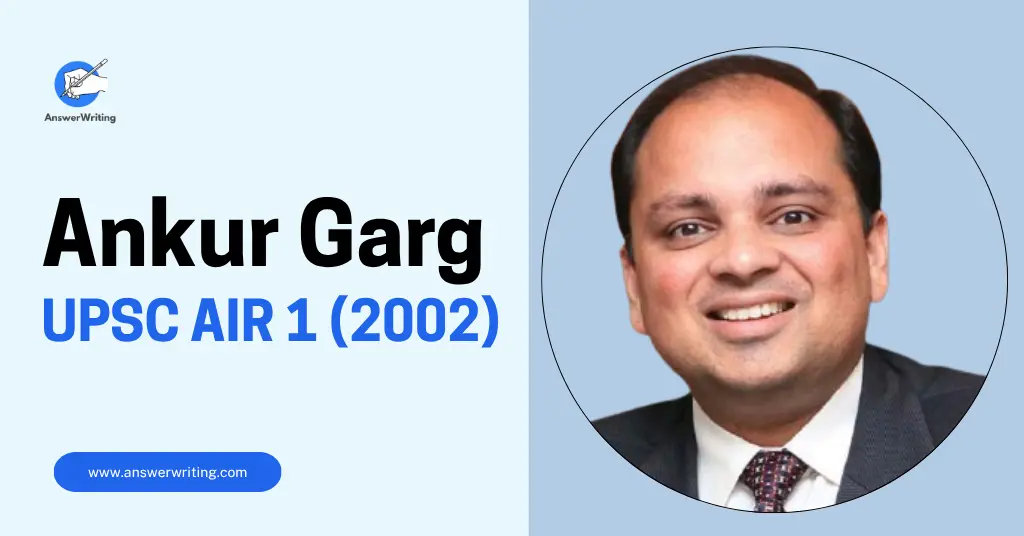
This feat of scoring 171 out of 170 marks in a Macroeconomics challenge went viral, but for those who followed his journey since 2002, it was just another day in the life of one of India’s most brilliant minds.
Ankur Garg did not just top the UPSC; he redefined what it meant to be a “young achiever” in the Indian bureaucracy.
Who Is Ankur Garg?
Ankur Garg is a 2002-batch Indian Administrative Service (IAS) officer of the AGMUT cadre. He achieved the prestigious All India Rank (AIR) 1 at the age of 22, making him one of the youngest individuals to ever head the civil services list. Originally from Patiala, Punjab, his journey is a testament to the power of academic discipline and a focused mindset.
| Feature | Details |
| Full Name | Ankur Garg |
| UPSC Rank | AIR 1 |
| Exam Year | 2002 |
| Service | Indian Administrative Service (IAS) |
| Cadre | AGMUT (Arunachal Pradesh, Goa, Mizoram, Union Territories) |
| Educational Background | IIT Delhi (Biochemical Engineering and Biotechnology) |
| Optional Subjects | Physics and Mathematics |
Ankur Garg UPSC Marksheet and Score Details
In the early 2000s, the UPSC pattern was significantly different from the current format. Candidates had to choose two optional subjects, and the General Studies weightage was lower. Ankur’s success was driven by his near-perfect execution in his technical subjects.
| Paper | Marks Obtained |
| General Studies | As per reports, consistently high (Top 5%) |
| Optional 1 (Physics) | Exceptional (Distinction levels) |
| Optional 2 (Mathematics) | Exceptional (Near-perfect accuracy) |
| Personality Test (Interview) | High (Demonstrated maturity beyond age) |
| Final Result | All India Rank 1 |
Educational Background and Early Life
Ankur Garg was born and raised in Patiala, Punjab. From a very young age, he displayed a proclivity for numbers and logic. His schooling was marked by academic excellence, which eventually led him to the prestigious Indian Institute of Technology (IIT) Delhi.
At IIT Delhi, he pursued a degree in Biochemical Engineering and Biotechnology. He wasn’t just a student; he was a gold medalist. This foundation in engineering played a massive role in his UPSC preparation. It instilled in him the “IITian approach” to problem-solving: break the syllabus into modules, identify the core logic, and practice until there is no room for error.
How Many Attempts Did Ankur Garg Take?
Ankur Garg cleared the UPSC Civil Services Examination in his first attempt. This is a rare feat, especially for the Rank 1 position. What changed the game for him was his refusal to treat the first attempt as a “trial run.”
Many aspirants enter their first attempt just to “see how the paper feels.” Ankur, however, treated his first attempt as his last. He spent his final year of engineering and the months following graduation in an intensive “monk mode.” He believed that the momentum of being a student helped him maintain the stamina required for the 10-12 hour daily study sessions.
Ankur Garg Optional Subject: Why They Chose It and How They Scored
During his time, aspirants had to pick two optional subjects. Ankur chose Physics and Mathematics. For a modern aspirant, this might seem like a heavy burden, but for Ankur, it was a strategic masterstroke.
- Objective Marking: Unlike humanities, science subjects offer objective marking. If the derivation is correct and the answer is right, the examiner cannot deduct marks based on “opinion.”
- Syllabus Overlap: There is a significant conceptual overlap between higher mathematics and classical physics.
- The IIT Edge: Having spent four years at IIT, his foundation in these subjects was already at an advanced level.
| Subject | Strategy | Key Focus Areas |
| Physics | Derivations and Numericals | Mechanics, Optics, and Electricity |
| Mathematics | Accuracy and Speed | Calculus, Linear Algebra, and Real Analysis |
UPSC Preparation Strategy of Ankur Garg
Ankur’s strategy was built on three pillars: Syllabus Mastery, Resource Limitation, and Rigorous Testing.
- Micro-scheduling: He didn’t just have a “monthly plan.” He had a daily schedule that accounted for every hour. He prioritized his optional subjects in the morning when his brain was freshest and kept General Studies for the late afternoon.
- NCERT Foundations: Despite his high academic standing, he started with NCERT books to ensure his “basics” for subjects like History and Geography were solid.
- Self-Study vs. Coaching: While he took guidance for specific modules, he was a staunch advocate of self-study. He believed that no coaching can replace the deep thinking that happens when an aspirant sits alone with a textbook.
- Note Making: He made concise, bullet-pointed notes. He famously said that your notes should be so compact that you can revise the entire syllabus in the week between the Prelims and Mains.
Books and Resources Recommended by Ankur Garg
While the UPSC syllabus has evolved, the core resources Ankur used remain the “Bible” for many aspirants today.
| Subject | Book/Resource | Author/Publication |
| History | India’s Struggle for Independence | Bipin Chandra |
| Polity | Indian Polity | M. Laxmikanth |
| Economics | Indian Economy | Dutt and Sundaram |
| Physics | University Physics / Resnick Halliday | Sears and Zemansky |
| Mathematics | Linear Algebra / Calculus | Hoffman & Kunze / I.A. Maron |
| Geography | Physical Geography | Goh Cheng Leong |
Mains Answer Writing Approach
Ankur Garg’s approach to Mains was mathematical, even in the General Studies papers. He avoided long, flowery introductions. Instead, he focused on a direct “hit-the-nail-on-the-head” style.
- Structure: He used a clear Introduction-Body-Conclusion format.
- Data and Diagrams: Being an engineer, he used flowcharts and diagrams to explain complex administrative processes or geographical phenomena.
- Precision: He strictly adhered to the word limit. He believed that writing 150 perfect words is better than 250 mediocre ones.
In today’s digital age, replicating this level of precision requires constant feedback. Platforms like AnswerWriting.com offer an Answer Evaluator that uses AI to provide the kind of structural and content-based feedback that Ankur used to generate through manual self-correction. For serious aspirants, using the Daily Answer Writing tool on the platform can help build the consistency that saw Ankur through to Rank 1.
Interview (Personality Test) Experience
Ankur appeared for the interview at a very young age. The board was curious about whether a 22-year-old engineer possessed the emotional intelligence to handle a district.
- The Board: He faced a board that tested his views on India’s technological future and the “brain drain” from IITs.
- The Harvard Mindset: Even then, he displayed a global outlook tempered with local empathy.
- Honesty: When he didn’t know an answer, he admitted it gracefully. He believed the interview was about “personality,” not just “knowledge,” which had already been tested in the Mains.
Service and Cadre Allotted to Ankur Garg
Ankur Garg was allotted the IAS and the AGMUT cadre. Over the years, he has served in various capacities that highlight his versatility.
- District Administration: He served in various capacities across the Union Territories, including Chandigarh and Delhi.
- Central Deputation: He has held significant positions in the Prime Minister’s Office (PMO), contributing to national policy-making.
- Global Exposure: He took a study leave to pursue a Master’s in Public Administration in International Development (MPA/ID) from the Harvard Kennedy School. His academic performance there once again proved his mettle on a global stage.
Key Lessons Every UPSC Aspirant Can Take from Ankur Garg
- Age is just a number: Don’t wait until you feel “ready.” If you are eligible, give it your best shot with a “killer instinct.”
- Play to your strengths: Ankur chose Physics and Maths because he was good at them, not because they were “popular.” Choose your optional based on your aptitude.
- Discipline over Intelligence: Being an IITian helped, but it was his 12-hour study sessions and rigorous revision that secured Rank 1.
- Academic Curiosity: Never stop learning. Whether it is topping the UPSC or scoring 171/170 at Harvard, maintain a student’s mindset throughout your career.
FAQs About Ankur Garg
What was Ankur Garg’s optional subject?
Ankur Garg chose Physics and Mathematics as his optional subjects under the old UPSC pattern.
How many attempts did Ankur Garg take to clear UPSC?
He cleared the UPSC Civil Services Examination in his very first attempt in 2002.
What was Ankur Garg’s age when he became an IAS officer?
He was 22 years old when he topped the UPSC exam, making him one of the youngest toppers.
Which college did Ankur Garg attend?
He graduated from IIT Delhi with a degree in Biochemical Engineering and Biotechnology.
Where is Ankur Garg posted now?
Ankur Garg is an IAS officer of the AGMUT cadre and has served in various high-profile roles, including the PMO and the Ministry of Electronics and Information Technology.
Did Ankur Garg go to Harvard?
Yes, he pursued a Master’s degree from the Harvard Kennedy School and famously scored over 100% in a Macroeconomics course.