Ankita Agarwal: UPSC AIR 2 (CSE 2021), Strategy, and Journey
What does it take to prepare for one of the world’s hardest examinations while already undergoing training as a government officer?
Ankita Agarwal did exactly that. She was a trainee IRS officer at NACIN, Faridabad, when she sat for UPSC CSE 2021. She came out with All India Rank 2. And she did it after going from AIR 236 in her first attempt to the second position nationally, one of the most dramatic rank improvements in recent UPSC history.
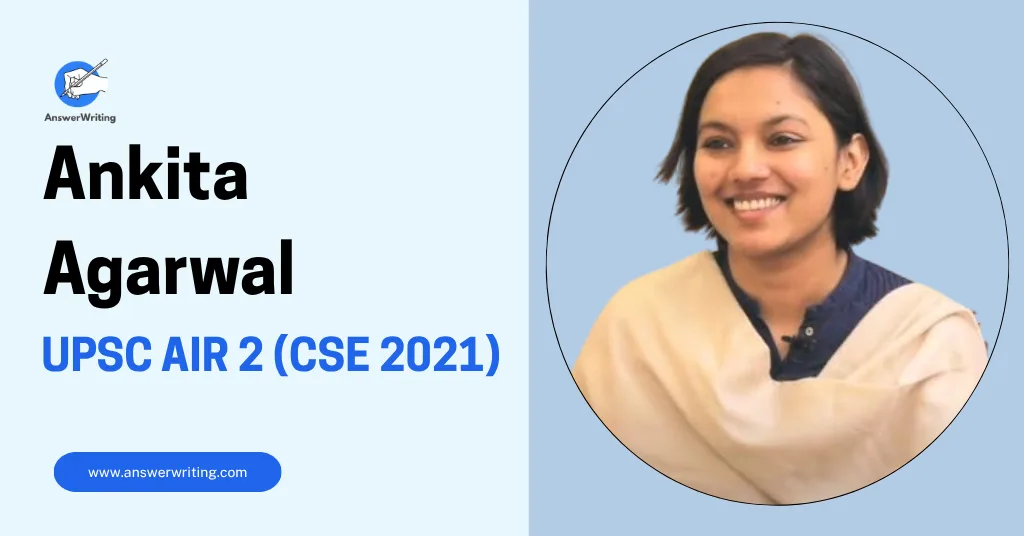
Her story is not just about topping an exam. It is about understanding what went wrong, fixing it methodically, and giving everything in the attempt that actually counted.
Who Is Ankita Agarwal?
Ankita Agarwal hails from Kolkata, West Bengal. She completed her schooling in Kolkata, moved to Delhi for graduation, briefly worked in the private sector, and then committed fully to the Civil Services Examination. She cleared it on her third attempt in 2021, securing All India Rank 2.
| Detail | Information |
|---|---|
| Hometown | Kolkata, West Bengal |
| School | DPS Ruby Park, Kolkata |
| Graduation | B.A. (Hons) Economics, St. Stephen’s College, Delhi University (2017) |
| Work Experience | Dalberg Global Development Advisors (1 year, 2017-18) |
| UPSC Exam Year | CSE 2021 (results declared May 2022) |
| All India Rank | 2 |
| Number of Attempts | 3 |
| Optional Subject | Political Science and International Relations (PSIR) |
| Service Allotted | Indian Administrative Service (IAS) |
| Cadre | West Bengal (home cadre, as per her stated preference) |
Her father runs a hardware business in the Burrabazar area of Kolkata. Her mother is a homemaker. Her brother was pursuing an MBA in Delhi at the time of the result. She grew up in a joint family in the Kalindi neighbourhood of Kolkata, raised under the care of her grandparents and extended family. Her family originally hails from Bihar.
Ankita Agarwal UPSC Marksheet and Score Details
Ankita scored a total of 1050 marks in UPSC CSE 2021. Her written Mains total was 871, and she scored 179 in the Personality Test (Interview).
| Component | Marks Obtained |
|---|---|
| Written (Mains) Total | 871 |
| Interview (Personality Test) | 179 |
| Grand Total | 1050 / 2025 |
Paper-wise subject marks are not consistently verified across credible public sources and have therefore not been included to avoid inaccuracy. Aspirants may cross-check the official UPSC marksheet for subject-level details.
One number in this table deserves specific attention: the 179 in the interview. Among the top three rankers in CSE 2021, Ankita’s interview score was the highest. AIR 1 Shruti Sharma scored 173 in the Personality Test. Ankita’s 179 reflects a particularly well-prepared, composed, and articulate candidate who made the most of her interview opportunity.
Educational Background and Early Life
Ankita was a sincere and reserved student throughout her school years at DPS Ruby Park in Kolkata. Her teachers remember her as sharp and focused. She joined DPS Ruby Park in 2003 and completed her secondary education there before moving to Delhi for college.
At St. Stephen’s College, Delhi University, she pursued Economics (Honours), graduating in 2017. During her college years, she was actively involved beyond academics. She participated in the Campus Placement Cell and the Finance and Investment Cell. She served as chief editor of the yearbook for the Economics Society. In 2015, she interned at CRY (Child Rights and You), working on child rights issues. In 2016, she completed a three-month internship at Pratham, an organisation focused on quality education for underprivileged children.
These internships matter in the context of her UPSC story. Her motivation to join the civil services was not abstract. It was grounded in direct exposure to grassroots-level social challenges, poverty, child welfare, and education, years before she appeared for her first UPSC attempt.
After graduation, she joined Dalberg Global Development Advisors, a prestigious international consultancy, for a year. Her work there involved developing-country contexts, including projects related to Bangladesh. In 2018, she left that well-paying job to prepare for UPSC full time.
She grew up in a household that supported her choices without imposing expectations. That environment of quiet encouragement, without pressure or urgency, shaped the calm and sustained approach she brought to a three-attempt UPSC journey.
How Many Attempts Did Ankita Agarwal Take?
Ankita took three attempts to reach AIR 2. She has spoken candidly about what was different in each one, and her self-assessment is one of the most practically honest accounts available from a recent topper.
In her first attempt in 2019, she secured AIR 236 and was allotted the Indian Revenue Service (Customs and Indirect Taxes). She has said directly that in this attempt, she simply did not have enough time. Her preparation was not complete. That rank, while exceptional by any standard, reflected an unfinished effort.
She was not satisfied. The IRS was not her goal. IAS was. So she decided to attempt again.
In her second attempt in 2020, she appeared again but has openly said that there was a lack of diligence. The exact rank from this attempt is not consistently confirmed across sources and has therefore not been included here. What matters is that she recognised the gap herself and named it clearly.
By the time her third attempt came in 2021, she was a trainee IRS officer at the National Academy of Customs, Indirect Taxes and Narcotics (NACIN) in Faridabad. She was undergoing formal government training while simultaneously preparing for UPSC. That level of parallel commitment required a completely different kind of discipline: structured time management, no room for distraction, and a clear sense of what had to be fixed.
In her third attempt, she gave everything. The result was AIR 2.
Her own summary of the three attempts is widely reported: the first had too little time, the second had too little effort, and the third had both. That clarity of self-assessment, without excuses, is a lesson in itself.
Ankita Agarwal’s Optional Subject: Political Science and International Relations
Ankita chose Political Science and International Relations (PSIR) as her optional subject. This is worth noting because her graduation was in Economics, not Political Science. PSIR was a subject she came to fresh, without an academic foundation from her degree.
She chose it deliberately for one reason: it kept her interested. In an examination that takes two or more years to prepare for, sustaining engagement with your optional subject is not a minor concern. If a subject bores you in preparation, it will show in the exam hall. PSIR offered her the intellectual engagement she needed to stay consistent over a long preparation period.
Her combined optional score contributed to a written total of 871. PSIR is considered a demanding optional with a vast syllabus covering political theory, Indian government, comparative politics, and international relations. The fact that she chose it without a prior academic base, and performed well enough to reach AIR 2, reinforces her broader principle: preparation depth matters more than prior familiarity.
For aspirants considering PSIR, Ankita’s approach points to one key test: can you stay genuinely interested in this subject for two years? If yes, the subject is worth considering regardless of your graduation background.
UPSC Preparation Strategy of Ankita Agarwal
Ankita’s preparation was built around a principle she has stated clearly: sustainability over intensity. She aimed for 8 to 12 hours of study daily but did not hold herself to a rigid fixed number. The goal was consistent, quality engagement with the material, not performing a certain number of hours for their own sake.
She began her preparation four years before her final attempt, starting with the basic foundational books. She used NCERTs to build conceptual clarity before moving to standard reference material.
One of the most distinctive aspects of her preparation was how she took notes. Unlike most toppers who recommend handwritten notes, Ankita made her notes on a computer. She found digital notes easier to organise, update, and revise. She translated source material into her own language before saving it, a process that both tested her understanding and made revision faster.
For current affairs, she read newspapers daily and used monthly magazines to stay updated. She did not treat current affairs as a last-minute addition. It was integrated into her regular preparation throughout the year.
She deactivated all her social media accounts during preparation, identifying them as a significant source of distraction. Like several other recent toppers, she made a deliberate environment choice: remove what takes focus, keep what builds it.
She combined self-study with selective coaching, using formal guidance when she needed it and relying on her own judgment for the rest. She solved previous years’ question papers consistently, which helped her understand the actual demands of the exam rather than preparing in the abstract.
She has also emphasised having a clear reason to join the civil services. That internal clarity, knowing why you are doing this, is what she credits for getting through the difficult stretches of a three-attempt journey.
Books and Resources Recommended by Ankita Agarwal
Ankita has not publicly released a detailed book list. Based on widely reported interviews and strategy sessions, here is what her preparation drew from:
| Subject/Area | Book/Resource |
|---|---|
| All Subjects (Foundation) | NCERT Books (Class 6 to 12) |
| Current Affairs | Daily newspapers + monthly current affairs magazines |
| Optional: PSIR | Standard PSIR reference books (revised repeatedly) |
| Revision | Self-made digital notes (translated from source material) |
| Prelims Practice | Previous year UPSC Prelims question papers |
| Mains Practice | Previous year Mains question papers + answer writing practice |
| General Strategy | Limited sources, multiple revisions |
Her core principle on study material mirrors what most high-performing UPSC candidates advise: do not keep adding new books. Pick fewer sources, understand them completely, and revise them until the content is second nature.
Mains Answer Writing Approach
Ankita identified answer writing practice as a central part of her Mains preparation. Her approach was built on three qualities: clarity, structure, and precision.
She did not aim to impress with length or elaborate language. Each answer needed a clear argument, backed by relevant facts or examples, presented in a way that could be read quickly and understood immediately. That administrative clarity in writing is exactly what UPSC rewards at the Mains level.
She practiced writing answers from past year papers regularly. This gave her a realistic picture of what the exam expects, not what preparation resources suggest it expects. There is an important difference between the two, and aspirants who skip this step often discover it too late.
For aspirants building this habit, getting structured feedback on your answers is what separates improvement from repetition. Writing practice alone does not correct weaknesses. Evaluation does. Platforms like AnswerWriting.com allow aspirants to submit their Mains answers and receive AI-powered feedback on structure, content, language, and UPSC scoring parameters. Using that kind of regular evaluation, the way Ankita used past papers and revision cycles to audit her own gaps, is how answer writing actually improves over time.
The takeaway from her approach is direct: start writing early, write to a structure, and get your work evaluated.
Interview (Personality Test) Experience
Ankita’s interview score of 179 was the highest among the top three rankers in CSE 2021. That result came from deliberate preparation, not just confidence.
Her Detailed Application Form (DAF) offered the interview board a rich set of threads to explore. Her Economics graduation from St. Stephen’s. Her work at Dalberg on international development projects. Her internships at CRY and Pratham, where she worked directly on child rights and education. Her Kolkata roots and her stated interest in working on issues of poverty, unemployment, and climate change in West Bengal. All of these provided material for substantive, value-driven questions rather than generic current affairs.
She prepared by studying her DAF thoroughly, knowing every entry she had made and being ready to go deep on each one. She stayed updated on current affairs through consistent newspaper reading. She attended mock interviews to get comfortable with the format and the pressure of facing a panel.
Her stated approach for the interview was to remain calm, composed, and honest. She did not try to impress. She focused on being clear about her motivations, her understanding of governance, and what she wanted to do as a civil servant.
Her Dalberg experience was particularly valuable in the interview context. Work on international development policy, even for a year, signals analytical depth and a global lens on local problems. For aspirants with work experience in their DAF, Ankita’s profile is a strong example of how that experience can actively help rather than simply fill a line.
Service and Cadre Allotted to Ankita Agarwal
Ankita Agarwal was allotted the Indian Administrative Service (IAS). She expressed a preference for the West Bengal cadre, her home state, and as per available reports she received it. Aspirants should verify current cadre and posting details from official sources.
Her administrative focus areas are specific and stated: women’s empowerment, primary healthcare, rural development, education, poverty reduction, and climate change. These are not broad ambitions. They map directly to the ground-level governance challenges in West Bengal and reflect the kind of purposeful career vision that her earlier work at CRY and Pratham had already shaped.
She has said she wants to serve close to people, at the grassroots level, and believes the IAS offers the best platform to do that. For a candidate who had already secured the IRS, that clarity of preference, choosing people-facing work over a revenue service career, speaks to a well-defined sense of purpose.
Key Lessons Every UPSC Aspirant Can Take from Ankita Agarwal
- Rank 236 is not failure, it is data: Ankita’s first attempt gave her the IRS, which most candidates would celebrate as success. She used it as a baseline and came back for more. If your first result is not what you wanted, it still tells you how close you are and what needs fixing.
- Know exactly what went wrong in each attempt: She named her failures with precision. Attempt 1 had insufficient time. Attempt 2 had insufficient diligence. Attempt 3 had neither problem. That kind of honest self-audit is more valuable than any strategy guide.
- Choose your optional for sustained engagement, not just marks: She chose PSIR without an Economics-to-Political Science link, because it held her interest. A subject you stay curious about for two years will always outperform one you find technically “safe” but mentally exhausting.
- Digital notes are a legitimate preparation tool: Her choice to make organised notes on a computer rather than by hand challenges the assumption that handwritten notes are the only effective method. Use the format that you will actually maintain and revise consistently.
- Build a preparation environment you can sustain: She studied for 8 to 12 hours but did not impose a rigid daily target. She took breaks, spent time with family and friends, and deactivated social media. Sustainability over three attempts requires an environment designed for the long term, not just for a single sprint.
FAQs About Ankita Agarwal
What rank did Ankita Agarwal get in UPSC?
Ankita Agarwal secured All India Rank 2 in UPSC CSE 2021. The results were declared in May 2022. She scored a total of 1050 marks, with 871 in the written Mains and 179 in the interview.
What was Ankita Agarwal’s optional subject?
She chose Political Science and International Relations (PSIR) as her optional subject. Notably, her graduation was in Economics, not Political Science. She chose PSIR because it sustained her interest throughout the long preparation period.
How many attempts did Ankita Agarwal take to clear UPSC?
She cleared the exam in her third attempt. She secured AIR 236 in her first attempt in 2019 and was allotted the IRS. She attempted again in 2020 and then cleared with AIR 2 in her third attempt in 2021.
Was Ankita Agarwal already an IRS officer when she topped UPSC?
Yes. When the CSE 2021 results were declared in May 2022, she was a trainee IRS officer undergoing training at the National Academy of Customs, Indirect Taxes and Narcotics (NACIN) in Faridabad. She was preparing for her UPSC third attempt simultaneously during that training period.
Which college did Ankita Agarwal attend?
She completed her Bachelor’s degree in Economics (Honours) from St. Stephen’s College, Delhi University, graduating in 2017.
What is Ankita Agarwal’s cadre?
As per available reports and her stated preference, she was allotted the West Bengal cadre in the IAS. Please verify current details from official sources.
Did Ankita Agarwal take coaching for UPSC?
She used a combination of self-study and selective coaching. She did not rely exclusively on either, stating that a balance between the two is important for a serious aspirant.