Animesh Pradhan: UPSC AIR 2 (CSE 2023), Strategy, and a Story That Deserves to Be Told
His teachers in Odisha had saved his father’s phone number as “Animesh IAS” years before he ever appeared for the exam. His father, a Political Science lecturer, never got to see the result. His mother, who fought cancer through his entire preparation, passed away on March 2, 2024, weeks before UPSC declared the results on April 16.
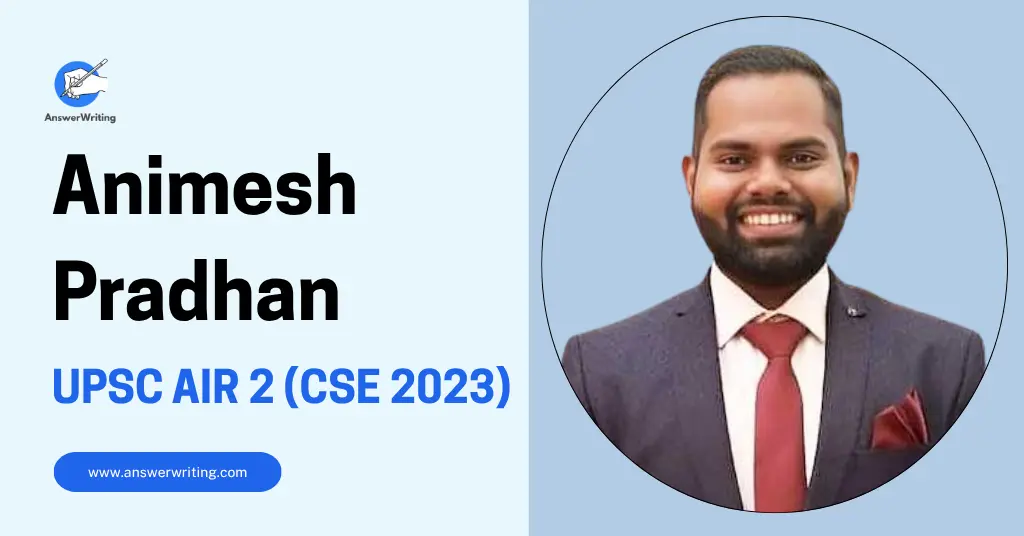
Animesh Pradhan secured AIR 2 in UPSC CSE 2023. He was 23 years old. It was his first attempt. He was working a full-time job the entire time.
The rank was earned. But the story behind it belongs to a different category altogether.
Who Is Animesh Pradhan?
| Parameter | Details |
|---|---|
| Full Name | Animesh Pradhan |
| AIR | 2 |
| Exam Year | UPSC CSE 2023 |
| Total Score | 1067 out of 2025 |
| Number of Attempts | 1 (first attempt) |
| Optional Subject | Sociology |
| Medium | English |
| Hometown | Bhalugadia Village, Angul District, Odisha |
| Age at Result | 23 years |
| Education | B.Tech Computer Science Engineering, NIT Rourkela |
| Work during Preparation | Information System Officer, Indian Oil Corporation Limited (IOCL), Delhi |
| Service Allotted | IAS (cadre to be verified from official UPSC allocation list) |
His father, Prabhakar Pradhan, was a Political Science lecturer at Hingula College, Odisha. He passed away in 2017 when Animesh was in Class 11. His mother, Aruna Patra, held a postgraduate degree in History. She passed away on March 2, 2024, just weeks before the result that she had devoted years of her life to supporting.
His sister works in the Horticulture Department of the Government of Odisha.
Animesh grew up in a household where education in humanities was the norm. That background, quietly and directly, shaped every major strategic decision he made for UPSC.
Animesh Pradhan UPSC Marksheet and Score Details
| Component | Marks |
|---|---|
| Essay | 118 (as per available reports) |
| General Studies Paper 1 | 105 (as per available reports) |
| General Studies Paper 2 | 118 (as per available reports) |
| General Studies Paper 3 | 109 (as per available reports) |
| General Studies Paper 4 | 121 (as per available reports) |
| Sociology Paper 1 | 155 (as per available reports) |
| Sociology Paper 2 | 166 (as per available reports) |
| Written Total | 892 |
| Interview (Personality Test) | 175 |
| Grand Total | 1067 |
His Sociology combined score of 321 out of 500 (as per available reports) is one of the standout figures in his marksheet. It reflects both a strong optional strategy and the natural advantage that comes from choosing a subject your family background has already prepared you to think in.
Cross-check all paper-wise figures from official UPSC publications, as individual paper scores are not formally released by UPSC.
Educational Background and Early Life
Animesh completed his Class 10 from DAV Public School in Odisha, scoring a perfect 10 CGPA in 2015. He followed that with a 98% in Class 12 in 2017, the same year he lost his father.
He then secured admission to NIT Rourkela, one of the National Institutes of Technology, for a B.Tech in Computer Science Engineering. He graduated with a CGPA of 9.17 in 2021.
At NIT Rourkela, he was not only an academic performer. He served as Chief Coordinator of the Student Media Body, a role that built his writing, communication, and structured thinking skills. He was also active in debating, journalism, and freestyle dancing.
Those extracurriculars were not distractions. They were building the exact qualities that UPSC, especially the Personality Test, rewards in a candidate.
After graduation, he joined Indian Oil Corporation Limited (IOCL) in Delhi as an Information System Officer. He began UPSC preparation while working there, never leaving his job to prepare full-time.
How Many Attempts Did Animesh Pradhan Take?
Animesh cleared UPSC CSE in his very first attempt.
He also cleared the Odisha Civil Services Examination during his preparation period, a parallel achievement that many aspirants overlook when discussing his profile. That clearance signals both his preparation quality and his ability to perform under exam conditions before the UPSC final.
His preparation ran alongside a demanding full-time role at IOCL in Delhi. He did not have the luxury of uninterrupted 10-hour study days. He structured his preparation around the time he had, not the time he wished he had.
His preparation timeline spanned roughly two years post-graduation, balancing IOCL responsibilities on weekdays with intensive test practice on weekends. The discipline required to sustain that over two years, while managing grief, a corporate job, and exam pressure simultaneously, is something no strategy article can fully capture.
The first attempt success is rare. But it did not happen by accident. It happened because of choices made years before the result.
Animesh Pradhan’s Optional Subject: Why a CSE Engineer Chose Sociology
Choosing Sociology as a Computer Science engineer is not the obvious move. But for Animesh, it was a researched, deliberate decision.
His father taught Political Science. His mother held a postgraduate degree in History. Animesh grew up in a household where social sciences were not abstract, they were dinner table conversation. That background gave him an intuitive grasp of sociological concepts long before he formally studied them for UPSC.
He also researched the overlap. Sociology connects directly to GS Paper 1 (Indian society, social change, diversity), GS Paper 2 (social justice, governance), and GS Paper 4 (ethics, human values, social influences). It strengthens essay writing because social analysis is a recurring demand in UPSC essays. Choosing Sociology did not just add 500 optional marks to his preparation. It reinforced his entire Mains performance.
His combined Sociology score of 321 out of 500 (as per available reports) is a strong reflection of that alignment.
Standard books that aspirants use for Sociology optional, and which align with Animesh’s reported preparation approach, include:
- C.N. Shankar Rao’s Introduction to Sociology for the conceptual foundation
- Anthony Giddens’ Sociology for western sociological theory
- Haralambos and Holborn for breadth of perspectives
- Ram Ahuja for Indian sociological context
- IGNOU MA Sociology notes for structured syllabus coverage
- Previous years’ UPSC Sociology papers for answer pattern calibration
The key insight Animesh’s optional choice offers aspirants: your background, including your family’s educational environment, counts as preparation. Do not ignore what you have already absorbed.
UPSC Preparation Strategy of Animesh Pradhan
Animesh prepared while holding a full-time job. That constraint forced a precision in his strategy that many full-time aspirants never develop.
Structured weekly rhythm. He used weekdays for content reading and note-making, and dedicated Sundays to full GS test practice across all four papers. That weekly test habit, sustained over nearly two years, gave him the answer writing speed and structure he needed in the actual exam.
Handwritten notes with expandable space. His notes were handwritten, with deliberate blank spaces left for later additions, Supreme Court judgments, committee recommendations, constitutional articles, and relevant quotes. This made his notes living documents rather than static summaries. He could return to them repeatedly and enrich them without rewriting.
Current affairs via PDFs, not newspapers. Given his job constraints, he relied on weekly current affairs PDFs rather than daily newspaper reading. He tagged current affairs content to specific GS papers and syllabus headings. This is a more efficient method than passive daily reading, especially for working professionals.
Volume of testing. He attempted 40 to 45 Mains tests and 30 to 35 Prelims tests (as per available reports). That volume is significant. It means he spent as much time being evaluated as he spent studying.
No classroom coaching. He enrolled in test series and mentorship programmes at platforms including Plutus IAS and Yojna IAS (as per available reports), but never attended classroom coaching. His content strategy was entirely self-directed.
Syllabus as the filter. Every resource he read was mapped back to the syllabus. He did not chase breadth. He chased depth on what was relevant.
Books and Resources Recommended by Animesh Pradhan
| Subject | Book / Resource | Author / Source |
|---|---|---|
| Indian Polity | Indian Polity | M. Laxmikanth |
| Modern History | India’s Struggle for Independence | Bipan Chandra |
| Ancient and Medieval History | NCERT Class 6 to 12 | NCERT |
| Geography | Certificate Physical and Human Geography | G.C. Leong |
| Indian Economy | Indian Economy | Ramesh Singh |
| Environment and Ecology | Shankar IAS Environment | Shankar IAS |
| Ethics (GS4) | Ethics, Integrity and Aptitude | G. Subba Rao and P.N. Roy Chowdhury |
| Current Affairs | Weekly Current Affairs PDFs | Various platforms |
| Sociology Optional | Introduction to Sociology | C.N. Shankar Rao |
| Sociology Optional | Sociology | Anthony Giddens |
| Sociology Optional | Haralambos and Holborn | Haralambos |
| Sociology Optional | IGNOU MA Sociology Notes | IGNOU |
| Mains Practice | Plutus IAS and Yojna IAS Test Series | As per available reports |
Cross-check this list against his published interviews, as specific recommendations may vary by paper.
Mains Answer Writing Approach
Answer writing was the axis of Animesh’s preparation. His weekly Sunday tests were not optional. They were the structure that held everything else together.
His answer format followed a clear pattern: a precise introduction that frames the issue directly, an organized body with sub-points backed by data, policy references, or constitutional provisions, and a conclusion that connects to governance outcomes or values. He avoided padding. Every sentence in his answers had a purpose.
His handwritten notes method fed directly into his answer quality. Because he had organized his notes with space for additions, he always had updated content to draw on. Supreme Court judgments, recent committee reports, and relevant statistics were part of his notes, not last-minute additions.
He also practiced writing answers at realistic speed from early in his preparation. That habit prevented the common problem of knowing content but running out of time in the exam hall.
One challenge working professionals face with answer writing is getting consistent feedback. Writing answers and filing them away without evaluation does not improve your score. Animesh used test series for structured feedback. Aspirants who want to supplement that, or who are in locations without access to regular test series evaluation, can use AnswerWriting.com’s Daily Answer Writing feature, which provides fresh daily prompts and tracks writing progress over time. Consistent evaluated practice, not just writing volume, is what builds Mains scores.
He used diagrams and flowcharts selectively in GS3 and in Sociology answers, specifically where visual representation of a relationship or process was cleaner than prose.
Interview (Personality Test) Experience
Animesh scored 175 out of 275 in the Personality Test. Given that his mother had passed away just weeks before his interview, the composure and clarity he brought to that room reflect something beyond preparation.
He gave multiple mock interviews in Delhi before the actual board appearance (as per available reports). His preparation focused on DAF-based anticipation. His profile offered a board significant material: NIT Rourkela engineer, IOCL professional, Student Media Body leader, Odisha rural background, debating and journalism experience.
He also used Instagram to stay updated on regional and Odisha-specific current affairs, recognizing that a candidate from a specific state will face questions about that state’s governance, economy, and social issues. That targeted geographic awareness is something many aspirants neglect.
His interview lasted approximately 25 to 30 minutes (as per available reports). The board appeared to probe his understanding of technology policy, Odisha’s development, and his transition from an engineering career toward public service.
His 175 reflects a candidate who was present, honest, and grounded, not one who performed.
Service and Cadre Allotted to Animesh Pradhan
With AIR 2, Animesh Pradhan is allotted the IAS. The specific state cadre had not been officially confirmed in all publicly available reports at the time of writing. Readers should verify cadre allotment from the official UPSC allocation list once published.
His earlier clearance of the Odisha Civil Services Examination stands superseded by the IAS allotment. That state-level result was a milestone on the path, not the destination.
Key Lessons Every UPSC Aspirant Can Take from Animesh Pradhan
- A full-time job does not disqualify you from a top rank. Animesh prepared while working at IOCL without ever going full-time for UPSC. The key was a structured weekly rhythm, not unlimited study hours. If you are a working aspirant, build your preparation around what you have, not around what full-time candidates have.
- Your family’s educational background is preparation you have already done. Animesh chose Sociology because his parents’ backgrounds in Political Science and History had already given him a conceptual foundation. Audit your own background honestly before choosing your optional. You may already be ahead on a subject you have not considered.
- Handwritten, expandable notes outperform static summaries. His method of leaving deliberate blank spaces in notes for later additions kept his content current without requiring rewrites. Build notes as living documents from the start.
- Test volume matters, but evaluated test volume matters more. He attempted 40 to 45 Mains tests and 30 to 35 Prelims tests. The point was not quantity alone. Each test was an opportunity for feedback and correction. Writing answers without evaluation is practice. Writing answers with evaluation is improvement.
- Prepare your DAF as seriously as your GS papers. Animesh’s interview score of 175 came from a candidate who had thought deeply about every line in his DAF, his engineering background, his IOCL role, his Odisha roots, and his extracurriculars. The board will follow whatever threads you give them. Make sure you have pulled on those threads yourself first.
FAQs About Animesh Pradhan
What is Animesh Pradhan’s UPSC rank? He secured AIR 2 in UPSC Civil Services Examination 2023, results declared April 16, 2024.
What was Animesh Pradhan’s optional subject in UPSC? His optional subject was Sociology.
How many attempts did Animesh Pradhan take to clear UPSC? He cleared UPSC CSE in his very first attempt, at age 23.
Was Animesh Pradhan working during his UPSC preparation? Yes. He was employed as an Information System Officer at Indian Oil Corporation Limited (IOCL) in Delhi throughout his preparation. He never left his job to prepare full-time.
What is Animesh Pradhan’s total UPSC score? His total score is 1067, comprising 892 in written and 175 in the Personality Test (Interview).
Which coaching did Animesh Pradhan attend for UPSC? He did not attend classroom coaching. He enrolled in test series and mentorship programmes at platforms including Plutus IAS and Yojna IAS (as per available reports). His content and strategy were self-directed.
What is Animesh Pradhan’s educational background? He holds a B.Tech in Computer Science Engineering from NIT Rourkela with a CGPA of 9.17, graduating in 2021.