Akansh Dhull: UPSC AIR 3 (CSE 2025), Strategy, and Journey
What does it take to watch your rank go from 342 to 3?
Akansh Dhull spent four years finding out. Four attempts. Three documented results. A steady, measurable climb that ended with AIR 3 in UPSC CSE 2025, declared in March 2026.
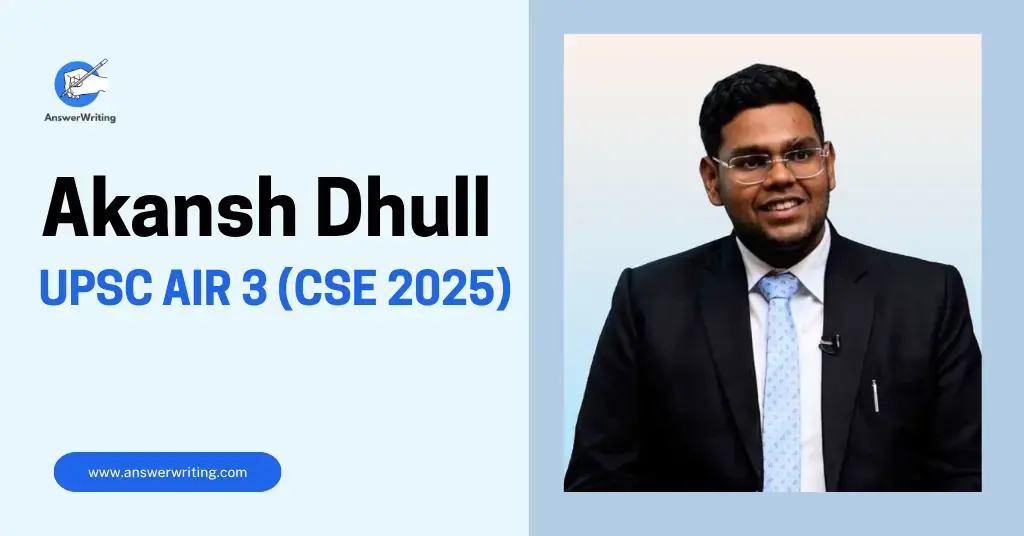
He was approximately 22 years old when that result came out. He is among the youngest candidates in the top 3 of any recent UPSC batch. And he got there not through a single brilliant attempt, but through four years of iterative, disciplined improvement.
Who Is Akansh Dhull?
| Parameter | Detail |
|---|---|
| Full Name | Akansh Dhull |
| AIR | 3 |
| UPSC Exam Year | CSE 2025 (result declared March 2026) |
| Roll Number | 3512521 |
| Age at Selection | Approximately 22 years (as per available reports) |
| Born | Rohtak, Haryana |
| Raised | Panchkula; schooling in Chandigarh |
| School | St. Kabir Public School, Chandigarh |
| Graduation | B.Com (Hons), Shri Ram College of Commerce (SRCC), University of Delhi, 2022 |
| Optional Subject | Commerce and Accountancy |
| Total Attempts | 4 |
| Father | Krishna Dhull (BJP Minister, as per available reports) |
| Mother | School Principal |
| Coaching | VisionIAS (GS Mains, Prelims, Essay, Abhyaas Series, Personality Development Programme); Vajiram and Ravi (GS Prelims cum Mains Classroom Programme) |
| Service Preference | IAS (as per available reports) |
Akansh Dhull UPSC Marksheet and Score Details
Rank Progression Across Attempts:
| Attempt | Exam Year | AIR |
|---|---|---|
| 1st | Details not publicly confirmed | Not confirmed |
| 2nd | UPSC CSE 2023 | 342 |
| 3rd | UPSC CSE 2024 | 295 |
| 4th | UPSC CSE 2025 | 3 |
This progression table is more instructive than any single marksheet. Each attempt produced a result. Each result produced information. And that information was used to drive the next attempt forward.
Score Details (CSE 2025):
| Component | Marks |
|---|---|
| Mains Written Total | To be cross-checked from official UPSC marksheet |
| Interview (Personality Test) | To be cross-checked from official UPSC marksheet |
| Grand Total | To be cross-checked from official UPSC marksheet |
Individual paper-wise GS marks and confirmed totals for CSE 2025 were not available in verified public sources at the time of writing. Readers are advised to check the official UPSC marksheet once published. What is confirmed is the AIR 3 rank from the official UPSC results declared in March 2026.
Educational Background and Early Life
Akansh was born in Rohtak, Haryana, and grew up in Panchkula. He completed his schooling at St. Kabir Public School in Chandigarh, one of the region’s well-regarded institutions.
He then secured admission to Shri Ram College of Commerce (SRCC) at the University of Delhi, graduating with a B.Com (Hons) in 2022. SRCC is consistently ranked among the top commerce colleges in India, and its graduates are among the most sought-after on campus placement circuits.
Akansh declined those placements.
That decision, to walk away from the placement security that an SRCC degree offers, is one that many commerce aspirants face. He chose full-time UPSC preparation instead. His father, Krishna Dhull, is a BJP minister, as per available reports. His mother is a school principal. The family background brought exposure to public life, but Akansh built his own credibility through four years of preparation and a documented rank progression that speaks for itself.
How Many Attempts Did Akansh Dhull Take?
Akansh took four attempts to secure AIR 3 in UPSC CSE 2025.
His second attempt produced AIR 342 in CSE 2023. His third attempt produced AIR 295 in CSE 2024. His fourth attempt produced AIR 3 in CSE 2025.
Read that again slowly. AIR 342. AIR 295. AIR 3.
Most aspirants would have accepted AIR 342 or AIR 295 and moved on. Both ranks lead to good services. Akansh treated them as data points instead. He identified what was holding his score back, made targeted corrections, and returned with a preparation that was fundamentally better, not just marginally improved.
The jump from AIR 295 to AIR 3 is not a small refinement. It is a structural improvement in one or more components, most likely Mains answer quality, optional subject output, or interview performance, or a combination of all three. That kind of leap between attempts only happens when a candidate does honest post-attempt analysis and acts on what it reveals.
For aspirants who have attempted once or twice without the desired rank, Akansh’s four-attempt arc is one of the most practically instructive examples in recent UPSC history. The question to ask after every attempt is not “why did I fail” but “which specific component underperformed and what will I do differently.”
Akansh Dhull’s Optional Subject: Commerce and Accountancy
Optional Subject: Commerce and Accountancy (C&A)
This choice was as strategic as it was natural. Akansh had just spent three years at SRCC studying commerce at an advanced level. His conceptual foundation in accounting, corporate finance, business economics, and management was already strong before UPSC preparation began.
Choosing C&A as his optional meant he was not starting from scratch. He was deepening expertise he already had. This gave him a preparation efficiency that candidates who pick an entirely new optional subject do not have.
C&A also has practical benefits for the broader UPSC examination. It strengthens GS Paper 3 preparation, which covers economic development, infrastructure, and government budgeting. Candidates with a C&A optional tend to approach economy-related GS3 questions with greater depth and precision.
The optional also performs well in terms of scoring consistency when prepared thoroughly. For commerce graduates, it removes the anxiety of learning a completely new discipline under examination pressure.
Books and Strategy for Commerce and Accountancy Optional:
| Paper | Book or Resource | Author or Source |
|---|---|---|
| Financial Accounting | Advanced Accountancy (Vol 1) | R.L. Gupta and M. Radhaswamy |
| Corporate Accounting | Advanced Accountancy (Vol 2) | R.L. Gupta and M. Radhaswamy |
| Cost and Management Accounting | Cost Accounting | S.N. Maheshwari |
| Business Finance | Financial Management | I.M. Pandey |
| Business Statistics | Business Statistics | S.P. Gupta |
| Both Papers | ICAI Study Material (CA Foundation and Intermediate) | ICAI |
| Both Papers | Previous Year Questions (last 10 years) | Self-compiled |
| Both Papers | VisionIAS Optional Notes (if available) | VisionIAS |
Note: Akansh’s specific optional books and study resources are not fully confirmed in verified public sources. The above list reflects standard C&A optional preparation resources widely recommended by toppers with this optional. Readers should cross-check his specific recommendations from his interviews once available.
UPSC Preparation Strategy of Akansh Dhull
Coaching vs. Self-Study: Akansh used both VisionIAS and Vajiram and Ravi for his structured GS preparation. He enrolled in Vajiram and Ravi’s General Studies Prelims cum Mains Classroom Programme and used VisionIAS for test series across Prelims, Mains, and Essay. He also completed VisionIAS’s Personality Development Programme for interview preparation.
The dual-institute approach is not common, but for a candidate on his fourth attempt, it reflects a willingness to use every available resource without anchoring to a single coaching philosophy.
Source Discipline: Like most high scorers, the goal was not more sources but better mastery of fewer ones. Four attempts give a candidate clear visibility into which sources are useful and which are noise. By his fourth attempt, Akansh’s reading list was almost certainly tighter and more purposeful than it was in his second.
Paper-wise Sources (as per available reports):
| Subject Area | Primary Source |
|---|---|
| History | NCERT Class 6 to 12, Spectrum by Rajiv Ahir |
| Geography | NCERT Class 11 and 12, G.C. Leong |
| Polity | M. Laxmikanth |
| Economy | NCERT Class 11 and 12, Economic Survey, Ramesh Singh |
| Environment | Shankar IAS Environment |
| Ethics (GS4) | Lexicon for Ethics, case study practice |
| Science and Technology | The Hindu, PIB, VisionIAS current affairs |
| Current Affairs | The Hindu, VisionIAS Monthly Magazine |
| Essay | VisionIAS Essay Test Series, wide reading |
Prelims Approach: Four attempts means four rounds of Prelims. By his final attempt, Akansh had a thorough understanding of Prelims patterns, UPSC’s question framing style, and the exact topics that recur. His Prelims preparation was sharpened by years of actual examination experience, not just mock tests.
For aspirants in their early attempts who want to sharpen Prelims accuracy, structured MCQ practice with detailed explanations is essential. The MCQ Practice tool on AnswerWriting.com offers topic-wise and full-length practice with UPSC-specific question patterns, which helps build the kind of elimination-based reasoning that Prelims rewards.
Revision: Multi-pass revision was central. First pass for understanding, second for retention, third for rapid recall. Short notes built during revision, not during first reading, kept his recall sharp across long preparation cycles.
Books and Resources Recommended by Akansh Dhull
| Subject | Book or Resource | Author or Publisher |
|---|---|---|
| Polity | Indian Polity | M. Laxmikanth |
| Modern History | A Brief History of Modern India | Rajiv Ahir (Spectrum) |
| Geography | Certificate Physical and Human Geography | G.C. Leong |
| Economy | Indian Economy | Ramesh Singh |
| Environment | Environment and Ecology | Shankar IAS Academy |
| Ethics | Lexicon for Ethics, Integrity, and Aptitude | Niraj Kumar |
| C&A Optional | Advanced Accountancy (Vol 1 and 2) | R.L. Gupta and M. Radhaswamy |
| C&A Optional | Financial Management | I.M. Pandey |
| Current Affairs | The Hindu (daily), VisionIAS Monthly Magazine | Various |
| NCERTs | Class 6 to 12 across subjects | NCERT |
Note: This list reflects widely recommended resources for his preparation profile. Readers should verify his specific booklist from post-result interviews once publicly available.
Mains Answer Writing Approach
Four attempts teach you something that no coaching class can. They teach you the exact gap between what you know and what you can communicate under timed examination conditions.
Akansh used both VisionIAS Abhyaas Mains Test Series and VisionIAS GS Mains Test Series as structured writing platforms. Regular submission and evaluation of answers gave him a feedback loop that improved his writing quality across attempts.
By his fourth attempt, his answer writing was almost certainly shaped by three prior cycles of Mains examination experience. He knew which answer structures the UPSC rewards, where to use diagrams, how to balance breadth and depth within word limits, and how to open and close answers in ways that signal command of the topic.
For aspirants earlier in their preparation who do not yet have examination experience to draw from, consistent daily writing practice with honest evaluation fills that gap. The Daily Answer Writing feature on AnswerWriting.com provides fresh UPSC-style prompts every day and tracks your writing progress over time. Pairing that with the Answer Evaluator, which gives detailed AI feedback on structure, content, and UPSC scoring parameters, builds exactly the kind of writing muscle that Akansh’s repeated Mains appearances built over four years.
He focused on multi-dimensional answers for GS papers, covering economic, social, governance, constitutional, and international dimensions wherever relevant, and kept conclusions forward-looking rather than merely summarising.
Interview (Personality Test) Experience
Akansh prepared for his interview through VisionIAS’s Personality Development Programme, which is a structured mock interview and DAF preparation process.
His DAF offered rich material for the board. An SRCC B.Com graduate who declined campus placements for civil services. A candidate from Haryana with a BJP minister father who chose the administrative path on his own terms. Commerce and Accountancy as optional subject. Four attempts with a documented rank improvement across each. These are entries that invite genuine, probing questions from any interview board.
The questions almost certainly touched on why he declined placement opportunities, how his family background shaped his understanding of governance, what drew him to C&A as optional despite the availability of humanities alternatives, and what he learned from two previous attempts that resulted in good but not top ranks.
His interview score is not confirmed in verified public sources at the time of writing. Readers should cross-check it from the official UPSC marksheet once published.
Service and Cadre Allotted to Akansh Dhull
As per available reports, Akansh expressed a preference for the Indian Administrative Service (IAS). His AIR 3 in UPSC CSE 2025 places him firmly within IAS allotment range.
His specific state cadre has not been officially confirmed in widely available public sources at the time of writing. Readers are advised to cross-check the final service and cadre allotment from the official UPSC or DoPT allotment list once published.
Key Lessons Every UPSC Aspirant Can Take from Akansh Dhull
- Treat every attempt as a diagnostic, not a verdict. Akansh’s rank went from 342 to 295 to 3. That progression only happens when you use each result to identify exactly what needs to change, not just study harder in the same direction.
- Choose your optional subject at the intersection of academic background and strategic benefit. His B.Com from SRCC gave him a head start in Commerce and Accountancy that no amount of coaching could replicate for a candidate without that foundation. Play to your actual strengths.
- A good rank from a previous attempt is not a reason to stop. AIR 342 and AIR 295 both lead to good services. He kept going anyway, because he had a clear sense of what he was aiming for. Purpose drives re-attempts better than dissatisfaction does.
- Declining placement is a valid preparation strategy, not a gamble. Many aspirants try to balance a job and UPSC preparation simultaneously. Akansh made a clean break from SRCC placements to prepare full-time. That focus compounded over four years into AIR 3.
- Age is not a handicap in UPSC preparation. He is approximately 22 years old and AIR 3. Starting early, staying consistent, and using each attempt constructively produces results that have nothing to do with age.
FAQs About Akansh Dhull
1. What was Akansh Dhull’s optional subject in UPSC CSE 2025? His optional subject was Commerce and Accountancy (C&A), which aligns with his B.Com (Hons) degree from SRCC, University of Delhi.
2. How many attempts did Akansh Dhull take to clear UPSC? He took four attempts. He secured AIR 342 in CSE 2023, AIR 295 in CSE 2024, and AIR 3 in CSE 2025. Details of his first attempt are not confirmed in widely available public sources.
3. Which coaching did Akansh Dhull attend for UPSC? He attended Vajiram and Ravi for the General Studies Prelims cum Mains Classroom Programme and VisionIAS for test series across Prelims, Mains, Essay, and for his Personality Development Programme for interview preparation.
4. What is Akansh Dhull’s educational qualification? He completed B.Com (Hons) from Shri Ram College of Commerce (SRCC), University of Delhi in 2022. He studied at St. Kabir Public School, Chandigarh before that.
5. What service was allotted to Akansh Dhull? As per available reports, he expressed a preference for IAS. His AIR 3 places him within IAS allotment range. Final cadre allotment should be verified from official DoPT or UPSC sources once published.
6. Why did Akansh Dhull choose Commerce and Accountancy as his optional? His B.Com background from SRCC gave him a strong conceptual foundation in commerce topics, making C&A a natural and strategically sound choice. It also strengthens GS3 preparation, particularly for economy and financial governance topics.
7. What is Akansh Dhull’s family background? As per available reports, his father Krishna Dhull is a BJP minister and his mother is a school principal. He grew up in Panchkula and was born in Rohtak, Haryana.