Aditya Srivastava: UPSC AIR 1 (CSE 2023), Strategy, and the IPS-to-IAS Story
When UPSC CSE 2023 results came out on April 16, 2024, Aditya Srivastava was already in uniform. He had cleared UPSC CSE 2022 with AIR 236 and was serving as a probationary IPS officer. He gave his third attempt anyway. And he topped the country.
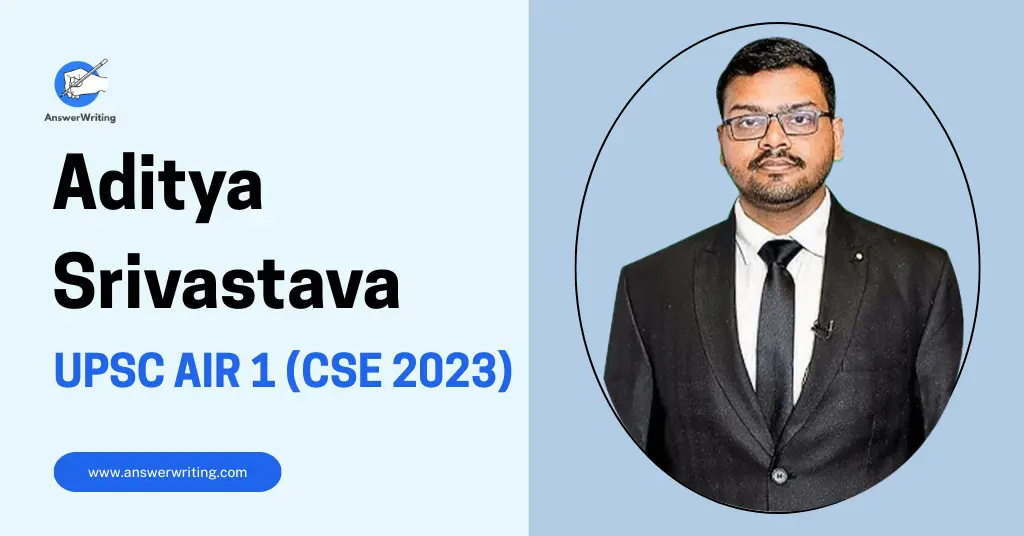
Most aspirants work toward getting into the civil services. Aditya was already in, and he came back to finish the job.
He was 26 years old. An IIT Kanpur engineer. A former Goldman Sachs analyst. And now, the country’s top-ranked IAS officer of the 2023 batch.
Who Is Aditya Srivastava?
| Parameter | Details |
|---|---|
| Full Name | Aditya Srivastava |
| AIR | 1 |
| Exam Year | UPSC CSE 2023 |
| Total Score | 1099 out of 2025 |
| Number of Attempts | 3 |
| Optional Subject | Electrical Engineering |
| Medium | English |
| Hometown | Lucknow, Uttar Pradesh |
| Education | B.Tech and M.Tech, Electrical Engineering, IIT Kanpur |
| Service Allotted | IAS (cadre to be verified from official UPSC allocation list) |
| Prior UPSC Result | AIR 236, UPSC CSE 2022, IPS allotted |
His father, Ajay Kumar Srivastava, works as an Assistant Audit Officer. His mother, Abha Srivastava, is a homemaker. His is not a family of civil servants. It is a family that believed in education, and Aditya took that belief as far as it could go.
Aditya Srivastava UPSC Marksheet and Score Details
| Component | Marks |
|---|---|
| Essay (GS Paper A) | 117 |
| General Studies (all four papers combined) | 474 |
| Electrical Engineering Optional (Paper 1 + Paper 2) | 308 (as per available reports) |
| Written Total | 899 |
| Interview (Personality Test) | 200 |
| Grand Total | 1099 |
His written score of 899 is exceptionally high. It reflects a candidate who dominated on paper before even entering the interview room. His optional subject score of 308 (as per available reports) was a major differentiator, a direct result of choosing a subject he had formally studied at the postgraduate level.
Prelims marks are not disclosed by UPSC. Cross-check the detailed breakdown from official UPSC publications.
Educational Background and Early Life
Aditya grew up in Lucknow and completed his schooling at CMS Lucknow, Aliganj campus, scoring around 95% in Class 12 (as per available reports).
He then secured admission to IIT Kanpur, one of India’s most competitive engineering institutions. He completed both his B.Tech and M.Tech in Electrical Engineering there, giving him a deep, research-level understanding of his subject.
After IIT Kanpur, he joined Goldman Sachs in Bengaluru as an analyst in 2019. He worked there for approximately 15 months before resigning to prepare for UPSC full-time.
That decision to walk away from a Goldman Sachs salary at 22 was not impulsive. It was a values-driven choice. Aditya wanted to work in public service. He had the options many aspirants dream of, and he chose the harder, longer path.
That clarity of purpose became a foundation for everything that followed.
How Many Attempts Did Aditya Srivastava Take?
Aditya took three attempts. Each attempt was meaningfully different from the last.
Attempt 1 (UPSC CSE 2021): He did not clear Prelims. This is the attempt most people do not mention when discussing his story, but it matters. Even an IIT Kanpur engineer with strong fundamentals failed to clear the first filter on the first try. Prelims is its own beast. It rewards a specific kind of preparation, and Aditya had not yet calibrated for it.
Attempt 2 (UPSC CSE 2022): He cleared all three stages and secured AIR 236. That rank would have given most aspirants everything they wanted. He was allotted IPS and began his training as a probationary officer.
Attempt 3 (UPSC CSE 2023): While serving as an IPS probationer, he appeared again. He improved his written score significantly, scored 200 in the interview, and secured AIR 1 with a total of 1099.
The gap between AIR 236 and AIR 1 was not luck. It was targeted improvement in answer writing quality, essay structuring, and GS depth, areas he had identified as weak after his second attempt. He treated his second result not as a success to celebrate, but as a diagnostic report to act on.
That is a mindset most aspirants never develop.
Aditya Srivastava’s Optional Subject: Electrical Engineering from IIT to UPSC Rank 1
Electrical Engineering is a technical optional. It is not widely chosen. Most aspirants with engineering backgrounds pivot to humanities or social science optionals for UPSC because they assume those subjects are “safer” or “easier to score in.”
Aditya did not pivot. He chose the subject he had spent five years studying at one of India’s best institutions.
This is why it worked.
First, depth. A postgraduate from IIT Kanpur knows Electrical Engineering at a level that most UPSC candidates attempting the same optional cannot match. The subject rewards technical precision, and Aditya had it in abundance.
Second, overlap with GS3. Electrical Engineering intersects directly with GS Paper 3 topics including energy, power infrastructure, renewable energy, grid management, and technology policy. His optional preparation reinforced his GS preparation, not competed with it.
Third, consistency. He did not have to rebuild knowledge from scratch. He was refining, not learning for the first time. That saved significant preparation time compared to candidates who choose an entirely new optional subject.
His optional score of 308 out of 500 (as per available reports) is a strong reflection of how decisive a well-chosen optional can be in the final tally.
The lesson for aspirants: your optional subject should be the one you can go deepest in, not the one that looks popular on a forum.
UPSC Preparation Strategy of Aditya Srivastava
Aditya’s preparation was built around three pillars: syllabus mastery, daily answer writing, and structured revision.
Syllabus as the compass. He treated the UPSC syllabus document as the primary filter for everything he read. If a topic was not in the syllabus, it did not get deep attention. This sounds obvious, but most aspirants read broadly and revise narrowly. Aditya did the opposite.
NCERT foundation. He built his GS base on NCERTs across subjects before moving to standard reference books. This created a clean conceptual framework that made advanced reading faster to absorb.
Daily current affairs. He followed The Hindu consistently and tagged news items to specific GS papers and syllabus headings. Passive reading of newspapers does not work. Systematic tagging does.
Test series. He enrolled with ForumIAS for their Mains Guidance Programme (MGP), which gave him structured answer writing practice with feedback. He used test series not just for exposure to questions, but for evaluating how well he was converting knowledge into written answers.
Study hours. Aditya reportedly studied 8 to 10 hours daily during his peak preparation phase (as per available reports). Importantly, quality of those hours, specifically focused, distraction-free blocks, mattered more than the raw number.
Coaching vs. self-study. He used coaching selectively. ForumIAS for answer writing evaluation. Interview preparation at reputed institutes. His content and strategy remained self-driven throughout.
Books and Resources Recommended by Aditya Srivastava
| Subject | Book / Resource | Author / Source |
|---|---|---|
| Indian Polity | Indian Polity | M. Laxmikanth |
| Modern History | India’s Struggle for Independence | Bipan Chandra |
| Ancient and Medieval History | NCERT Class 6 to 12 | NCERT |
| Geography | Certificate Physical and Human Geography | G.C. Leong |
| Indian Economy | Indian Economy | Ramesh Singh |
| Environment and Ecology | Shankar IAS Environment | Shankar IAS |
| Ethics (GS4) | Ethics, Integrity and Aptitude | G. Subba Rao and P.N. Roy Chowdhury |
| Science and Technology | NCERT Class 8 to 12 Science | NCERT |
| Current Affairs | The Hindu (daily) | Newspaper |
| Mains Answer Practice | ForumIAS MGP (Mains Guidance Programme) | ForumIAS |
| Electrical Engineering Optional | Standard B.Tech / M.Tech textbooks and UPSC previous years papers | IIT Kanpur curriculum |
Cross-check this list against his published interviews, as specific recommendations may vary by paper.
Mains Answer Writing Approach
Answer writing was the single biggest factor that separated Aditya’s second attempt from his first, and his third from his second.
After failing Prelims in 2021, he cleared Mains in 2022 but identified that his answer quality, specifically the structure and use of evidence, needed refinement. He enrolled with ForumIAS’s Mains Guidance Programme specifically to fix that.
His answer structure followed a consistent format: a sharp introduction that directly addresses the question, a well-organized body with clear sub-points, relevant examples drawn from current affairs or government schemes, and a conclusion that connects to constitutional values or policy direction.
He used flowcharts and diagrams selectively in GS3 (economy, internal security, disaster management) and in his Electrical Engineering optional. Diagrams are not decoration. They work when they communicate a relationship or process more efficiently than prose would.
He practiced answers under timed conditions from early in his preparation, not just during test series weeks. That habit built the speed and clarity his GS answers eventually reflected.
One challenge most aspirants face is writing answers without knowing whether they are actually good. You can follow a structure and still miss what UPSC examiners reward. Regular external evaluation closes that gap. Platforms like AnswerWriting.com offer an Answer Evaluator that gives structured AI feedback on Mains answers covering content, structure, language, and UPSC scoring parameters. For aspirants who want the kind of consistent written feedback Aditya got through ForumIAS MGP but do not have access to a formal test series, that kind of tool can replicate the feedback loop at scale.
Word limits were strictly followed. He never treated “writing more” as a proxy for “writing better.”
Interview (Personality Test) Experience
Aditya scored 200 out of 275 in the Personality Test. That is a strong score, reflecting confident articulation and a well-prepared DAF.
His Detailed Application Form presented a rich and layered profile: IIT Kanpur, Goldman Sachs, active UPSC preparation, current IPS service. Each of those threads gives a board significant material to probe.
He prepared for the interview by anticipating questions across all DAF areas. Why did you leave Goldman Sachs? What did you learn from your IPS training? How does an Electrical Engineer approach public administration? These are the kinds of questions that need prepared, honest, and well-reasoned answers, not rehearsed scripts.
He used mock interview sessions at reputed institutes (as per available reports) to stress-test his answers before the actual board appearance.
His interview score suggests the board found him credible, grounded, and self-aware. Those are qualities you build over preparation, not just possess naturally.
Service and Cadre Allotted to Aditya Srivastava
Aditya Srivastava is allotted the IAS as AIR 1 of UPSC CSE 2023. The specific state cadre had not been officially confirmed in all publicly available reports at the time of writing. Readers should verify cadre allotment from the official UPSC allocation list once published.
He was previously allotted IPS through UPSC CSE 2022. With the IAS allotment from the 2023 batch, his IPS appointment from the prior year stands superseded.
Key Lessons Every UPSC Aspirant Can Take from Aditya Srivastava
- Not clearing Prelims in your first attempt is not a signal to quit. Aditya failed Prelims in 2021 and came back to rank AIR 1 two attempts later. Prelims requires its own targeted strategy. Treat a Prelims failure as a calibration problem, not a capability verdict.
- Your optional subject should be your deepest subject, not your safest bet. Aditya chose Electrical Engineering because he had mastered it at IIT Kanpur. The optional is worth 500 marks. Choosing it based on what “toppers usually take” rather than what you actually know best is a costly mistake.
- A government job during preparation can be an asset, not a distraction. Aditya was an IPS probationer during his third attempt. Real administrative exposure sharpened his GS answers and interview responses. If you clear a state service or Group A post during preparation, use that experience deliberately.
- Improve between attempts using your marksheet as a map. Between AIR 236 and AIR 1, Aditya targeted specific weaknesses. He did not just “prepare harder.” He prepared differently in the areas his previous result told him to fix. Every UPSC result is a data point. Use it.
- Answer writing feedback is not optional, it is the process. Aditya used ForumIAS MGP specifically for structured feedback on his Mains answers. Knowledge without the ability to convert it into well-written, examiner-friendly answers does not translate to marks. Build your feedback loop early, whether through a test series, a mentor, or a dedicated evaluation platform.
FAQs About Aditya Srivastava
What is Aditya Srivastava’s UPSC rank? He secured AIR 1 in UPSC Civil Services Examination 2023.
What was Aditya Srivastava’s optional subject in UPSC? His optional subject was Electrical Engineering.
How many attempts did Aditya Srivastava take to clear UPSC? He took three attempts. He did not clear Prelims in 2021, secured AIR 236 (IPS) in 2022, and topped with AIR 1 in 2023.
What is Aditya Srivastava’s total UPSC score? His total score is 1099, comprising 899 in written and 200 in the Personality Test (Interview).
Which college did Aditya Srivastava attend? He completed his B.Tech and M.Tech in Electrical Engineering from IIT Kanpur.
Did Aditya Srivastava attend coaching for UPSC? He used ForumIAS for Mains answer writing (MGP) and attended interview preparation programmes. His content strategy was largely self-directed, as per available reports.
Was Aditya Srivastava an IPS officer before becoming IAS? Yes. He cleared UPSC CSE 2022 with AIR 236, was allotted IPS, and was serving as a probationary IPS officer when he appeared for his third attempt and secured AIR 1 in UPSC CSE 2023.